Mountain real estate at end of peak
Atlanta and Charlotte are major financial centers, and the free spending
Across price ranges, no category is immune, but the most expensive properties seem to be taking an especially big hit. For example, just four homes have sold in the last three months at $900,000 or more, uncharacteristic for this part of the mountains. And evidence is emerging that foreclosures are starting to infect the top of the market too.
"I have seen a few very high-end foreclosures lately," says Carol Clay, a Brevard realtor who publishes an interesting blog about mountain real estate [click here]. "I wouldn't call it a stampede, but they're there."
Carol has a foreclosure listing for a 5.6-acre tract of land in the posh Bald Rock community in Cashiers. At $249,900, or $44,000 an acre, it is priced below the customary $50,000 per acre price for lots in Bald Rock. Yet in this skittish market, it is hard to imagine that a 12% discount is going to motivate any buyers, especially when they can get a 40% discount on many blue chip stocks (and a decent divided to boot).
At this point, an investor would be hard pressed to choose among an unimproved piece of property, 10,000 shares of General Electric or some $250,000 FDIC insured bank account. The banks holding the paper are going to have to do considerably better. Isn't that an understatement for these times?
 Home On The Course newsletter
Click here to sign up for our Free monthly newsletter, loaded with helpful information and observations about golf communities and their golf courses.
Quote of the Day: Wishful thinking
"This is a good market to get into while it's in a down cycle, because I believe it will come back soon." David Brasfield, a real estate investor, commenting on Gulf Coast real estate in a special advertising section of the Wall Street Journal today.
Yes, of course the market is in a down cycle, but it will take years for the overbuilt Florida market to snap back to normal. And what qualifies the confident Mr. Brasfield, who owns a software business in Birmingham, AL, to postulate that the nutty Florida real estate market "will come back soon?" Actually, he owns a luxury home in Destin, FL, which he has listed for $5.2 million. Oh, yes, he dropped the price $500,000 recently. And, surprise, he has had it on the market for 18 months.
If you believe his prediction about the Gulf Coast real estate market, he may have the perfect house for you.
Golf for geezers?
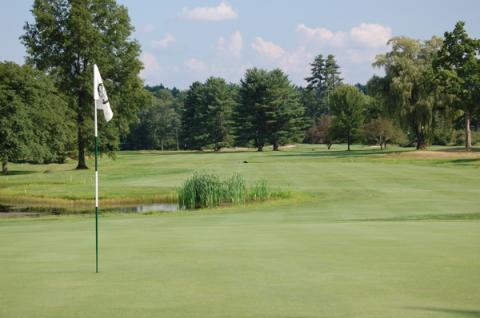
The second shot at the par 5 18th at Hop Meadow must steer clear of a stream down the left hand side and, for the approach, a pond in front.
My friend Bill and I played golf today at Hop Meadow Country Club in Simsbury, CT. The course was in great condition, it was a beautiful bracing fall New England day, and we managed to avoid throwing too many verbal punches at each other about Presidential politics (he's for one candidate, I am for the other). I am on a leave of absence from the club, where I have been a member for more than 20 years and have until February to decide whether to return. In recent years, with summer travel and other commitments, my family and I had not gotten enough use out of the club to justify the expense of dues and a modest assessment for clubhouse renovations a few years ago.
It is going to be a tough decision, although with the stock market and nation's financial system in crisis
Like me, Bill is a leading edge baby boomer bemoaning the fact that he has lost a few miles per hour on his clubhead speed (I know the feeling). In the course of conversation, he told me a dozen of his fellow club members had traveled to Ireland for a week of golf this summer. "They played 36 holes a day," he said, with some amazement. "I couldn't do that." I agreed, having struggled through some 18-hole days in Scotland this June on courses where pull carts were the only means of conveyance available.
Bill, who along with his wife Janet recently bought a second home in The Landings near Savannah (six golf courses on property), wants to keep walking the golf courses he plays as he ages but is mindful that 18 holes may become a bit of a struggle at some point. "If I were developing a golf course," he mused out loud, "I'd hire Nicklaus or Dye to put in just 12 holes."
We discussed it a little more and came to the conclusion that, for convention's sake, an 18-hole course made more sense but with the 6th and 12th holes coming back to the clubhouse. In that way, the super seniors could walk six holes and either quit for the day or take a cart for the rest. Others could walk the 12 holes or, if they were feeling especially spunky, walk all 18.
On a golf course on a beautiful New England day, many things seem possible.
A view on home ownership from down under
Like most Americans, I do not presume to understand the intricacies of
The nuances of credit default swaps, derivatives and hedge funds are way beyond the ability of many Harvard graduates to understand, let alone Joe Bag of Donuts or the lesser minds in Washington. But all of us can figure out that you should never buy something you cannot afford. Somehow, this lesson was lost on everyone from first-time home buyers to the guys who ran Lehman Brothers, AIG and Merrill Lynch who bet their companies' ranches on toxic bundles of paper.
Assuming our financial system, which is changed forever, returns to some sort of equilibrium and the banks begin to lend money again for home purchases, the new rules of the road had better be simple enough for all of us to understand. When my wife and I purchased our first home three decades ago, our income had to be a minimum of 28% of the amount we intended to borrow, and the down payment a minimum 20% of the home price. The rules were strict, and they were in place to protect the bank as much as they were to protect us. We didn't whine about the size of the house we could afford. Our parents had taught us never to do anything beyond our means. Did these people on Wall Street all come out of orphanages?
The Wall Street Journal published an interesting editorial today written by an Australian journalist. It is entitled "Not Everyone Should Own a Home." If you can't access it from the Journal's web site, let me know and I will email it to you (use the Contact Us button at the top of the page). The view from Down Under, where the banking system is relatively stable, is compelling now that our own system is down under.
Toughest Ones: #4, Lundin Golf Club

From the tee, #4 at Lundin looks innocent enough, but with ocean on the left, rough on the right, a burn in front and a small, elevated green, it is anything but.
Lundin Golf Club in Fife, Scotland was born of necessity 100 years ago. The original links course was shared with the townspeople of next-door Leven and was played starting at both ends. With 1,400 enthusiastic golfers -- this is Scotland golf we are talking about, after all -- things got a bit congested as townspeople crossed each others' paths. Thus, the towns decided each should have its own links course, and Lundin, designed by five-time Open championship winner James Braid, opened in 1909.
Overall, Lundin is not a difficult course to negotiate, playing to just 6,371 from the tips and offering generous bounces down firm fairways. But, of course, the wind affects play on seaside courses, making some holes play longer than their yardage, and making it tough to control shots launched downwind.
Lundin is no different. The 455-yard par 4 4th, the #1 handicap hole on the course, stands out from all other holes at Lundin, not only for its length but also for what faces the golfer on both the tee shot and the approach. Played along the beach, which is out of bounds, the 4th is a continuing test of courage right until the ball goes in the cup. First challenge is the tee shot where the temptation is to turn away from the roiling ocean on the left and aim well right. But the fairway is humped in the middle, and a ball even just a smidgen right will bound off into the rough, turning a long approach shot into a likely lay-up shot. Consider that a 255-yard drive, almost certainly into the wind, still leaves another 200 yards, and many players will opt to approach the hole as a par 5, and hope for "birdie." (Note: My son Tim and I each bogeyed the 4th when we played it last June, one of only three bogeys he had all day.)
The long approach shot is just the half of it. A "burn" crosses the fairway 44 yards from the green, and its running water eagerly gobbles any misplayed fairway wood or long iron shot. Those who opt to play short of the burn are still not guaranteed a putt at par, as the 28-yard, perfectly circular green is elevated on all sides. When the green is firm, as it most always is, the only play is to deftly run the pitch shot up the front slope and hope you don't run it down the back.
The Scots love to put names on all golf holes, and this one is tagged with "Mile Dyke." The ocean, the creek and the sheer length of the hole makes it seem to play like a mile long. Toughest holes are those where par seems a major accomplishment. The 4th at Lundin fills the bill.
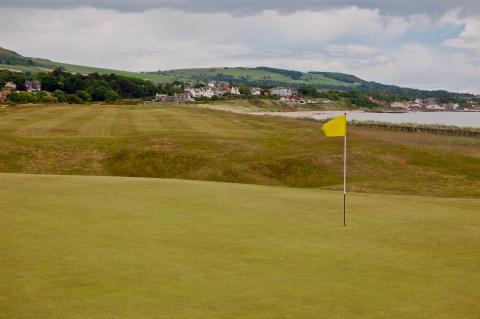
Thar she blows: The 4th at Lundin Golf Club is long and lean and mean when the wind is up, which it almost always is.
Golfweek: Fazio best residential golf course designer; Nicklaus close second
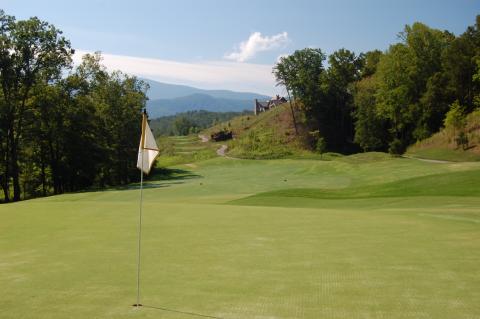
The two-year old Bright's Creek Golf Club in Mill Spring, NC, a Tom Fazio course, cracked the top 100 list at Golfweek. Photos by L. Gavrich
Golf course designer Tom Fazio is finicky about what assignments he takes on. If he doesn't like the canvas, he won't paint the picture. During a trip through the western North Carolina mountains recently, I learned Fazio had turned down a commission on a brilliant piece of property at Balsam Mountain Preserve, near Waynesville. Arnold Palmer took up the challenge and the result is a beautiful layout with some occasionally odd holes.
I have never encountered a hole I would call "odd" on a Fazio designed course, and I have played nearly 300 holes on his courses. Although it is fairly easy to identify certain Fazio elements on all his courses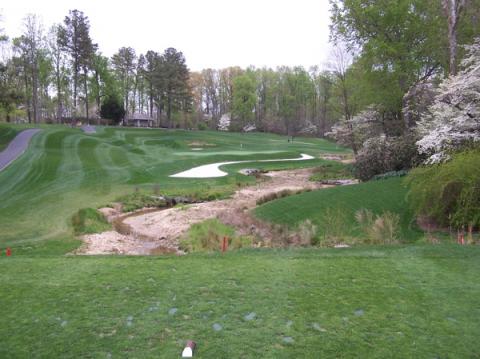 (banked fairways, buried cart paths, elaborate fairway bunkers), a few holes stand out. The best example for me is #17 at The Cliffs at Keowee Vineyard, a 260 yard downhill par 3 with water on the right, a bunker wedged between the lake and the green, and ample bailout to the left. The go for broke shot to the green, over water and bunker, gives the effect of a dogleg right, something you don't see every day on a par 3. It is a beautiful hole, as well as a brutally challenging one, for a few years the toughest hole on the Nationwide Tour when the course hosted preliminary rounds of the local BMW Pro-Am.
For the visual appeal of his courses and their not-too-hot, not-too-cold but just right playability factor, Fazio is the darling of many high-end golf community developers. On Golfweek magazine's 2009 list of "Top 100 Residential Golf Courses," Fazio leads every other designer with 19 courses, followed closely by Jack Nicklaus with 18, including the cleverly named Concession Golf Club in Florida where he shares credit with Tony Jacklin, to whom he conceded a famous Ryder Cup tying putt a few decades ago.
Fazio and Nicklaus also command the first four spots on the list, with Fazio's 1988 design at Wade Hampton in Cashiers, NC, holding down its perennial top spot, and Nicklaus' Castle Pines (Colorado, 1981) and Mayacama (California, 1988) in second and third position. San Antonio's Briggs Ranch, designed by Fazio in 2001, is at #4, followed in fifth place by Cuscowilla, a favorite of mine in rural Georgia that was designed by Bill Coore and Ben Crenshaw 10 years ago and has vied with Wade Hampton for the top spot in the last few years.
No other designers crack the double-digit mark on the list, although Tom Weiskopf has his name on 10 courses, four in partnership with Jay Moorish and all but one (in Michigan) in the southwest region of the country. By my count, Pete Dye has five on the list, and Arnold Palmer, Rees Jones and Greg Norman four each.
A handful of courses are new to Golfweek's list, including Mill Spring, SC's Bright's Creek (#38) and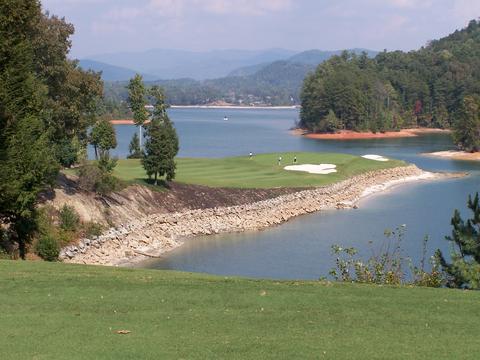 Madison, GA's Long Shadow (#74). I played Bright's Creek, another fine Fazio layout, a few weeks ago and reviewed it here. I played Long Shadow a few years ago before it opened, invited to do so by designer Mike Young, one of the most accomplished architects you have never heard of (he has designed 40 courses around the world). Long Shadow's layout was wide open, for the most part, with Scottish links touches around the yawning fairway bunkers. When the wind blows, I would imagine it is a bear (apologies to Nicklaus).
Golfweek has also published its list of 100 top resort courses for 2009, with the usual suspects in the top five positions (ranked in order from #1): Pacific Dunes, Pebble Beach, Whistling Straits, Pinehurst No. 2, and Bandon Dunes. Many of the resorts are in the middle of golf communities where residents coexist with vacationers.
Oddly, Golfweek's web site only displays the 2007 and 2006 top 100 lists, but the full 2009 lists for residential communities and resorts are in today's weekend edition of the Wall Street Journal. I cannot find any link to the Golfweek list at the Journal's web site. If you have any questions about a particular community or course, residential or resort, send me a note and I will check on it for you.
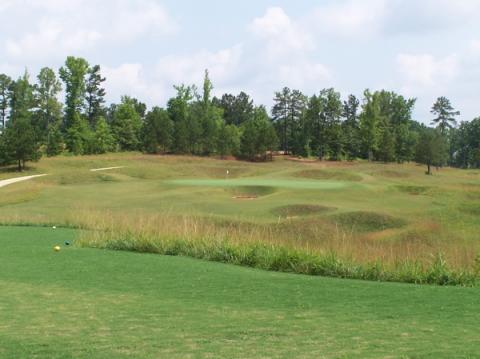
Designer Mike Young adds a number of Scottish elements to his rural Georgia course, Long Shadow, near the charming town of Madison.
Death rattle for suburbs not likely
Roger Selbert is a "business futurist" who specializes in spotting trends and sharing them with his business clients. He posted an article yesterday at one of my new favorite sites, NewGeography, that argues clearly and well that the suburbs are here to stay. Most job growth is in the suburbs, and most commuting is within suburbs. That runs counter to the popular notion that most people commute from suburbs to city. Anyway, Selbert argues, one-fourth of the nation's work force run their businesses from their homes. With a little better regional and local planning, the suburbs can offer more of the conveniences we associate with urban living.
I recommend to you Mr. Selbert's article, "The Future of Suburbs? Suburbs are the Future."
Quite a lot: $14,000 property comes with free $65,000 club membership
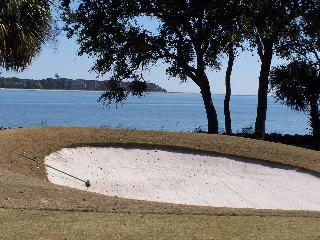
From the Haig Point golf course, you can see Hilton Head Island across the Calibogue Sound.
I received an email yesterday from a real estate agency in South Carolina. It included a listing for a handsome looking lot with a view of the second fairway on the excellent Rees Jones designed 27-hole golf course at Haig Point on Daufuskie Island. The lot included free social membership in the club (you have to pay the monthly dues, though). The price for the property was just $72,000. I thought it was a misprint and sent a note to the agency asking for more details, but they have not responded to my request. I dug a little deeper and found that other agencies in the area have the same property listed at $72,000. They can't all be wrong.
In doing the additional research, I found other listings that were even cheaper and included full golf membership, which the Haig Point club lists as a $65,000 value. Consider this description: "This lot is priced to sell NOW! Located on the 10th fairway of Haig Point Golf Course with a clubhouse and lagoon view. The golf cottage neighborhood features white picket fences and charming cottage style homes. A signature Full Golf Membership...is included in price!" The price? $14,000.
Having visited Haig Point a few years ago, I know there are some expenses that do not meet the eye. These include higher than average construction costs -- $500 per square foot and more -- because all materials and labor must be carried to the island by ferry. Then there are the community and golf club dues, which exceed $13,000 per year (exclusive of any assessments). It is expensive to run the ferry to and from Hilton Head Island every hour.
For the intrepid island lover, however, a life without cars and pollution and shopping malls may be worth the surcharge.
Public golf in western North Carolina
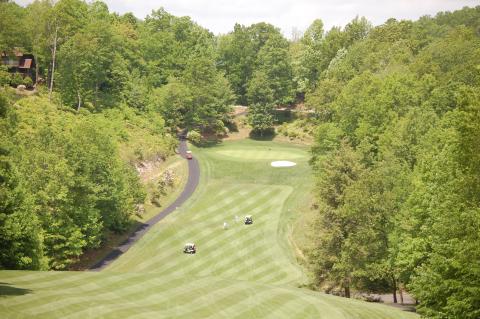
Public golf course Connestee Falls is in the middle of an attractive, mature community in the mountains of western North Carolina and features a number of dramatic downhill and doglegged par 4s.
I recently reviewed a number of golf communities in the western North Carolina mountains, most of them offering private club privileges. But for those who would prefer to play a rotation of good courses rather than commit to one, the area within an hour of Asheville offers a buffet of excellent daily fee courses at surprisingly reasonable prices.
The Asheville Citizen-Times publishes an annual WNC Mountain Travel Guide that lists the 37 best public golf courses in western North Carolina, among them some excellent tracks I have played, like Reems Creek, Connestee Falls and Etowah Valley.
Click here for the Mountain Travel Guide and a page that lists all the golf courses, including green fee information and web sites. If you have any questions about mountain real estate and mountain golf, please do not hesitate to contact me. I will respond quickly.
Notice to readers: Some of you have taken me up on my offer to provide you personalized information about golf communities in the southern U.S. However, the notes I received from a few of you did not include name and email address. As you can understand, I am unable to respond unless I have your email address. I hope you will resubmit your requests; I promise to respond promptly with some ideas that fit your criteria, including your geographical preferences. (Name and email address are now required fields to fill in.)
The 5th at Reems Creek, a half-hour north of Asheville, provides the ultimate in risk reward. The green on the par 4 is reachable from the tee but fraught with danger.
Don't just do something, stand there
If you have been voting for politicians who promise to give you goodies at someone else's expense, then you have no right to complain when they take your money and give it to someone else, including themselves - Thomas Sowell, economist
Karl Marx thought that capitalism would collapse eventually because of worker exploitation. He was wrong. Our "workers" in Washington are exploiting us, with their lack of vigilance and casual attitudes toward Fannie Mae and Freddie Mac and Wall Street.
You are probably as angry as I am. The stakes have never been higher,
I was glued to my television set yesterday, watching my kids' college funds and my retirement fund evaporate in congress with -- pun intended -- the vote on the bailout bill. As it became clear the vote was going negative, the market dropped a couple of hundred points in a matter of minutes. I was apparently the only American who didn't get up from the TV to phone or email my representative to express outrage at the provisions of the proposed package. I am not smart enough to know whether the bailout plan will save the Republic or cause irreparable harm, and I am not minimizing how difficult it is to make the call on whether to entrust the Department of the Treasury with $700 billion. Even savvy economists disagree on the merits. But faced with a choice between self-interest and conscience, many of our elected representatives chose reelection (probably on the convoluted theory that, if they don't get reelected, then they can't vote their conscience).
I do know what shameless self-interest and partisan bickering and counter-productive finger pointing look like. As the great American humorist H.L. Mencken wrote, "Under democracy, one party always devotes its chief energies to trying to prove that the other party is unfit to rule -- and both commonly succeed, and are right."
The word "change" is thrown around rather cavalierly during this election season, but there is no better one to describe what needs to be done in Washington. We all get a chance to cast our votes a month from now for Congress and the Presidency. In another 34 days, our "workers" in Washington will know if they acted wisely (if at all).
We will let them know.
Privacy has its privilege...and its cost
A life well lived
A five-foot putt to halve the match

Now on Sale

- The only book about golf communities in the last 10 years.
- 156-page step-by-step guide to finding your dream golf home.
- Info on nearly 100 golf communities the author has visited.
- Paperback version costs less than a sleeve of Pro VIs.
Here is what the experts are saying:
“The book is chocked full of information…applicable to anyone looking for a move to the Southeast regardless of whether they are looking for a golf community or not.” — John LaFoy, golf architect (Linville Ridge CC, CC of Charleston, The Neuse GC)
“Larry has done a tremendous amount of work and anyone — like me — who is looking to search for a golf home now or in a few years needs this book.” — Brad Chambers, golf blogger, ShootingYourAge.com
“Wow! What a thorough piece of work…a must for anyone moving South. This book will help many people.” — Brett Miller, owner and founder of MMA, Inc, a golf industry consultancy
Buy It Now at Amazon.com or BarnesandNoble.com.