Hot spots: If you can stand the heat, check out Georgia resort communities this summer
Tucked between the popular Carolinas and the historically hot (in more ways than one) Florida, Georgia is an afterthought for many golfers looking for a vacation home on the course or a permanent one. But Georgia shouldn't be an afterthought. The Peach State may not have the number of golfing communities of its neighboring states, but what it lacks in quantity it more than makes up for with quality courses, stable developments and a wide range of golfing options.
This correspondent has been particularly impressed with Georgia's golfing resorts cum communities. The benefit of looking for a home at a resort is that you have a choice of either having your hand held for four
The thought of sharing a golf course and other "member" facilities with vacationers may be off-putting, but the green fees the transients fork over help pay for the maintenance of the course, keeping everything
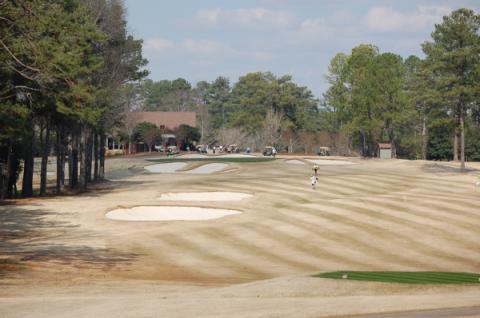 well-conditioned and members from having to pony up for extra assessments. Over time, resorts have become more sensitive to the need for residents' privacy and have carved out "members only" facilities such as locker rooms, dining areas, bars and even extra golf courses on properties with multiple courses. Then again, some people want to live in a resort to feel as if they are perpetually on vacation, and they don't mind sharing the amenities with others.
Prices for summer visits to Georgia golf resort communities are at their most reasonable from now until the middle of September. This week, I will feature a few I have visited and can recommend. We start today with Callaway Gardens.
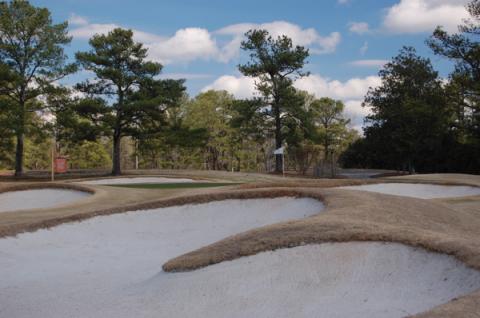
Bunkers surround the 18th green on Callaway Gardens' Mountain View course. Owners of golf cottages at Callaway (note sign at rear left) will have a view of the hole and a short walk to the practice facility.
Callaway Gardens, Pine Mountain, GA
Callaway Gardens is not as remote as it seems and can form the centerpiece for a serious weeklong golfing trip. Located in rural western Georgia, it is just 20 minutes from the Alabama state line and less than an hour from the midpoint on the vaunted Robert Trent Jones Golf Trail. Fly into Atlanta's huge international airport, and you should be unpacking your bags at Callaway's rustic lodge within 90 minutes.
The accent is on the gardens and picture-perfect landscaping throughout the resort, and the golf courses benefit from the management's fussiness about the grounds. The resort's 36 holes of golf is anchored by the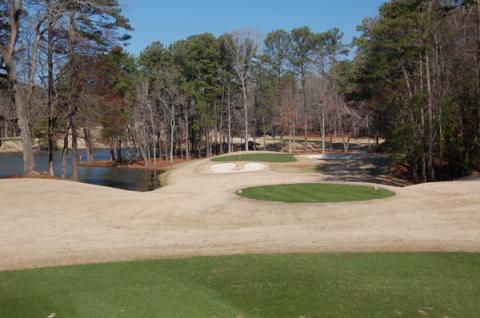 Mountain View Course, a Dick Wilson design whose fairways are framed by a thick helping of Georgia pines. At 6630 yards from the white (men's) tees, the course is tough, with a rating of 71.9 and slope of 134. The original Lake View Course doesn't receive the same accolades as its tougher sister course, but if you stick around for more than two days, the Lake is worth a play. Golf rates are incredibly reasonable for the quality of the courses, with summer weekday play at Mountain View just $80 (cart included) and $100 on the weekends. The Lake View green fees run about 20% less. Memberships for residents are available.
Housing options run the gamut from golf cottages to town homes to single-family homes tucked into heavily wooded neighborhoods secluded from the regular resort traffic. A recently opened group of 30 golf cottages look out over the finishing hole at the Mountain View course and are adjacent to the new practice facility. A neighborhood called Longleaf offers open-plan, highly energy-efficient single-family homes from 2 to 4 bedrooms. Highland Park, the newest neighborhood, has begun to sell home sites in the ½ acre to 1 acre range beginning at $190,000. The neighborhood is a convenient walk to the resort's golf practice facility, spa and lake. For those looking for a place for no muss, no fuss vacations, a section named Camp Callaway may fill the bill. Details are only emerging now, but Camp Callaway will offer 47 cabins, fully furnished, strung along the shores of Martin Lake.
If you are interested in property at Callaway Gardens, contact us and we will identify the best possible agent to work with you. For a map of the resort's location, click here.
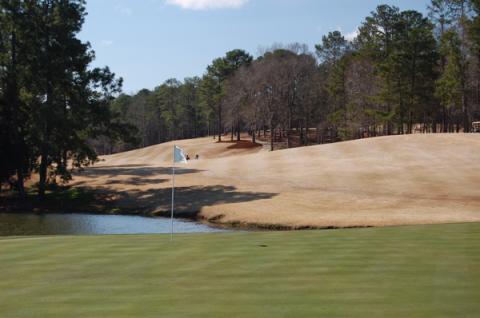
The 15th at Callaway Gardens' Mountain View course is one of the toughest par 5s in my experience. A drive must find a narrow slice of fairway before a lay-up shot to a severely sloped landing area (it slopes toward the lake). Negotiate those two shots and you are "rewarded" with a carry over the lake to a pin that may be tucked beyond the false front (as it was here). Land just short, and you are all wet.
 Home On The Course newsletter
Click here to sign up for our Free monthly newsletter, loaded with helpful information and observations about golf communities and their golf courses.
Where the deer and the interlopers play
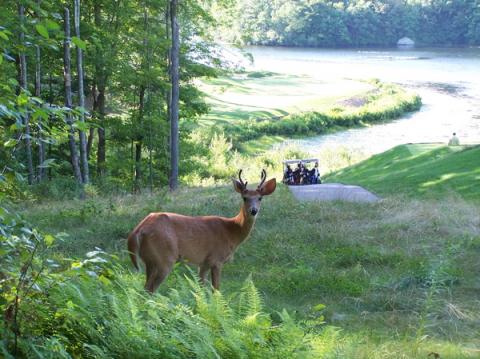
As my foursome rounded the corner toward the 11th tee at Ledyard, CT's Lake of Isles South Course today, we came upon this interested bystander. I will have more to say about and additional photos of the Rees Jones layout in the coming days.
Tough ones: St. Andrews Old Course, #14

Damned if you do: Those who steer clear of Hell bunker and play down the right side of #14 at the Old Course will be faced with an approach over a large hump that guards the right front of the green.
Par 5 odyssey features heaven, Hell and a little Kitchen
The way American golf holes are rated tends to be annoying and a little insulting to decent golfers. Par 5s too often receive the #1 handicap hole designation no matter how mild the challenge. On some courses, you know that one or two of the par 3s are tougher than the par 5s. But length appears to equate to difficulty for those who rate golf courses, probably because most golfers have trouble putting three straight shots together.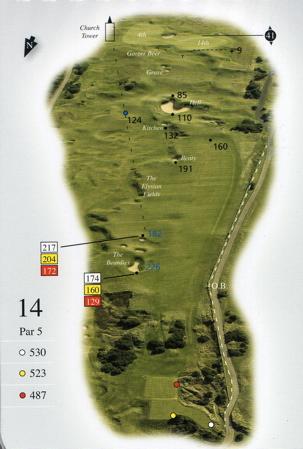
The Scots have more respect for their golfers, and on courses I played in Scotland recently, the toughest hole is as likely to be a par 4 as it is a par 5. At Scotscraig Golf Club in Tayport, the 4th hole, called Westward Ho, measures just 366 from the tips but is the #1 "stroke index" hole. At the seaside Crail Balcomie Links, the long par 4 5th, the aptly named Hell's Hole, plays around the shoreline and into the prevailing winds and rates toughest at 447 yards from the tips. The three par 5s at Crail are rated the 5th, 10th and 14th most difficult on the course.
Perhaps their par 5s play shorter than American fives because of longer rolls on links fairways. Or maybe the Scots hit the ball straighter than Americans do, having had a few hundred years more practice. But straight is not at all helpful at the toughest hole at St. Andrews' Old Course, the par 5 14th called simply Long. The Old Course yardage book calls it the "model for strategic golf holes the world over." I call it beautifully brutal.
The middle of the three tees on #14 plays from 523 yards, and the strategy depends entirely on how the wind is blowing off the nearby Firth. If you are able to ignore the Siren call of the cityscape beyond the green and hit the ball 210 yards into the wind, the play is down the left, over the group of four bunkers called the Beardies, to an area of fairway aptly named the Elysian Fields. In mythology, Elysium is the eternal resting place of the virtuous and the heroic. I don't know how virtue plays into the tee shot at #14, except in regards to patience, but heroic effort certainly comes into play if the wind is blowing. (And how often does it not blow at St. Andrews?) The less adventurous will find ample fairway to the right of Elysium, but a wall with out of bound beyond it runs down the entire right side of the fairway, making placement there almost as scary as the Beardies.
If you negotiate the tee shot properly and make it to the Elysian Fields, the next play is a lay-up of 170 to 190 yards to a small area to the left of one of the most famous bunkers in the world, the Hell bunker, placed front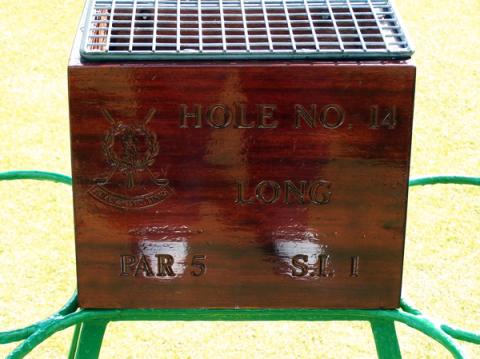 and center on the path to the green. It is large, it is arced and shaped in such a way as to maximize the potential for a lie under the perfectly vertical and sodded front edges, and it is strangely beautiful. For those shy about risking Hell, laying up short of the bunker is not much of an option since the tiny but deadly Kitchen bunker guards Hell. I have not been able to find the derivation of the name Kitchen, but Cerberus would be a more apt name for this little devil.
Those with no pretense of heroics can play short and right of the Hell bunker, but that leaves a 160-yard approach to the green over a large hump that guards the front right. Land on either side of the hump and the ball will skitter away from the green. Land over the hump and chances are good the ball will roll off the back of the firm and sloped green. In short, the chance of getting within easy two-putt range will be remote if you approach from the right side of the fairway.
Okay, let's say you make it safely to the area just left of Hell, leaving about 125 yards into the largest green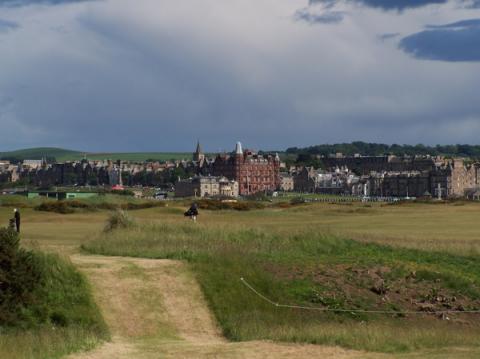 you have ever played (the 14th green combines with the 4th). You are now faced with an all-carry shot over two menacing pot bunkers called Ginger Beer (each appearing to be about the size of a bottle of ginger beer). The green is elevated and, of course, firm; the approach must be short in order to roll on and have a chance of staying on the putting surface. If you have made it there in three shots, you have an excellent shot at par or even birdie -- assuming you haven't pulled the ball onto the 4th green and left yourself a putt of 50 yards.
Welcome home, Odysseus.
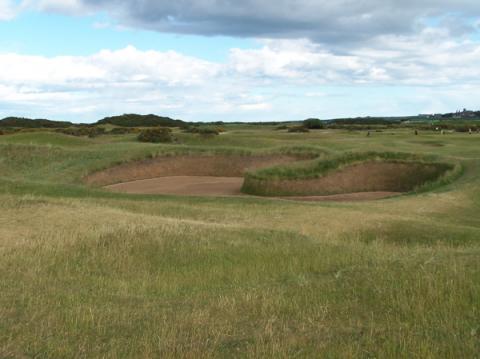
A play off the tee at #14 to the Elysian Fields at the Old Course will leave you with a lay-up to the left of the other-worldly Hell bunker.
Flood plans: Insurance companies offer new approaches for coast dwellers
The Hartford, a major insurance company, presented its "Coastal Catastrophe Partnership" plan last Wednesday. It urges the federal government to back huge storm claims and state governments to subsidize the flood coverage of its lower-income citizens. Of course, the plan also calls for rate increases for the insurance companies to reflect their true risk in states where major storms pose the biggest risk. The industry claims, for example, that the state of Florida has been suppressing the insurance companies' rates.
Earlier, the Travelers and Nationwide Mutual Insurance companies proposed their own plan that would create federal "coastal zones" for windstorm insurance. The wind coverage in an individual's homeowner's policy would be set by an independent federal agency. The two companies thought the current approaches to flood insurance were okay as is, which is to say that the states should continue to regulate flood insurance.
Since the big storms of a few years ago, insurers have dropped from their plans thousands of people in coastal areas and raised rates and deductibles for others after Katrina alone cost the industry almost $42 billion. Customers and states have battled the companies over the definitions of wind and flood damage.
For those who live in coastal areas, or plan to, it might be worthwhile to compare the plans, although I find them a little complicated to understand, just like most insurance policies. The details can be found at TheHartford.com and Coastplan.com.
Putting foreclosed, abandoned homes to use
My brother Bob recoiled at my idea the other day that the U.S. government consider tearing down some homes that are in default. I saw that idea, proposed in the Wall Street Journal, as a way to avoid further urban blight and spur the housing market by shrinking the overall inventory of unsold homes. Here is what Bob wrote me:
"DON'T tear the houses down. Instead, use them to house homeless individuals and families, including Katrina victims, with virtually no-cost long-term contracts, so long as the heads of households agree to be retrained to work on massive infrastructure programs. The result. You:
1) Get the housing off the market without destroying anything,
2) Help solve the homeless dilemma, and,
3) Gather together the labor force needed to help repair the nation's ailing infrastructure.
Win/Win/Win. It's stupid just to tear these houses down."
Although Bob's idea is filled with compassion and logic, one wonders about the additional bureaucracy needed to figure out who qualifies for the houses; what it will take to set up the entire retraining scheme; and what kind of buyout those who hold the paper on the homes will accept. I am tempted to wonder as well if it is possible to train some people who signed up for loans they had to know they couldn't repay. I don't buy into the theory that all of them were ignorant stooges hoodwinked by greedy mortgage brokers. Not all of them.
On the other hand, I am willing to cut them all a break if they promise to march to the mansion of Countrywide Financial's Angelo Mozillo and drag him to Las Vegas or Miami or some other area savaged by foreclosures, and give him the public flogging he deserves.
And when they are done, lock him up...in one of those foreclosed houses.
Gimme Shelter Harbor: Classic elements on modern course put it in "best" category
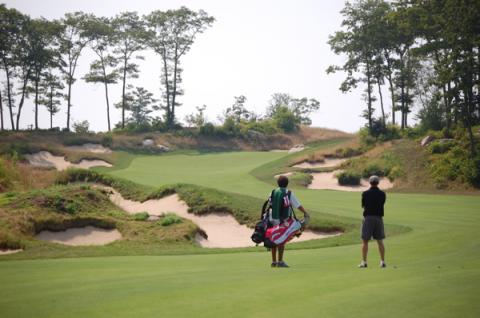
Visually and strategically, the 9th at Shelter Harbor is the epitome of a great par 5, with a lay-up second shot that demands thought and care.
by Tim Gavrich
On Monday, my father and I had the pleasure of playing the Shelter Harbor Golf Club in Charlestown, Rhode Island, during a fundraiser outing for my former high school. Shelter Harbor is challenging, varied in its shot-making requirements, and a great deal of fun. I have been struggling the rest of this week to think of where it ranks among the few other great courses I have played. Only Newport CC, Yale GC, and Pinehurst No. 2 stand ahead of it in my mind. I would rank Shelter Harbor ahead of two other outstanding courses I have played -- Cuscowilla, a highly ranked course in Georgia by Coore & Crenshaw, and TPC River Highlands in Connecticut, one of the PGA players' favorite courses.
One of the most important aspects of golf course architecture is a good mix of playability and difficulty. These may seem like opposite characteristics, but when they come together, as they do at Shelter Harbor, the result is a top-notch course.
Higher handicap players will appreciate the wide fairways on the course although they may not feel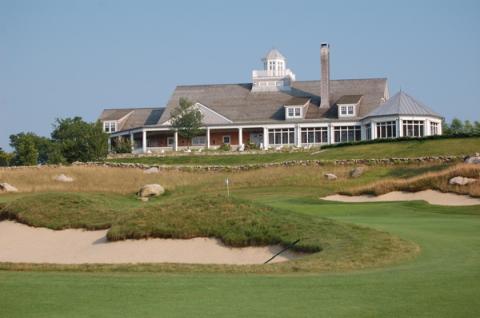 comfortable with some of the forced carries (e.g. the short, two-shot par 4 13th hole, which requires the tee shot to clear an expanse of wetlands). But pains seem to have been taken via local rules to minimize the penalty. (On the 13th, the drop area across the wetlands affords a shot to the green, so that the player can easily save bogey, if not make a one-putt par.) The trouble off Shelter Harbor's fairways is often severe, coming in the form of bunkers out of which the only escape is often a wedge back to the fairway. In an age in which bunkers have been leveled to the point that many don't quite fit the definition of "hazard," Shelter Harbor's sandy spots are best admired from afar (and by camera, as the accompanying photographs attest).
Another prerequisite for architectural greatness is interest and variation on and around greens. The world's great golf courses - the Pine Valleys, Augusta Nationals, and Oakmonts - are renowned for their superb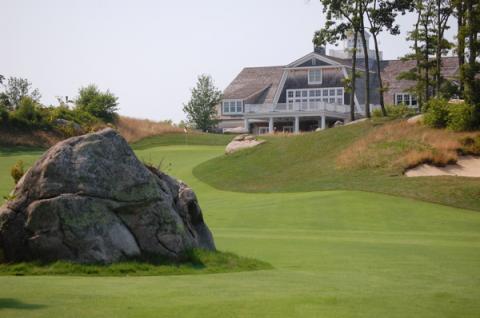 greens. I cannot think of more than a few more varied, challenging, and fun sets of 18 greens than those I played at Shelter Harbor. In addition to being exquisitely maintained (not surprising for a club whose initiation fees are in the neighborhood of $125,000), these greens reward thoughtful shot making and creativity. Many of them have wild undulations that allow the player to move the ball around the green in interesting ways. For example, some slopes on Shelter Harbor's greens have "backboards" behind the pins that give you an option to hit past the pin and bring the ball back. The greens were fast, perfectly cut and held every well-struck shot. I could spend hours on and around these greens.
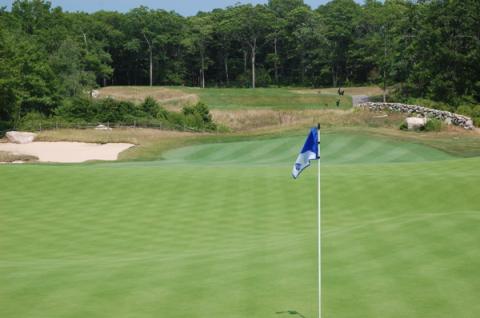
I enjoyed every hole at Shelter Harbor, but two stand out as being particularly excellent. Hole #4, a long par three, is one of the best one-shot holes I have ever played. The hole appears to be architects Dr. Michael Hurdzan and Dana Fry's interpretation of a Biarritz hole, a long par three that plays to a huge, deep green with a deep trench running sideways through the middle. Those who have played Yale Golf Club in Connecticut and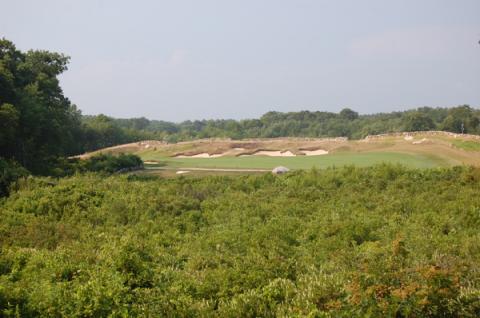 its 9th hole will recognize the classic Biarritz. The green on Shelter Harbor's 4th hole is 62 yards from front to back and a larger-than average Biarritz trench runs sideways across the middle third of the green. This allows for pin placements in the trench; trenches at most Biarritz holes are not wide enough for that. There is also a pronounced slope at the rear-middle of the green that allows a player whose ball has found the bottom of the trench (a player such as myself) to putt well beyond the hole in the hopes of the ball rolling up the slope and back down towards a hole located near the base of that slope. This is a great example of the creativity made possible by contours in the greens at Shelter Harbor.
The par five 9th is another fantastic hole. Two bunkers in the center of the fairway serve a more psychological than practical purpose - they make the fairway seem narrower than it is. A drive just left of these bunkers can put the player in position to blast a fairway wood uphill to a green tucked up around a corner below Shelter Harbor's magnificent Cape Cod-style clubhouse. Bunkers farther down the fairway punish any casual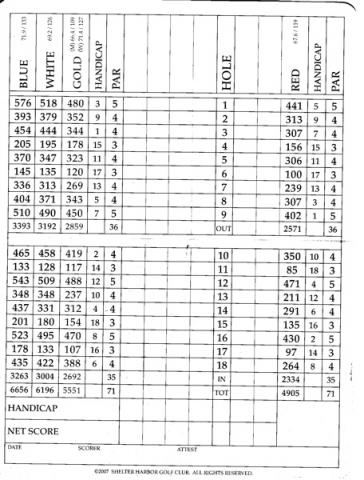 lay-up shot, and a large boulder guards the left edge of the fairway about 125 yards from the green and so too does one just in front of the green on the right. If the player chooses (successfully) to be more aggressive with the lay-up shot, he will be rewarded with a more straightforward pitch up the length of the green. The 9th green itself is two-tiered, with sideboards and backboards to reward creative wedge play (or a shot hit to pin high but slightly offline). The 9th is definitely a birdie hole that can get away from a player who does not give thought to each of his first three shots.
If there is any drawback to Shelter Harbor's layout, it is the lack of a drivable par four. Hole 7 is an interesting par four in its own right, with a tiny green protected by steep slopes short and long. Even though it is listed at 336 from the members' tees and plays about 40 feet downhill, it is not as reachable as the website description (www.shgcri.com) indicates. It is a good hole; it just is not reachable from the tee for even the longest bangers.
Shelter Harbor is a fantastic golf course from beginning to end. Even though it is only three-years old, I would venture to say that it is one of the best golf courses built in New England in recent memory and may challenge for best-in-Rhode Island honors in time (a post held by the renowned Newport Country Club).
Those who have the opportunity to play Shelter Harbor will experience an unforgettable day of golf.
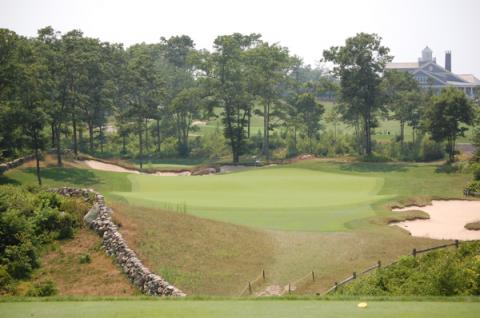
From the tee (above), the 4th green is easy to hit but woe be to anyone whose ball comes to rest in the mid-green trench (see below) when the pin is elsewhere.
Home wreckers: We own em, so why don't we just tear em down?
I am not an economist, nor do I play one at this blog site. But I know just enough to be dangerous in my thinking that, maybe, as a Wall Street Journal columnist suggests today, we should start taking the wrecking ball to thousands of abandoned houses across the land. Holman Jenkins Jr. has made this point before, which I faithfully regurgitated here, but some ideas are worth repeating.
The ugliest component of the housing mess is oversupply, a couple of years worth of inventory in places like
...unless you are among the brilliant minds that manage such things for the rest of us. The government has spent more than $1 trillion in mortgage bailouts since the beginning of the mess. And now, that same gang is shoveling another $300 billion into the incinerator, the equivalent of trying to stop an un-rushing train by tying blonde, innocent Nell to the tracks. It strikes me, as it does Mr. Jenkins and the others he quotes in his excellent piece, that $300 billion would buy thousands of abandoned houses.
We, the taxpayer, who are now paying to prop up our foundlings, Freddie and Fannie, would probably get a pretty good deal from the banks, too. Those houses are more than an eyesore to them. We own the mortgage lenders, they own the abandoned homes, so let's buy them, blow them up, clean up the neighborhoods, and start all over again. Or simply hand out axes to the mayors of Newark and Camden and Toledo and Miami and let them fix the problem. Whatever will bite into the oversupply will certainly help things along.
There is zero creativity in Washington, so maybe it is time for a little creative destruction.
If you can't get to the article by clicking here, let me know and I will email a copy to you.
A rave review for Bethpage Black
The Black Course at Bethpage in Farmingdale, NY, on Long Island, is inarguably one of the best daily fee courses in the nation, right there with Whistling Straits, Pebble Beach, the Ocean Course at Kiawah Island, and the hot courses of Bandon Dunes. Golfers who post their impressions online and in such media as the Zagat survey of top courses tend to give Bethpage Black higher marks than another public-fee U.S. Open course, Torrey Pines.
I've never played the Bethpage course but will make a point of it after receiving the following review from GolfCommunityReviews reader and contributing photographer, Elliot deBear, who played the Black on Friday. Elliot is much traveled and has played most of the better daily fee courses in the nation. His own impressions follow, although he left the camera home in order to concentrate on his game. Our loss apparently was his gain.
On Friday I played Bethpage Black...FROM THE TOURNAMENT TEES!!! First off, my friend Mark called up and got an 11:57 tee time. $55.00 for the round. They don't allow carts so everyone walks either with a pull cart you can rent or you can ask for a caddy with 24 hours notice @ $40 plus a $20-$25 tip. Club house and pro shop are terrific. I dropped $200 on logo shirts before I even teed it up.
We were matched up with two single-digit players who turned out to be great guys. Other than my buddy, none of us had ever played Bethpage so we agreed to walk back to tournament tees and play from the yardage plates even though no tee markers were set up. We decided to go with the experience and see the course from the pros standpoint. I play to a 9 and my goal was to break 90.
The Black Course is simply fantastic. Besides being in great shape, the course is probably the most interesting layout I ever played. It is magnificent to look at from almost every vantage point. The card lists the blue tees at 7,468 with a 76.6/144 slope rating and a par of 71. The card, however, doesn't account for two new tees. I have no idea what the yardage is from the tournament tees, but suspect it is around 7,580. This is the hardest track I ever played bar none. [It features] thick rough and natural traps framed with fescue and a big variety of large, mature trees framing the course.
Some of my favorite holes included the 230-yard par 3 third, 608-yard par 5 thirteenth and certainly the uphill 411 par 4 18th coming back to the clubhouse. And, of course there is the #1 rated handicap hole, the par 4 15th. The card says 490 yards from the blue tees...who knows what it is from the tourney tips, but it's a magnificent view looking out to the fairway (you need binoculars to see the green). It's looooooong. The real view is when you look back to the tee from the green and see what you just played. Wild.
I can't imagine this course when it is set up for the Open when they grow the rough another three inches, narrow the fairways to 20 yards on many holes, lengthen the rough from tee to fairway where, in some cases, it's a 240 to 250 yard carry to the fairway, and speed up the greens to a 13 stimp.
This course is a bear to walk now. To do it 4 days in a row with an Open set-up is unfathomable to me. These guys will need to be in the greatest shape ever and mentally sharp. This is a public venue open to one and all. If any of you decide to make the trek and have the chance to play Bethpage, you will not be disappointed. [The course] is just a brilliant test of golf in every way. I achieved my goal of breaking 90, with an 87 as the golf gods let me score a number of up and downs. I felt privileged to have had the experience.
The long and short of competitive golf
At barely 5 feet tall, Ms. Chung does not drive the ball very far, and she gave up 20 to 30 yards to her opponents off the tees. But unerring approach shots on par 4s she could reach with her fairway metal and an outstanding short game narrowed the differences.
But at this level of competition, even outstanding shotmaking is not
In match play, you can turn your distance disadvantage to advantage. Ms. Chung almost always played first from the fairways, and because she was so unerring in her approach shots, she put tremendous pressure on her opponents. The best junior players don't show much emotion, but Ms. Chung's opponents had to be roiling inside when they were way longer off the tee than she was and yet consistently left the green with a halve at best. Length off the tee isn't all it's cracked up to be...until it is.
That showed in the grueling 36-hole final match between the 13-year old Ms. Chung and her opponent, the much taller and more seasoned Alexis Thompson of Florida, also 13. This was the first final between two girls this young in the tournament's 60 years. The second 18 holes began with Ms. Thompson going 3 holes up after #1. But timely putting brought Ms. Chung back to just one down on the 6th tee. However, after she bunkered her tee shot at the par 3, Ms. Thompson holed a 35-foot putt for birdie to stop her opponent's momentum.
Ms. Chung stayed within two holes down but as they turned into the wind on the back nine, Ms. Chung's lack of length off the tee began to put her at a major deficit. The accomplished Ms. Thompson was consistently straight off the tee and a good 50 yards beyond Ms. Chung. Hitting first from the fairway is only an advantage if you put the pressure on your opponent, but Ms. Chung was having trouble getting to the putting surfaces on her approach shots into the wind. Ms. Thompson won holes 12 thru 14 and earned the championship with a 5 and 4 victory.
A great week of competitive golf...
Tough ones: Sunningdale Old Course, #12
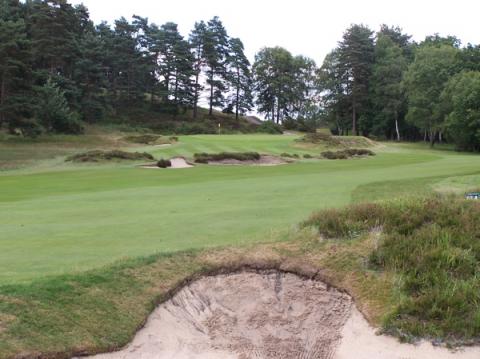
The bunker that guards the right side of the 12th fairway at Sunningdale is bogey territory...or worse.
From time to time, I will share photos, diagrams and observations here about holes that are rated the #1 handicap on their courses.
I would have been quite content on a recent first trip to Scotland to have played the Old Course at St. Andrews and just the few other terrific links layouts we played. The Old Course met every expectation I had in terms of atmosphere and nostalgia. The golf course was a delight, a mix of the familiar (from having watched the Open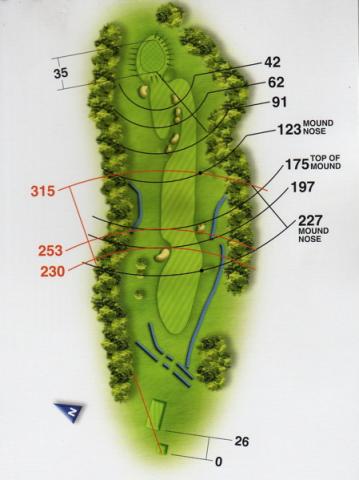 Championship on television and skimmed golfing picture books) and all the inherent atmosphere of where the game began. During that same week, our rounds at Elie, Lundin and Crail Links, as well as a surprisingly challenging round at Scottscraig, the world's 13th oldest course, were all so good that I could have stuck the golf bag in its travel container and gone happily on to London for a week of relaxation with the family.
But as luck would have it, golf had been arranged for my son Tim and me at Sunningdale, a belated birthday present for Tim from his English aunt (my sister). After all the golf in Scotland, I didn't expect the famed Sunningdale to be an improvement, certainly not on the Old Course.
Boy, was I wrong. The Willie Park Jr. course, which I wrote about previously here, was wondrous in all regards -- condition, layout, atmosphere on and off the course, everything. I didn't play well and I didn't care. Standing over my ball and looking down each fairway or over the rising slopes in front of the greens, I thought how great it would be to be a professional golfer with the ability -- and chutzpah -- to stare down the forced carries and swirling putts, and to linger for an exquisite moment or two deciding whether a lofted shot or bump and run was the best way to approach one of Mr. Park's sloping greens.
The toughest hole at Sunningdale's Old Course, the par 4, 404-yard 12th, wraps all the course's challenges into one big present for those with the stiffest of upper lips. As you stand on the tee, you are faced with a thinking man's choice; aim down the right side and chance landing at the base of the swale just into the rough about 230 yards out or worse, the yawning steep bunker another 20 yards along; or go the short way down the left and face the prospect of a long approach from a kidney-shaped bunker, also about 230 yards from the tee. If left is the choice, then the approach must fly a series of five bunkers that split the middle of the fairway diagonally, like a group of armadillos marching down a Texas highway. For good measure, a bunker at front left makes any safe play short of the green a big risk. Just to add to the all-or-nothing-at-all nature of the approach shot, the green is elevated, with significant runoff on all sides.
Once on the green, hopefully in no more than three shots, the sloping is not as severe as on some of the other surfaces on the course, the only "break" you get on this terrific hole.
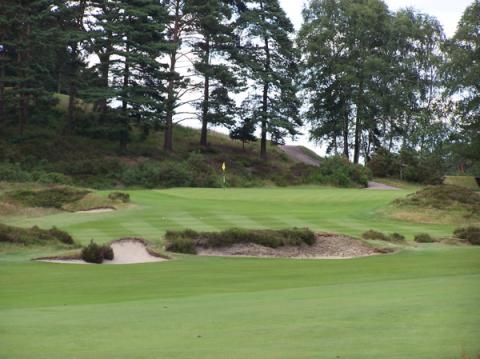
The best approach to the well-protected, elevated 12th green is from the center of the fairway. (Now there's a revelation!)
Senior moments on the junior circuit

Now on Sale
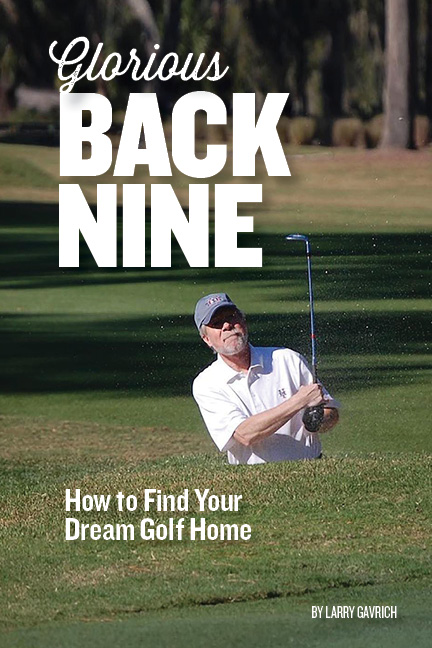
- The only book about golf communities in the last 10 years.
- 156-page step-by-step guide to finding your dream golf home.
- Info on nearly 100 golf communities the author has visited.
- Paperback version costs less than a sleeve of Pro VIs.
Here is what the experts are saying:
“The book is chocked full of information…applicable to anyone looking for a move to the Southeast regardless of whether they are looking for a golf community or not.” — John LaFoy, golf architect (Linville Ridge CC, CC of Charleston, The Neuse GC)
“Larry has done a tremendous amount of work and anyone — like me — who is looking to search for a golf home now or in a few years needs this book.” — Brad Chambers, golf blogger, ShootingYourAge.com
“Wow! What a thorough piece of work…a must for anyone moving South. This book will help many people.” — Brett Miller, owner and founder of MMA, Inc, a golf industry consultancy
Buy It Now at Amazon.com or BarnesandNoble.com.