Pinnacle: Championship community, awful web site
This week's Ladies PGA tournament, The Northwest Arkansas Proctor & Gamble Beauty Championship, ended yesterday with a victory for Seon Hwa Lee, who birdied the par 5 18th hole for a one-stroke victory at the Pinnacle Country Club. I watched a few holes of play before TV coverage cut away for the men's event and noted that the course played through a housing development. I tried to do some modest research this morning and was frustrated at every turn. The Pinnacle Country Club community has wasted a great opportunity to take advantage of all the publicity surrounding the tournament.
Pinnacle is located in Rogers, AR, in the northwest corner of the state, within an hour of both the Missouri and Oklahoma borders and just 15 minutes from Bentonville, whose name you may recognize. Bentonville was the birthplace of the late Sam Walton who founded Wal-Mart and sited his company's headquarters in his hometown. That may explain the 25% population increase in the area since the official 2000 census.
The 18-hole Donald Sechrest course features zoysia fairways and bent grass greens and runs to 6745 yards from the back tees (the lady pros played it from under 6,300 yards and Lee's winning score was 15 under par). It is a par 71 with a rating of 73.3 and slope of 139.
The PinnacleCC web site offers links to available real estate listings but, alas, the link led nowhere (an error message). After searching many of the local real estate agency sites, all I could find was a listing for an impressive 5,500 square foot home with wraparound views of two of Pinnacle's fairways. At another site, it appeared one large house was on the market for $900,000. I can't follow up with a phone call as I am off to a round of golf today (and anyway, it being Monday, and the Monday after a big tournament, the club is probably closed). If any of you out there has more luck than I, please post what you learn here in the comments section.
Many thanks.
 Home On The Course newsletter
Click here to sign up for our Free monthly newsletter, loaded with helpful information and observations about golf communities and their golf courses.
Buyer's agreements serve mutual interests
I had put our friends in touch with an agent at the Landings real estate office, and they were quite complimentary about the work he had done for
Assume you wander into an open house and meet the agent who is showing the house. She shows you around and asks what kind of home you are looking for. She offers to show you other houses that might fill the bill. You like her and for the next few days she lines up a dozen homes for you to look at. But, eventually, you decide you want to make an offer on that first home you wandered into. Understand that your agent represents the seller of that home. Some states might permit her to be a "dual agent" -- that is, to represent both you and the seller -- in which case she is prevented from sharing any personal information about you with the seller. But, naturally, her first obligation will likely be to the seller.
If you ask an agent to help you find a home, it is always best to ask for a "buyer's agreement." (Many agents will offer this without you asking as happened with a piece of property my wife and I purchased in South Carolina.) This agreement binds the agent to represent your interests, even if the agent's firm secured the listing of a home for which you are considering making an
Although a buyer's agreement might seem restrictive, it is fair to look at the issue from the real estate agent's point of view. Most of them invest a lot of time searching MLS listings in behalf of their clients, talking with other agents, making phone calls, arranging house visits and conducting other kinds of research. If their client, three weeks into the process, should wander into an open house on their own, the agent, who has worked so hard in their behalf, could get cut out of the deal. All their work would go for naught.
It seems only fair that if the agent has the client's best interest at heart, the client should return the favor. Yes, you give up a little flexibility but you gain a representative who will prosecute your interests. A buyer's agreement protects both parties, and if an agent refuses your request for such an agreement, or insists you sign a too-restrictive one, you should take your business elsewhere.
Seoul sisters: Can American women golfers challenge Koreans in professional golf?
American's women's golf is in an even more precarious competitive position. Mexico's Lorena Ochoa owned the first half of the ladies professional golf tour. Now
In the near term, perhaps Paula Creamer (she of the perfectly color coordinated outfits and golf gear) or Kristie Kerr or some other American player will emerge from the pack and reenergize American women's golf. But to this observer, they don't appear as relentlessly focused as the Parks and Kims who are in contention every tournament. In a couple of weeks, the U.S. Junior Girls Championship will be played at the Hartford Golf Club, about 15 minutes from my Connecticut home. Maybe a female Tiger Woods is lurking in the under 18 crowd. I'll be watching.
* Andre Agassi, 1992
Alabama overall tax burden lightest in south
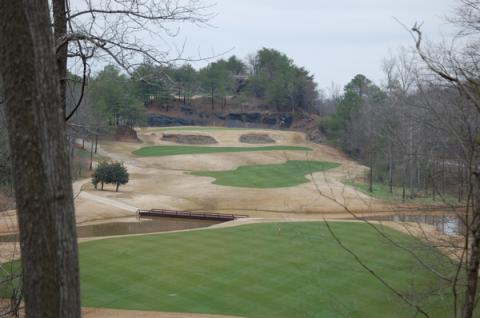
The Oxmoor Valley Ridge course (par 4 3rd hole shown), part of the Robert Trent Jones Trail, is just a few miles from the interesting and sophisticated city of Birmingham. Alabama imposes the second lowest tax burden in the nation on its residents.
It seems fitting on this July 4th to reference independence from taxation, or at least the kind of taxation that came without representation. The Colonists in 18th Century America were more upset about being told they had to pay taxes to the Crown, without having any voice in the matter, than about how much they had to pay (which is reported to have been much lighter than our own burdens today).
Some might say the English Crown's role of absolute authority over taxation in America has simply been transferred over time to the IRS. Regardless, Americans
Most of us do not have a retired CEO's financial planning resources or as much to lose to taxes, but that doesn't make the investigation any less important. But a word of caution: Income taxes should not be the only kind of tax we look at when considering where to live. If it were, we would all live in Florida, Texas, Tennessee, Nevada or one of the other dozen or so states that don't assess their citizens an income tax. No, a state's overall tax burden, and the way we plan to live our lives, should guide one of the most important decisions of any person's or couple's life. If you plan to own an expensive house in retirement, property taxes will play an important role. If you are aggressive consumers, beware the high sales-tax states. Planning to live in a remote area where you will rely on your car for daily trips to town? Gasoline taxes vary widely state to state.
There are a number or resources to determine the overall tax burdens on a state-by-state basis, but one I find particularly useful is at MSN's Money Central web site, under the title "Best and Worst Tax States." MSN rolls up all the various taxes into one overall tax burden rate by state. For example, Florida ranks #12 (#1 is worst, #50 best) on the overall list; I am chagrined to admit my own state of Connecticut ranks #1. The other no-income-tax states in the southern U.S., Texas and Tennessee, rank #41 and #46 respectively, explaining somewhat why both these states are showing net population inflows.
Oklahoma, not known as a retiree destination, ranks #50, just ahead of Alabama, which I have visited and where I reviewed a few courses along the Robert Trent Jones Trail (to find them, search by "Alabama" in the box at upper right). If taxes are your major concern, the growing state of Alabama is worth a look (I found the city of Birmingham sophisticated and surrounded by excellent private and public golf courses).
Lost in all these lists of tax rates and financial calculations, of course, are quality of life considerations. Ask a West Palm Beach, FL, couple sitting in bumper to bumper traffic on the way to the early bird special, and they might admit that, for a few dollars more, they would pay to see the local roads widened.
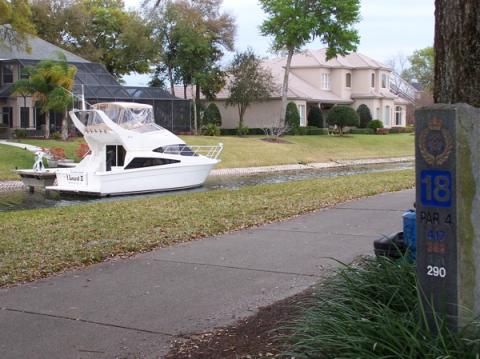
Florida levies no state income tax, so it must make up for that with taxes on property such as homes and boats like these at Queens Harbour, near Jacksonville.
-- Article and photos by Larry Gavrich
Final observations about Scotland...finally
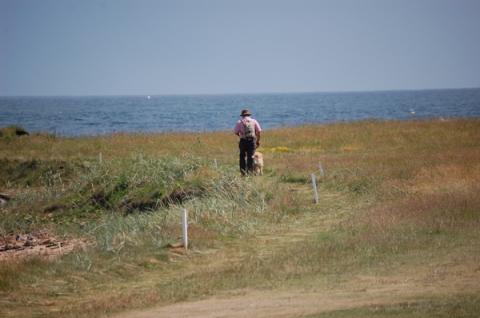
Golf courses in Scotland are considered essentially public land. On every course we played, including the Old Course at St. Andrews, we saw people walking their dogs, often across fairways. They never got in the way.
I've just about run out of material about our weeklong stay in Scotland (no applause necessary). Here are a few final thoughts, although I will share more photos of the courses we played in the coming days. (Note: Click on small photos for larger versions and captions.)
Bad drives...It took 60 years, but I finally had the experience of driving on the wrong side of the road (apologies to any Brits reading this who think we Yanks drive on the
No escaping the Donald...It is bad enough we have to endure Trump on billboards and TV promos and newscasts here in the States, but to find him the big story in
American spoken here...but not Japanese. At the Old and New Courses in St. Andrews, we heard a lot of American accents, belying the current exchange rate imbalance. Subtract the caddies, and we heard more American than Scottish. Beside the first tee I overheard a few obviously well-heeled Yanks -- you could tell by their bag tags from upscale U.S. courses -- comparing all the world's great courses they had played. As we moved to the lesser-known but outstanding courses of Crail and Lundin, I heard a smattering of German and French accents on the practice greens. I was surprised not to see anywhere the world's most passionate golf travelers, the Japanese and Koreans.
A wee bit about Shanks...Virtually every locker room at every course we played in Scotland featured urinals and toilets made by Armitage Shanks, a major porcelain
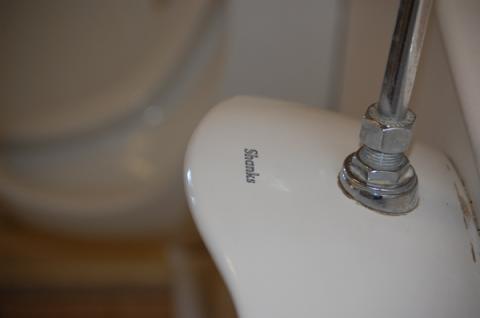 manufacturer in the Isles. It is a little disconcerting to stop at the loo after nine holes and have to confront the Shanks. You would think that golf courses in the land where the game arguably was invented would show a little more delicacy in their choice of depositories. What's wrong with Ideal Standard, Farmeloe, Yukka (yes, that is really the name of a toilet manufacturer) or the many other toilet makers of Great Britain?
Out of phase...Five hours doesn't really seem like much, but the time difference between the Isles and the east coast of the U.S. is always a bit disorienting. I was forced to pre-set my lineups days in advance for my fantasy baseball league. We didn't read many newspapers or watch much television in Scotland, except for the exciting and splendid Euro Cup football (soccer) matches, so we weren't up on much news, and certainly none from the U.S. It was therefore a shock to fire up our laptops at the Bean Scene in St. Andrews, about the only place with an internet connection, to find that Tim Russert, the NBC political correspondent, had died...and then, a day or two later, George Carlin. The news would have been shocking if we had been home, but somehow the distance from home made it more so. My worries about my fantasy baseball team suddenly seemed small indeed.
Food for thought...The Scots still haven't quite caught onto the dining out thing, although all evidence is that the food in Scotland is way better than it is alleged to have been just a few years ago. We queued up for fish and chips at the legendary
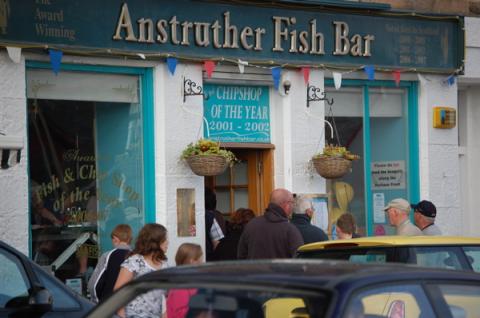 Anstruther Fish Bar in the town of the same name. After an hour wait, the sodden little piece of fish served in a cardboard box (inside the restaurant) and the mediocre fries (chips) would hardly pass muster at Long John Silver's. We found it was best to keep it simple when it came to ordering out, as in a nice cheese plate at the Bean Scene; or ethnic, as in the good Thai restaurant we dined at in St. Andrews. That was probably our best meal of the entire week in Scotland, save for the Peat Inn, which I reviewed here a few days ago and which cost essentially a month of house payments. Actually, come to think of it, one of the best dishes of my week was the chicken tikka masala, an Indian dish I ordered, with some trepidation, in the Scotscraig Golf Club clubhouse. It was excellent, perhaps as much for the meals I had eaten in the days before as for its own inherent good taste.
The simple life...If Americans were faced with the enormity of the taxes the Brits pay -- income tax up to 40%, a national health insurance tax that begins at 11% and a value added tax of 17.5% on all goods and services -- we would probably start the 21st Century equivalent of the Boston Tea Party. We'd complain as well about the waits for doctor's appointments and surgery in the National Health system. And if you think we have an immigration "problem" in the States, spend a little time in London where the doors are wide open to the outside world and even the stiffest upper lips are starting to quiver. And yet, in Scotland and London, everyone we met seemed quite content with their lot in life, despite the comparable shortfall in worldly possessions and entertainment options (compared with Americans). The standard form of entertainment in the UK seems to be get-togethers among friends and family in homes or in the many beautiful parks. And everyone walks a lot, especially on the golf courses. In a week of golf in Scotland, I saw only two electric carts. On the quality-of-life scale, the people of Scotland and England don't seem to be taxed at all.
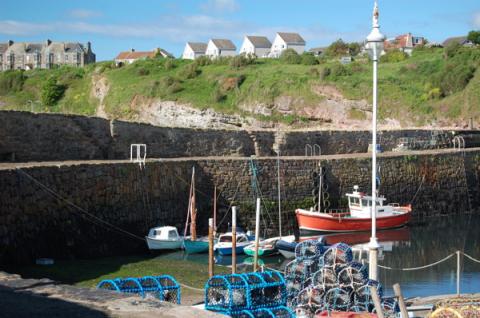
It was not easy to leave our temporary home in the quaint fishing village of Crail, just nine miles from St. Andrews and just one mile from the fabulous 36 holes at the Crail Golfing Society.
-- Article and photos by Larry Gavrich
Depression: Business section leaves me in a funk
I suspect the news on housing in Connecticut is being replayed in your own geographies. The median sales price of homes in our state plunged 11 percent in May. It was the worst of the last five months of declines, indicating that things will get worse before they get better (despite what those nattering nabobs of sunshine at the National Association of Realtors say). The richest state per capita in the nation has seen the median value of a home drop from $305,000 a year ago to $272,000. A declining sales rate just adds to the gloom.
I suppose my wife and I are fortunate to own property in coastal South Carolina where prices are also declining, but at a slower rate than in Connecticut. That means the delta between what our primary house may be
The other side of the news for us is that, according to today's business section, insurance rates for coastal residents are up between 20% and 100% in just the last four years. Scientists say that rising sea temperatures -- thank you global warming -- are increasing the likelihood of stronger hurricanes and, therefore, greater damage to property. Our condo is ¾ of a mile from the ocean, and our own insurance rates are up about 50% since 2004. Property and casualty insurers, though, have taken a page from the oil industry; the insurers' profits were up $66 billion in the three years ending in 2006.
And then there is the item in the business section under the headline "Study: Workers Not Saving Enough for Retirement." Hewitt Associates found that four out of five workers will not be able to maintain their lifestyles at their current rates of savings. Two thirds of the 2 million employees Hewitt studied at large U.S. corporations will wind up in retirement with less than 80% of what they need. I, of course, have a vested interest in people's interest in golf. But golf, as much as we love it, is discretionary spending, and given a choice between golf and eating something better than dog food, I know what my choice would be. (No wisecracks, please; it will be the food)
At least I am not a customer of Citibank. Today's business section says hackers stole ATM card codes of the bank's customers. It is a sad state of affairs when the only good news for some of us in the business section is bad news for others.
For just $500, membership in a course Trump's man designed
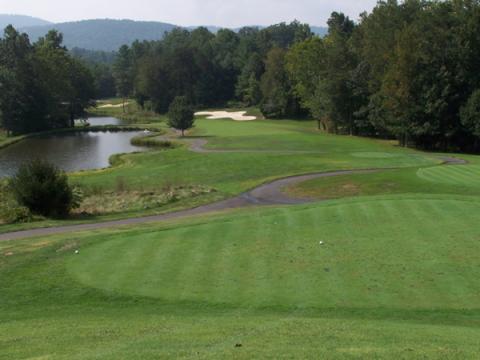
Easy to be hard: The 5th green at Reems Creek (just to the left of the bunker in the distance) can be driven, but the almost sure par four is to hit a mid iron off the tee.
The Old Course at Lahinch Golf Club in Ireland is one of the best courses in the world, according to design experts and players alike. It might surprise many that the massive redesign begun 10 years ago was handed to an architect many of us have never heard of, Dr. Martin Hawtree of Hawtree Golf Design. Hawtree's grandfather founded the firm in 1912. Hawtree the younger has gained some notoriety lately for
At today's currency exchange rates, Lahinch's green fees are about $260 US. Add in the cost of airfare and lodging in Ireland and you are into the thousands of dollars. For a lot less, you can actually join Reems Creek, a Hawtree Design course in the Asheville, NC area that I enjoyed when I played it a few years ago.
I recall at the time comparing Reems Creek to a few British Isles courses I had played. Reems Creek, located in Weaverville, just 20 minutes from the popular city of Asheville, wasn't quite a links course, but it did show its share of heather-like rough, rolling fairways and bunkering in the sides of hills, all of which gave off the odor of golf
I recall one hole especially, the short par 4 5th, that offered a risk/reward tee shot if ever there was one. You could hit a safe five iron to the fairway and have an 8 iron or less into the green. Or you could try to fly the large pond that fronts the green and skirt the trees at front left to put yourself in position for a possible eagle putt, a carry of about 220. (I think Hawtree may have been considering the 10th at The Belfry when he designed Reems Creek's #5.) I chose risk aversion and hit the five-iron; I recall I parred the hole.
Current membership in the Reems Creek club is a measly $500, with monthly full family dues of just $170. Okay, the facilities are a little skimpy and you'll share your course with the daily fee players, but members at Lahinch do so as well. Real estate adjacent to the course is a good buy, and some homes have impressive views not only of the golf course but also of the nearby Blue Ridge Mountains as well. Lots begin at $90,000, single-family homes at $400,000, and town homes at $250,000. The largest lot available currently is 6 acres and is listed for $255,000. At the high end, a new 5 BR, 4 BA, 4,800 square foot home, with a view of the course and distant mountains, is on the market for $948,000. A 3 BR, 3 BA, 3200 square foot home with similar views is listed at $549,000.
I visited Reems Creek the same week I toured Champion Hills in Hendersonville, Kenmure in Flat Rock and Mountain Air in Burnsville. Reems Creek was not as high in
If Reems Creek or the Asheville area appeals to you, let me know by clicking the "Contact Us" button at the top of the page, and I will be glad to provide you with more information and, if you want, a qualified real estate agent who knows Reems Creek and the Asheville area well.
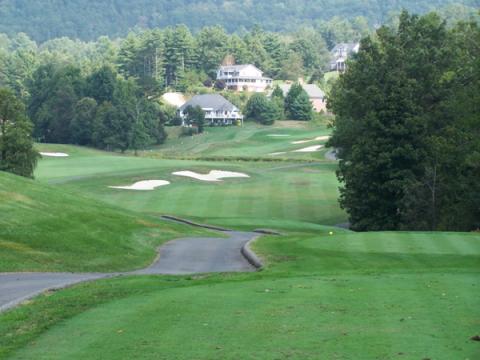
Homes sit above most fairways at Reems Creek and provide some impressive views.
-- Article and photos by Larry Gavrich
Hidden treasure: Best rural restaurant in Scotland is out there in location and prices
The Peat Inn is in the middle of nowhere, a good 25 minutes from St. Andrews. From any direction, the narrow roads to get there twist and turn and fall and rise past cow and sheep farms. At every bend you slow down lest the guy coming toward you from around the curve ahead fails to do the same.
After such a grip-the-wheel drive, the Peat Inn's antique and handsome façade was a welcome sight, and the maitre d's warm and friendly greeting made me forget
Maybe in recognition of what an effort it takes to get there, or more likely because it is the most expensive restaurant within a radius of hours, Peat Inn rushes nothing. You open the front door into a very pleasant lounge with a handful of tables and corner banquettes. Here you are invited to sit, order a drink and, only when you are fully settled in, to peruse the menu of the evening. The maitre d' is a pleasant chap who seems eager to answer any questions about the dishes of the night, and shows great patience when a nearby table of four wants every dish on the menu deconstructed.
We spare him a repeat performance since we have already heard it, and both of us order the special of the evening, the beef daube ($42), a hunk of meat marinated
After our drinks and the first "amuse bouches" of the evening, a small round of toast with a rich olive tapenade and an airy little parmesan puff, we are escorted into one of Peat Inn's three dining rooms. Our room, the farthest from the front door, looks out on the garden where the inn grows many of the herbs that embellish its dishes. Lovage, a member of the celery family, is one of them, and it is at the base of a foamy little soup our waiter presents us as the second amuse of the evening. It is shot through with a mild but distinctive plant flavor, a real palate cleanser. A crunchy fennel roll, one of four bread choices we are offered, complements the soup.
The appetizers arrive and they are stunners, if a bit dainty, not the relatively Bunyanesque portions we Americans are used to. Tim's plate is an exercise in
Oddly, we hit a bit of a snag with the entree. Obviously, the perfect square of beef, which is placed dead center on the plate, has been pampered by the slow-cooking method. It is properly soft but strangely lacking in either beef flavor or the flavor of whatever it marinated in for the advertised 24 hours. The red wine sauce helps only a little, but the little bits scattered about the plate -- oyster mushrooms, broad beans and radishes, all tasting as if they came from the garden out back -- are exquisite. Still, if I had a do over, I would have opted for the breast of duck with asparagus, potato gallette, young spinach and Calvados sauce ($38); or the roast rump of veal, saffron rice, peppers, fennel and oregano jus ($38).
I'm not a major dessert eater, but the listing for the hot peach soufflé with vanilla ice cream ($16) catches my eye, and I am willing to wait the 20 minutes the waiter warns me it will take. Tim, whose chocolate fetish comes from somewhere other than his father, goes for the dense and rich pavé of chocolate, chocolate brownie, raspberry mousse and raspberry sorbet ($16). When my soufflé is served, the waitress cuts a perfect crosshatch in the puffy crown and then slips a perfectly shaped dollop of ice cream, pointed at both ends, into the opening. I watch it slide in, the performance a nice opening act to the actual eating of the thing, which is light, airy, peachy keen and worth the wait. I don't bother Tim, who appears fairly hypnotized by his striking plate of reds and dark browns.
The Peat Inn's final gift to us is a small plate of six chocolates, three for each. Even in the better restaurants, these last little parting gifts seem almost reflexive, but at Peat Inn they are special. The log of crushed hazelnuts and chocolate is intense, rising beyond the familiar taste of a packaged Perugina. Mint from the garden was clearly used in the piece of mint chocolate, such was its intensity of flavor. But the most unusual piece was the jasmine tea chocolate, the tea equivalent of a cup of mocha coffee, something I had never tasted before but certainly look forward to again.
All the free stuff moderated just a little the sting of the prices at the Peat Inn. (A set menu of appetizer, salmon entrée, dessert or cheese and coffee and petits fours would have saved a few dollars, but we wanted free range of the menu for what may be my one and only trip to the area.) The inn is not for the faint of wallet, especially with the current exchange rates. When all was said and done, our meal cost $220. For perspective, it cost more than $600 for the two of us to play the Old Course at St. Andrews a few days earlier.
That was worth it too.
The Peat Inn, Cupar, Fife, Scotland. Tel: (01334) 840-206. Web: http://www.thepeatinn.co.uk/index.htm. Starters: $16 to $28. Entrees: $32 to $42. Dessert: $16 to $18. Set menu of the day: $64. Tasting menu: $96; $170 with selection of wines. 17.5% Value Added Tax included (thankfully).
Your editor weighs in on golf course ownership
That said, there are many courses available for sale now, and the prices are close to historical lows. (The operating costs, however, might be the highest ever.) For a sampling, check out the web site for Coldwell Bankers' National Golf Sales.
You can read the NuWire article by clicking here.
The kid and I rank the UK courses we played
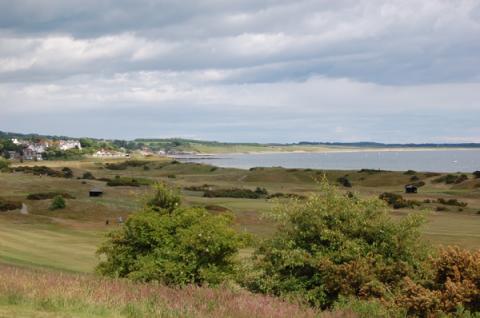
I was captivated by the views from almost everywhere on the Lundin Golf Club links.
After a glorious couple of weeks of golf and visits with family and friends in the United Kingdom, we are back in the U.S. of A. I probably played more golf in the UK than was good for my game; I haven't walked eight courses within 11 days since I was in my early 30s. At a certain age, the law of diminishing returns seems to kick in after a week of virtually daily golf, even though I feel healthier for having walked almost
All but one of our courses in Scotland was laid out on links land, the exception a fine combo of parkland and heathland at the 190-year old Scotscraig Golf Club. I thought I had played links courses here in the states - at Truro on Cape Cod, Shinnecock Hills on Long Island, the Ocean Course on Kiawah Island - but there are clear differences
 between that group and the true links courses we played at Lundin, Elie, Crail and, of course, St. Andrews. The Scottish links are firmer, less sculpted, and more natural looking than their American counterparts. The perfectly shaped sod bunkers we played around and, occasionally, into certainly were not carved by sheep huddling against the harsh winds, but it was easy to imagine that scene hundreds of years ago. Links golf in Scotland is golf darn close to its primordial state.
My son Tim and I thought it would be an interesting exercise to rank separately the courses we played over the last two weeks. He tends to pay much more attention to architectural flourishes on the courses than I do; I play the layout then take my temperature at the end, counting a little less on details than the overall experience. It turns out that we agreed substantially about the courses we played. Our biggest point of difference was Scotscraig, which Tim ranked #3 and I placed at #5. Excellent golf course, amazingly so for the small piece of land it uses; I just thought Elie and Crail provided better views and layouts that, while more self-consciously dramatic than Scotscraig's, nevertheless seemed more interesting.
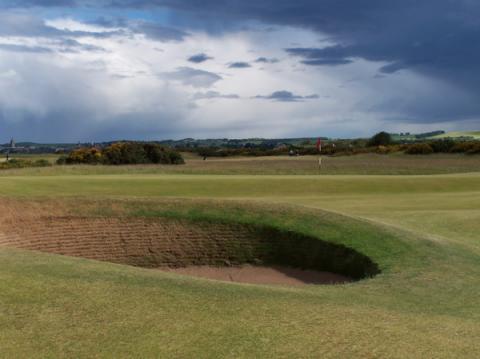
A brooding sky just added to the experience of playing the Old Course for the first time. So too did the old sod bunkers as here at the 12th green.
Some explanatory notes follow our rankings (below). If you are planning a Scottish golf vacation in the area of St. Andrews, I would be happy to share more details about our trip and experiences (just hit the "Contact Us" button above). In the coming days, I'll offer some additional reflections and observations about golf and travel in the Kingdom.
Larry's ranking (Tim's ranking in parentheses):
1. Sunningdale Old Course (1)
2. St. Andrews Old Course (2)
3. Crail Balcomie Links (4)
4. Elie Links (5)
5. Scotscraig Golf Club (3)
6. Lundin Golf Club (6)
7. Hartsbourne Country Club, London (8)
8. St. Andrews New Course (7)
Explanation:
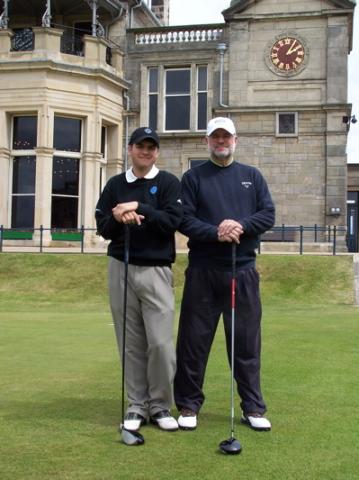
As I wrote yesterday, the Willie Park designed Sunningdale Old Course, updated by Henry Colt in the ‘20s, was a revelation, tough and beautiful and a pleasure no matter what score you produce. The Old Course at St. Andrews was no letdown for us, as it has been for others; its charms are as obvious as some of its pot bunkers are not. I finally played the Old Course at St. Andrews after 60 years; it only took my son Tim 18 years, but isn't that the way it is supposed to be, one generation improving the lot of the next one?
Crail Balcomie was everything a seaside links course should be, challenging on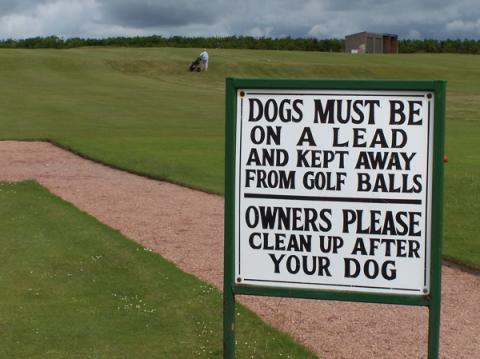 breezy days and a brute when the wind blows. We played it twice, once under each condition, although we did not suffer a drop of rain. I thought Balcomie played four or five strokes harder in the wind. Elie Links was the toughest walk of the eight courses. Its hills seemed a little steeper than at other courses we played; the volcano-induced rock formations at the edges of some holes only heightened (ahem) the drama. Scotscraig was easily the most efficiently designed course we played, on just 106 acres. With only a few blind shots, it was probably the only track where the yardage book was not essential (we referred to it anyway).
Lundin's dramatic first hole along the sea, with the seaside town lurking a mile beyond the green, set the tone for the rest of the round there. Though we pushed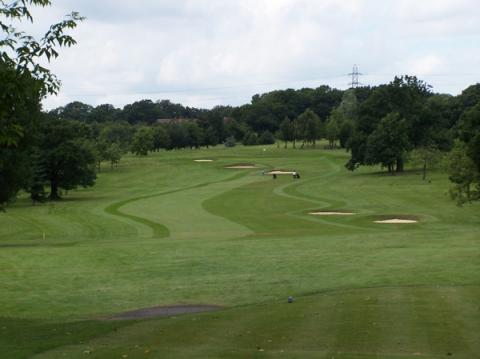 inland on our walk, the sea was almost always in view, a lovely backdrop for the few holes that played downhill toward the beach. Hartsbourne, just north of London, is more in the style of a U.S. country club, with an active membership and pampered course that was among the best conditioned of the week. Not the high drama of the links courses, but a refreshing change.
Finally, we might have ranked the New Course at St. Andrews higher had we not played the Old Course (thankfully after we played the New). The best views from the New are of the city of St. Andrews, the same as you get at the Old, but the layout, which seemed fresh to an American who plays links courses rarely, ultimately seemed Old Course lite. The New was a disappointment only in comparison with the Old.
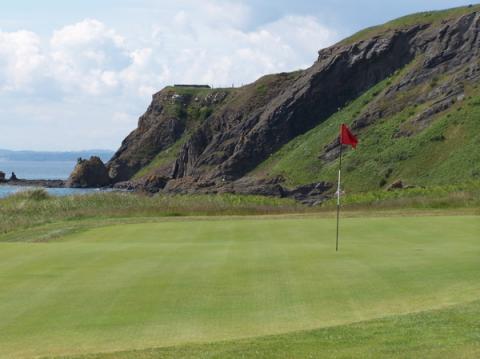
High drama: Cliffs and sea frame the 13th green at Elie Links.
Now on Sale

- The only book about golf communities in the last 10 years.
- 156-page step-by-step guide to finding your dream golf home.
- Info on nearly 100 golf communities the author has visited.
- Paperback version costs less than a sleeve of Pro VIs.
Here is what the experts are saying:
“The book is chocked full of information…applicable to anyone looking for a move to the Southeast regardless of whether they are looking for a golf community or not.” — John LaFoy, golf architect (Linville Ridge CC, CC of Charleston, The Neuse GC)
“Larry has done a tremendous amount of work and anyone — like me — who is looking to search for a golf home now or in a few years needs this book.” — Brad Chambers, golf blogger, ShootingYourAge.com
“Wow! What a thorough piece of work…a must for anyone moving South. This book will help many people.” — Brett Miller, owner and founder of MMA, Inc, a golf industry consultancy
Buy It Now at Amazon.com or BarnesandNoble.com.