Dyslexic caddie only one highlight of Golf Odyssey's year in review
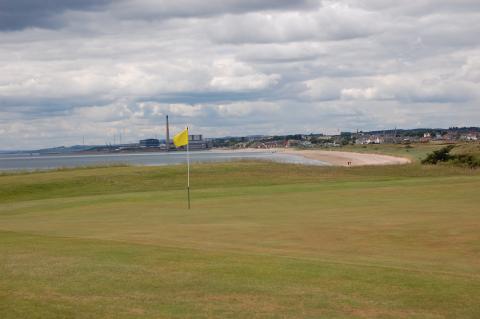
The first hole at Lundin Links is everything Golf Odyssey says it is, one of the best starters int he world.
This is the time of the year that many publications take a deep breath, meaning they cut and paste from their dozen or so issues during the year and spit out a special "best of" or "review" issue. Ironically, the most faithful subscribers feel a bit cheated with an issue that repeats what they read just a few months earlier.
Subscribers to Golf Odyssey, which reviews golf vacation destinations, should not feel cheated at all with
Golf Odyssey tempers the offbeat with serious disquisitions on golf courses they have played around the world; and where my own trips have taken me to places they have reviewed, I can only say they are spot on. Although I might have played a better opening hole than their favorite opener of the year, at Scotland's Lundin Links, I can't recall one; and their description of the hole and its glories match my own vivid and fond memories. And to their comments about the surrounding Kingdom of Fife being the "most glorious golf neighborhood," I second that emotion.
The year end issue also includes a comprehensive list of "platinum" places to play arranged by categories with which most golfers will identify, not just "top 100" or the like.
If you are a traveling global golfer, or want to feel secure about that expensive impending trip to Pebble Beach or Pinehurst, consider seriously a subscription to Golf Odyssey. I like it because, like me, David and Craig travel anonymously, paying their own way for accommodations, golf and food. And like Golf Community Reviews, they are unique in that they review objectively the courses they play, never accepting any promotional fee or other consideration that might color their opinions. You can trust their judgment, and in this world of Madoffs and Blagojeviches, that is worth more than the modest subscription price. Click here for the Golf Odyssey sign up page.
 Home On The Course newsletter
Click here to sign up for our Free monthly newsletter, loaded with helpful information and observations about golf communities and their golf courses.
Darwinian golf: Only strong, well located courses survive in Myrtle Beach
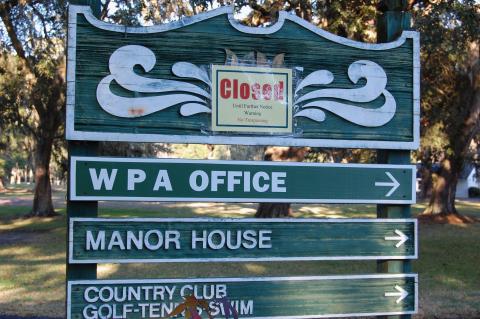
Upon our arrival on Saturday in Pawleys Island, SC, we were greeted with the news that the Wedgefield Plantation golf course had closed, the owners filing for Chapter 7 bankruptcy. I reviewed the course here in 2007 (click here for article).
Wedgefield, never rated near the top of Myrtle Beach's long roster of golf courses, nevertheless was sporty and fun to play. More importantly, it
When Wedgefield first opened in 1974, just at the beginning of the golf course explosion, Myrtle Beach offered around 35 courses, and Wedgefield found its way onto the list of courses open to package players down for a long weekend or buddy-golf week. But by the late 1980s, the Strand had become oversaturated with courses, topping the 120 mark. Today, the number is 95, and only the financially strong and well located survive.
Sadly, Wedgefield was not one of those and now finds itself in the dustbin of Myrtle Beach golf history along with Robbers Roost, Marsh Harbour, Beachwood, Deer Track, Bay Tree Plantation and half of the four courses at Wild Wing, all among the two dozen or so Myrtle Beach area courses that have closed since 2005. Add to that list Winyah Bay, the only other course in Georgetown and which, for a few years, held the distinction of furthest southern course on the Grand Strand. It closed in 2005. Efforts to sell lots and build homes on the former course have fallen well short of expectations, and four years later, just a couple of homes have been built there.
A slick way to keep track of where you play
I'm sure you've encountered people who have mapped out all the places they've visited, or wish to visit. In the golf world, I like to keep track of where I've played. Thanks to today's technology, it's not only rather easy, but it also gives you the ability to save as much information from your round as you'd like.
I've used Google, although I'm sure there are other programs that would accomplish the same goal. Here's how Google Maps works. Go to www.google.com and then click on "Maps." Under the Maps page, you have options for "Get Directions" and "My Maps." Click on "My Maps"
Next, click on "Create new map." This will give you the ability to add a "Title" and provide a description for your map that you can edit in the future.
Now you'll be looking at a blank map of the United States, but you have the ability to insert "place marks" wherever you'd like (click on the pushpin icon in the row just above the map). With these place marks, you can add information, dates, photos, scorecards and other information. Best of all, with the great satellite views that are available today, you can even put specific place marks on particular holes.
Once you've saved your place marks and information, you can go back at any time and update, edit or share with others.
My wife Kim and I have a goal of playing golf together in all 50 states. We have 25 down thus far, and it's fun to be able to look at the map and see just how much of the country we have left to go. If you would like to check out our map, click here.
Tom and Kim Hoyt live in Hanover, N.H. where the golf season is short, no deterrent at all to the peripatetic couple. Tom and Kim recently played the golf courses at Reynolds Plantation, in Georgia, and at the best golf communities in the Aiken area and contributed their golf reviews here. Click here .
Is it all about the golf, or about all the golf?
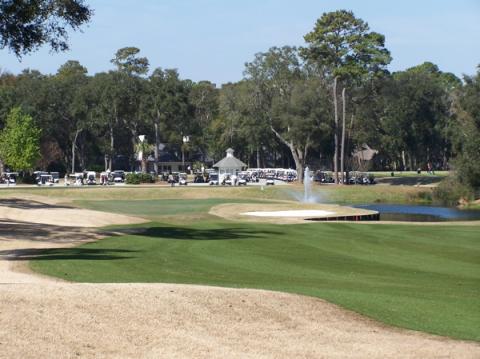
At The Landings, traffic jams involve golf carts more often than they do cars. Many golfers own their own carts to drive to one of the six golf courses they belong to.
Tip #2: You can gorge on lots of golf, but you will pay for it
Are you a gourmet or gourmand golfer? The gourmet golfer dines, metaphorically speaking, at only the finest courses. He or she avoids play at Muni Golf Club and saves up his green fees for Kiawah’s Ocean Course or Bandon Dunes. If he is a private club member, he makes his choice based on layout and amenities, and maybe how many friends and business colleagues belong. But he chooses a course that will not bore him over repeated plays.
The gourmand is more like the rest of us, ready to confront the grand
When you go looking for a place to live on or near a golf course, you will do well to understand which type of golfer you are. Doing so will save you money and add immeasurably to your experience. Some golf communities offer multiple golf courses, but you have to ask yourself if you will really play four or six courses often enough to justify the higher club membership prices. In multi-course communities I’ve visited, members develop their favorite and tend to play one or two of them more regularly than they do the others. And without being a snob about the issue, I have also observed that the lower handicap golfers tend to gravitate toward the best one or two courses, and the higher handicappers tend to play wherever a tee time is available.
For the golfing gourmet, the best option may not be a community golf course at all, but rather an outstanding private golf course within a few minutes drive of their home. This approach gives a little more leeway to handpick the course and the type of members. Near most towns, like Greenville, SC, or Charlottesville, VA,
There are dozens of multi-course communities to choose from in the southern U.S. One I particularly like for its unpretentiousness and carefully thought out array of golf courses is The Landings on Skidaway Island, just outside Savannah. I have written about the community a number of times, and good friends recently purchased a home behind a green at one of the six courses there. The challenging Arthur Hills Palmetto course at The Landings is one of the best I have played in the last decade, in nice condition and with impressive marsh views. I played one of the other courses there, a Tom Fazio layout that was mild in comparison but in even better condition. Unlike a community like The Cliffs, where its six courses are spread across the Carolina mountains, about one hour apart at their most distant, The Landings courses are less than five minutes apart. (Note: Many residents own their own golf carts and travel to the courses that way.) Moreover, Cliffs membership is $150,000 whereas The Landings has held the line at $50,000.
Another multi-course option, a bit unconventional in my estimation, is the Wintergreen Resort in Virginia, which offers the double-dip of golf and skiing. The Ellis Maples designed Devils Knob course at the top of the mountain closes for the winter, its first tee not 200 yards from the resort’s ski lift. In summer, the temperatures at Devil’s Knob, which is the highest altitude course in Virginia at 3,850 feet, can be as much as 18 degrees cooler than at the 27-hole Stoney Creek course at the base of the mountain. Stoney Creek, a pleasing layout designed by Rees Jones, remains open throughout the winter and locals brag that on some January days they have skied in the morning and played golf in the afternoon. Because it is a full-service resort and residential community, there are no shortages of activities, and the university town of Charlottesville (U of Virginia) is just 40 minutes away.
The coastal area of North Carolina, between Myrtle Beach and Wilmington, is dotted with multi-course communities, including the plantations of Sea Trail, Ocean Ridge and St. James. I have played golf at all of them and can testify that they have enough in the way of challenge and variety to satisfy the most ravenous golfing gourmand. The scant few miles to the beach will also impress beach goers who need the occasional respite from golf (or from their golf addict spouse).
No matter your golfing “diet,” I would be happy to help you develop some ideas about what community or golf-rich area might suit you best. There is never a fee or obligation whatsoever for my services. Just send me a note (click the contact button at the top of the page) and I will get back in touch with you promptly.
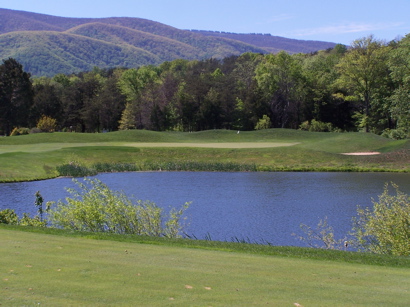
The Rees Jones designed Stoney Creek at Virginia's Wintergreen Resort is open year round. Some ski in the morning at the top of the mountain and golf in the afternoon in January.
On the road to SC for the holidays
After a huge meal today with friends in Connecticut, we hit the road early tomorrow for South Carolina. I will be in the Myrtle Beach area until just after New Years, with plans to play the well-regarded golf course at The Thistle Club, and to have a post-game libation in their stunning new clubhouse. Look for my golf review in this space within the next couple of weeks. If you have been thinking about a possible relocation to the Myrtle Beach area and want me to check out a community personally for you, please send me a note (use contact button at the top of the page) and I will do my best.
In the meantime, I wish you peace and happiness for the holiday season and the new year. And thanks for stopping by at Golf Commuity Reviews.
Larry
Sticker shock: What happens when you inherit all those amenities?
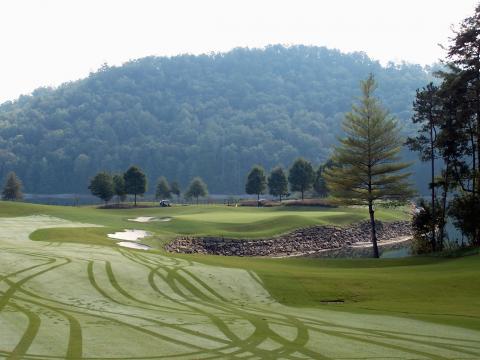
The Cliffs at Keowee Vineyard, a sparkling Tom Fazio design, is one of six courses (a total of eight planned). Besides golf, The Cliffs offers such amenities as wellness centers, equestrian centers, and nature trails.
Tip #1: Avoiding the traps when buying into a golf community
This is the time of the year for Top 10 lists, and Golf Community Reviews can pander with the best of them. Over the coming few weeks, we will share in this space our top 10 ideas for making the smoothest possible move to a golf community.
Golf communities run the gamut from a pure focus on golf -- a course and a clubhouse and little else -- to a roster of amenities that counts golf as just one of the activities. You get what you pay for, and you pay for what you get. There is a reason, for example, that The Cliffs Communities in the Carolinas charges $150,000 for club membership, in addition to the fact they believe they can; The Cliffs offers more amenities than any other community (including its number of golf courses, but more about multiple golf courses in a later tip). Communities with just one good golf course may not top $5,000 in initiation fees, and the club dues they charge are likely to be half of what the amenities-loaded communities assess their members.
If golf is your prime or only physical activity, you don't need the fitness
But one day, the developer will sell all properties and turn over the amenities to the residents or an outside management firm. Either way, the
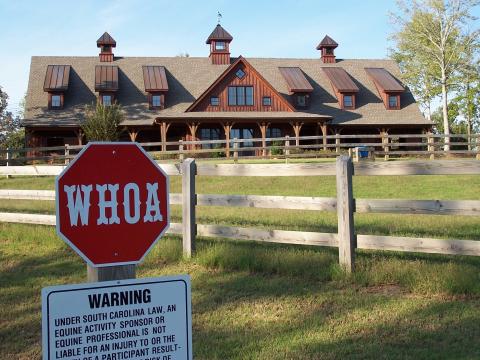 developer stops subsidizing the costs of maintenance and replacement for the pools, fitness centers, tennis courts, nature trails, marinas and golf courses. Then sticker shock sets in for you and your fellow residents; you bought it, you own it. Suddenly, the equestrian center doesn't smell so good to the golfers, and the horse people wonder why it costs so much to cut the grass on the golf course.
I know, it is like the old saying that if you can afford $150,000 in initiation fees, you shouldn't have to ask how much dues are. All true, but these days, in the wake of the Madoff ripoff and the overall hit to investment portfolios, you cannot be too careful.
Missing the point on the housing crisis...again
No matter the condition of the housing market, count on the National Association of Realtors to promote that there has never been a better time to buy. Today, however, they are saying that there has never been a better time for the government to rush in to stimulate buying.
"We should extend the first-time buyer tax credit to all homebuyers and
The "We" he refers to, of course, is the U.S. government and "we" taxpayers. And the "high-cost markets" he mentions are largely that way because of the irrational exuberance the NAR fed to the media, blithely ignoring all logic and warnings to the contrary from real economists like Dr. Robert Shiller of Yale. Does the housing market need more steroids?
Cracker Jack box economics
We cannot expect mea culpas from the NAR, but the organization's continuing ignorance of logic is disconcerting. Here's the NAR's chief economist, Lawrence Yun, piling on today to his boss's warnings with his own set of the dire consequences if the government doesn't pump the housing market full of steroids.
"Falling home prices would lead to faster contraction in consumer spending and further deterioration in bank balance sheets," Yun said. "More importantly, falling home values would lead to higher loan defaults, including those recently modified distressed mortgages." Well, Mr. Chief Economist, thanks for the exquisite analysis. You are, oh, about eight months late!
Leave it to the NAR Cracker Jack box economists to ignore reality if it
Too many agents, too few houses
Of course, trade associations are supposed to argue for their members and their industry, but not when it contravenes logic and adds fuel to the fire. The NAR did no favors for its members when it fed a lazy and ignorant media and the media in turn fed dreamers young and old about how real estate prices would ascend forever, and how buyer and seller and agent would be rich and live happily ever after. To every dreamy eyed retiree with some time on her hands or the hairdresser, mechanic or car salesman who bought the media's hooey about the market, a career as a real estate agent seemed like an easy way to mint money.
Thousands of new agents joined the ranks of realtors just in time for the irrational exuberance to get a dose of rational reality. Now we had way too many agents chasing fewer and fewer houses, and the less veteran among them didn't hesitate to tell Joe Seller that, "Sure, I can sell your $300,000 house for $400,000, no sweat." Irrationally over-priced houses in a plummeting market exacerbated the problem. Real estate agents have to put food on the table too, and with brutal competition among them and just a few months of experience under their belts, many ignored (or didn't see) the obvious consequences of their buyer clients taking on debt they obviously could not afford to repay.
What's good (for the industry), or what's right?
We have all read about how the lenders, the ratings agencies and Wall Street led us to where we are now. But the NAR too abrogated its fiduciary responsibility, as did a relatively few unethical agents, by not warning about the consequences -- personal and national -- of toxic lending practices. Directly or indirectly, the NAR encouraged the thieves at Countrywide Financial and other lenders to push sub-prime loans on folks who had zero hope of paying them off. If the NAR had its way, their behavior seems to suggest, the homeownership rate in America would be 100%, even if 40% of homes were in foreclosure. (Why not, since banks, after all, hire real estate agents to help them sell the homes they are stuck with?)
No, don't expect to hear a mea culpa from the folks at the NAR. Rather than confronting the current mess with an honest discussion of how they can best serve their constituents and the national interest at a time of crisis, they have taken their hand out of one cookie jar and extended it toward a much bigger one.
Living the dream of a Scotland golf vacation, and at a reasonable price
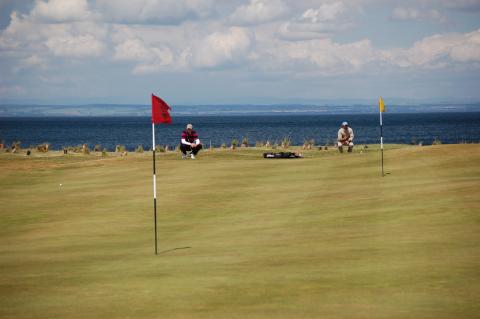
The 11th green at Crail Balcomie Links is shared with the 8th green (background). At any one time, eight players plus caddies share the large expanse.
Yesterday, I wrote about the Old Course at St. Andrews, a dream come true for me after 50 years of golf. Nevertheless, it was an expensive dream; the round cost my son and me about $700 US because of a brutal exchange rate between pound and dollar. The dollar/British pound exchange rate is more favorable now by almost 50%, making a golfing trip to Scotland somewhere between fairly expensive and outrageous. If a trip to the Old Sod is on your wish list, I offer a few tips to ease the burden somewhat.
Mid-June was perfect from a weather and traffic standpoint, so if you have the flexibility to schedule a trip then, consider it. Although you won't get much of a price break compared with the high summer season, your odds of avoiding persistent bad weather are better than earlier in the year. (Note: The driest areas of Scotland suffer 150 days with rain annually, the wettest 250, so bring raingear no matter when you visit.) In seven days of golf, we were rained on only for about six holes on two different golf courses. It went from spring to winter to spring in the course of three holes at the Old Course. Overall, we were exceedingly lucky.
In July, the crowds begin to increase, limiting your chances for having your name pulled out of the ballot box at the Old Course. You can sign up for a stay-and-play package and have your tee times prearranged, but that costs more and will box you into staying at one of the more expensive hotels. The other thing -- and some chauvinists might object to me saying this -- is that in the high season for tourists, you have the greatest chance of hearing a substantial amount of American English spoken on the city streets, around the practice greens and in the local pubs. That may be either comforting or off-putting when visiting another country, depending on your point of view.
Rather than pay the high cost of the more upscale hotels, you might consider a stay at one of the smaller bed and breakfast inns within a half hour of St. Andrews. We stayed in the charming fishing village of Crail, just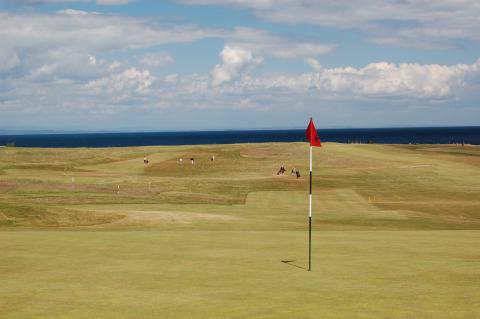 nine miles from the Old Course and featuring two outstanding links courses in town. I thought Crail Balcomie Links, the 13th-oldest course in the world, was almost the equal of the Old Course experience, and for a lot less in green fees. We stayed in a private house courtesy of a home exchange -- click here for more information and see below -- but I just checked prices for June at the Caiplie House , a bed and breakfast inn in Crail, and a double room is running about $550 US for a week's lodging. There are other choices as well in Crail and the nearby towns. Crail itself doesn't offer much in the way of dining options, but St. Andrews to the north does, and some of the towns south of Crail, such as Anstruther, have a fair complement of restaurants. Crail is surrounded by great golf, including Kingsbarns and the new Castle Course in St. Andrews, and some excellent courses, like Lundin, Elie and Leven Links to the south. None of these is more than a half-hour away.
If you like the dollar exchange rate today and can commit to your Scottish golf vacation, consider booking your tee times and accommodations and paying as soon as possible. You run the mild risk that the dollar will become more favorable in the exchange rate game, but the greater risk is that it will go so far the other way as to make you think twice about going. At least you will know in advance how much you will be paying and can budget for it and then dine appropriately -- in better restaurants if a favorable exchange rate, or maybe ratchet back your dining excursions a little if the dollar nosedives again. The abovementioned Caiplie House offers meals beginning around $18 US, not a bad price in our experience. Truth be told, the food in St. Andrews and the surrounding areas was generally no better than okay. The beer, of course, is great.
Finally, if you want to avoid lodging charges altogether, and you own a home you think someone from Scotland might want to stay in, you can consider signing up for an international home exchange program. Don't dismiss the desirabilty of your home; I heard from a couple in Edinburgh recently that they have exchanged with people in suburban Connecticut, and had a great time.
There are a few such exchange programs, including HomeLink International, which we use. We had a tremendous initial experience with our swap with George and Dorothy Horsfield of Glasgow. They stayed at our place in South Carolina last April, and we stayed at their cottage in Crail in June. Any anxieties we might have had about our first such exchange melted after a few email exchanges between George and me. We even were able to play a couple of rounds of golf with them at Crail and Scotscraig, the 7th oldest course in the world. Best of all, we have made friends for life.
If you have any questions about our golf vacation or the home swapping program, please contact me.
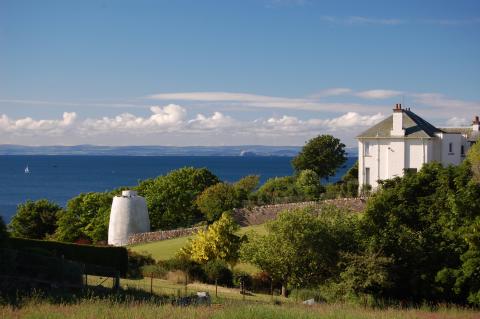
The fishing village of Crail is picture-postcard perfect, and with reasonably priced lodging and two splendid golf courses in town, it is a great alternative to the higher priced accommodations in St. Andrews.
Scary tee shot at wide open #1 at Old Course
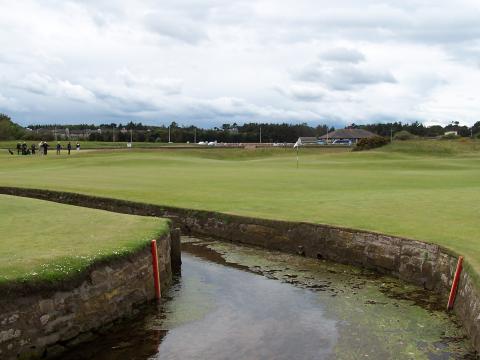
The Swilcan Burn wiggles its way in front of the first green at the Old Course. The green is somewhat easier to approach from the left side than it is from the right.
As a golfer of some 50 years, I did not know what to expect when I stepped onto the first tee at the Old Course at St. Andrews last June. Would I cry because a lifelong dream was finally coming true (or because I was dropping about $700 large for two green fees and caddies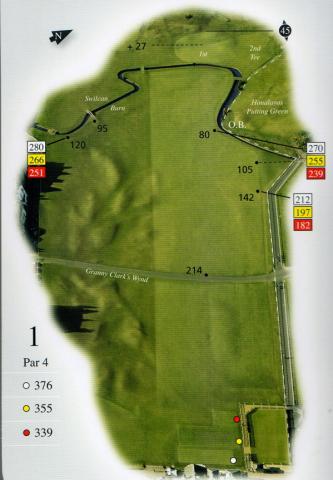 fees, given a usurious exchange rate at the time)? Would I be so intimidated that it would feel as if I were wearing three ski jackets as I attempted to take the driver back for my tee shot? Could I possibly whiff in front of all the people at the adjacent practice green and those waiting to follow us onto the tee box?
Nerves tend to dissipate a little as you actually step onto the first tee at the Old Course and survey the fairway ahead, the widest I had ever faced, if you include the parallel 18th fairway, the equal of two and a half fairways at most wide-open and treeless muni courses. Yet you are still aware that this is the Old Course, and no force was going to take my club back in a perfect arc; I swung as if I were wearing the Michelin Man's suit and used almost all of the two fairway's width, ripping the ball about 45 degrees hard left. Firm fairways and extra roll are not always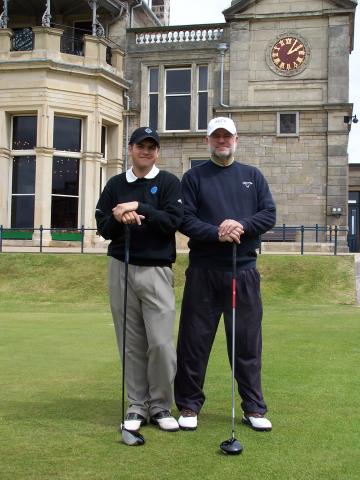 benefits, as I found out, my tee ball stopping at the right edge of the 18th fairway, just short of the out-of-bounds fence that guards the adjacent road (the same "Road" as in the Road Hole, #17).
The ring-bound yardage book suggests aiming left off the tee, but only just left of center toward a small gorse bush at the edge of the Swilcan Burn, not left of Glasgow. Remarkably, I had an open and fairly short approach for having hit the ball so far left, and I was able to cut a six-iron just over the Burn which guards the front of the green. After the drive I was almost happy to get down in just three more strokes for a gentleman's bogey 5.
Golf is definitely a game played between the ears, as I found out when faced with the easiest -- and toughest -- tee shot of my life.
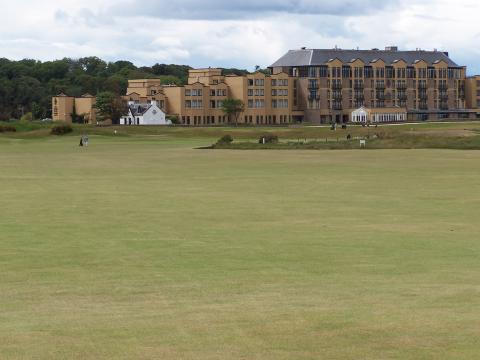
Out of bounds lurks off the right side of fairway #1 at the Old Course; therefore, the tendency is to aim well left. My tendency was to aim left and hit it one fairway and a half to the left of where I was aiming.
Tomorrow: Advice on making the Scotland golf vacation affordable (somewhat).
Latest on Aiken, rural Georgia golf communities courtesy of Tom and Kim Hoyt
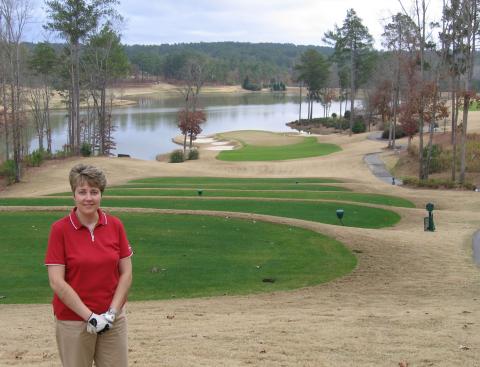
Kim Hoyt at the 3rd hole at Woodside Reserve's Nicklaus Design course.
-- photo courtesy of Tom Hoyt
Hanover, NH's Tom Hoyt, a faithful reader, and his wife Kim recently combined a golf vacation and prospecting trip to Reynolds Plantation in rural Georgia and the golf communities in and around Aiken, SC. Here is Tom's report, only lightly edited, which reconfirms what I found during a trip to Aiken a few years ago.
We flew into the airport in Columbia, SC., our first time there. We found it very convenient as the size is not overwhelming, and the access to Interstate 20 is just minutes away. Certainly flying in/out of Charlotte or Atlanta may give one more direct flight access, but coming from the Northeast, we are used to connecting to get anywhere.
The Fairfield Suites in Aiken gave us quick access to many of the amenities of Aiken, as well as downtown shopping and dining. As for driving in Aiken, many of the downtown streets are divided by small parks. The north to south "Chesterfield" and the east to west "Chesterfield" are actually two different roads. Making turns and crossing traffic requires a bit of thought for a "first timer."
From Aiken, we drove around Augusta, GA (Aiken and Augusta are practically twin cities) and, of course, made our way around the perimeter of Augusta National. Having never been there before, I was amazed at two things.
Elevation change. It sure looks flat on TV, but it is otherwise. While driving along Washington Road reveals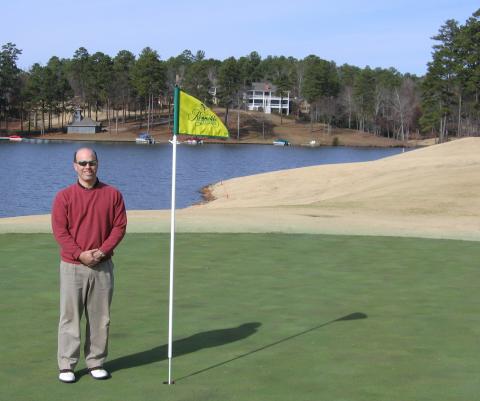 little but a stark green fence, the side roads of Berckmans and Vineland really showcase the rolling terrain. Interesting note is that while there are many houses in the immediate area, there is an open area on the NW side of Berckmans that I'm told comes from the club buying homes in the area, razing them, and then using the land for parking.
Infrastructure. How they host one of the countries major sporting events in this location is beyond me. It's certainly not "Mayberry RFD" but it's far from a major metropolitan city. Across the street is strip mall city.
There is some road construction in the area, especially the loop around Augusta, but most people locally will tell you the many traffic delays and construction will be worth the result.
Reynolds Plantation in Greensboro, GA, is about a 90-minute ride from Augusta on easily traveled I-20. You will find some amenities right at exit 130. It's about an 8-mile ride to the entrance to Reynolds and, not surprisingly, you see nearby what appears to be rapid commercialization, including restaurants, retail, medical offices, entertainment. Everything seems nicely designed but doesn't appear to have been "thrown up on a whim."
We stayed at the Ritz Carlton on site. There is no other lodging at Reynolds, nor much else in the general vicinity. What's not to love about a Ritz Carlton? It's not inexpensive, but you know you aren't staying at the Super 8 either. Packages that include golf and meals are available, but not cheap. Parking is by valet which will run you $15 (plus tax) per day and a tip to the valets each time you need your car.
There are five golf courses at Reynolds (soon to be six). Four of them are open to outside play, two are private. The Creek Club recently opened, and the Richland course is being built. In addition to being members
Our first day's tee time at Lake Oconee was rained out. This course is the closest to the Ritz and also is home of the Taylor Made Golf Academy. It's located on the far end of the driving range, which is out the back door of the Lake Oconee lodge.
On the second day, we played the Reynolds Plantation Course. It gives you a few glimpses of Lake Oconee, most noticeably on the downhill #5 hole.
On the third day, we played the Reynolds National Course. It is made up of three 9-hole courses -- the Bluff, Ridge, and Cove. Because of the time of year, there was an 11 a.m. shotgun start. I thought this was a very smart idea as frost delays are certainly possible; and although 11 a.m. might be late, it ensures everybody goes off and enjoys a round without their start time being pushed back. Despite my wife and I playing as a twosome, we never felt "stuck" or slowed down by the pace of play.
After the round at the National Course (which ended around 3 PM), we
On our fourth day, we played at Mount Vintage Plantation in North Augusta, SC. Augusta is in Georgia, but North Augusta is in South Carolina (I thought that was interesting). Mount Vintage is about six miles from the exit off I-20; halfway to the community along Sweetwater Road, you pass the BP distribution center (oil and gas, I'm guessing). It sort of sticks out but it's a good reminder that you aren't lost. Mount Vintage is in the middle of horse country with fenced area's on either side of the round. At the entrance, the road splits; a left takes you to the stables. Mount Vintage recently built a community center complete with exercise equipment, tennis, and pools. There are three 9-hole courses here as well. Two revolve around the clubhouse, an 1800s building moved to the location, and with modern buildings attached to it. All structures blend nicely. We played the Chester and Vintage courses, my favorite design of the trip. A great combination of elevation changes, views, conditioning, water, and the over-seeding made it even more spectacular. We had a nice tour afterwards from one of the community's agents who grew up nearby and was able to share many historical perspectives.
Day five took us to Cedar Creek back in Aiken. There are two ways to get there -- the back way will take you down Whiskey Road (the major commerce road in South Aiken), and the road to the front gate brings you through more rural horse country. Cedar Creek is a non-gated community. As our host pointed out, the community may construct gates manned by guards someday, but for now the cost savings of no gates are considerable.
It's hard to compare Cedar Creek to the other communities because, to be fair, it's a different animal. There is only one 18-hole course. The clubhouse has only a small "grill room", and the practice facilities are rather utilitarian. That said, Cedar Creek's real estate is 25% to 35% less expensive than anything else we saw. Golf membership for the publicly accessible club is $2,000; at Reynolds, initiation fees run into the six figures. The 18-hole Arthur Hills design at Cedar Creek has the bones of a masterpiece, but after drenching rains the week before, the course was not in good shape. Some of the holes might have you say to yourself, "Boy, if this were in perfect condition, it would be really nice." Unfortunately, it's not.
We didn't plan on saving the best for last, but in our opinion it turned out that way. Woodside Plantation is located in the heart of South Aiken, and yet in a world by itself. The community has four entrances. One takes you into the back of the Aiken Mall, two sides entrances appear that they belong in your typical gated community, and a fourth, currently on a dirt road, enters into the middle of the equestrian development.
Woodside has 4 1/2 courses, and membership is a bit confusing. Basically, two of the courses are managed by ClubCorp (with their own clubhouse), and two are member owned (with their own clubhouse). The Nicklaus Design course, The Reserve Club at Woodside, was terrific in December, but I'd especially love to play it in May. It and the Fuzzy Zoeller course, still in the process of being completed, come back to the same clubhouse, which is undergoing an expansion.
One thing that struck us at all communities is that in this part of the country, most houses are built on piers or pilings. If there is sufficient elevation change, you might have a walkout or lower level, but if not, that area becomes a crawl space, which gives you access to the mechanical systems. This crawl space in some spots is four to six feet high, so moving wiring and ductwork around is easy.
Coming from the northeast and a lifetime of two-story houses, iwalking through homes with 2,000+ square feet on one level felt massive to us, and smart. It makes you wonder: Why not just have everything on one floor and take the extra space to open up the kitchen/dining/living area that everybody ends up spending most of their time in anyway?
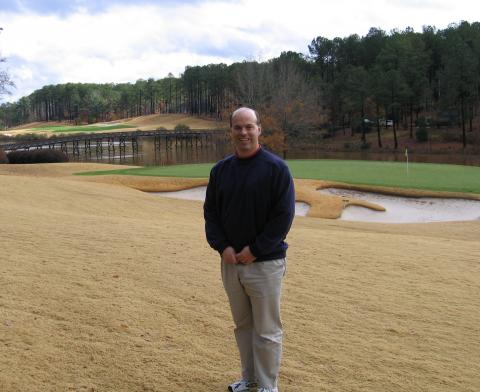
Tom Hoyt at #17 at the Lake Oconee course at Reynolds Plantation.
-- photo by Kim Hoyt.
Same old same old, but with ads
Hitting the wall: Colgate's Seven Oaks, #10
It hurts to write this article
Best-places lists the worst kind of ideas

Now on Sale

- The only book about golf communities in the last 10 years.
- 156-page step-by-step guide to finding your dream golf home.
- Info on nearly 100 golf communities the author has visited.
- Paperback version costs less than a sleeve of Pro VIs.
Here is what the experts are saying:
“The book is chocked full of information…applicable to anyone looking for a move to the Southeast regardless of whether they are looking for a golf community or not.” — John LaFoy, golf architect (Linville Ridge CC, CC of Charleston, The Neuse GC)
“Larry has done a tremendous amount of work and anyone — like me — who is looking to search for a golf home now or in a few years needs this book.” — Brad Chambers, golf blogger, ShootingYourAge.com
“Wow! What a thorough piece of work…a must for anyone moving South. This book will help many people.” — Brett Miller, owner and founder of MMA, Inc, a golf industry consultancy
Buy It Now at Amazon.com or BarnesandNoble.com.