No pork served at golf courses...or other palaces of vice
We might have thought that building or rehabbing a municipal golf course would put people to work and
"None of the funds appropriated or otherwise made available in this Act may be used by any State or local government, or any private entity, for any casino or other gambling establishment, aquarium, zoo, golf course, or swimming pool," according to one section of the bill.
"...Small issue and redevelopment bonds also are subject to additional restrictions on the use of proceeds for certain facilities (e.g. golf courses and massage parlors), " the bill indicates later on.
And finally this last shot, that businesses receiving relief "do not include any private or commercial golf course, country club, massage parlor, hot tub facility, suntan facility, racetrack or other facility used for gambling..."
Okay, since we all occasionally engage in a friendly wager on the golf course, I can take the gambling reference. But massage parlors? Sorry, that just rubs me the wrong way.
 Home On The Course newsletter
Click here to sign up for our Free monthly newsletter, loaded with helpful information and observations about golf communities and their golf courses.
Time is on my side: Magazine gives it to Mozilo, 15 months later
At the top of Time's list is Angelo Mozilo, former CEO of Countrywide Financial. You know his firm, if
But no character is more at the heart of our problems than Mozilo. Here is what I wrote in this space on November 17, 2007, long before the stock market collapse almost a year later.
"I can't feel sorry for lenders like that whining multi-millionaire hypocrite Angelo Mozilo of Countrywide Financial who gave shovels of money away to people clearly without the means to repay; some were even in bankruptcy, according to reports."
Back in late 2007, Mozilo was just a nasty character worthy of scorn. By August 1, 2008, when I last wrote about him, he was much more. I suggested, only partially tongue in cheek, that he be dragged from his mansion "to Las Vegas or Miami or some other area savaged by foreclosures, and give him the public flogging he deserves."
"And when they are done," I suggested, "lock him up...in one of those foreclosed houses."
I know our President wants us all to look ahead rather than back, but it is hard to reconcile people being thrown out of their homes while Mozilo lives off the roughly $400 million he made in the six years before he left Countrywide and a legacy of yuck behind.
Fan's appreciation deep in the heart of Texas
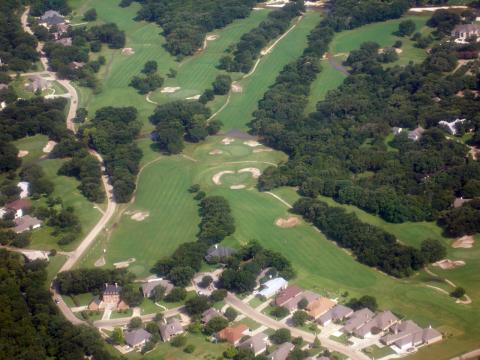
Heart of Texas: Robert Trent Jones Jr. presented Mill Creek Golf Club with a valentine when he designed the course in the 1980s. The heart-shaped green is at top center in the photo. Photo by Travis Fell.
Golf review: Mill Creek Golf Club, Salado, TX
With thousands of golf courses across the U.S., it is impossible for all of us to have an appreciation for more than a small percentage of them. We rely on the reviews and comments of others to advise that, if we are ever passing through Simsbury, CT, Cedar Rapids, IA, or Salado, TX, for example, we might just want to stop for at least four hours (half if we only have time for nine holes). I was gratified, therefore, when Letta Meinen, a resident and club member at Mill Creek in Salado, offered to provide an overview of her golf club and community. I've never been to Salado, but based on Letta's comments, I hope to in the near future. Her proud reviews of her town, community and golf course follow. I invite others to share here their own odes to their clubs and communities.
by Letta Meinen
The Mill Creek Golf Course has been around since the 1960s, originally as a nine-hole layout. Within the confines of the village of Salado, about halfway between Austin and Dallas/Ft. Worth, the former ranchland was originally untamed country rife with brush, mesquite, live oaks and a range of other flora and wild life. The course and community are named for the meandering limestone-bottom creek that runs through the property.
Salado is a small, historic village whose famous and popular Stagecoach Inn restaurant was an official stop on the Chisholm Trail. (For more history and dozens of photos of the town, visit SmallTownGems.com). Original investors in Mill Creek saw a different trail, Interstate 35, as bringing enough traffic to the area to justify a golf course. In the late 1980s, a local investor, Don Mackie, led a group that bought the course and expanded it to 18 holes with a vision of expanding the adjacent residential community. He organized the Mill Creek Community Association and made plans to build additional homes on the land his group had purchased. He also built condominiums and town houses that were used mostly as rental properties. (Mr. Mackie passed away in 2001, before he could realize his vision of a 36-hole golf club. Morris Foster, a lifelong resident of Salado and a local businessman, purchased the club.)
Mr. Mackie was a friend of golf architect Robert Trent Jones Jr. and hired him to design Mill Creek's first 18 holes. (Jones added another nine holes in the 1990s to accommodate the growing community.) When friends of Mr. Jones asked him where he was working, he kept answering "in the heart of Texas." He brought his response to life, designing the green complex on his signature hole at Mill Creek in the shape of a heart, and the tee box in the shape of an arrow. [Editor's note: It must be a popular place on Valentine's Day.] Jones also designed three holes with trees in the middle of fairways.
The three nines are named the Mill, the Creek, and the Springs, the Mill and Creek being the original 18. They feature water on eight of the holes, as well as plenty of trees and sand. The Mill carries a par of 36 and the Creek a 35. The Spring course is more open, although three holes are ringed by trees; #9 has two of those Jones trees in the fairway. Par is only 34. The most challenging combination of nines carries a rating of 72.1, slope of 128 and yardage of just under 6,500. The Mill Creek pro shop makes sure we play alternate combinations of holes each day, which keeps things challenging and never boring.
The Mill Creek community, which is not gated, is home to 650 residents. Condominiums start around $90,000 and patio and single-family homes are in the $150,000 to $1 million category. Golf membership, which is just $3,000 and $275 per month for dues, is not mandatory for residents, but it does provide advantages. Active Men's and Ladies Associations sponsor a number of tournaments and other activities throughout the year. The two swimming pools and tennis court are well used. Residents are permitted to own and use a golf cart in the community and on the course, with the payment of an annual "trail fee." A driving range and putting green are available for practice sessions and golf lessons. As a semi-private club, we encourage large groups to use Mill Creek for their events, but with 27 holes, we always have the extra nine for members to continue playing on the days of the outside events.
All kinds of artists will feel at home in the Salado area. Our residents get involved in painting, writing, music, humanities, and drama; throughout the year, the community is host to stage plays, community chorus and art festivals. Salado also has a great library, several active churches, a number of bed and breakfast inns, as well as shopping that includes boutiques and art galleries. We have several great gourmet restaurants and excellent coffee shops and tearooms.
Smack in between the flat metro area of Dallas/Ft. Worth and the Texas Hill Country of Austin, our town is a little bit hills and a little bit farmland. Salado, which was incorporated just a few years ago, is a few miles from the town of Temple, whose Scott and White Hospital is well regarded; we are also near Killeen, which is home to one of the largest military bases in the nation, Fort Hood. With Austin and the Dallas/Ft. Worth areas just an hour away, and Houston just three hours, Salado is truly at the heart of Texas.
The Mill Creek web site is at MillCreek-Golf.com.

Jones' gotcha: The finishing hole on the short, but tricky Spring nine at Mill Creek features not one but two trees dead smack in the middle of the fairway. Photo by Letta Meinen
Southern communities push ahead with plans, hope for best
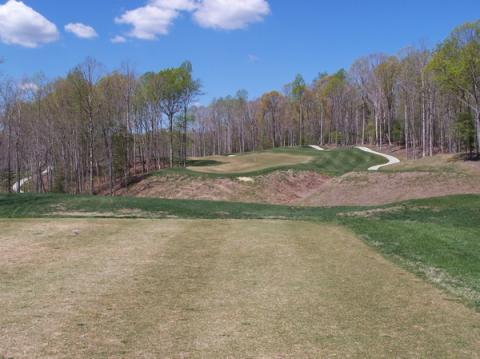
The Arthur Hills course at the age-retricted Colonial Heritage community in Williamsburg, VA, is one of the toughest layouts I've played in recent years, with many forced carries, as this one on the 13th hole. Perhaps that is why the community is targeting a "younger" demographic, 45 year olds.
As I reported here yesterday, I attended this past weekend's Live South Show in Greenwich, CT. Live South brings a few dozen communities to a hotel exhibition space where local people can take a one-stop shopping spin through the hall, ask questions of each community's agents, sign-up to receive marketing materials and, if inspired, arrange for a visit and tour. The next show stop is in Parsippany, NJ (click here for the Live South web site and show schedule).
Although the agents I spoke with were still smarting from the worst sales year in their experience, they were ever hopeful that things will pick up this year. Already, as a few told me, they had sold more properties in January alone than they had in the previous three months. In one case, that was just six properties. I have also noticed at real estate discussion boards on the internet that agents in some areas of the northern U.S. saw a similar uptick in activity in January. The Cliffs is backing up its own optimism with a spend of more than $14 million for promotion in 2009. In this economy, that is quite a statement, at least for The Cliffs.
Here are some notes on my discussions at Live South.
Forty-five is the new 55
Colonial Heritage, an age-restricted community in Williamsburg, VA, has
Grape expectations?
River Landing, a community adjacent to I-40 in North Carolina, will open its new 59,000 square foot clubhouse in April. The community, which was developed by a local family, features 36 holes by Clyde Johnston, a respected southern golf course architect. Golf membership is $28,000, with dues of around $400 per month, reasonable for 36 holes of quality golf (and a big clubhouse). Although River Landing is a little remote, at 30 minutes to Wilmington and 75 minutes to Raleigh, services are developing nearby, including a Super Walmart opening next summer. More than 1,100 of the community's 1,500 lots have been sold, and 300 homes are in. Lots in River Landing start around $80,000 and reach $500,000 for those on the river. Most homes are in the $300,000 to $1 million range. Next month, construction begins on a new neighborhood called The Vineyards; the developers have planted 18 acres of grapes within the neighborhood.
High-end competition on Lake Keowee
I visited The Reserve at Lake Keowee four years ago and I was eager to
Cliffs notes
Speaking of The Cliffs Communities, representatives at their booth said sales were off about 20% last year, but that plans keep chugging along to add to their impressive golf course portfolio. A new course designed by Gary Player, who has moved his company's offices to The Cliffs, should be ready for play next spring, and earth is being moved for the new Tiger Woods course, his first in the U.S., at High Mountain, near Asheville. Full-family golf membership The Cliffs has reached the $150,000 mark, but that entitles the member access to any of the six courses in place now and the Player and Woods courses later. Driving distance between the farthest Cliffs courses is a little over an hour, but some are within just 20 minutes or so of each other. And they are all beautifully conditioned, as one should expect for those kinds of prices. Any new property owner has the choice to purchase the refundable membership at the time they purchase their property. If they decline, they will not be able to buy the full golf membership later (unless, of course, they buy an additional developer property). If they sell their home and the purchaser opts for membership, The Cliffs will refund the initiation fee almost right away. If the buyer does not opt for membership, the seller might have to wait six months for the refund, according to the agent at the Cliffs booth.
Impressive track record for developer at Wild Wing
For those looking for a significantly more modestly priced golf

The Reserve at Lake Keowee course is vintage Jack Nicklaus.
Fear strikes out: Real estate show traffic, exhibitors way off
I spent a few hours yesterday at the Live South real estate show in Greenwich, CT. The number of exhibitors was down to about 30, well off the 70 of just two years ago and less than the "45+" that Live South advertised at its web site. Although exhibitors I spoke with are keeping a stiff upper lip, they are concerned after suffering their worst year in 2008, with sales off more than 25% in some communities.
The problem is that the migration from north to south has ground almost to a halt. People who have lost 20% or more in their primary homes, and more in their stock portfolios, have shelved their relocation plans. Real estate agents north and south say 2008 was the worst year for sales in their careers. However, those same agents say January sales were a significant improvement over a dismal fourth quarter of 2008.
"Some sellers can't wait anymore," said Susan Albright, a Fairfield County (CT) real estate agent who spoke at the show. She offered as reasons health issues, job relocation and the desire to get on with their lives, including retiring to their dream homes. Ms. Albright also added that those who want or need to sell their homes this year should be doing so sooner rather than later.
"Spring is the time when people are looking at homes to get their children ready for school in the fall," she said. Summer, she added, may be too late in the current economy to find enough buyers.
Exhibitors echoed her experience, a few saying that sales in January were greater than the three preceding months. They are cautiously optimistic that performance will continue.
One couple at Ms. Albright's presentation has been searching aggressively for their perfect southern community. They complained that many communities are not sharing information about resale properties and are, instead, pushing their developer lots and homes. Most exhibitors I spoke with said they handle re-sales as well as new properties. But when I asked about the referral fees they were paying to agents who send them customers, they indicated they are paying more for new properties than for those owned by their residents. If you are looking at a partially completed community, make sure you inquire about all properties available. Re-sales are often lower priced, sometimes by a significant measure.
Bottom line: Golf communities in the south are desperate and ready to deal. If you have plans to relocate there, and the means to do it, now is a good time to "run the numbers." Keep in mind that cost of living in most parts of the south is lower than elsewhere; by relocating, you could recoup some of your lost equity just in living expenses. If you want some help with some cost of living comparisons for southern communities, let me know by clicking on the Contact Us button at the top of the page. There is no obligation or fee whatsoever.
Non-standard deviations: Cost-of-living data all over the place
The problem is that some of the widely used sources of data differ wildly in their comparisons. Where to
I have calls into both Where to Retire and Sperlings and hope to reconcile the differences between them in the coming days. Once I can explain their conflicting conclusions, I'll provide some market-to-market comparisons in this space. I hope their explanations are simple enough that I won't have to use the word "respectively" again.
Do a couple of good months a rebound make?
This was typical: "In the San Antonio (TX) area, we are seeing the investors from out of state starting
"In my area, homes are still seeing appreciation -- and the ‘overstocked' inventory that was on the market over the past year is decreasing," wrote a Raleigh, NC, realtor. "Market activity has increased dramatically over the past two months."
Even the prospects for newly built developments received shout outs. "We have seen traffic increase tremendously at a new construction site (55+ community)," wrote a realtor who sells near the Pennsylvania and Delaware state lines, "and I've submitted and received multiple offers [for properties]."
All these rosy reports certainly fly in the face of the national media's gloomy reports and continually dismal economic data. But as one agent gently chided me after I asked about his bullish predictions for his island community in Florida in the face of economic chaos, "Real estate is local and....here the buyers we are working with are mostly local people."
That sounds a bit too much to me like the movie The Truman Show. (Truman, who is played by Jim
In the face of all that, it is hard to imagine any safe haven market, although there is little doubt that housing prices in some areas of the country sunk so far so fast that they are now attracting buyers once again. Are they false positives? Some of them will be. But there are some phenomenal buys out there, with circa 1999 prices attached to them. The recent spurt of buying activity could be a positive signal, given the reports of local real estate agents. Even eternal optimists are sometimes right.
The cheapest and best golf membership
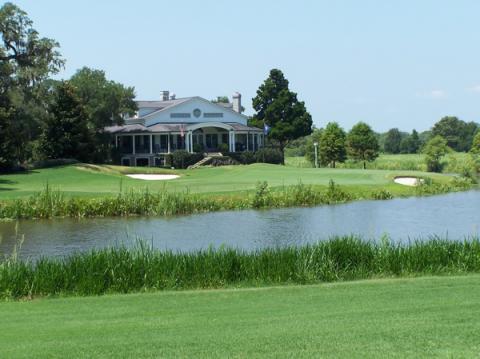
As if the finishing hole at Caledonia is not challenging enough, other golfers can gather on the deck overlooking the 18th green and cheer you -- or jeer you -- on. Caledonia, whose high-season green fee is close to $200, can be played at a significant discount with the Myrtle Beach Golf Passport card.
Not every golfer needs or wants to belong to a private club. Sure, the privacy part of it and the ability to walk up and play without a tee time is a luxury, but it can be a costly one. For the price of initiation fees at The Cliffs Communities, for example, you and your significant other could play Pebble Beach and the Old Course at St. Andrews for 15 years, airfare and nice accommodations included (Cliffs membership is $150,000 for access to seven courses).
The Myrtle Beach Golf Passport is again being offered this year to residents of North and South Carolina, as well as second homeowners in the Myrtle Beach area. At just $39 for membership, it is the best way to sample a range of highly rated golf courses at deep discounts. It is also a good reason for golfers who enjoy a variety of layouts to consider a vacation or retirement home between Southport, NC, and Georgetown, SC, a span of exactly 100 miles and encompassing every conceivable type of community, with golf or without, at every price point.
The Passport, which is sponsored by the Myrtle Beach Area Golf Course Owners Association, provides multiple rounds at virtually every daily fee course on the Grand Strand, including Caledonia Golf and Fish Club, rated by respondents to the Zagat survey as good as the Ocean Course at Kiawah Island; TPC at Myrtle Beach; True Blue Golf Club; Heritage Golf Club; Tidewater Golf Club; Pawleys Plantation; Grande Dunes; and the courses at Barefoot Landing, including those designed by Love, Fazio and Norman. The discounts, which are typically about 40% off list prices but sometimes more, are good not only for the card holder, but also for up to three guests. Most courses are available even during the busy seasons in the spring and fall.
The Passport also is good for discounts at some of the more popular local restaurants, include Austin's in Pawleys Island, which I can testify is quite good. Cardholders receive a 25% discount on their entrees at the participating restaurants. The card is also good for a 10% discount on merchandise at a large local golf retailer.
Passport applicants must either show proof of residency or proof of ownership of a second home in the area (a utility bill worked for me). For more information, check out the Myrtle Beach Golf Passport web site, which includes a list of all participating courses, or call them at (843) 477-8822.
Cape fear: Dramatic increase in homes for sale in iconic New England vacation area

The classic, Donald Ross designed Oyster Harbors is one of the best golf courses on Cape Cod.
The latest data on home inventories hints at the thrashing the vacation home market is taking across the land, and especially on the traditionally bulletproof Cape Cod, in Massachusetts. People worried about job loss or saddled with growing interest rates on variable rate mortgages on their primary homes are hedging their bets before they have to hit the panic button and unload their treasured vacation homes at deeper discounts.
The real estate brokerage firm Zip Realty published its latest report on
Depending on what real estate reports you read, home prices on Cape Cod decreased by about 12% last year, with a median sales price of $330,000. Golf club choices in the area are varied, ranging from one of the best public courses in the nation, Cranberry Valley in Harwich, to the higher end, quite private Donald Ross designed Oyster Harbors in Osterville. Membership fees on the Cape have been traditionally high, but like real estate in the current economy, they too could be on their way back to Earth.
My dentist weighs in on boomer real estate psychology
I asked about his plans for retirement. He said in a few years, he and his wife would probably move to South Carolina, if he could sell his house in Connecticut. This, of course, led me to my common refrain, of which my dedicated readers are probably tired, that people are foolish to hold out for the price they think their house is worth, rather than take what the market will give them and move south, if that is what they were planning.
"They want what they want," I said of my fellow boomers.
To which my wise new dentist responded, "Well, we are baby boomers, aren't we?"
HGTV Dream Home in nightmare community
Foreclosures not the only "distress" sales

Now on Sale

- The only book about golf communities in the last 10 years.
- 156-page step-by-step guide to finding your dream golf home.
- Info on nearly 100 golf communities the author has visited.
- Paperback version costs less than a sleeve of Pro VIs.
Here is what the experts are saying:
“The book is chocked full of information…applicable to anyone looking for a move to the Southeast regardless of whether they are looking for a golf community or not.” — John LaFoy, golf architect (Linville Ridge CC, CC of Charleston, The Neuse GC)
“Larry has done a tremendous amount of work and anyone — like me — who is looking to search for a golf home now or in a few years needs this book.” — Brad Chambers, golf blogger, ShootingYourAge.com
“Wow! What a thorough piece of work…a must for anyone moving South. This book will help many people.” — Brett Miller, owner and founder of MMA, Inc, a golf industry consultancy
Buy It Now at Amazon.com or BarnesandNoble.com.