Golf Course Review: Wynlakes Golf and Country Club, Montgomery, AL
by Tim Gavrich
Each private club takes on a different atmosphere, its own separate character. Some are strict golf clubs and are demure, out-of-the-way operations that the outside world barely knows exist. I think of Palmetto Golf Club in Aiken, SC, as emblematic of this type of club. Other clubs are larger in scope, with deep membership rolls and lavish clubhouses; they add tennis, swimming, and other sides to the club experience for their members. Wynlakes Golf and Country Club on the outskirts of Montgomery, AL, which certainly falls into this latter category, does an excellent job of balancing the needs of a family for a rounded communal experience with the needs of a golfer for a challenging layout.
[Editor’s Note: The community that surrounds Wynlakes Golf & CC features single-family homes that range in price from the high $200s to $1 million. If you would like more information about properties for sale in the community or about other golf properties in the Montgomery area, please contact me.]
Opened in 1986, the course at Wynlakes was designed by Joe Lee, who produced such well-known American venues as the Blue Monster at the Doral Resort and Pine Tree Golf Club, both in Florida, as well as the original Dubsdread course at Cog Hill Golf Club outside of Chicago. Cog Hill and Doral are annual stops on the PGA Tour schedule. These Lee designs are known for being solid tests of golf with large, undulating greens and sprawling, many-fingered bunkers. Wynlakes exhibits these hallmarks of Lee’s architectural style as well.
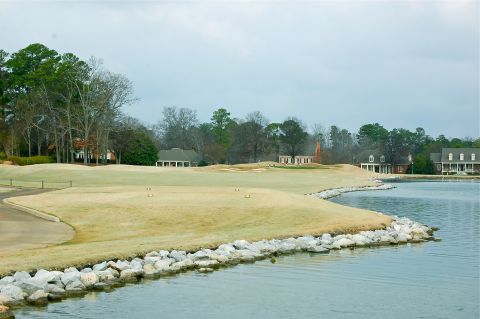
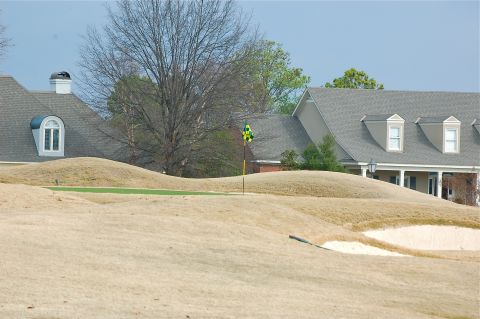
Scary prospects along the right side of the par 4 5th hole at Wynlakes sends most drives well left. The green is well guarded and elevated, making approaches from the safer left side especially challenging. Photos by Larry Gavrich
As golf courses go, Wynlakes is not particularly difficult from any set of tees. The tips, at 6,979 yards, play to a rating of 73.3 and a slope of 126. Although houses sit along one or both sides of most fairways, they are well back, leaving ample room for recovery shots or pitch outs in most cases.
Wynlakes begins somewhat awkwardly, with a 583-yard par five that doglegs hard to the left around two fairway bunkers. Even a straight drive may force players to curl their lay-up shot around trees that line the left side of the fairway. This is Wynlakes' only strange hole, and its transgressions are by no means horrible.
After two slight dogleg-left par fours, the player encounters the first of four stout par threes. The fourth hole weighs in at 183 yards from the tips and 158 yards from the middle “Member” tees. The shot plays slightly downhill, all carry over a corner of A.W. Dale Lake to a deep rectangular green surrounded by grass hollows and bunkers. A green in regulation on this hole is well earned.
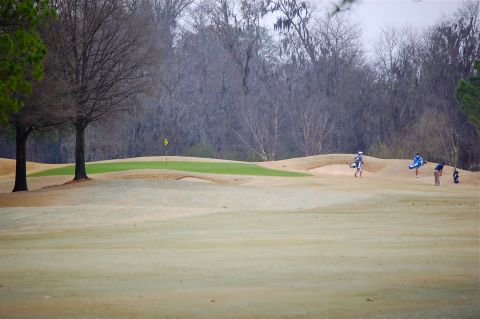
Trees along the left side and near the green at the par 5 starting hole at Wynlakes make a layup down the right side of the fairway mandatory.
Wynlakes features a good amount of water, but in all but three cases, the player has options to go around or play over the hazards. Oftentimes, this allows the aggressive players to put their scores at risk in pursuit of an easier next shot. The sixth hole is an excellent example of this choice. It is a hard dogleg left around a pond where the player can choose to play to the right of the pond, leaving a mid-iron shot to the green, or directly over it, leaving as little as a half-wedge. Taking the short route requires a drive that carries at least 250 yards from the back tees. A ball hit too far left will definitely find the hazard, but a well-executed shot will create a great birdie opportunity.
Wynlakes’ front nine is long and challenging, but the back nine is more charming and dramatic. Hole 11 is the longest of Wynlakes’ four par threes and is also the only hole on the course without a bunker, but by no means is it a pushover. At 202 yards from the back tee box, the long iron plays to one of Wynlakes' largest greens and the one with the boldest contours of any putting surface on the course. Various ridges and slopes separate the green into three distinct sections. Playing the hole on consecutive days could demand different club selections, especially if the wind is kicking up, and even different shapes to the shot. Such variability of play on a particular hole day to day is often what separates the thoughtful designer's work from the mundane.
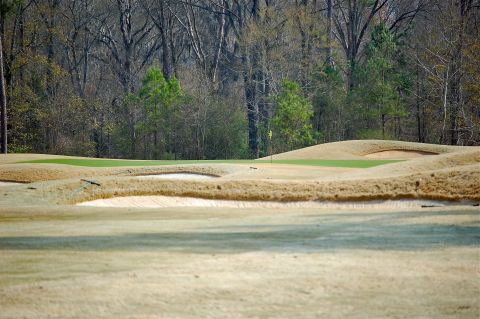
Bunkering around the 12th green is indicative of the protection designer Joe Lee provides for many of the putting surfaces at Wynlakes.
The back nine exposes an interesting quirk of the routing at Wynlakes. After holing out on the par four 15th, players must walk (or ride, as is most often the case) about 350 yards to the 16th tee — a journey past the putting green, driving range and clubhouse. The final three holes are laid out in a triangle — used, no doubt, by members wishing to test out what they’ve been practicing on the range late in the afternoon and evening. This is the finest three-hole stretch on the golf course. It begins with a 548-yard par five, a straightaway hole that invites a big swing off the tee. Trouble awaits on the second and third shots. The green sits hard by a pond, with bunkers protecting its outer edges. Depending on wind (which is abundant at Wynlakes) and firmness of the fairways, one might be tempted to try for the green in two, making a wide range of scores (from 3 to 8) a distinct possibility.
The 17th changes the pace beautifully at a crucial point in the round. Many golf courses’ penultimate tests are long par threes with abundant trouble, ready to extract bogeys and worse while making players work hard to save par. The 17th at Wynlakes, by contrast, is a mere 136 yards from the back tees — a late birdie opportunity. But this is not a smart place to relax: Water bordering the entire left side of the sloping green and a bunker on the right mean a careless swing could easily lead to a big score late in the round.
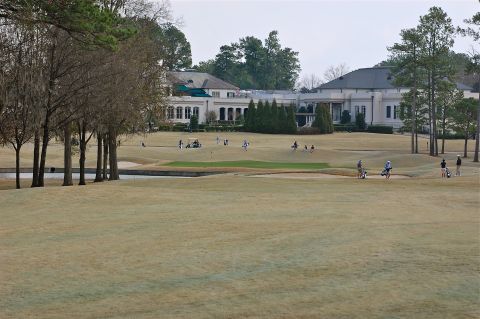
Wynlakes' massive clubhouse frames and dwarfs the finishing hole while a lake dominates most of the front of the green.
Like many courses, Wynlakes saves on of its stiffest challenges for its closing hole. At just under 440 yards from the back tees, it boasts a narrow fairway guarded by bunkers and water with a green that follows through on the theme of protection. The putting surface is huge but, as at number 11, the bold internal contouring forces the player pressing to end the round on a high note to consider much more than merely finding the green in regulation in order to avoid a crushing three-putt. The 18th at Wynlakes provides a solid ending note to a solid golf course.
Winlakes golf by the numbers:
Championship tees: 6,979 yards/73.3 rating/126 slope
Chairman: 6,575/71.1/124
Member: 6,347/69.9/123
Founders: 5,625/66.4/111
Forward: 4,826/68.7/120 (women’s)
Tim Gavrich is a senior at Washington & Lee University in Lexington, VA, where he is majoring in English. A four-year member of the college golf team, he finished in 9th place in February at the Wynlakes Invitational, hosted by Huntingdon College. After graduation in May, Tim plans to embark on a writing career that, he hopes, will involve golf in some way.
 Home On The Course newsletter
Click here to sign up for our Free monthly newsletter, loaded with helpful information and observations about golf communities and their golf courses.
W I D E Open: Seriously big-hole golf something of a laughing matter
Anyone who has played golf for a long time knows the game will find cruel and unusual ways to crush high expectations. And one good round does not always beget another. I was reminded of this over the course of 18 holes at Pine Needles Golf Club on March 11.
My humiliation started with a triumph on March 1 when my college golf team, the Division III Washington & Lee Generals, completed our second spring tournament,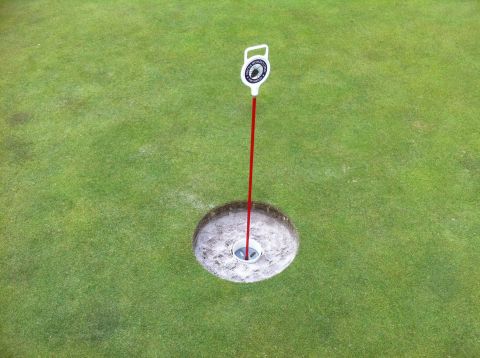 the Pine Needles Invitational in Southern Pines, NC. The team finished seventh out of 10 at the event, but I was able to put together solid rounds of 76 and 72 to take the top spot in the event individually. I mention this because my solid play 10 days earlier helped push my expectations to Icarian heights for my March 11 round.
About a week ago I read a tweet from Golf Digest Senior Travel Editor Matt Ginella containing a link to a short article advertising an upcoming magazine-sponsored tournament, the W I D E Open at Pine Needles, the Donald Ross gem in the sandhills of central North Carolina. The article raised the question, “Ever wonder what you’d shoot if the golf hole were a lot larger?”
The W I D E Open Championship was billed as a normal romp around Pine Needles, save for cups that, instead of the standard four and a half inches, were to be 15 inches in diameter, just three inches smaller than a basketball hoop. (In other words, enormous.)
Can’t miss, right? That’s what I thought too.
I was able to recruit my friend and former teammate Nathaniel, a student at W&L School of Law. We set out from Lexington, VA, excited and expectant about how the enlarged targets would affect our rounds — how many strokes it would shave off of our typical scores, what length of putt would be a gimme, etc. As we speculated, my heartbeat quickened at the idea of shooting a seriously low score. Something in the mid-50s even, I thought.
When we arrived at Pine Needles, we were greeted with a crater-like hole on the practice green. Nathaniel and I cackled at the size of it. Visions of a sub-60 score continued to dance through my head. They only grew when I noticed the scoreboard bearing a 58 from a player in one of the first groups.
I was further heartened as I stood about five yards short of the green at the par-five first hole, having hit a long drive and good five iron. Peering up the green at the absurdly wide hole, I was already imagining marking myself down for an opening eagle.
Most golfers would agree that this is where I doomed myself, of course. In my excitement, I played an aggressive pitch shot into the back fringe some 20 feet long and then I missed the putt, turning a three into a five and my excitement to private rage.
Most of my fellow golfers recognize the trap that anger can set for you on the golf course. In my tizzy over the missed opportunity and size of the holes, I proceeded to make a parade of bad swings. I managed only one birdie — from my lone green in regulation — in the first nine holes while Nathaniel, who has always had an enviably even keel, made five birdies, chipping in a few times along the way to a 67 that included only 15(!) putts.
I righted the ship somewhat on the back nine, managing a few birdies against yet more maddening disappointments. In the end, I was faced with a 40-footer on 18 to climb all the way back to even-par 71, but I left the putt an inch short of the massive cup. Naturally, the 72 I shot matched my score in the “real” competition a couple of weeks earlier.
Despite my foul mood at having gotten so far ahead of myself, I could only laugh as I filled out the questionnaire on the back of the Golf Digest-produced scorecard. It asked how much fun we had. I could not remember laughing more on the golf course during a crummy round. The sheer size of each hole lent an air of absurdity and humor to every sand shot, chip and putt. This made the round fun in its own way, and Nathaniel and I agreed it was a day well spent.
But it was certainly not the type of golf I would want to play very often, as the huge cups sapped the Pine Needles greens of their nuances and devalued skillful putting. If one bashed a putt at the hole, it was going in. Virtues such as reading breaks and lagging putts were deemphasized to the point of being unnecessary. Even so, the event was something even the most tradition-oriented golfers ought to put on their bucket lists, if for no other reason than to try to channel the anticipation of a low score into, well, a low score. Good luck.
For more photos of the Pine Needles event, click here. For our previous article on the W I D E Open event, click here.
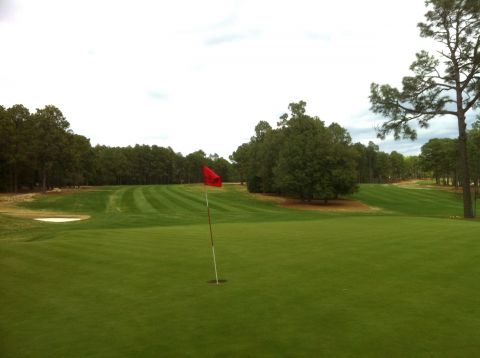
Can't Miss Opportunity? The basketball-hoop sized hole at the 18th at Pine Needles, and all the other holes, seemd like a slam dunk for birdie. Photo by Tim Gavrich.
The March issue of Home On The Course: Whose golf community is it anyway?
Anyone who still thinks “safe” investments can yield consistently good returns has never heard of a guy named Madoff. If the last few years taught us anything, it is that investments that seem too good to be true are. No group of investors learned this lesson a harder way than real estate speculators who gambled that what goes up most continue to go up. After the crash, few of us shed tears for such rampant –- some would say greedy –- speculation, but let’s not forget that many folks who had no greater intention than to buy and live in their retirement home were hurt as well.
As prices have reset to pre-boom levels, and 401Ks have recouped most of their recession losses, many baby boomers are coming back to the market for a golf community retirement home, and many working couples are thinking that maybe it is the time to think about a vacation home with a golf course and other amenities. All of these buyers are concerned about the safety factor in whatever they buy.
In the March issue of our free monthly newsletter, Home On The Course, we will discuss the status of the ownership of a golf community and its surrounding real estate as a function of the long-term financial security of the community. We will look at a few communities and clubs owned entirely by their residents, at communities whose residents make decisions about the real estate but not the golf club, and at communities in which the developer runs everything. Some are safer than others but you can find a secure community across all the categories. Learn how in the next issue of Home On The Course, arriving in email boxes in the next few days.
Don’t miss your copy; subscribe now at the top of this page.
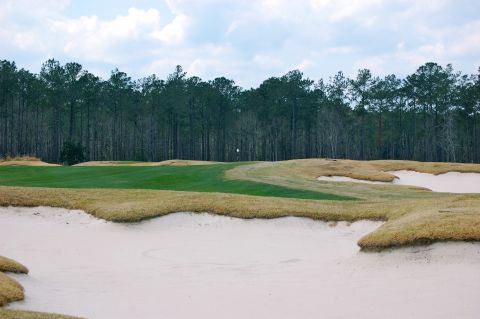
The Brunswick Forest golf community of Leland, NC, and its Tim Cate designed golf course are fully owned and run by one entity. The community is featured in the March issue of Home On The Course.
Could this be golf’s hole new world?
Since we posted this article initially, we have learned that the W I D E Open scheduled for Thursday March 10 has been postponed to Friday, March 11 because of heavy rains in North Carolina. Those registrants who will not be able to play on Friday may free up some space for golfers in the central North Carolina area who might want to participate. Contact information is at the end of the article.
Pine Needles Golf Club in Southern Pines, NC, is a classic Donald Ross layout but a golf event there this Thursday will literally stretch one time-honored measurement of golf. The Pine Needles W I D E Open, sponsored by Golf Digest, will feature golf holes 15 inches in diameter, about three times larger than the normal hole and almost as large as a basketball hoop. For those who obsess over the number of putts they take each round, this could be their day to remember.
The event's geneology traces back to Taylor Made CEO Mark King who suggested publicly that one way to encourage new golfers was to enlarge the hole. Golf Digest editor Jerry Tarde found the idea intriguing and organized this first W I D E Open to gauge the impressions of professional and amateur golfers alike.
There may be a few openings left for the event on Thursday. Cost is $100 per person and includes lunch, a fair price for a wonderful golf course I visited just a week ago. The greens were in splendid condition.
Contact Pine Needles at 910-692-8611 if you are interested.
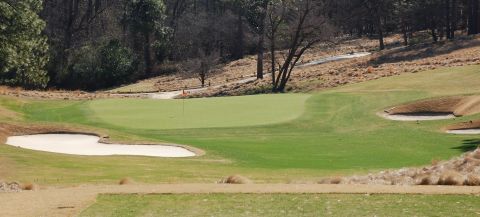
The greens at Pine Needles are so tough to hit and hold that some players may see more birdies from chip-ins to the larger holes than from putts. (Par 3 13th green shown)
Sincerity, Bobby Ginn style
No one developer has done more to make buyers nervous about purchasing a golf community home today than has Bobby Ginn, whose genius was at tapping into the hopes, dreams and egos of wealthy and wannabe wealthy clients. Of course, we now know how dreams turn into nightmares as former Ginn clients are suing the developer in the hopes of recouping millions of dollars.
Whether the collapse of his empire, which included lush
With thanks to Toby Tobin, the Florida real estate blogger who has followed the Ginn saga more closely than anyone without a financial interest in the proceedings, I just watched a video of Ginn from August 2008 in which the developer addressed rumors about his organization’s financial problems, specifically as they related to his Ginn sur Mer project in the Bahamas. In it, Ginn admits it would take hours to explain the financing for the property. “It’s complicated,” he admits, with disarming understatement.
Those unfortunate folks who were taken in by Ginn’s lavish up-front expenditures, like the $32 million Tuscan-style clubhouse at Bella Collina which I visited in February and write about in the March issue of Home On The Course, will no doubt feel a chill as they watch and listen as Ginn says, with an unflinching air of sincerity, “We never want to say something we can’t back up, and we never want to sell someone something we can’t back up. We’re out of business if we ever do that.”
Honestly, he said that.
You can watch the Ginn video from 2008 here. You can read Toby Tobin’s latest piece on Ginn here. You can subscribe to our free Home On The Course newsletter by subscribing at the top of the page.
Zillow talk not so smart
“…the real story is in the meteoric rise of real estate prices in retiree-friendly markets: Despite the national housing collapse, prices in Boulder, Colo., have risen 10% in the last four years, according to Zillow.com, while other cities, like Madison, Wis., have suffered very small declines. As a result, many of those spots are prohibitively expensive, even after prices have fallen.”
First of all, “prohibitively expensive” and “prices have fallen” seem incompatible and beg at least for some further explanation, which Smart Money does not offer. Also, it is sheer lazy journalism to rely solely on Zillow estimates. Zillow’s property valuations are based on a complicated algorithim and factor in city and county tax records, which have not been universally updated to reflect the downturn in the market. Neither do they take into account the condition of the homes for which they provide “Zestimates,” and in a time of unprecedented foreclosures and short sales, the Zillow estimates cannot be relied on for accuracy.
With that said, every once in a while I check the Zestimate on my primary home in Connecticut, but I don’t get too worked up about a jump or drop in value. Zillow is way more entertainment than gospel. For an accurate number, hire a professional appraiser.
Donald Ross and wind take measure of college golfers at Pine Needles
The Division III golfers did their best to ride the wind on their tee shots and especially their approaches to the slick greens. The best score on Monday was a 73, outstanding given the conditions and the speed of the putting surfaces; but most scores were above 80, a few well above 80. Interestingly, the best score under much milder conditions on Tuesday was a 72, although the field racked up far more rounds in the 70s than the day before. Of course, the downwind holes played longer in the milder winds on Tuesday, but some of the long par 4s into the wind still played long enough.
Tim shot a 76 on Monday and the above-mentioned 72 on Tuesday, and he earned medalist honors by a single shot over four other golfers. It was fun to watch. I will be revisiting the Southern Pines area in a few weeks and will provide a fuller report on the golf course and the surrounding community. In the meantime, enjoy the accompanying photographs of a classic golf course you can play any time you want.
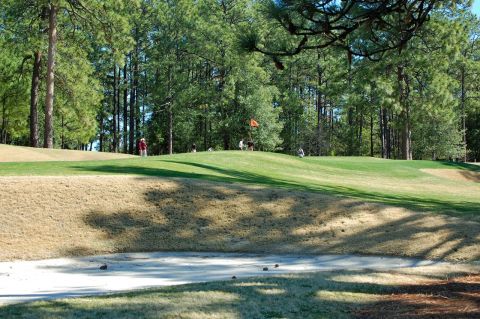
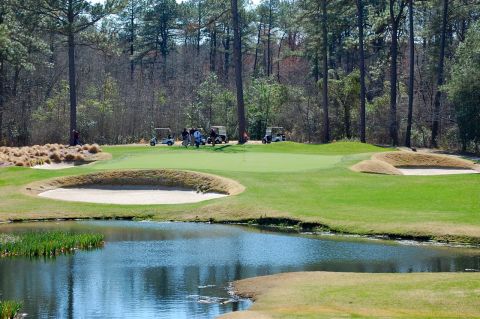
The par 5 1st hole at Pine Needles (top) is reachable in two, if you avoid the bunkers left and right and keep the ball on a green that tilts left to right. The short par 3 3rd hole is one of the easiest on the Donald Ross layout -- if you hit your short iron precisely.
Father & Son Team Classic, a good time to bond…and look for a vacation golf home
The extreme heat of the summer scared away many golfers, but the beach traffic helped make up for the lost revenue and kept the restaurants and area’s sprawling outlet malls busy. One summer-time golf event, however, has continued to attract hundreds of golfers for three days in July, in good economic times and bad. The Father & Son Team Classic will run from July 21 to 23 this year and, once again, the event organizers are expecting more than 1,000 golfers; last year, the smallest field ever still reached 530 two-man teams, one of the reasons that summer has been the only season in Myrtle Beach that has actually shown an increase in golf rounds played the last few years. Although the entry fee may seem pricey at $1,175 per two-man team ($950 if you have played in the event before), competitors receive an ample array of freebies. For the winners and many others, though, the memories can be priceless.
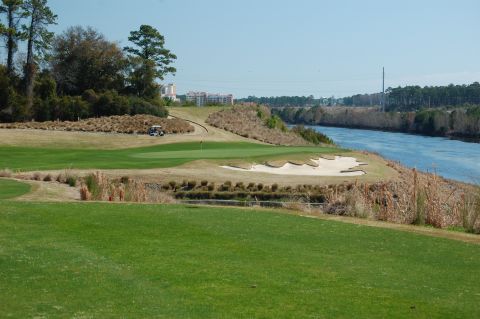
Some participants at the Father & Son Classic will have the chance to try the testing 190-yard par 3 14th at the Grande Dunes Resort course. The Grande Dunes Members course is also in the Father & Son rotation.
Teams comprise fathers and sons, grandfathers and grandsons, stepfathers and stepsons, fathers and sons-in-law, and even uncles and nephews. Relationships are tested during the competition, especially on day two, when an alternate shot format has been known to create a few sharp looks and comments. The other two days, the format is the milder best ball and scramble (captain’s choice), a lot more fun if not as stern a test of a team's mettle. Teams are placed into flights based on their combined handicaps (all competitors play at 80% of their USGA handicap).
The roster of more than a dozen courses that host the event is impressive and includes the Barefoot Resort, the resort and private clubs at Grande Dunes, the Thistle Club, Founders Club and the three courses at The Legends Resort.
For the entry fee, each team receives a nice lineup of extras, including $200 in gift certificates to Golf Dimensions, a local golf superstore; an additional $200 in merchandise from Titleist and FootJoy; lunch at the golf course each day; a closing-day cookout before the awards ceremony; and a shirt and hat. Of course, the entry fee includes all golf and cart fees.
Afternoons are free during the Father & Son Golf Classic, and with Myrtle Beach area real estate prices at their lowest in 10 years, you might consider taking a couple of hours to look for a potential vacation golf home. I know the Myrtle Beach area as well as any others and would be pleased to answer any questions about specific golf communities along the Grand Strand. Contact me if you would like more information.
For more information about the Father & Son Golf Classic, go to FatherSonGolf.com.
Rivals, neighbors, Americans in Alabama golf community
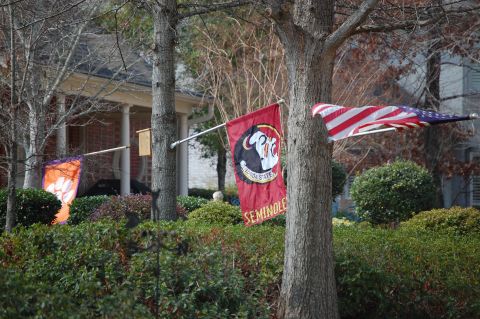
People tend to carry their rooting interests with them when they move from one state to another. I have seen it time and again, in golf communities like The Landings in Savannah, GA, where the golf community’s TV station lists meetings of the “Illinois Club” and “New Jersey Club.” The more partisan residents of these golf communities hang the flags of their alma maters outside their homes, especially before and during March Madness or when a national football championship game involves their teams.
It was, therefore, with little surprise that I happened upon the two homes featured in the photo below at Wynlakes Country Club in Montgomery, AL a week ago. One Florida State fan living next to one Clemson fan: Yet a third flag showed that no matter the rivalry, both root ultimately for the same team.
Snapshot of buyer’s market that is Florida
Toby’s chart of communities includes inventory levels of unsold homes –- Hammock Dunes has a whopping 58 months worth – as well as an accounting of how many homes are lender owned and distressed, how many homes have sold and at what median prices. It provides an eye-opening snapshot of just how severely Florida real estate has suffered during the recession and, by implication, what kinds of bargains are available in golf communities for those with a little appetite for risk.
You can read Toby’s article at gotoby.com. If you have specific questions about Florida golf communities. please contact me and I will be happy to help.Willoughby Golf Club community, Stuart, FL
For a few days, golf industry feels the love

Now on Sale

- The only book about golf communities in the last 10 years.
- 156-page step-by-step guide to finding your dream golf home.
- Info on nearly 100 golf communities the author has visited.
- Paperback version costs less than a sleeve of Pro VIs.
Here is what the experts are saying:
“The book is chocked full of information…applicable to anyone looking for a move to the Southeast regardless of whether they are looking for a golf community or not.” — John LaFoy, golf architect (Linville Ridge CC, CC of Charleston, The Neuse GC)
“Larry has done a tremendous amount of work and anyone — like me — who is looking to search for a golf home now or in a few years needs this book.” — Brad Chambers, golf blogger, ShootingYourAge.com
“Wow! What a thorough piece of work…a must for anyone moving South. This book will help many people.” — Brett Miller, owner and founder of MMA, Inc, a golf industry consultancy
Buy It Now at Amazon.com or BarnesandNoble.com.