Black Hall Golf Club short on yardage but long on challenge (and waiting list)
For those who think all golf clubs are in trouble, get in touch with the membership chairman at Black Hall Golf Club in Old Lyme, CT, and ask what it will take to join the 44-year old club. “About eight years,” he’ll respond. That is the length of the waiting list at a golf club so purely about golf that the 19th hole is a 10-minute car drive to a local saloon.
There are just two ways to play Black Hall; either become friends with a member who will invite you, or be lucky enough to be part of an outing at the club. As a member of the Junior & Senior Golfing Society of Connecticut, whose members get to play four of the Nutmeg State’s private golf courses each summer, I was able to take the outing route on Monday (and because it was a private party, post-round libations were available on the stone deck in front of the unpretentious but comfortable clubhouse).
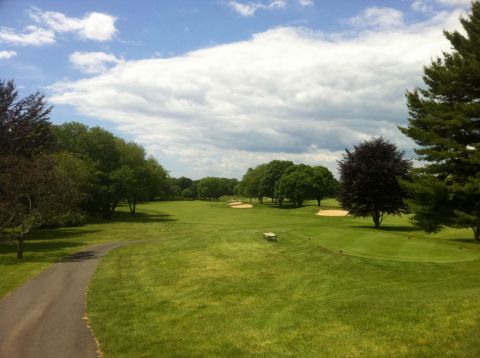
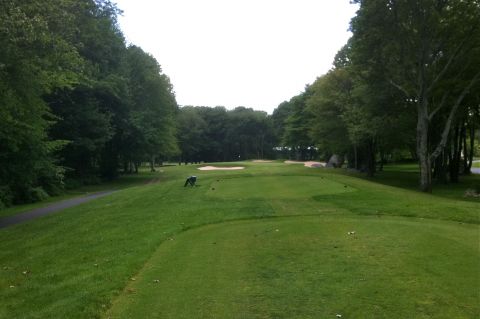
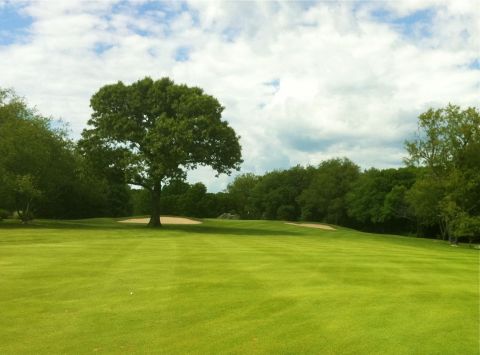
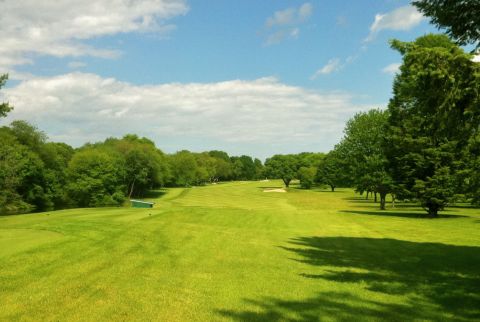
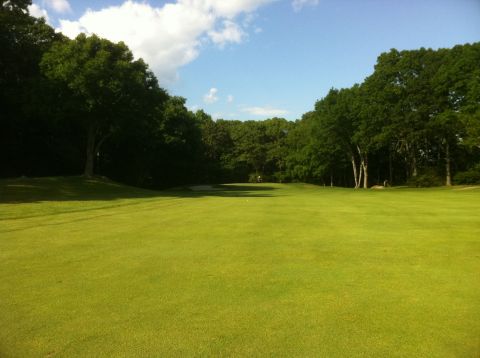
Designed by Robert Trent Jones Sr and opened in 1967, Black Hall doesn’t play long; we played the white tees at 6,242 yards. But head back to the tips (6,656 yards), and some of the tee boxes in front of you seem like green airport runways (and block partially the views of the sloped fairways beyond). The turf conditions were excellent from tee to green, and although the bent grass putting surfaces showed signs of aeration about two weeks earlier, the only consequence was that putts did not break quite as severely as they looked on the contoured greens. Otherwise, the rolls were pretty smooth.
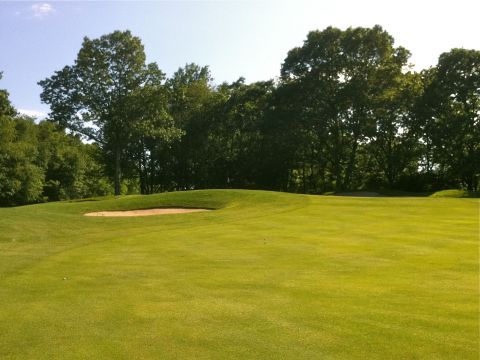
The layout features a number of doglegs that tempt the big hitter to fly a few bunkers and many trees. A few times our foursome hit what we thought were outstanding drives that bounded through the fairways and into the gnarly rough. Elevated, well-bunkered greens tended to neutralize the effects of the relatively short layout, making even wedge shots enough of a challenge to force some serious thoughts about playing to safe parts of the green, rather than at the pins. In a few weeks when the greens superintendent can shave the putting surfaces with confidence, any approach shot left above the holes will almost guarantee a three-putt. The only quibble with course conditions were the bunkers, whose sand was a bit inconsistent one to the next.
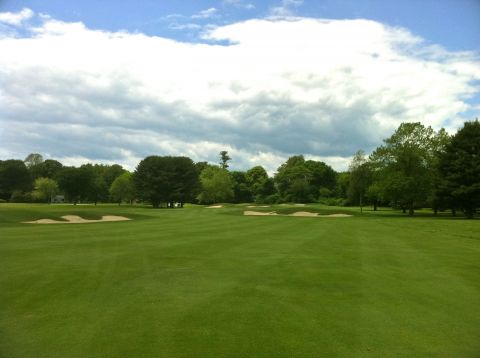
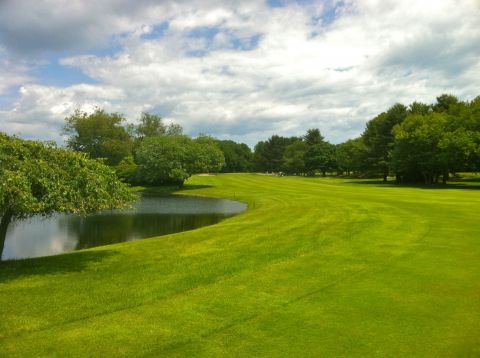
I wanted to enjoy the course without the pressure of too much picture taking, so I did not bring my camera bag. However, I was able to snap off a few pictures from my iPhone. I hope they give you some idea of the Connecticut classic golf course that is Black Hall.
 Home On The Course newsletter
Click here to sign up for our Free monthly newsletter, loaded with helpful information and observations about golf communities and their golf courses.
Wall Street Journal says “It’s Time to Buy”
“The Clouds Haven’t Quite Parted,” the paper indicates in its subheading, “But the Long-Term Case for Home Ownership Is Looking Stronger.” That is because builders have stopped building new homes (for now) and the rate of household formation will climb in the next few years, according to demographers. When short supply, after the foreclosed properties work their way through the system, meets increased demand, logic and experience tell us prices rise.
Of course, you want to be confident that you can sell your home at a fair price before you consider your long-planned move to a warmer climate. The Journal's argument is good news for you: The relationship between incomes and home prices has dropped almost 21% below the 15-year average that ended in 2010. Home affordability has reached back to 1990 levels. In the coming months and years, if you price your home appropriately, you could very well find an enthusiastic buyer for it.
I have encouraged readers previously that if they can afford to rent a home in a golf community they might be considering, that is a good way to get to know the neighbors and fellow golf club members before making a multi-hundred-thousand-dollar commitment. That has been an effective financial strategy as well in the last five years as rental costs have been significantly lower than the costs to purchase and finance a home. But with the continuing drop in home prices, that is no longer the case in many areas. It now may be cheaper -– in some cases, significantly cheaper -- to buy a home comparable to one you would rent.
The link to the Wall Street Journal article is here. If you cannot connect (for some articles a subscription is required), please contact me and I will email a copy.
The next issue of our own newsletter, Home On The Course, will explore some of these issues in more depth using the wit and wisdom of Mark Twain as our foil. Although the issues are serious, we will try to inject a little levity into the discussion. If you have not subscribed to our free newsletter, you can do so in the column above. Just click on the box, fill in your name and email address, and we will make sure you receive the June issue of Home On The Course and all future issues.
10º of Separation: Wintergreen hopes golfers warm to its cool summer temps
As part of the celebration last week of my son Tim’s graduation from Washington & Lee University in Virginia, our family stayed for a few days at the Wintergreen Resort in the western part of the state. I reviewed the Wintergreen community after my first visit in 2007. The following is an updated look at the sprawling mountain golf community.
At the four-season Wintergreen Resort, you can ski and play golf to your heart’s content, sometimes on the same day. Located in Nellysford, VA, about 35 miles from Charlottesville, Wintergreen is one of those hybrid resort/residential communities where the transient and permanent exist in peaceful harmony.
At 11,000 acres, Wintergreen is huge, with mountain real estate accounting for about 2,000 acres and the Stoney Creek community in the valley below sitting on 3,000 acres. The rest will remain natural forever thanks to an arrangement in 1994 between Wintergreen’s owners and
At Wintergreen, the core recreation activities are skiing and golf, although the community offers its members the full range of customary amenities, including an Aquatic & Fitness Center and a tennis program that one magazine rated among the top 20 in the U.S. Wintergreen’s mountaintop area is warm and inviting, with a Euro-village style lodge just steps from the resort’s 24 slopes, more than half of them lighted. The resort has little trouble filling its lodge and rental units with eager skiers from Charlottesville, Richmond and Washington, D.C. Attracting golf play is a little more challenging, in spite of 45 holes of excellent and scenic golf. Devil’s Knob, an Ellis Maples 18-hole layout that inspires fear and a little loathing in those uncomfortable with fairly tight mountain tracks, spans the top of the mountain, one of the highest courses east of the Mississippi. [For some comments on Devil’s Knob, click here.] Opened in 1977, the course provides the views you’d expect from 3,800 feet, but some occasionally crazy rolls and (cliff)hanging lies as well. Many local golfers prefer the two original nines of the 27 holes at the Stoney Creek course at the bottom of the mountain, which is open year round. It is not uncommon in January and February for Wintergreen’s hardiest sportsmen and women to ski in the morning and play golf at Stoney Creek in the afternoon.
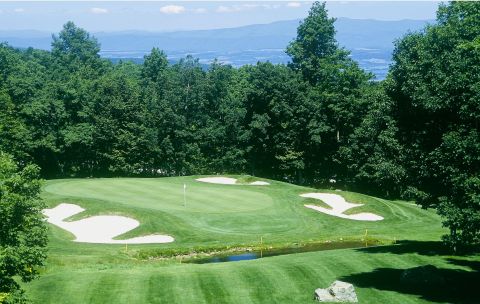
Far Out: The 17th hole at Devil's Knob is nearly 3,800 feet up, providing spectacular views of the Shenandoah Valley. Photo courtesy of Wintergreen Premier Properties.
The Shamokin and Tuckahoe nines at Stoney Creek are the combination most favored by members. Rees Jones laid out the Shamokin and Monaccan nines in 1988 and added the Tuckhoe 10 years later. The routing is clear and without surprise, with only one or two blind shots from the tees and no gussied-up landscaping. The greens, which are well bunkered, roll fast and true with many undulations, yet we didn’t scratch our heads once over a misread break. The first hole on the Tuckahoe nine starts from a dramatically elevated tee to a generous fairway framed by bunkers on the right and a huge lake at greenside right. It forms a beautiful and intimidating tableau from the tee box. A decade ago, Golf Digest named Stoney Creek one of the top 50 resort golf courses in the U.S. With a grand smorgasbord of activities at Wintergreen, the community offers a dizzying array of membership plans. After dropping the prices of their “Premier (equity)” and non-equity membership fees last year, Wintergreen sold 140 new memberships. That was enough to convince them to retain the promotional fees at $12,000 for the Premier, 50% of it refundable when a membership is resigned and reissued; and $5,000, with no refund. (Note: Wintergreen permits new members to pay for their membership over five years at 0% interest.) Membership opens up the resort’s amenities on a “cafeteria-style” basis that includes not only golf, but also tennis, skiing, fitness centers, pools and access to the community lake. Depending on what amenities you choose, and whether the membership is for an individual or family, annual dues range from $1,800 to $5,000.
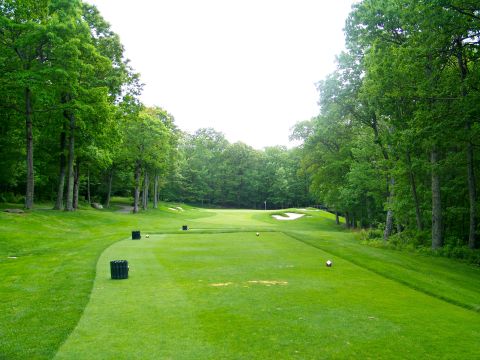
The flat par 3 6th hole at Devil's Knob belies the mountain venue, but is characteristic of all but a few holes on the course. Most tee boxes, however, are elevated.
Photo by Tim Gavrich
Housing options are high and low in Wintergreen in terms of both altitude and price, with nice golf course lots in the ½ to ¾ acre range typically selling for between $100,000 and $125,000. Count on an average of about $150 to $175 per square foot in construction costs. A few of the most expensive homes, some with impressive views, top $1 million but the median price is close to $450,000, down from around $600,000 when I first visited Wintergreen in 2007. Town homes rarely exceed $300,000, and some feature spectacular mountain views from about 3,800 feet up. Some of the homes in Wintergreen are approaching 35 years in age, and across the mountain you see roofs and windows being replaced. Last week we drove by a home we rented last year and noted extensive renovations underway; would that the dismal home we rented this year had undergone a thorough cleaning, if not a total renovation. (Note: We did not rent it through the resort, a mistake we shall not make again.)
Life at some remove from a sizable town (Wintergreen is 40 minutes from Charlottesville) demands a few modest accommodations. At 15 miles, it can seem a long way to a supermarket, and some Wintergreen residents take coolers on their weekly grocery expeditions. Wintergreen Partners Inc., the group of residents that runs the community, recently took over the on-site market with plans to enhance the offerings. Nearby Nellysford has opened a few interesting small restaurants. The Ambrosia Bakery and a small bistro called Bare Necessities offer boutique food and wine offerings. Next door to the Ambrosia, the Blue Ridge Pig is properly rough and rustic in its décor and its nicely smoked barbecue. For beer lovers, a number of brewpubs have sprung up in the immediate area. For those who love their cars and their cameras, the amazing Blue Ridge Parkway, with some of the most spectacular views east of the Mississippi, is less than two miles from Wintergreen’s front gate.
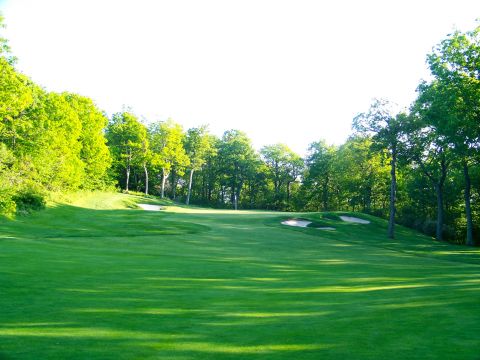
The 13th at Devil's Knob begins a spate of holes that are more tilted and challenging than earlier holes. Photo by Tim Gavrich
Although the area around the Stoney Creek golf course is home to many year-round residents, the mountain resort attracts a large transient population. Condo and other homeowners have little trouble renting their places to skiers for the three core months of the ski season, but golf course competition in Virginia and the Carolinas makes it tougher to attract summertime guests in spite of aggressive golf package pricing. An average temperature at least 10 degrees cooler than in Charlottesville, Richmond and other hot Virginia towns certainly helps the cause.
Golf resorts that are also golf communities must strike a balance as they try to appeal to both their full-time residents and their short-term guests. Although Wintergreen’s residents and resort guests co-exist quite peacefully, the full-timers tend to arrange their recreation schedules accordingly, opting to play golf and ski on weekdays rather than the more heavily trafficked weekends. Given the incredible amount and variation of the natural landscape in Wintergreen, its residents are more than happy to literally take a hike on weekends.
*
If you would like more information about life at Wintergreen and the wide range of properties for sale there, please contact me.
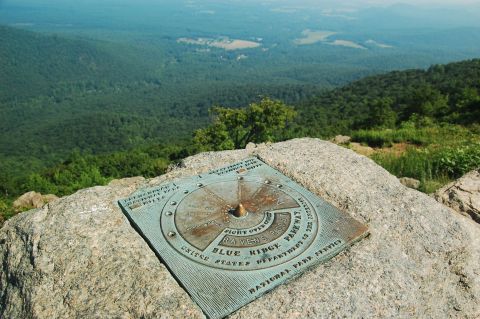
An entrance to the Blue Ridge Parkway is less than two miles from Wintergreen's gate.
High Test: Devil's Knob golf course at Wintergreen Resort a fair test from tips
Our family is celebrating the college graduation of our son Tim this weekend by gathering at the Wintergreen Resort in Nellysford, VA, atop
Still, the Ellis Mapls design is more restrained, if a bit more narrow, than I expected from a mountaintop layout. Some of the locals suggest keeping driver in the bag “unless you play from the back tees.” We gave it a go from the tips, which I hadn’t done in years, but the elevated tees at Devil’s Knob actually took some fairway bunkers out of play (too far away) and left more middle irons than long irons and woods into the greens. The greens were still recovering from an earlier aeration but we were told that when they get back up to speed in both senses of the word, they will be treacherous. Understood; the sloping of the fairways are mimicked on the greens, sometimes in the same direction but other times in the opposite direction. Devil’s Knob is a golf course that begs for you to stick around at Wintergreen an extra day to take full advantage of what you learn on the first go.
Today we make a return visit to Stoney Creek, the resort community’s bottom-of-the- mountain layout designed by Rees Jones. Stoney Creek does not hide its charms. We wrote a few years ago during our first visit to the resort that, “The routing is clear and without surprise, with only one or two blind shots from the tees and no gussied-up landscaping.” It should be fun. Look for more notes on the Wintergreen golf community and its golf courses in this space in coming days.
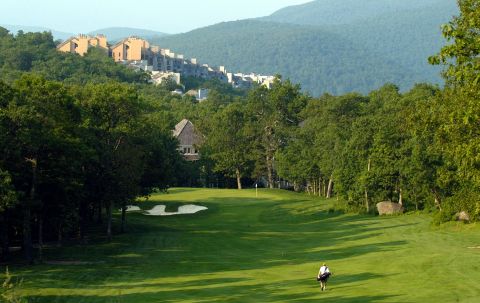
Although on the mountain top, Devil's Knob golf course is relatively flat. Many condo units at the Wintergreen Resort, such as those beyond the 16th hole, are available for nightly, weekly or weekend rental and are a short drive from the interesting layout. Another 27 holes are available for play at the bottom of the mountain.
Photo courtesy of Wintergreen Resort Premier Properties.
In one South Carolina golf community, price drops give hint of larger picture
Because I own a vacation home there, I am on the mailing list for a few real estate agents who list and sell properties in Pawleys Plantation in Pawleys Island, SC. Occasionally they send out market reports indicating
Owners of condos in the sample tended to be a little more flexible in dropping their prices than were owners of single-family homes. In Pawleys Planation, owners of the two condos sold them at prices 13% and 6% less than the original asking price (percentages rounded off). The discounts off list price for the four single-family homes that sold were just 2%, 3%, 4% and 5%.
Each real estate negotiation has its own particular calculus. But these numbers at Pawleys are not dissimilar from what real estate agents in other areas of the south are telling me. The conclusion for anyone searching for a golf community home is to decide what a home is worth to you and, if a few percentage points gets you there, do the deal. You don't necessarily win when the other guy loses.
Experts predict active hurricane season
Higher than normal sea surface temperatures and a weakening La Niña effect have led scientists in two respected organizations to come to about the same conclusion -– the upcoming hurricane season that begins next week is likely to produce above-average activity. The La Niña effect –- the opposite of El Niño -- lowers sea surface temperatures, leading to dryer periods. When the effect weakens, conditions support more rain.
The National Oceanic and Atmospheric Administration (NOAA) issued its latest hurricane season predictions just a few days ago, forecasting that the nation will endure between three and six major hurricanes during the season (one to three is “normal”); six to 10 hurricanes (five to seven normal); and 12 to 18 named storms (nine to 12 is normal). The official hurricane season lasts from June 1 to November 30.
The NOAA’s predictions follow and concur with those of
We have helped some of our readers find homes in golf communities along the eastern seaboard, and others are currently considering the purchase of a home near the coast in the Carolinas. History suggests major hurricanes occur there, on average, every couple of decades. In 1960, for example, Hurricane Donna set something of a record by becoming the first, and still only, storm to register hurricane-force winds in Florida, the Mid-Atlantic states, and New England, including 120 mph gusts in Manteo, NC, at the southern end of the Outer Banks.
It would be almost 30 years, however, before another storm of
With such modern inventions as the Weather Channel and with well-honed local evacuation plans in virtually every beach community, those who live along the coast receive plenty of warning and have plenty of escape options before the storms come. Modern construction methods have made homes in most locations able to withstand the strongest storms. Most of us will take our chances in exchange for the opportunity to be close by a mostly peaceful ocean. Our hope here is for a safe and uneventful 2011 hurricane season.
Will your new golf home go up in value? Market forecasts available at a discount
Local Market Monitor and its predecessor firms have supplied banks, investors, real estate companies and homebuilders with analyses and
Local Market Monitor also makes its reports available to individuals, and its information, analysis and forecasts about local price trends can be especially invaluable for those of us trying to decide, say, between Myrtle Beach and Wilmington or Chapel Hill and Charlottesville. Local Market Monitor looks especially hard at market-by-market population trends and job statistics, two key predictors of home prices, although other factors, such as the overall inventory of homes for sale in a particular area, also factor into the forecasts. The service’s market reports include easy-to-follow charts and analyst commentary.
Local Market Monitor’s conclusions about Myrtle Beach were an
Yet, based on its data and analysis, Local Market Monitor forecasts that home prices will increase an average 7% in the Myrtle Beach area from 2013 to 2014 based on what the service’s analysts see in terms of population and job trends (e.g. job growth in March ’11 was the best since December ’06). Frankly, I trust Local Market Monitor’s numbers more than I do my own anecdotal observations (and my friends’ and neighbors’ pessimism).
You can look through a sample market report (for Miami/Miami Beach) at Local Market Monitor’s web site, LocalMarketMonitor.com. If you like what you see, LMM is offering a special 25% discount on its reports and subscriptions to readers of Golf Community Reviews. Just enter the special coupon code “golf” (don’t use the quote marks) and sign up for either a one-market report ($99 before the discount) or a full-year subscription for monthly updated reports on one market ($297 before the discount). If you would like to sign up for a full subscription to all 315 markets that LMM covers, please contact COO Carolyn Beggs toll free at 800-881-8653, extension 105.
Fair Exchange: Weak dollar leads to stronger U.S. property sales
When I published an article 16 months ago predicting increased British investment in American golf communities, the exchange rate for one pound of British sterling was $1.63 US. When I checked today, it was $1.62. With that kind of buying power and the over-supply of leisure residential properties in the southern U.S. driving prices lower than they were 1 ½ years ago, a modest Euro-invasion of American golf communities is not unlikely. In fact, according to the National Association of Realtors, the $82 billion foreigners spent on U.S. real estate in the year ended in March was one of the highest levels in recent years, up $16 billion from the prior year.
Some interesting data emerge from the NAR survey of its members concerning their foreign clients. Almost 80% said they would use their new home in the U.S. to entertain family and friends or as their primary home,
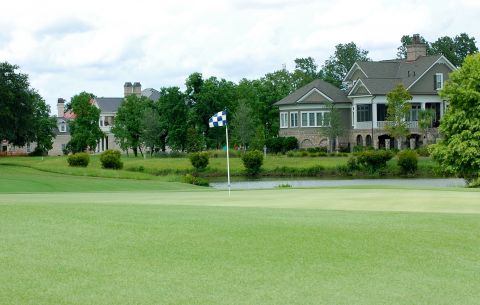
British citizens looking for an investment in a place like Daniel Island, SC, will be pleasantly surprised at the prices for golf homes, relative to those in the UK.
Let’s face it: The United Kingdom is a small country, and all of France is barely larger than Texas. They aren’t making any more land on which to put European golf courses, and if you think environmentalists are aggressive in the States, try building a new course in Europe. We may bemoan our own economy but it is still considered a safe haven by many investors around the world. Continuing worries about U.S. debt can only work against the value of the dollar, giving Europeans even greater leverage for large-scale purchases in the U.S. And considering the economic problems in Greece, Portugal and other bailed-out countries, Europeans seem to be more worried about rampant inflation than we in the U.S. are. As many economists tell us, real estate investment is one of the most effective hedges against inflation (especially when “safe” investments today are yielding barely 2% interest rates).
On an apples-to-apples basis, properties in Europe, especially in the UK, are more expensive than comparable properties here in the U.S.
Foreign dollars just could have a stimulating effect on one sector of the floundering U.S. housing market. If you are contemplating a purchase of a golf retirement or golf vacation home, keep an eye on this trend, as it might just push up prices in golf communities that look like a bargain today. If you would like some help in identifying the golf communities that best fit your criteria, please contact me.
Tiger Woods golf course plans have Asheville newspaper tied in knots
It is hard to keep track of the plans to restart construction of the Tiger Woods designed golf course at High Carolina, the struggling Cliffs
Last Wednesday, the Asheville Citizen-Times’ Keith Jarrett, who has followed The Cliffs closely over recent years, filed a critical piece under the headline, “Golf Course on Hold at Cliffs at High Carolina.” Then on Saturday, at the paper’s online edition, a piece written by David Dykes appeared under the headline, “Developer: Tiger Woods Cliffs Project Still on Track in Asheville Area”; the latter story served up the yin to the earlier piece’s yang.
Although we would like to believe in an independent press, we can’t help thinking that, in the days after Jarrett’s article, Mr. Anthony and his handlers may have reminded the Citizen-Times’ executives of the magnitude of the Cliffs’ advertising budget. At the height of their success, before the housing market tanked, the Cliffs spent as much as $14 million annually on marketing.
The Citizen-Times seems as confused as the rest of us about the status of The Cliffs’ highest profile unfinished project. In February,
After the optimistic tone Anthony set in February, April came and went, and during a TV interview last week, the developer implied that construction was on indefinite hold, later amplified by Keith Jarrett’s Citizen-Times column that characterized the developer’s explanation of the stoppage as “the dog ate my homework.”
“Anthony's comments that concentrating on getting a Gary Player design in South Carolina up and running by this fall is taking away from High Carolina construction,” Jarrett wrote, “sounds as flimsy as Tiger's apologies for fooling around.”
But then a few days later, in the online edition of the Citizen-Times, reporter Dykes writes that Mr. Anthony indicated construction would start “by this summer.” (words from the article, but not directly attributed to Mr. Anthony). The developer, however, is quoted in the online article as saying the work stoppage at High Carolina was “technically on hold,” whatever that means.
Uncertainty makes markets nervous. The Cliffs needs to assure its market of potential buyers and the Asheville community that it is organized and has a plan. It can start by getting its story straight about High Carolina.
Sedgefield Country Club: Classic Donald Ross course at heart of classic community
by Tim Gavrich (photos too)
The author will be graduated from Washington & Lee University later this month, having earned a bachelor's degree in English, with honors. He is available for writing assignments beginning in June.
There is no gate guarding the entrance to Sedgefield Country Club. There are multiple ways in and, besides, a gate would attract attention to Sedgefield’s presence in an affluent part of Greensboro, North Carolina. It is not as if people do not know it exists; after all, Sedgefield has been around since 1926 and hosts a regular event on the PGA Tour — the Wyndham Championship.
Despite these lofty credentials, Sedgefield is an unassuming club sitting quietly among woods, streams and houses. This modesty and calm is an essential part of Sedgefield’s charm. That charm rings through its superbly restored Donald Ross golf course. Ross designed the golf course at Sedgefield with the intention of building a second eventually, with the venue functioning as a genteel resort destination. But the Great Depression altered the course of the club, and the existing 18 holes became the centerpiece of a venerable residential community. Unlike most clubs of similar vintage, many of Sedgefield’s holes are bordered by front, back, and side yards of houses. But appropriately, these dwellings are set far enough back from the field of play so as not to intrude. Indeed, the residences are attractive and without ostentation. They lend a sense of place and purpose to a stroll and a round at Sedgefield.
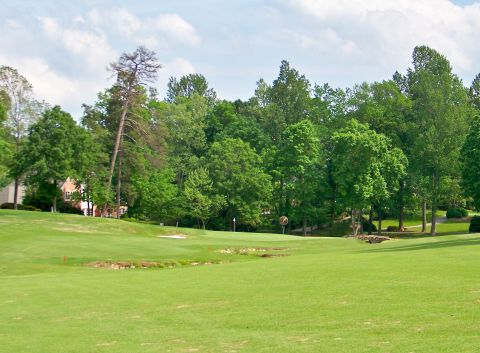
The approach over the stream to #2 at Sedgefield.
But what of the golf course? It is a faithfully restored, esteemed Donald Ross-designed gem. The man who created such famous courses as Pinehurst No. 2, Aronimink on the Philadelphia Main Line, and Seminole Golf Club in North Palm Beach, FL, left his deft mark at Sedgefield as well. The course lost some of its luster through the 20th and into the 21st Centuries but, in 2007, acclaimed architect Kris Spence oversaw a project that restored Sedgefield to Ross’ original plans. His team moved, recovered and rebuilt bunkers, expanded greens to their original sizes, regained lost-hole locations, and lengthened some holes in order to keep up with golf club technology. The result was a course that the PGA Tour deemed fit to return to after 30 years at nearby Forest Oaks Country Club. But even more importantly, the new-look Sedgefield Country Club course is one that its members rightfully treasure and adore.
Donald Ross courses almost always boast exemplary par 3s, and Sedgefield is no exception. The four one-shotters — the 3rd, 7th, 12th and the 16th — offer a complete examination of one’s abilities with clubs ranging from a fairway wood to a short iron. The mighty 12th is a 245-yard bruiser with a tough two-tiered putting surface and bunkers standing guard right and left. A merely “good” tee shot may still lead to bogey or worse, as the undulations within the putting surface can shunt the ball everywhere but towards the hole. The final par 3, #16, is only 165 yards from the tips, but its green also features multiple levels that shrink the target considerably. During the Wyndham Championship, many pros come to 16 eager to make a birdie and walk away disappointed with pars and bogeys.
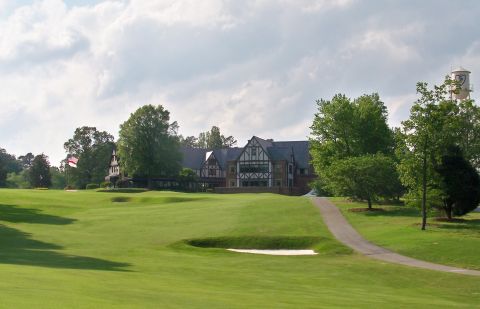
The approach to the 9th hole and the iconic Sedgefield clubhouse beyond.
Lee Trevino once described Sedgefield as “the best stretch of 18 par 4s I’ve ever played.” He was referring to the rigorous challenges posed by the short holes as well as the opportunities available at the three par 5s, which are all reachable in two. The 18th hole is a 509-yard darling that the PGA Tour turns into a 509-yard beast by calling it a par four, bumping the course par down from 71 to 70.
The class of the three-shot holes at Sedgefield is the 15th, one of three on the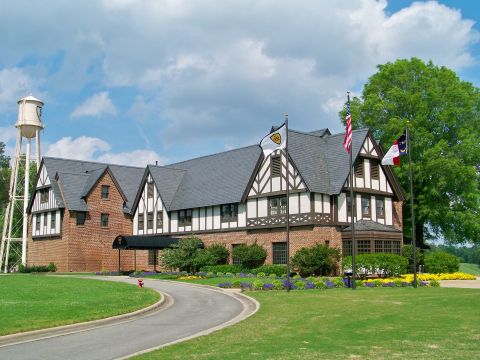 course where water is a deep concern near the putting surface. After a downhill tee shot to a fairway wedged between a stream, a bunker and a hillside covered with long grass, the layup and approach shots must contend with a lake, more sand and hollows and undulations on and around the green. In spite of these impositions, birdie and even eagle are very real possibilities, making for great potential drama late in any round, be it a Tuesday evening with friends or Sunday at the Wyndham. The two-shot holes at Sedgefield are strong as well. They range from the 488-yard 11th down to the 376-yard 8th, which is nearly drivable under favorable wind and ground conditions. The best of these is the 448-yard 2nd hole, where the player must negotiate a semi-blind tee shot downhill past a string of intimidating bunkers in order to attack a large green that slopes severely from left to right and is bordered on the right side by a meandering stream. It is simultaneously unique because of the terrain it covers and unmistakably a Ross hole.
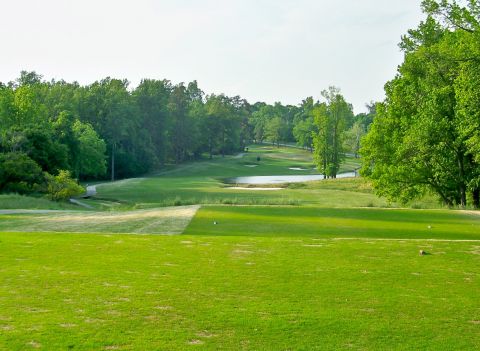
Water is in play on just a few holes at Sedgefield, but nowhere is it more intimidating than at the par 5 15th, a reasonable birdie hole after two and a half good shots.
Sedgefield Country Club’s golf course is an excellent test of a player's full range of shotmaking. With many narrow and some semi-blind fairways and multi-sectioned greens, it requires precision and tamed power from the metal woods and irons. Those rumpled putting surfaces also require a deft touch with the putter and wedges. Sedgefield is a golf course that hosts the world’s best golfers one week out of every year and delights the mortal player every other day.
[Editor’s Note: Current homes for sale in the community surrounding the Sedgefield Country Club are listed at prices up to $4 million. Recently, 33 homes in the community were on the market, with the “sweet spot” around $500,000. With the purchase of Sedgefield CC by McConnell Golf earlier this year, club members now have playing privileges at the other six courses in the McConnell portfolio, including nearby Cardinal Golf Club, also in Greensboro; and Raleigh Country Club, another Ross-designed course, and Treyburn Country Club in Durham, both within a 90-minute drive of Sedgefield. Current initiation fees at Sedgefield are $10,000. If you would like more information about real estate inside the Sedgefield community or would like to speak with the director of membership for the McConnell Group, please contact me.]
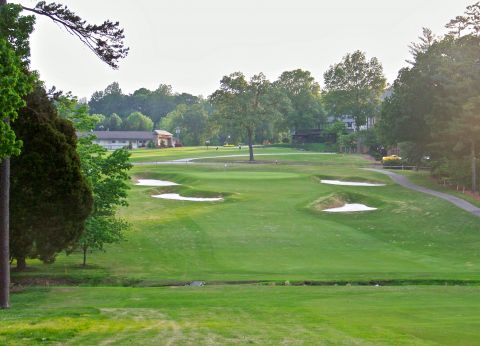
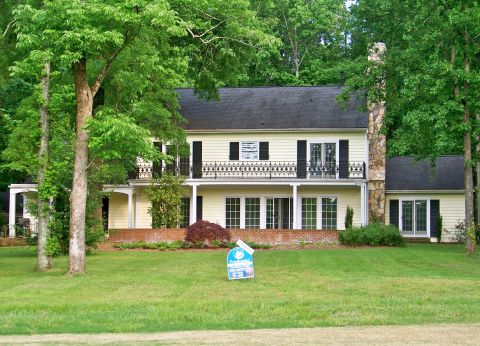
Sedgefield's home hole (top) and a home for sale at the 14th tee.
Golf condos that almost pay for themselves
Silver lining in declining home prices
Low and Outside: Cliffs pitches in the dirt
Rumors of golf’s death greatly exaggerated

Now on Sale

- The only book about golf communities in the last 10 years.
- 156-page step-by-step guide to finding your dream golf home.
- Info on nearly 100 golf communities the author has visited.
- Paperback version costs less than a sleeve of Pro VIs.
Here is what the experts are saying:
“The book is chocked full of information…applicable to anyone looking for a move to the Southeast regardless of whether they are looking for a golf community or not.” — John LaFoy, golf architect (Linville Ridge CC, CC of Charleston, The Neuse GC)
“Larry has done a tremendous amount of work and anyone — like me — who is looking to search for a golf home now or in a few years needs this book.” — Brad Chambers, golf blogger, ShootingYourAge.com
“Wow! What a thorough piece of work…a must for anyone moving South. This book will help many people.” — Brett Miller, owner and founder of MMA, Inc, a golf industry consultancy
Buy It Now at Amazon.com or BarnesandNoble.com.