Local real estate market price forecasts available to our readers at 25% discount
Local Market Monitor, a respected real estate forecasting service, has lowered prices for its individual real estate market reports from $99 to $65 each. Readers of this blog site receive an additional 25% off just by including the code word “golf” when they purchase a single report at the firm’s web site, LocalMarketMonitor.com. The net cost, therefore, is just $48.75 for a single report for one of the 300 markets Local Market Monitor covers each month. If you like the service, a full-year (12 monthly reports), regularly priced at $297, is also available to Golf Community Reviews readers at a 25% discount, bringing the subscription cost to $222.75. If you are considering a move, a Local Monitor report can be a useful tool in assessing the investment potential for real estate in your intended location, as well as understanding where prices in your current market might go.
Local Market Monitor uses a proprietary formula called “Equilibrium Home Price” to determine which markets are currently over or undervalued. Its real estate price forecasts extend out 12, 24 and 36 months. Additional information and a sample of one of their reports are available at LocalMarketMonitor.com. If you have any questions, please contact Chief Operations Officer Carolyn Beggs whose contact information is available at the web site.
Note: Golf Community Reviews occasionally uses information from Local Market Monitor as background for articles and we find the information helpful. We have arranged for the aforementioned discount as a service to our readers. We receive no commission or other compensation from Local Market Monitor.
 Home On The Course newsletter
Click here to sign up for our Free monthly newsletter, loaded with helpful information and observations about golf communities and their golf courses.
Hurricane Irene targets Carolinas, our home
Before we left our condo in Pawleys Island last week to return to Connecticut, my wife asked me: “Should we bring in the patio furniture?” “Nah,” I responded as quickly as I always do when long odds and physical exertion intersect. She, of course, was thinking of the ever-present threat of hurricanes on the southeast coast this time of year; I did my usual snap calculation and estimated the chances of a significant storm affecting our condo were about 1 in 20+ years (the last one being Hugo in 1989).
We will be calling our neighbors later this morning to ask them to take the furniture in for us. As of 6 a.m. today, our community of Pawleys Plantation is dead center in the projected path of Hurricane Irene, whose winds have now topped 100 mph as it barrels past the island of Hispaniola (Haiti and the Dominican Republic). Conceivably, the Atlantic gulfstream could deal us a double blow, bringing the storm up the coast to Connecticut and dropping significant rainfall on the entire state, with the inevitable flooding of rivers and streams. Even though we are 90 miles from Long Island Sound, high winds are possible as well; back in 1989, Hurricane Hugo’s winds reached almost 100 mph in Charlotte, a three-hour drive from Charleston, where the hurricane made landfall.
Fortunately, we have flood insurance for our home in Pawleys Island, as well as the easier-to-secure and cheaper wind and hail damage protection. One of our neighbors called us the other day to ask about our flood insurance policy because they don’t have one and started thinking what if. With a 60-day waiting period, their new policy won’t cover them for Irene. For their sake and ours, I’m hoping the odds are with them and others along the eastern seaboard, and that Irene wobbles her way out to sea. But it does not look good.
McConnell Golf makes its PGA debut
The McConnell Golf Group, the Raleigh-based firm that has built quickly a portfolio of some of the best private golf courses in the Carolinas, is having its PGA tour debut this weekend. The purchase of the famous Sedgefield Golf Club in Greensboro brought with it the hosting duties for the Wyndham Championship, which is played annually at the Donald Ross course.
As I write this, Webb Simpson, in search of his first PGA tour victory, leads the golf tournament by a stroke early in the final round. In preparation for the event, McConnell spruced up the grounds, the clubhouse and an
As we have written here a number of times, a McConnell membership –- they start anywhere from $10,000 to $26,000, depending on which “home” course the member chooses –- provides access to all eight McConnell courses. Currently, the McConnell golf clubs farthest from each other are Sedgefield and The Reserve at Litchfield Beach, on the south end of the Grand Strand of Myrtle Beach, about a four-hour drive between the two. McConnell Group members have access not only to the eight golf courses but also to lodging facilities at a few of the courses. That makes playing the more remote clubs like Musgrove Mill in rural South Carolina and Old North State Club on Badin Lake, NC, a bit more convenient; I stayed overnight at Old North State and the accommodations were comfortable and reasonably priced.)
Earlier this month, McConnell added its eighth golf club, Raleigh’s TPC Wakefield, and with it yet another pro event, the Nationwide Tour’s REX Hospital Open which is played in June. By purchasing a course designed by Hale Irwin, McConnell also added to its diverse stable of designers that includes Pete Dye (The Cardinal), Tom Fazio (Old North State and Treyburn), Greg Norman (The Reserve), Arnold Palmer (Musgrove Mill) and Donald Ross (Sedgefield and Raleigh Country Club). When I spoke with McConnell officials a couple of years ago, they hinted at an ultimate goal of nine clubs. Could an Arthur Hills or Coore/Crenshaw course be in McConnell’s future?
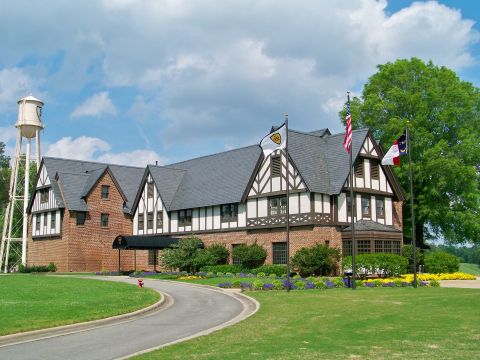
Sedgefield's clubhouse and water tower received a sprucing up in advance of the Wyndham Championship.
Photo by Tim Gavrich
SC Ross golf course: An RR runs through it
The one and only time I played the famed Wentworth golf course south of London, I flinched at the top of one backswing when a railroad engineer blasted the whistle on his passing train. A rail system separates the two 18-hole courses at Wentworth, and for a Yankee, the intrusion took some getting used to. After a few more trains passed by, I began to find it all quite quaint, mostly because I had never been “railroaded” on a golf course in the U.S., nor did I ever expect to be.
I will soon, though. Two weeks ago, as a member of the South Carolina Golf Rating Panel, I signed up to play one of South Carolina’s only Donald Ross designed golf courses, the Camden Country Club in the town of Camden. Sadly, the greens were undergoing aerification on the very day I chose, but I will return soon. (Note: In 2010, the SC Golf Panel ranked Camden the 42nd best course in the state.)
I happened to mention the bad timing for my visit to one of our readers, Bruce Wellmon, who had introduced me last year to the golf course at White Oak, a golf community in Tryon, NC. White Oak may be more than 100 years younger than Camden, but it displayed some of the classic touches the old master golf architect might recognize, such as bunkers with wisps of long grass at their edges.
No railroad, though. Bruce sent me the attached photo from Camden. Now I’m doubly psyched to play the golf course, which first opened in 1902 as an amenity for a local hotel that closed in the '40s. First Walter Travis and later Donald Ross renovated the course, working around the train tracks. Wrote Bruce: “You cross the train tracks twice. The actual tracks are out of bounds. If you hit it over the tracks, swing again.”

A different kind of hazard at Camden Country Club in Camden, SC.
Photo courtesy of Bruce Wellmon
Wee bit of Donald Ross just off I-95 on the way to a Myrtle Beach golf vacation
Lumberton, NC, is not really on anybody’s radar as a golf destination or, for that matter, a destination of other note. The city’s own official web site mentions only the Lumber River as a noteworthy part of the city’s history –- no major event, no economic driver like tobacco or textiles, just
Later, another noted golf course designer, Dick Wilson, was called in to bring harmony to the older and new nines. The golf course toddled along through the following decades until the latest recession hit it hard and convinced the local foundation to put it up for sale. To know Pine Crest, apparently, is to believe its best days lie ahead; the purchasers of the golf club earlier this year were its golf professional and superintendent, Dwight Gane and Chris Jackson, who have worked at the course for a combined 20 years.
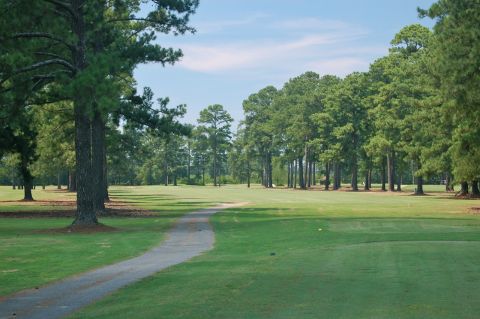
True to its name, most of the fairways at Pine Crest are lined with pines, as at the 413 yard par 4 16th, rated the toughest hole on the golf course.
My golf-in-the-south buddy Bob and I stopped at Pine Crest recently for a round on an extremely hot day. Although the typically crowned Rossian greens and ample collection areas were in strong evidence, our major disappointment was that the greens were like mohair, no fun at all to putt. I found myself welcoming approach shots that just missed the greens so that I could have a go at chipping up and over false fronts and bunkers or hitting the occasional bump and run shot: Anything to avoid a long putter backswing on putts of 30 feet or more.
Golf pro Gane indicated that, despite my assumption his partner the superintendent was being skittish about cutting the greens too short, it was actually the heat and sun that was promoting the rapid grass growth that made the greens so shaggy. Whatever, the putting surfaces made me long for a return trip in late fall or early winter when, the pro indicated, the greens will stimp (roll on the stimpmeter) at around 10, about medium fast. That should be fun.


The narrow 8th hole at Pine Crest is a seemingly unremarkable and short par 5 (450 yards from the back tees). The only trouble off the tees (top photo) are the pine trees and a fairway bunker on the left. The fun begins at the green, which presents itself like a dented upside-down frying pan.
Other than the greens, we found the fairways typically generous, as Ross tends to be, and the changes Dick Wilson made to the golf course were utterly harmonious. Before our round, pro Gane indicated for us which greens were credited to Ross and which to Wilson and, to be honest, there was no apparent difference. They all seemed to embody the customary Ross touches -– the crowned surfaces, the smallish sizes, bunkering protecting the flatter areas of the greens.
Golfing foursomes heading from the northeast to a week’s golfing vacation in Myrtle Beach might consider taking that Lumberton exit off the interstate, just five minutes from Pine Crest Country Club, for a little warm-up round and a walk through history. Just do it when the weather is cool and the green superintendent throws caution –- and grass clippings –- to the wind.


Water comes into play most effectively on the Pine Crest golf course at the par 3 12th (top) and on the approach to the par 4 13th.
Pine Crest Country Club, which first opened in 1929, is located at 110 Nigel Drive in Lumberton, NC, just five minutes from Interestate 95. From the tips, it plays only to 6,578 yards with a rating of 71.1 and slope of 123. Its design is credited to both Donald Ross and Dick Wilson. The pro shop is at 910-738-6541. Green fees are incredibly reasonable; we paid just $25 each, with cart (although the course is a flat and easy walk, if you are disposed to the extra exercise). The golf course, which is open year round, is best played in the cooler months when the greens roll faster. Pine Crest can certainly be a stimulating and economical stop for serious golfers traveling down the interstate toward a Myrtle Beach golf vacation.
Tax and Spend: Golf community members plug golf course leaks, buff up their courses
If you are a homeowner, you know the roof starts to leak at about the 20-year mark. If you are a golf club operator, you know the irrigation system is on about that same schedule. The mid 1980s were the heyday for golf community development along parts of the southeastern seaboard, and after two decades, many of the finer private golf clubs in the
The results are impressive and the upshot is that couples looking for a stable private golf club should seriously consider golf communities in which the members understand the relationship between the quality of their clubs and their own long-term property values. That is the subject of this month’s Home On The Course eNewsletter, which mails to subscribers on Monday (it’s free, by the way). There is still time to sign up to receive the August edition and all future issues. Just click on the box at the top of this page, fill out the basic information and that’s it.
No Sweat: CC of South Carolina Layout Makes Cool Statement on Hot Day
A round of golf in August in the heart of South Carolina, a 90-minute drive from the sea breezes of the coast, is an exercise in survival. On the day my friend Bob and I teed it up at the Country Club of South Carolina in Florence, the forecast was for a top temperature of 102 degrees. That may explain why the group scheduled to play ahead of us never showed; nor did the other three groups on the tee sheet. We had the course all to ourselves –- and the snack bar for breakfast and lunch too. On a normal day, with no groups in front of us, we might have finished our round in three hours. But in the hot south in August, you enjoy any outside activity at a leisurely pace.
Our measured pace of play gave us plenty of opportunity to mop the sweat from our brows and enjoy the fine Ellis Maples layout. Maples, a protégé of Donald Ross and member of a golf-business family that dates to the 19th Century, designed dozens of well-respected golf courses, including Grandfather Mountain in Linville, NC, Pinehurst #5 and Country Club of North Carolina, also in Pinehurst. His son and former business partner, Dan Maples, is himself a prolific golf architect. I’ve played a few Ellis

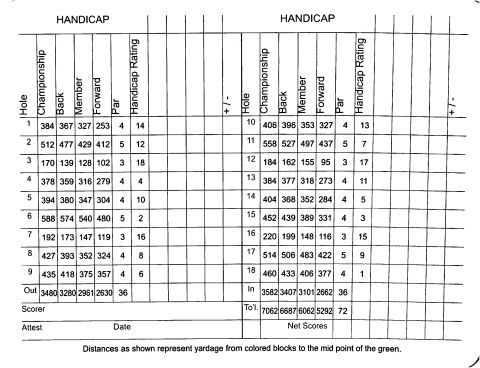
The 1st at CC of South Carolina is a nice warm-up hole, a dogleg left with a tree and bunker at the front of the green that echo obstacles to come.
Maples designs and liked every one of them, including Lexington Country Club in Virginia where my son’s college golf team (Washington & Lee) practiced; Devil’s Knob at the Wintergreen Resort in Virginia; and the aforementioned Country Club of North Carolina. The variety of landscapes Maples tackled keeps him from being pigeonholed as having a particular style. You won’t find landscapes more different than the top of the mountain Devil’s Knob layout and the incredibly flat land of the sand hills on which Maples built the Country Club of NC. And yet all are interesting and stimulating designs.

Maples' par 3s are quite tricky, among them the 139-yard 3rd.
With Country Club of South Carolina, which Maples, who died in 1984, designed in 1968, the architect had something of a “tweener” landscape -– not quite mountain or flatland, but rather land on which he could exercise a little more intervention than customary, push up a few greens above the fairways, use a few trees to define the crooks of doglegs, bank a few fairways and mound a few greenside bunkers. Water holes are elusive on the front nine of the course –- the only significant presence as a defense against a radically pulled layup shot on the par 5 6th hole –- but the natural ponds and small lakes come at you with a vengeance on the back nine, starting with the dangerously intriguing 157 yard par 3 12th hole. I groaned as I first ascended the tee box, disappointed in yet another par 3 over a pond to an easily approachable green that seems almost an obligation to many golf designers; it appeared at first blush that only a topped shot off the tee could possibly bring the pond into play. But looks were deceiving, and after a few moments of assessment, it became clear that the hole features a severely false front that will send any slightly short approach shot –- or one with a bit of backspin -- down into said pond. A second false “middle” on the right side of the green would make a knee-knocker out of a chip shot from the back of the green to a front-right pin position, bringing the pond into play if the greens are running even at medium speed.
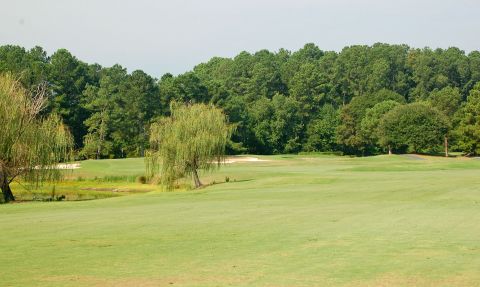
Water comes into play for the first time at the par 5 6th, where the biggest challenge is actually a layup second shot to avoid water and willow that won't weep for an errant play.
But greens superintendents are justifiably a skittish bunch when the sun shines constantly and temperatures run to 90+ for weeks at a time; they live in mortal fear of brown greens. On the day we played, the greens’ surfaces were awfully wooly, a disappointment because, in all other regards, the turf was in fine condition. I can’t wait to make a return visit during cooler weather when the greens are substantially faster.
Although CC of South Carolina is nominally a private golf club, there are a few ways for non-members to play it. We rented an extremely comfortable and large condo unit (three bedrooms) that had way more than enough space for the two of us and could easily accommodate a foursome. It is reasonably priced at $179 per night. Green fees for those who stay on property are $55, cart included, the standard “accompanied guest” rate. Golfers who don’t mind staying off property in Florence can put together a lodging and golf package through a local company called Swamp Fox for a little over $100 per night, with a choice of four local hotels.

A steep false front on the par 3 12th forces a play to the middle or back of the green, but another rise in the right side of the green puts a downhill chip or putt at risk of hazard duty.
For golfing groups headed to Myrtle Beach with no need of overnight lodging in Florence, ask your club professional to call ahead and book a warm-up round at CC of SC (the unaccompanied guest rate is $80). It could be the best golf course you play all week.

Note: John Thomas is the current golf professional at CC of South Carolina. Russell Glover, who was a great host, remains director of golf.
*
Retired golfers from the north may not think of Florence, SC, as a retirement golfing destination, but those looking for reasonably priced real estate and private club membership might want to consider the area. Florence is located just a couple of miles off Interstate 95, the major north/south route between New England and Florida. The train station in Florence is the daily stop for Amtrak service between New York and Miami. The neighborhood surrounding the Country Club of South Carolina is neat, well landscaped and mature, with prices that begin in the $200s for 3-bedroom, 2-bath homes. A furnished condo of almost 2,000 square feet that overlooks the 10th hole of the golf course and a lake beyond is currently listed for $224,900. Full golf membership in the club carries an initiation fee of $5,000 and monthly dues of just $310, with access not only to the golf course but also a fitness center, tennis courts, pool and an amply sized clubhouse.
If you would like more information about the Country Club of South Carolina and the surrounding real estate, please contact me.

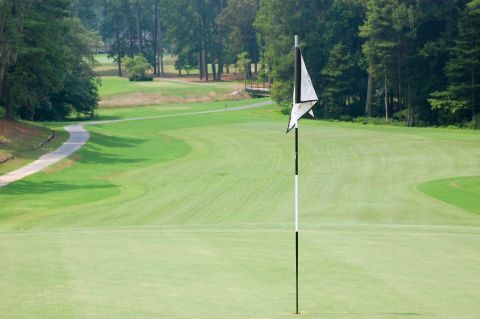
Above, the approach to the par 4 8th at Country Club of South Carolina. Below, the par 4 14th ends with an elevated green.
Nice lot in great golf community for $1; $65,000 initiation fee included
If you have envisioned yourself living in a home in an island paradise mere steps from an outstanding private golf course, your time could be at hand. A nice lot in just such a place is currently available for a buck.
What’s the catch? Well, for a person or couple looking for a small, primary, warm-weather home adjacent to a golf course they intend to use year round, there really is no catch. The “patio” lot at 2 Tabby Circle in the Haig Point community on Daufuskie Island, SC, is .19 acres; small, yes, but it would accommodate a patio home of up to, say, 2,300 square feet, maybe three bedrooms and 2 ½ baths comfortably. Clearly, the owners of the lot are attempting to get out from under the costs of club and homeowner association dues (see below). Costs to build on Daufuskie are a bit higher than in similar mainland golf communities because the island is car-free and reached only by ferry; all material and labor must be shipped over. Then, too, club dues are higher than many other mainland communities because the dues include the costs to subsidize the ferries, an idiosyncrasy that probably drives local real estate agents crazy trying to explain (typically, the ferry costs would be part of the homeowner association dues). When you add up all the fees at Haig Point for real estate and golf, the total runs to about $17,500 annually, a few thousand more than at such nearby, mainland high-end golf communities as Colleton River, Belfair and Berkeley Hall.
But consider the Haig Point lot, which is near the island’s famous lighthouse, costs just a buck, more than $100,000 less than a comparable lot in a comparable community on the mainland. Dues and homeowner fees at Haig Point total about $4,000 per year more than costs at some nice golf communities across the Calibogue Sound (Colleton River, Sea Pines Plantation, Belfair). Therefore, it will take about 25 years to spend that $100,000 savings on the lot. An environmentally conscious retired golfing couple who like the idea of a secluded retreat adjacent to one of the best golf courses in the golf–rich state of South Carolina might consider catching the next ferry to Daufuskie (service is frequent and free to those looking at property. (Contact me and I can arrange a meet-up with a realtor who knows the island well.) Larger home sites, some with marsh and sound views, are available at somewhat higher price points, most inclusive of initiation fees for the club.
It is probably worthwhile at this point to issue a reminder that, in
Last weekend I played the outstanding Haig Point golf course with fellow members of the South Carolina Golf Ratings Panel. In coming days, I will have more to say about Haig Point and Daufuskie Island in this space and in our free monthly newsletter, Home On The Course. You can sign up for the newsletter at the top of this page.
Mountains of Losses: Golf courses for sale on the rise in western NC
Western North Carolina golf is on sale. No, not green fees but rather the golf courses themselves. According to the Asheville Citizen-Times, no fewer than five golf clubs in the state’s popular mountain area are on the market. Considering that some golf course operators would prefer to negotiate a sale outside the public eye, the number could be considerably higher.
I recognized all of the golf courses mentioned in the article, including the Ed Ault designed Etowah Valley and Linville Falls, a combined Bruce Devlin/Lee Trevino layout.
Keith Jarrett, who has reported over the years on the Cliffs Communities and other golf communities in the Asheville area, wrote the article. You can read Keith’s piece by clicking here.
Stifling heat poses growing problems for putting greens in the Carolinas
My friend and itinerant golf partner, Bob Harris, and I spent the last two days playing golf in extreme heat in the Carolinas. Greens suffer mightily during hot and dry spells, but at least one golfer suffered more trying to putt on them. I consider myself a decent putter, but I left some 20-foot putts six feet short, and others I banged by the hole a like distance. At times I thought I had them figured out, but slow greens, at least for me, are tougher to putt than fast ones, despite what the TV golf commentators might say.
Caution, of course, is the byword for golf course superintendents during the dog days of Carolina summers. Greens are mowed only slightly to ensure they don’t brown out on days when the sun beats down and temperatures push the 100-degree mark and don’t leave the 80s overnight. But I was surprised to learn that the furry consistency of the greens of the Carolinas in summer is as much about horticulture as it is superintendent paranoia. As they say of corn in Iowa during the growing season, you can almost hear the grass grow on golf courses during a hot southern summer.
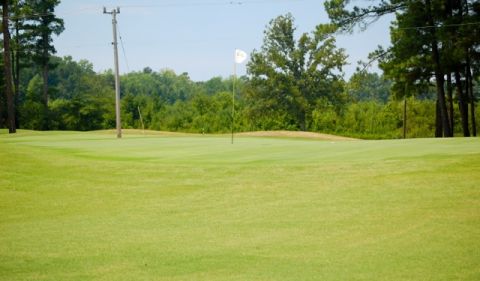
The 11th green at Pine Crest, like most of the others on the Donald Ross/Dick Wilson course, was crested, undulating and slow in mid-90 degree heat.
“It is the rapid grass growth more than the cut we put on the greens,” said golf professional and co-owner Dwight Gane of Pine Crest Country Club. Pine Crest, in Lumberton, NC, was the first stop on our two-day golfing trip. Gane estimated the stimpmeter reading on the greens at Pine Crest was around 8, which is just a bit faster than, say, putting entirely through fringe; over the winter months, course superintendent and co-owner Chris Jackson will have them up around 10, still not lightning, but on and around Pine Crest’s tricky green complexes, that will be fast enough. Records indicate Donald Ross laid out the blueprints for the greens at Pine Crest in the 1940s, as an accommodation to a local businessman and member of the club, and the “Crest” in the club’s name could as easily apply to the siting of the greens as to any other topographical quality. In winter when the greens are at normal length, they should be a treacherous delight.
Pine Crest’s original nine holes opened for play in 1929. Dick Wilson, whose many architectural credits include the famed Blue Monster at Doral in Florida, designed a second nine in the 1950s and did an excellent job of mimicking the Rossian style, at least for the additional nine greens. If Gane had not pointed them out, we would have been hard pressed to separate the Wilson holes (1 thru 3, 8 thru 11 and 17 & 18) from the Ross holes. As typical of Ross courses, all the action at Pine Crest is on and around the greens; the fairways are more than generous, posing few obstacles other than the pine trees that line many of the fairways. (I’ll have additional comments and photos of Pine Crest in coming days.)
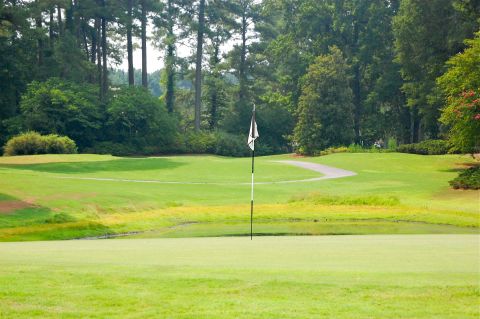
In fall and winter, a putt from the back of #12 at Country Club of South Carolina to a front pin position has a chance to trickle down the steep false front and toward the pond. But in summer, you will really have to slam your putt to get it past the hole.
I will say this about Pine Crest’s furry greens: They were uniformly slow, with no surprises one to the next. On Wednesday, we played the Country Club of South Carolina in Florence after a pleasant overnight stay in one of their condos, and the grass on some of the greens, perhaps because of a difference in topography (fewer trees, more water), had grown at somewhat different rates. Also, it was another six degrees warmer than at Pine Crest. We noticed at 8:30 a.m. that only one other group had signed up to play that day, and we jumped out before 8:30 a.m. to beat them and the heat (predicted to reach 102 in early afternoon). We had the Ellis Maples designed course (and the restaurant at our post-round lunch) all to ourselves –- I don’t think the 8:30 twosome showed up –- and we thoroughly enjoyed not only the pace of play but also the layout. As for the greens, they too were slow but inconsistently so; well into the round, some 30 foot putts I thought I hit properly wound up blowing past the hole by 10 feet. Though frustratied, I blame Mother Nature. I look forward to playing the fine CC of South Carolina course in more “normal” weather and to sharing some additional thoughts and photos here in the coming days.
Down so long, it looks like up…to Florida
Founders earns top Myrtle Beach golf award

Now on Sale

- The only book about golf communities in the last 10 years.
- 156-page step-by-step guide to finding your dream golf home.
- Info on nearly 100 golf communities the author has visited.
- Paperback version costs less than a sleeve of Pro VIs.
Here is what the experts are saying:
“The book is chocked full of information…applicable to anyone looking for a move to the Southeast regardless of whether they are looking for a golf community or not.” — John LaFoy, golf architect (Linville Ridge CC, CC of Charleston, The Neuse GC)
“Larry has done a tremendous amount of work and anyone — like me — who is looking to search for a golf home now or in a few years needs this book.” — Brad Chambers, golf blogger, ShootingYourAge.com
“Wow! What a thorough piece of work…a must for anyone moving South. This book will help many people.” — Brett Miller, owner and founder of MMA, Inc, a golf industry consultancy
Buy It Now at Amazon.com or BarnesandNoble.com.