Donald Ross course membership on sale
The Country Club of Asheville, whose golf course opened in 1928, is offering new memberships at $10,000 now through March 31, compared with the customary $25,000 initiation fee, a reduction of 60%. In addition, after March, the club will continue its policy of "trial" memberships: Pay a $1,000 initiation fee, plus monthly dues and assessments ($374.67 for full membership), and you will enjoy full membership for a year. At the end of a year, you either walk away from the membership or pay an additional $24,000, in installments if you wish, and become a full-fledged member. Other levels of membership are available, including a non-resident plan at a $6,500 initiation fee with annual dues of $1,763.
The roots of the club go back to the 1890s when local businessmen formed the Swannanoa Country Club. At one point in its storied history, the club was located on the current site of the famed Grove Park Inn, which sports its own Donald Ross course (there are four courses by the master designer in Asheville).
Today, the CC of Asheville includes a tennis complex of 10 courts and a pro shop, an Olympic-sized swimming pool, and a 35,000 square foot clubhouse, in addition to the 6,600-yard golf course. If you are interested in membership, contact Membership Director Debbie Ponder at debbieponder@charterinternet.com. If you want information on the golf communities in the area of Asheville, please contact me . I have visited a number of them and played their courses. I will be happy to send you a copy of a newsletter that includes my reviews of the golf communities.
 Home On The Course newsletter
Click here to sign up for our Free monthly newsletter, loaded with helpful information and observations about golf communities and their golf courses.
The ultimate water hazard
The passenger interviewed was asked his name and what he was doing on the plane.
"My friends and I were going on a golf trip," he said. Certainly, it was a golf trip he and his friends will never forget.
One preview of housing mess, circa 2006
I am hard at work studying for the Connecticut real estate licensing exam later this week. My course textbook, Modern Real Estate Practice, was published in 2006. Much has changed in the housing market in the intervening few years, and some of the concepts and words in the book are downright eerie.
"...by the end of year 2005," goes one sentence in the chapter called Home Ownership Concepts, "68.88 percent of households were homeowners." That worked out well, didn't it?
And then this: "However, real estate prices have risen, making it difficult for some buyers to save the down payment and closing costs needed to secure a conventional loan." Our representatives in Washington were all too aware of this, as was Countrywide Financial and other sub-prime lenders who helped start the fire and poured fuel on it.
And finally, this: "Because more homeowners mean more business opportunities, real estate and related industry groups have a vital interest in ensuring affordable housing for all segments of the population..."
One could add, with the benefit of hindsight,"...whether they can afford it or not." I hope that when the publishers update the textbook, they add some appropriately cautionary notes.
Even Mother Nature pours it on the golf economy
Where weather was favorable, in key golfing regions like Florida, Southern California and Phoenix, rounds were up as much as 10%, according to the research firm Pellucid. Where weather was bad, in Texas and the Ohio Valley, rounds were down enough to tilt the scales toward the negative. Travel golf also had its effect.
"...destination markets are taking significant rounds hits that aren't related to weather," Pellucid President Jim Koppenhaver, indicating reductions of 9% and 14% respectively in Las Vegas and Hilton Head."
You can read a full article about the research at WorldGolf.com.
Don't discount homes at list price
Couple B lives down the street and want to move south to a golf community. Their real estate agent provides them with the same comparable sales data Couple A viewed and suggests they price their home at $375,000, the average of the comparables, and 20% higher than Couple A. They figure that potential purchasers will expect to negotiate, and they have decided they will go as low as 15% less than the list price.
In this example, Couple B are market psychologists, and Couple A are market realists. Couple B believes, with some evidence to support them, that buyers expect to negotiate a reduction in price, especially in a buyers market, and they have built that expectation into their price. But Couple A decided that, in a tight market, it is better to grab the attention of as many buyers as possible than to attract a relative few and then give them the satisfaction of negotiating a bargain. Couple A can afford to turn down any offers below their asking price because, chances are, potential purchasers will keep landing on their doorstep, given their low list price.
The moral of the example cuts both ways, for buyers as well as sellers. If you are selling your home, your chances in this market may be better if you list it near the ultimate price you want rather than list it higher and leave wiggle room. As a buyer, understand that a home whose owners won't negotiate a lower price is not necessarily to be discounted. Pun intended.
Some golf communities lower prices, but take away a goodie
I have been asking the same question of developers in the southeast over the last couple of months: Are you lowering prices? The answer is typically "Yes," but with an explanation.
Many golf communities, to spur sales, had been offering "free" golf membership with the purchase of a lot or home. In some cases, the value of the membership was $25,000 or more. But now, some developers are taking the free membership off the table. Or are they?
In the current environment, developers are caught between a rock and a hard place. Market forces compel them to lower prices, but their current property owners don't take kindly to the lower prices. It depreciates the market values of their properties. To solve the dilemma and assuage their current property owners' angst, developers have lowered prices but have taken away the complimentary initiation fees. In that way, they can explain to their property owners that the overall value of their holdings -- property and golf membership -- has not really eroded.
But in the current environment, developers are desperate, and no matter what they are telling their property owners, any potential purchaser with the resources to buy today has all the chips on his side of the table. In short, if you are in that fortunate group, do not be afraid to ask for the golf fees and other goodies. Most developers faced with a choice between a sale or a ticked off resident will opt for the sale.
If you want further thoughts on the subject, or would like me to help you prepare to negotiate the best possible deal in a golf community, contact me by clicking on the button at the top of the page.
Once again, mainstream media not helpful on housing crisis
We have reported here in recent weeks, for example, the travails of the Ginn Resorts organization, which defaulted on a $635 million loan to Credit Suisse. Other developers have stepped in to take over some of the Ginn properties, including the lush Laurelmor in North Carolina.
There is no denying that times are tough in golf communities as they are elsewhere, but the New York Times and the other media overstate the carnage. In their examples of residential golf courses that have closed, the Times article points to California, Las Vegas and Florida. That is a little like doing an article on "Growth of Poverty around the World" and using as examples only Calcutta and Zimbabwe.
The Times article, which you can access by clicking here, reminds us of two things: First, don't trust everything you read and, second, consider purchasing property only in a community where the amenities are built and functioning, and where the developer or the club owners, if the golf club has been turned over to them, have deep pockets. I can help you separate the wheat from the chaff if you are interested in taking advantage of the lowest prices in four or five years (and that goes for club initiation fees as well). Just click on the Contact Us button at the top of the page, and I will get back to you promptly.
Golf communities appeal to the heart to generate sales
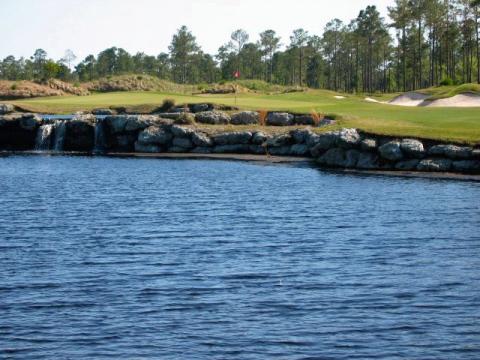
Ocean Ridge features four golf courses, with another on the way, most of them designed by Tim Cate. Photo courtesy of Ocean Ridge.
With the inventory of community homes and lots everywhere stuck in a holding pattern, one North Carolina development company has decided to put a little romance into its marketing efforts. River's Edge and Ocean Ridge Plantations are touting Valentine's vacation packages, both under the aegis of the development firm Coastal Companies.
The two golf communities are offering a $149 package per couple, which includes two nights of lodging and complimentary green fees. At Ocean Ridge, the first dozen couples to arrive on Valentine's Day will receive a complimentary dinner for two at a local restaurant. Of course, as is customary with such "discovery" packages, a property tour is required, a small price to pay for a discount priced mini-vacation. And, who knows, you just might find the home of your dreams.
Ocean Ridge, located in Sunset Beach, just a few minutes from North Myrtle Beach and the ocean, is home to the Big Cats golf courses, so named for its four layouts -- Tiger's Eye, Panther's Run, Lion's Paw and the one-year old Leopard's Chase. Willard Byrd designed Lion's Paw and the other courses are the work of Tim Cate, who also designed the community's fifth course, Jaguar's Lair, which will open late in 2009, a year behind schedule.
River's Edge, with a course by Arnold Palmer, is located another 30 minutes up the coast, south of Wilmington and Southport. Lots at Ocean Ridge and River's Edge begin in the $200s, with houses starting around $500,000 at River's Edge and in the $400s at Ocean Ridge. About 40% of properties remain to be sold by the developer at Ocean Ridge, and $200,000 will get you a lot with a view of the golf club and club membership, a $25,000 value.
Last year, I helped a reader purchase a lot in Ocean Ridge and would be happy to do the same for others. Just hit the "contact us" button at the top of the page, send me a note, and I will go to work for you. As always, there is neither an obligation nor a charge for this service.
The fine print says a lot
The following, lifted from the "disclaimer" statements at the web sites of a few well known golf communities in the southern U.S., are good reminders that the fine print paints a more realistic picture than do salespeople and marketing brochures. Names of the actual golf communities have been changed to protect the equivocating. Caveat emptor.
"The Perfect Golf Community, Inc. and/or its affiliates assume no liability, whether in contract or tort, for any direct [or] indirect special, consequential or punitive damages, including (without limitation) damages for loss of anticipated profits or revenue or other economic loss in connection with or arising from any act or omission by Perfect Golf Community, Inc., its agents, affiliates, joint venture partners, independent contractors, or unaffiliated third parties as a result of any act or omission in fulfillment of [or] in breach of this Policy." (Editor's note: I have inserted the needed [or]s; the community in question has spent more than $10 million in marketing expenses in some years and yet cannot proofread their own legal statements.)
"These materials including the features described and depicted herein are based upon current development
"Square footage[s] are approximate and may vary." (Editor's note: Since everything is blueprinted and surveyed, why must square footages be approximate?)
"Illustrations, maps, photographs, and other illustrative images are used for conceptual purposes only." (Editor's note: Get in writing at the time of contract that the clubhouse or amenities center will be substantially as promised.)
"All provisions of the master plan are subject to change, revision or deletion by the Developer at its sole discretion, at any time, without notice." (Editor's note: Ditto. Everything about a sale of property is up for negotiation, and most developers in the current economy will not quibble too much. If you are a good negotiator, you can override the disclaimer in the contract of sale.)
Member for a day: Attention to detail and 12-minute tee times give course private personality
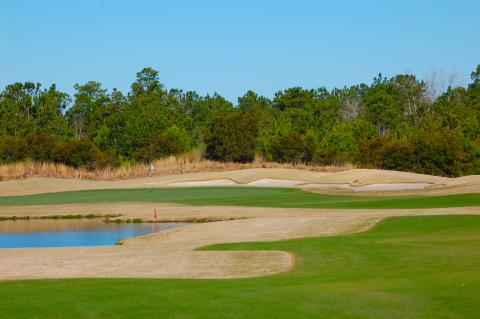
At the par 4 first hole on the West nine, you get the first of many tastes of sand and water at The Thistle.
Golf Course Review: The Thistle Golf Club
Contributors to golf discussion forums tend to be uniformly positive about The Thistle Golf Club in Sunset Beach, NC. That is not surprising, as The Thistle has much to recommend it, including a unique tee-time arrangement, impeccable service, a rustic new clubhouse, and a golf course with about the best greens on the Grand Strand of Myrtle Beach. Indeed, The Thistle is likely to charm the knickers off any but those who consider drama the defining criteria for a round of golf.
The Thistle layout runs along the lines of a resort course, which is to say it is designed for pleasurable and fast play, despite its profusion of sand and water. But whereas most resort courses in the Myrtle Beach area have maximum rounds in mind, The Thistle's schedule of play is designed for maximum pleasure. Tee times are spread by 12 minutes to ensure that no groups endure annoying waits to play their shots. Although we saw other players on the practice green before our round, we never saw them out on the course because none of the holes run parallel to others. Not to sound anti-social, but there is something to be said for play without distraction of any kind (even the waterfowl were absent on our 70 degree and sunny day). Maybe with an ongoing reduction in rounds played in Myrtle Beach, other courses will recognize the benefits to 12-minute tee times.
Golfing memorabilia
That kind of care for the "experience" of its visitors begins at The Thistle community's guardhouse, where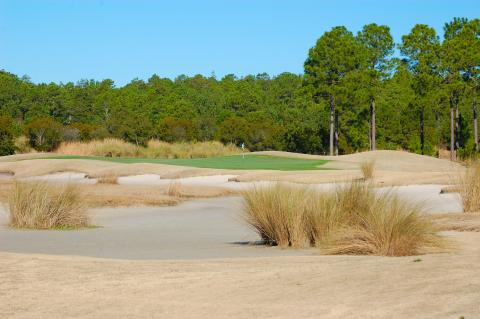 you are reminded to stop at the bag drop and encouraged to have a great day. Service inside and outside the clubhouse continues the pattern of friendliness and quality. Every employee treats visitors as if they were members and, indeed, The Thistle's owners would like them to consider it. Someday, the plan is to go fully private (current initiation fee is $45,000).
The Thistle tries hard to project a Scottish ambience, and even if it comes off as a bit faux -- the clubhouse is a cross between ski lodge and castle, and the course does not resemble any links courses I played in Scotland -- the collection of golfing memorabilia in the clubhouse lobby is a pleasant and educational diversion for the golfer who enjoys communing with golf history. Owner/developer Rusty Mackey has many more items in his collection, and it will be a treat to returning players to see them on view in the lobby as time goes on.
Space oddity
A word or two more about the clubhouse, which opened last June to much fanfare. With heavy antique wooden doors and a bar imported from overseas, as well as a sweeping view out over the golf course, the public dining room is a pleasant place to have a pre-round bite or post-round beverage. Given the extraordinary vaulted ceilings and large windows, the dining area, however, seems a bit cavernous; even the heavy wooden tables and chairs seem dwarfed by the space. The pro shop is capacious as well, the ratio of empty space to product space about five to one, unusual for a public course pro shop in a tourist area where hawking logo merchandise helps generate additional income. Other Grand Strand pro shops tend to cram product into their smaller spaces, making you almost walk sideways to get to the desk. The Thistle's pro shop is a refreshing, if odd, departure.
After our round, I visited The Thistle real estate office, which occupies part of the "members" half of the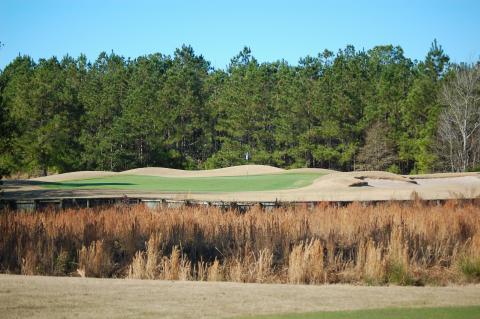 clubhouse. Trish, who greeted me at the front desk, was kind to take me on a short tour of the locker, dining and meeting rooms that are not be accessible to the public. I had made a similar inspection early in 2008 with Gene Weldon, the director of golf at The Thistle, and I was a little surprised that only modest construction progress has been made since then. However, given the current economic environment, developer Mackey is making the prudent choice to focus most of his investments out on the course, as well as in the adjacent residential community. For example, during our round we noted a large trench being dug for a waterway that will run just beyond the backyards of a new set of cottages. And, according to the real estate office, construction will start soon on the community's amenities center, adding a pool, fitness facility, full kitchen and library for The Thistle's maximum 145 homeowners.
Lot prices begin in the $200s, with water view lots starting at $300,000. Eighteen golf cottages with views of the course are under construction and priced in the $500s. One unique aspect of The Thistle is that almost every home has an unobstructed view, meaning that lots have been positioned so that no home looks out at another. Privacy is a strong selling point at The Thistle.
Smoothest rolls on the Strand
The Thistle's 27 holes are also the beneficiary of forethought and care. Good grooming is important at The Thistle, and even though the weather has been fairly mild in the south this winter, and rain has kept over-seeded fairways especially green, you don't expect bunkers to be so well clipped this time of year, or fringe areas tight enough to permit putting. But the most memorable aspect of The Thistle is its putting surfaces. Golfers from the northern states will find The Thistle's bent grass greens familiar. It is unusual to find such greens this far south because they don't typically do well in the extreme heat of the summer and in the salt air (Thistle is just a few miles from the ocean). But the greens were as good as any on the Grand Strand.
The fairways, which were wet from recent rains, kept us on the cart path the entire round, but nevertheless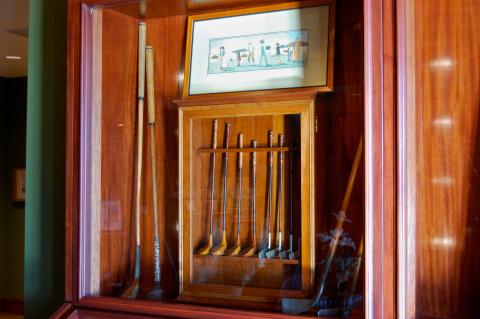 were quite nice, and although we decided to roll the balls over in the fairway, we could have played them up (save for a little mud that clung to the ball a few times). Tee boxes were in nice shape as well, and the Bermuda rough was matted enough to provide lies almost the equal of those in the fairway. Offline shots at The Thistle are not penalized unless, of course, you find one of the many huge bunkers or lakes that are incessant parts of the design. Of course, the contrast of brown rough with bright green fairways was eye candy, especially for a Connecticut boy whose brownish-green lawn has been buried under snow for a month.
Sand and water everywhere
The Thistle's three nines help to keep players moving along. The Tim Cate layout on the West/South combination we played was solid, but with few memorable holes (although a few memorable shots over water). The 4th hole on the South nine fit the memorable criteria, a severe dogleg right par 5 bordered along the right side by a lake from tee to green that forces a tee shot on a line away from the green. Long hitters can probably chew off an extra 100 yards of fairway, but for the rest of us, there was little chance of having a second shot from much inside 260 on the 515-yard hole (from the blue tees; 543 from the back tee).
The 18 holes we played seemed less difficult than the slope rating of 133 from the blue tees. The Thistle's degree of difficulty is in the long carries off a few of the tees and the subtle breaks on the smooth greens. Water came into play on 13 of the holes we played, and sand was something of a factor on every hole, yet the hazards seemed more for framing than ball gobbling. Only the highest handicappers should go through a sleeve or two of balls; The Thistle is designed for a pleasurable yet expeditious round. For all the hazards, we played in four hours flat, but would have been under 3 ½ if not for the cart-paths-only restriction and the long walks back and forth across the wide fairways.
Condition critical
After the round, Tim and I debated the course's virtues. At 20, and a frequent contributor to Golf Club Atlas, a web site for professional golf architects and course critics, Tim has more orthodox notions of golf course design than I do. For example, he prefers unkempt grasses growing from around bunkers to The Thistle's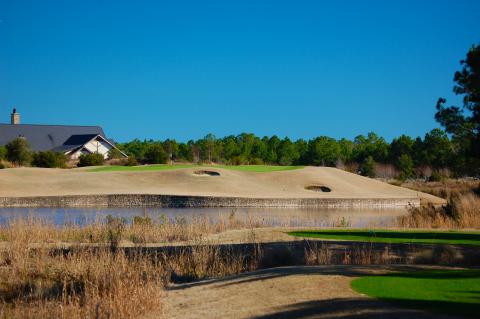 closely cropped edges. He prefers his greens with stronger contours than the subtle surfaces at The Thistle, where architect Cate's design seems conscious of the need to get average players on and off greens without too much fuss. Although he admitted the course was in nice shape, Tim disagreed with me about the weighting condition should be given in the assessment of a course. I figure that half the strokes in a round are on or around the putting greens, and I thought The Thistle's greens were as good as any I have played in the Myrtle Beach area, Caledonia Golf and Fish Club included. Any course that provides such smooth rolls on big and interesting greens should receive proper recognition.
The Thistle golf course will challenge most clubs in the bag, especially the putter, and what the layout lacks in drama the club more than makes up for in condition, atmosphere and service aimed at treating its visitors like members. For value and quality, The Thistle golf community is one of the best buys on the Carolinas coast.
Note: The Thistle is just one of an outstanding selection of golf communities between Myrtle Beach, SC, and Wilmington, NC. Others to consider include St. James Plantation and Ocean Ridge Plantation, which between them feature eight excellent golf courses; and River's Edge, Crow Creek and Brunswick Plantations. If you are interested in visiting any or all of these, please let me know and I will be happy to make arrangements for you with each of the communities. There is never a charge or obligation for this service.
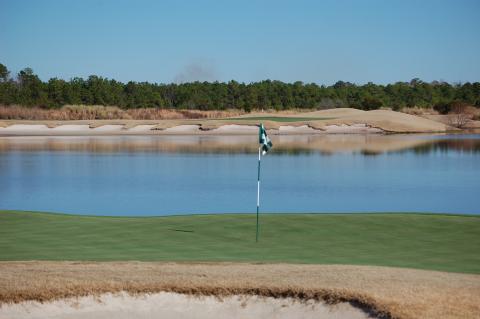
A big lake separates the par 3 3rd green from the 4th green on the South course. The 4th hole is a roundhouse par 5 that forces a long tee shot over the water.
Golf community in South Carolina for sale
Centex offers 3.5% rate on new homes
Location. Location. Price
Happy New Year
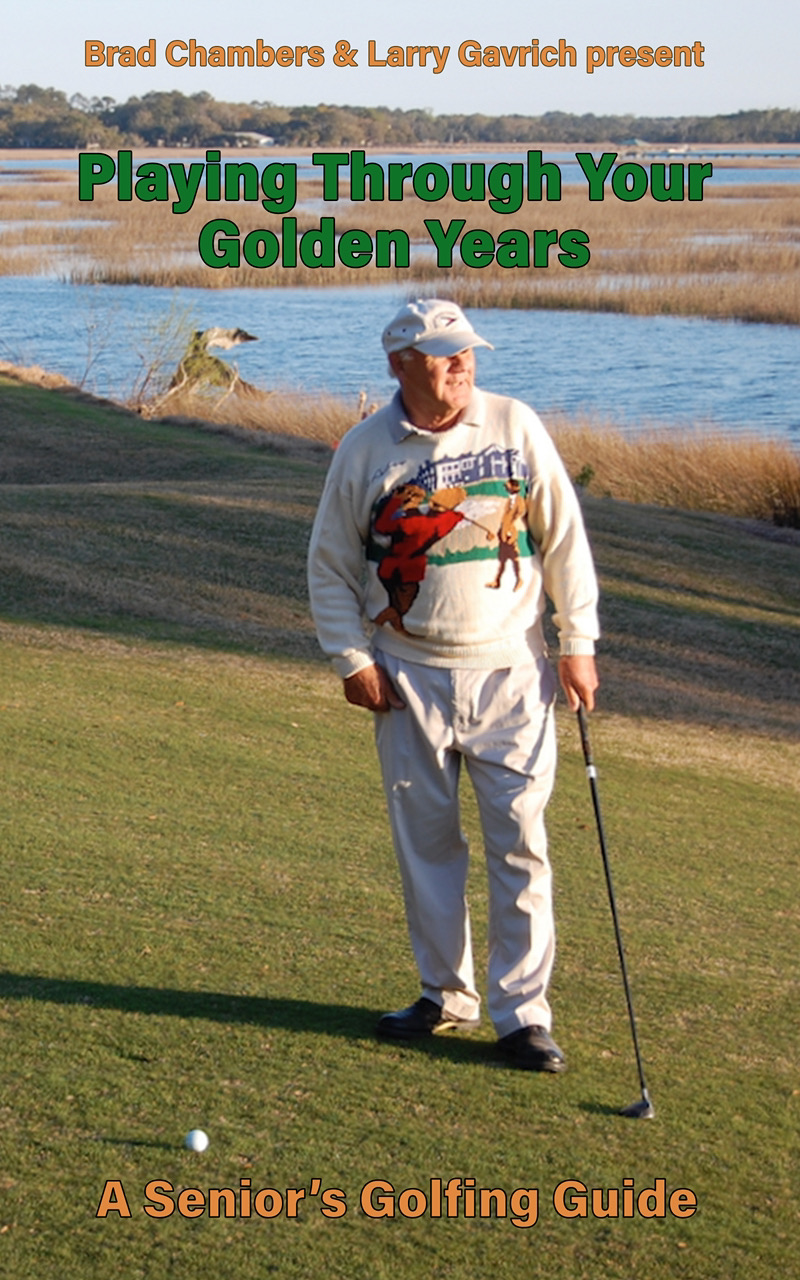
Now on Sale

- The only book about golf communities in the last 10 years.
- 156-page step-by-step guide to finding your dream golf home.
- Info on nearly 100 golf communities the author has visited.
- Paperback version costs less than a sleeve of Pro VIs.
Here is what the experts are saying:
“The book is chocked full of information…applicable to anyone looking for a move to the Southeast regardless of whether they are looking for a golf community or not.” — John LaFoy, golf architect (Linville Ridge CC, CC of Charleston, The Neuse GC)
“Larry has done a tremendous amount of work and anyone — like me — who is looking to search for a golf home now or in a few years needs this book.” — Brad Chambers, golf blogger, ShootingYourAge.com
“Wow! What a thorough piece of work…a must for anyone moving South. This book will help many people.” — Brett Miller, owner and founder of MMA, Inc, a golf industry consultancy
Buy It Now at Amazon.com or BarnesandNoble.com.