Developer Ginn's reach may exceed its grasp
It never is.
For a business that depends on positive public relations, Ginn Resorts has certainly had its share of bad press lately. Just last week, the developer announced that the Ginn Tribute, the LPGA tour stop at RiverTowne Country Club in Mt. Pleasant, SC, was kaput, two years short of his original commitment. Annika Sorenstam, whose name was on the tournament marquee with Ginn's, retired just in time. The published cause of the tournament's demise was lack of sponsors, but one could reasonably argue the cause was lack of sponsors who wanted to share any spotlight with Ginn, given his empire's shaky status. Ginn Resorts is under attack from residents of its communities who are still waiting for amenities promised years ago, from its lenders (Credit Suisse among them) and from a growing legion of bloggers who know the Ginn Resorts better than I do.
One of the bloggers is Marian Schaffer who, along with her business partner and husband Terry Molnar, runs a Chicago-based real estate firm that helps people find homes in the southern U.S. Marian has visited virtually every one of Ginn's properties. She and Terry understand the southeastern U.S. leisure residential market as well as anyone, and I rely often on their advice and guidance. In return, I contribute to them my thoughts about golf communities they should consider recommending, or not, to their clients.
Schaffer Realty Group's new blog at SouthernWayofLife.com is loaded with insights and advice. It includes an especially interesting piece on Ginn's problems, with Marian sharing her own personal insights from working with Ginn executives over the last seven years. Marian pulls no punches, and if you want to understand where Ginn is coming from, and where he might be headed, it makes compelling reading. Click here for a link to the story.
 Home On The Course newsletter
Click here to sign up for our Free monthly newsletter, loaded with helpful information and observations about golf communities and their golf courses.
My own course gets a touch-up
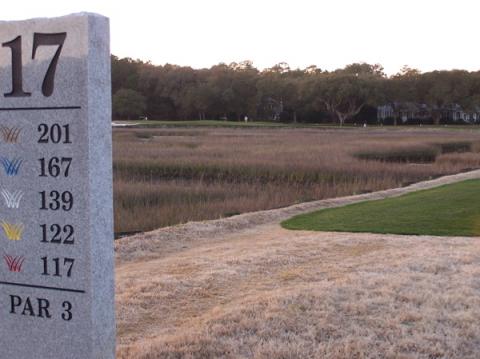
The par 3 17th at Pawleys Plantation plays from the dike over the marsh to a green that is only about 40 feet deep. It is tough enough when the wind doesn't blow.
The quality of the turf at Pawleys Plantation, my vacation course in Pawleys Island, South Carolina, has been somewhat inconsistent in the nine years since we bought our home there. But after hundreds of thousands of dollars in renovations, things are looking much better.
In late June, during my last visit, the practice range was closed for an expansion of about 25%, from 8,000 to 10,000 square feet. The tees on the unique dike, which once served to control water flow to the rice plantation that preceded the golf community, had been built up and re-sodded. Two great par 3s, the all-carry #13 and #17, play from the dike over the marsh to greens not very deep (and much less so when the wind blows, which is just about always). And the fairways were in about the finest condition I recall. Even the Tif-Bermuda greens, usually a little thin, seemed to have sprouted some extra green.
In recent months, owners of the Jack Nicklaus Signature course, which caters both to members and resort guests, have also brought in a boatload of sod to smooth out areas alongside the fairways and cart paths. The course is really being spiffed up, and I can't wait to get down there in the coming months to give it another go.
As for golf real estate in the community, prices have eroded a little, but much less than 40 miles north in Myrtle Beach with its higher inventory. Vacation condos in Pawleys Plantation that were selling for around $225,000 and up a couple of years ago have settled back about 10%. More houses are on the market in Pawleys Plantation than at any time we have owned over the last nine years, but prices for single family homes seem to be holding up as well.
Obviously, I know the community well so if you would like more information, let me know. Just use the Contact Us button at the top of the page.
Great bones: Manchester long on pedigree, short on pretension and distance
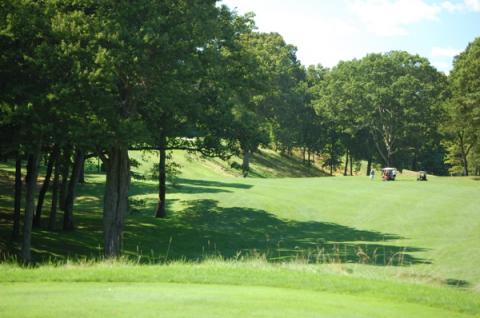
Manchester Country Club presents options on many tees. At the par 4 13th, you can take your drive over the trees (risk) for the possibility of a lob wedge to the green (reward). Or aim down the right with a five wood and you will still have less than 125 yards in.
Manchester CC, just outside Hartford, CT, has a high-class pedigree but aims at the average Joe, charging reasonable green fees and offering a membership program that, for the three-day-a-week player, cuts the pro-rated green fees even further. It is a nice alternative to higher priced private clubs, some of which would love to boast a layout originally designed by Devereaux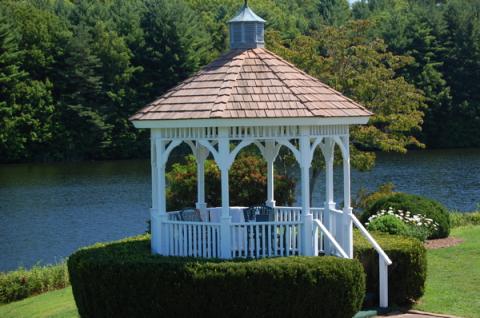 Emmet (Hartford GC, Congressional, Garden City) and reworked by the renowned A. W. Tillinghast (Winged Foot, Baltusrol, Ridgewood). Besides a discreet nod to the two famous golf architects on the front of its unfussy scorecard, the very public Manchester puts its emphases in the two best possible places -- service and the golf course. So organized are the folks at Manchester that, as we arrived yesterday, the starter informed us they were running a little ahead of time on the first tee. I have never been greeted that way at a public or private golf course.
Manchester is a delightful course, in fine condition and short enough from the tips at 6,300 yards that I was able to play a competitive round against my son, Tim, yesterday (his stroke index is nine better than mine). The course plays to a rating of just 70.6 and slope of 128. The longest par 4s, both at 410 yards, are also the #1 and #2 handicap holes. Blind tee shots, of which there are a good number, are not of the tricky variety, and a newcomer can play straight over the hills without fear of going into woods or other hazards (as long as the tee ball is straight). The course presents plenty of birdie opportunities for disciplined players, no matter their length off the tee. Some holes take driver out of the long hitter's arsenal. Right off the bat, on the first hole, a 324-yard par 4 that slopes right to left toward a lake, a long iron is the right play. My 3-iron hybrid left me with less than a 100-yard approach into the green.
With one exception, the par 5s are reachable in two shots for most players. (Oddly, the two par 5s on the front nine run consecutively, as do the two on the back.) The first three par 3s are all short (under 155 yards) but the last one, the 18th hole, is a splendid one-shotter, one of the toughest holes if you don't hit the ball straight to the severely two tiered green. If the pin is on the smaller back tier and you miss the green right or left short or long, you must pitch toward the cup along the steep ridge. If the pin is at bottom, as it was yesterday, you can use the hill between the tiers as a backstop from the tee, but if you are pin high either right or left of the green, as I was, your chip shot will hit hard against the hill and keep going (as mine did). If you are long, your chip shot down the hill will put you off the front of the green. In short, miss the green and you will be reconciled to bogey.
Manchester uses elevation changes to great advantage, but the only elevated greens that inspire a little sweat from the fairways are those with pins near the front. The greens held shots, but even mid-irons that were well struck rolled 10 feet beyond their pitch marks. A few of the short holes at Manchester are excellent birdie opportunities, even with something less than a driver off the tees, but others demand precise placement. Most memorable for me was #13, a 343-yard par 4 with encroaching trees on the left that dare you to fly over them to the fairway just below the steeply elevated green. From there, a simple lob wedge to yesterday's front pin position was the best play. But most players will opt, appropriately, for a five wood or rescue club aimed at a lone tree on the right edge of the fairway. From there, the approach is about 120 yards, short enough to loft a shot to the green and stop it. It is a beautiful hole, filled with risk and reward.
For those of us who don't hit the ball as far as we once did but still want the rush of playing from the tips,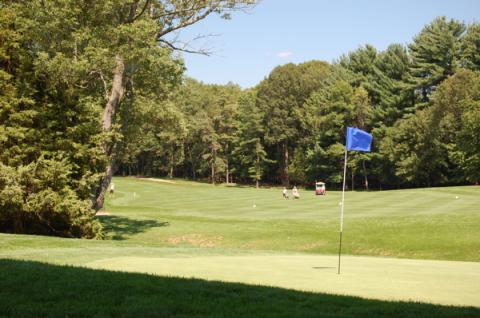 Manchester is the perfect kind of course, challenging yet short enough to offer the promise of breaking 80 if all things go well. Some might complain about typical slow play at popular public courses, but the round at Manchester took us 4 hours and 20 minutes on a Sunday afternoon, certainly within the realm of acceptable, if not speedy. The experience reinforced my notion that, for many, membership in a fine public course can be more rewarding, literally, than private club membership (to the tune of around $300 or more saved per month). The little cupola behind the first tee and overlooking the adjacent reservoir is a very nice touch, worthy of any private course.
Although it is 30 minutes from my home, I may just consider making Manchester my club of choice next year.
Manchester Country Club, 305 Main Street, Manchester, CT. (860) 646-0103. www.mancc.com . Annual membership: $2,000 (approximately). Not much in the way of locker room facilities, but most open their trunks, lace up their golf shoes, and head for the first tee. Only a few homes are within view of Manchester's fairways, and none are close enough to affect play or distract the golfer. Housing stock within a few miles of the Manchester course runs the gamut from apartments and condos to single-family homes, neat, well kept and priced low enough to be contenders for a summer home close to a classic golf course.
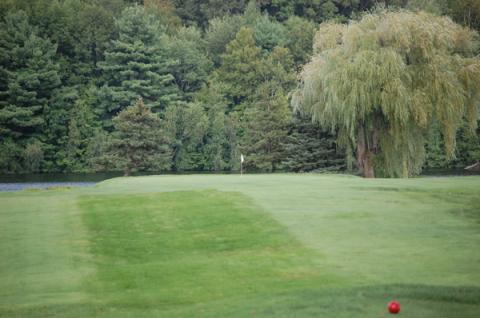
From 192 yards away, Manchester's 18th green (above) appears benign and approachable, but if your shot does not find the correct tier (below), bogey is almost inevitable.
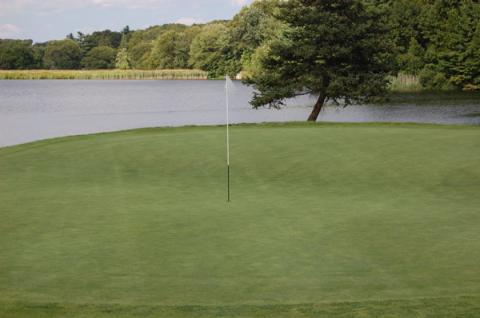
Tough ones: Tanglewood Championship Course, Clemmons, NC
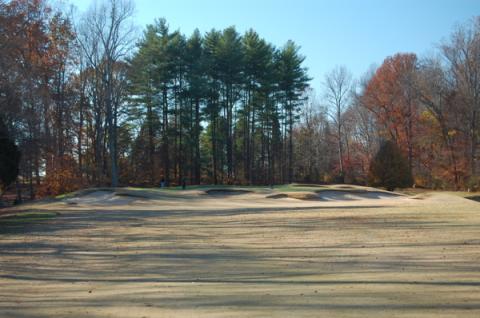
The approach to the 5th green at Tanglewood will set your heart aflutter for a few reasons.
Over the history of the PGA Championship, the Tanglewood Championship Course near Winston-Salem, NC, has been one of the toughest, tougher on the pros than such legendary tracks as Medinah, Winged Foot and Southern Hills. When Lee Trevino won the 1974 PGA at the public golf course, set on land granted to the county by the mega-wealthy Reynolds Tobacco family, he carded a four-under-par 276 and beat Jack Nicklaus by a stroke. Alas, that would be the one and only major tournament that the excellent Tanglewood Championship Course would host.
Arguably the toughest hole Trevino, Nicklaus and their competitors played was Tanglewood's par 5 5th, an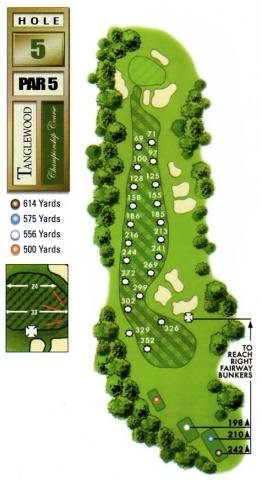 endlessly long, relentlessly bunkered and masterful Robert Trent Jones design. Played at 614 yards from the Championship tees and a similarly intimidating 575 yards from the "mid back" tees, #5 is rated the number-one handicap hole on the card.
From the mid back tees (6,600 yards overall), your tee shot must stay left of the huge bunkers that guard the right side about 200 yards from the teeing ground to about 260. Hit your ball in that direction and you can count on a tricky second shot back to the fairway (and a long third shot). Even if you find the narrow bit of fairway to the left of the bunkers, your ideal lay-up shot to inside 150 yards, probably with a long iron, will have to avoid another set of three bunkers just to the right of the fairway, as well as the trees down the left.
As you contemplate the approach shot from 125 yards or so, you won't know whether to shake your head in marvel or fear. About 70% of the green is protect by four bunkers, including an unusual small one directly in front that runs toward the green, not alongside it. If you find that little slit of a bunker, you are likely to have an awkward lie against one side or the other and, therefore, an awkward stance.
As reward for the golfer who makes the putting surface in three good shots, the green itself is of modest size and offers some pin positions that make birdie possible, if not likely.
Golf course raters sometimes are biased in favor of the longest holes, forgetting that some par 3s and many par 4s may indeed be the toughest. But at Tanglewood, the brutish #5 is worthy of its designation as the #1 handicap hole.
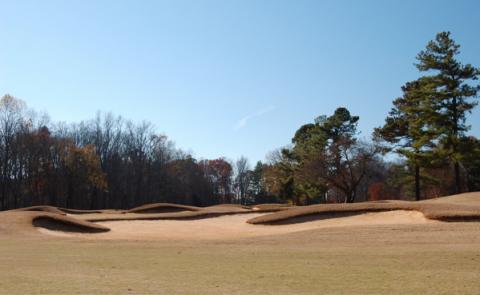
If you push your tee shot just a little right on Tanglewood's 5th, you could wind up in any of three huge bunkers (above), making a play back down the fairway to inside 150 yards to the green very difficult. The second set of fairway bunkers (below) come into play as well.

Chip shots (and cheap shots)
What happens in Vegas may not stay there
It appears we may have more than Angelo Mozilo, Countrywide Financial and their ilk to blame for much of the housing crisis. According to today's real estate update from the Wall Street Journal, as the housing market started to show signs of tanking, many builders and developers offered incentives so tempting that the housing boom was artificially prolonged. Some experts believe that may have eventually deepened the crisis.
Allegedly the developers offered incentives worth up to $100,000, including cars and other toys, all in an effort not to cut prices, something developers live in fear of (imagine what the guy who paid full price the week before will think when his neighbor buys in for 25% less, and imagine the message it sends to the market).
The Las Vegas division of giant homebuilder Centex, the Journal reports, paid off car loans, mortgage payments, and credit card bills to entice home owners to purchase Centex homes. Mortgage lenders knew nothing of these deals.
Apparently what happens in Vegas won't necessarily stay in Vegas; the FBI is investigation Centex and others who offered such incentives and deceived the mortgage companies.
One way to Pebble Beach
For those who want to live in the neighborhood of Pebble Beach for the rest of their lives, the famed "House on the Hill" has come on the market. Also known as Casa Ladera, the 1930 Mediterranean estate offers a 7,500 square foot home and separate guest quarters with dramatic ocean views, all on three acres. It is being offered for $17.5 million, but certainly the owners would be willing to knock off a few thousand at least, which you can then parlay into green fees at Pebble (now approaching $500). No word if the real estate agent with the listing can get you into Cypress Point if you buy the House on the Hill, but let me know if you are interested (insert smiley face here), and I will see what I can do.
Trump's new tenant
Good news for Ed McMahon, Johnny Carson's famous foil. You may know that Mr. McMahon's six bedroom, multi-million dollar home in California has been on the brink of foreclosure for months, and that the octogenarian was getting close to being thrown out on the street. But the good news is that a white knight - well, okay, a blond knight -- has burst onto the scene to save the day by offering to purchase the mansion and lease it back to Mr. McMahon. The deal isn't quite done, but if all goes well, McMahon's new landlord will be Donald Trump. Despite Mr. Trump's penchant for doing whatever keeps his name out front, we are willing to say this is a nice thing Mr. Trump has done. However, the statement from his PR machine is bizarre, puffing up Mr. Trump at poor Mr. McMahon's expense.
"Even a man who hadn't had such a great career," Mr. Trump said in a statement released by his office, according to the Journal, "shouldn't have this happen to them in their later years."
Mr. Trump's one hand giveth, and the other hand taketh away.
Caveat emptor
This year's cycle of LiveSouth shows begins in North Central New Jersey at the Parsippany Hilton September 5 thru 7. The shows feature dozens of communities in one place, and many of them feature golf courses. It is a great place to collect brochures and ask a lot of questions about specific golf communities, but not the best place to find totally unbiased information. The planned communities pay $5,000 or more for the privilege of promoting themselves at the shows, and the representatives are there to encourage you to visit their properties. Go by all means, but understand that the photographs are beautiful, the sales representatives are enthusiastic, and all the places seem like paradise. Oh, any if you leave them your name, count on a full mailbox and the occasional phone call.
If you do visit a LiveSouth show and see some places you like, especially those with golf courses, let me know and I will give you an unbiased, objective opinion (use the Contact Us button at the top of the page). Upcoming LiveSouth show stops include Reston, VA (9/12-14) and Melville, NY (9/19-21).
Timing the market: Greenspan predicts housing market turnaround
Well, we know that the chairman's sense of timing was impeccable, if a tad suspicious. But there has been nothing gentle about Greenspan's "retirement." Unlike past Presidents who do a pretty good job of not criticizing their successors, regardless of their party affiliation, Greenspan has not been able to restrain himself regarding current Fed policy. His latest salvo, the other day, savaged his former organization for throwing a lifeline to Fannie Mae and Freddie Mac.
Most of us are not qualified to understand economic theory and the Fed's decisions in all their exquisite complexities. (Although could any of us have done a worse job of managing Fannie and Freddie?). But am I the only one who thinks it unseemly for the guy who left the steering wheel just before the ship hit the iceberg to criticize his successor so publicly?
If nothing else, Mr. Greenspan is a master of timing. And bitter though he may be about being out of the "arena," his predictions about the economy
"Home prices in the U.S. are likely to start to stabilize or touch bottom sometime in the first half of 2009," Greenspan told the Wall Street Journal. He qualified his opinion a bit, adding that "prices could continue to drift lower through 2009 and beyond."
He has not been wrong often, and his prognostication is worth listening to, maybe even acting on, even if it bumps against the logic of increasing foreclosures and joblessness rates and falling home prices. I don't have the economic charts in front of me, and I wouldn't know what to do with them if I did, but I do have 61 years of being part of the baby boomer generation, and here is my take:
Many baby boomers have deferred selling their primary homes despite deep desires to move to the next phase of their lives in a new, more relaxed environment (say, a golf community). They remember when their homes were worth so much more just five years ago. They have built a psychological barrier for themselves, one that says, "I worked hard for this home and I am not going to sell it for less than it is worth." Only a few cold-hearted financial executives among us can reconcile that our houses are worth what someone will pay for them, not what we think they are worth.
But baby boomers want what they want when they want it - remember, I speak with some personal authority here. And if Mr. Greenspan is right about stabilizing prices, next year or maybe the year after, baby boomer owners of many of these homes will look at the modest increase in their house value and the psychological barriers will come down. We will pat ourselves on the back for having waited out the crisis, we will take a percentage point or two more than we think we could have gotten a year earlier, and off we will go. This is more about ego than it is about money, especially for those who have owned their homes for a decade or more. They are way ahead of the game.
If Greenspan's first instinct is correct, and if my little pop psychology is as well, then it is likely prices in the southeast will move up as quickly, probably quicker, than elsewhere. Seacoast and mountains, what most boomers have dreamed about for years, are abundant in this part of the country, and there is a lot of unsold inventory priced at a discount to past and future prices. For a certain period of time, boomers with the stomach to take just a little less than their primary homes are worth will have the pick of the litter at some nice prices.
If I am wrong, blame Greenspan. He will blame Bernanke anyway.
Drilling down: Housing market data best at micro level
Today's listing in the Courant is a reminder that the housing market is local and that national, regional, statewide or even town data are misleading, as well as scary, in the current market. I say "scary" because the macro data is much more depressing than some of the local data.
In West Hartford, for example, a popular town with an excellent tax base and convenient services, housing market data across the four zip codes are all over the place. Median prices are down year to year in three of the zips - by as much as 7.3% - but they are up 1.7% in zip code 06110. The median prices of condos are up in three of the zips - not the same three as above - and down 22% in the other. And over the past year, foreclosures are down in one zip code, level in another, and up in the other two, in one case a staggering 117% (a total number of 13 foreclosures, not inconsequential for one zip code).
Such inconsistent data can be confusing, and if I were moving to West Hartford, or any other town for
What role do foreclosure numbers play? In West Hartford, the zip code with a 117% increase in foreclosures saw only a modest decrease in sale prices (down 1.3%). In the zip code in which prices softened the most, 06107, the foreclosure rate dropped the most as well, and the median price of condos in that zip code increased by 158%. (Note: Some new, upscale condos skew the numbers, but if the developers can get those kinds of prices in this market, it implies something positive about that zip code's attractiveness.)
It is all quite confusing, but the bottom line here is that it is better to have information than not. And the best information is the most local.
Test drives: Southeast developer offers golfers opportunity to be Member for a Day
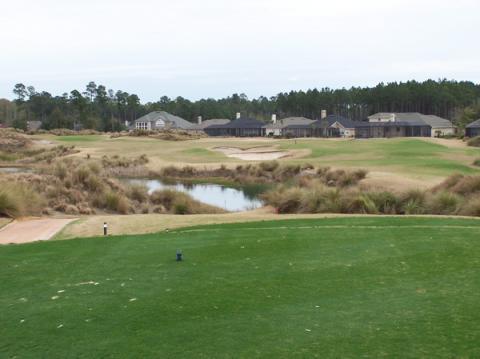
If there is anything wrong with the links-style layout at North Hampton Golf Club, it is that homes are often in view just off the fairways, although rarely near the field of play.
These are perilous times for big national developers whipsawed by the housing crisis, and they are pulling out all the stops to reduce their inflated inventories. Virtually all of the name developers, as well as smaller ones, are pricing their homes aggressively and offering other attractive incentives. But given the beating that real estate investors have taken, no one is going to buy a home without visiting their future property at least once. So developers are not only sharpening their price reduction pencils but they are also concentrating on more creative ways to attract potential buyers to make that visit.
One of the most prominent developers in the southeast, LandMar, is making a special appeal to golfers in that regard, offering a Member for a Day plan for those looking for a vacation or permanent golf home in the southeastern U.S. The Member for a Day (or Stay and Play package at some of their developments) offers all the privileges of club membership to the non-member who is willing to be shown around a LandMar golf community for a few hours.
Florida-based LandMar's roster of developments is impressive, spanning Florida and Georgia and including communities with highly regarded golf courses like North Hampton in Fernandina Beach, FL, and Osprey Cove
The LandMar Member for a Day package includes a round of golf per person, the required community tour with a member of the sales staff, and access to all the facilities. In truth, though, North Hampton is available to the public for play, so if you wanted to avoid the community tour, you could pay a little more and test the golf course before you take the tour (green fees are incredibly reasonable for this quality of golf, around $60 on a weekday, cart included). My experience with these tours is that they are not hard sell, they do not take more than a couple of hours, and the sales people are generally open and honest with answers to your questions.
North Hampton still has a few home sites available at prices beginning in the low $100s and some built homes starting in the $400s. Amelia Island and its beaches (and resort golf courses) are just a few minutes away, and the increasingly popular city of Jacksonville about 20 minutes away. If you are considering a slightly more rural golf community, LandMar's Osprey Cove, about 40 minutes north of North Hampton and near the charming St. Marys, GA, offers not only Member for a Day but also a stay and play package for just $99 per night that includes golf on its private Mark McCumber course. I've visited Osprey Cove and liked it, although rain prevented me from playing the golf course. Home site and house prices are lower than at North Hampton but the low country environs, for me, are even better.
I have contacts at both Osprey Cove and North Hampton, as well as other golf communities in the Jacksonville area, so if you are interested, contact me and I will get you more information and put you in touch with the person best able to help you with golf arrangements or a stay and play package.
Peoples choice: GolfLink list defies logic
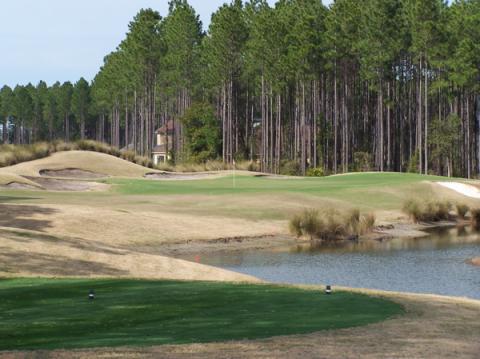
North Hampton Golf Club in Fernandina Beach, FL, ranked #45 on GolfLink's list of best courses in the U.S., ahead of the Ocean Course at Kiawah Island and Torrey Pines. Golf homes adjacent to the Arnold Palmer course are reasonably priced beginning around $350,000. Above is the par 3 14th hole.
The popular web site GolfLink.com published its take on the top 100 courses in the U.S. recently. According to the web site, the list reflects the opinions of its millions of readers rather than experts ("editors of golf magazines"). It shows. As in major league baseball, whose all-star teams are largely decided by fan votes, the results can defy logic.
The top 10 is all over the place. I won't bellyache about #1 on the list, Bethpage Black on Long Island, NY, a
I don't know Kearney Hill Links in Lexington, KY, a 20-year old Pete Dye layout that ranks fourth on GolfLink's list. The courses rated #5 thru #7 all have solid reputations, respectively Riviera Country Club in California, World Woods (Barrens Course) in Florida and Koolau in Hawaii. The problem with the list really begins at #8 where GolfLink's readers place the wonderfully wacky, but not-to-everyone's-taste Tobacco Road in North Carolina. I suppose there is a list somewhere on which Tobacco Road should rank in the top 10 -- perhaps the list of most acres of un-raked sand -- but a best-courses list is not it. Tobacco Road's eighth place rating puts it ahead of Pebble Beach, Spyglass, Shinnecock, Merion, Oakmont and dozens of others it should trail.
As you move down the list, the choices become more and more illogical. Baywood Greens in Delaware is a
I also scratch my head over the 45th choice, North Hampton Golf Club in Fernandina Beach, FL, the best Arnold Palmer designed course I have played. It is a fine links style course a few miles from the beach, and its attractions include tall grasses that appear native, well placed bunkers (and not as huge as the typical Palmer traps) and shore breezes that can play with shot selection and your head. But if North Hampton is better than the Ocean Course at Kiawah and Oak Hill, as the GolfLink list suggests, someone had better let the organizers of the Ryder Cup know.
There are plenty of reasonably priced golf homes and properties near many of these courses. If you would like more information about golf communities in these areas or about other golf real estate, let me know by clicking the Contact Us button at the top of the page.
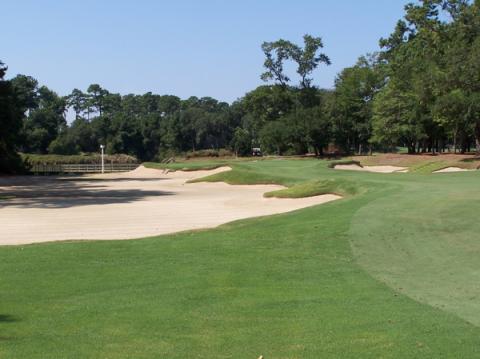
Caledonia Golf & Fish Club in Pawleys Island, SC, is rated 15th on the GolfLink list of best U.S. courses (approach to the par 4 13th hole is shown). Caledonia's sister course, True Blue, came in at 38th, ahead of courses that have hosted U.S. Open and Ryder Cup competitions. A number of condos priced in the low six figures are adjacent to a few of the fairways at True Blue.
Mountain golf communities trip: Tell me where to go
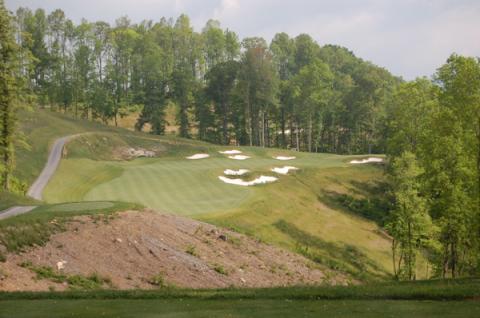
I am hoping to play the new nine-hole course at Bear Lake Reserve, sited on the top of the mountain at the four-year old community near Sylva, NC.
I am putting together a five-day trip to the mountains of western North Carolina for the first week in September. My plans are to visit a few golf communities within an hour or so south of Asheville, an arc roughly from the Rutherfordton/Lake Lure area to Waynesville/Sylva and including the Hendersonville/Flat Rock area. Candidates on the list include Bright's Creek, Balsam Preserve, Cummings Cove, Queens Gap (Nicklaus golf course under construction) and possibly a round of golf at the Grove Park Inn on its famed Donald Ross course. If time permits, I might make a stop to play a quick round at Bear Lake Reserve, whose stunning nine-hole course opened a few days after my visit in June.
If you are interested in golf real estate in this popular and beautiful area, let me know which golf developments you are interested in, and I will try to put it on my visit list. Just use the Contact Us button in the tool bar above (or click here), and I promise to respond quickly.
Tough ones: Tobacco Road #9
Chateau Elan Winery & Resort, Braselton, GA
Cuscowilla Golf & Country Club, Eatonton, GA

Now on Sale

- The only book about golf communities in the last 10 years.
- 156-page step-by-step guide to finding your dream golf home.
- Info on nearly 100 golf communities the author has visited.
- Paperback version costs less than a sleeve of Pro VIs.
Here is what the experts are saying:
“The book is chocked full of information…applicable to anyone looking for a move to the Southeast regardless of whether they are looking for a golf community or not.” — John LaFoy, golf architect (Linville Ridge CC, CC of Charleston, The Neuse GC)
“Larry has done a tremendous amount of work and anyone — like me — who is looking to search for a golf home now or in a few years needs this book.” — Brad Chambers, golf blogger, ShootingYourAge.com
“Wow! What a thorough piece of work…a must for anyone moving South. This book will help many people.” — Brett Miller, owner and founder of MMA, Inc, a golf industry consultancy
Buy It Now at Amazon.com or BarnesandNoble.com.