#13 at Pawleys Plantation: Shortest par 5 in America
My son and I are playing today in the Pawleys Plantation Independence Day scramble. Pawleys Island, SC, is where our family hunkers down for a good part of the summer. Tim and I haven't met the couple we have been matched with but look forward to making their acquaintance, having an enjoyable round and, perhaps, hearing our names called during the late afternoon awards ceremony (check back here later for results, if you are interested).
One hole on our Jack Nicklaus designed marshland course, which opened in 1989, may determine who
Because it is a scramble (Captain's Choice) tournament today, we will play from the white tees, the second shortest; the female member of our team will play from the shorter reds, just 45 yards or so. The white tees on #13 are a ridiculous 69 yards out (the blue tees are just 115 yards and the back tees 145). If the tide is out when we come through the 13th around 3:30 p.m., the short but intimidating shot will be even more intimidating for all the golf balls we will see below stuck in the muck. Once we get to the green, we will see a like amount of balls in the marsh beyond. When you land on the back third of the surface, typically the most you can hope for is a roll into the narrow strip of rough (like 18-inches narrow) that grows between green and rear bulkhead. But because the surface is firm -- we haven't had more than a thimble of rain the last week -- most shots that land beyond mid-point of the green bound off the back and over the bulkhead.
Yesterday, in talking about today's scramble, one of my neighbors described #13 as a "67-yard par 5." I have probably played the hole 60 times over the last 10 years, from the 115 yard tees, and I do not believe I have had a bogey four on the hole more than a couple of times, fewer than I have made birdie actually. The chip from the drop area, although entirely over dry land, is a long, curling affair sideways to a green that slopes back to front. If the pin is at back, it takes the deftest of shots to keep the ball along the ridge that leads to it; count on a 10-foot or longer uphill putt for bogey. If the pin is middle or front, you must play the ridgeline to get it down to the hole, a delicate proposition. If you concentrate on line and not on distance, it is easy to leave the chip 25 feet short or, worse, hit it off the other end of the green and into the marsh. Because the green is small, three-putts are rare for the decent player. If you are on in one, par (or better) is pretty much assured. Bogey is a rare score on the hole; you either make 3 or 5.
I haven't kept all my scorecards over the years, but I am sure I am well over par at #13, which makes it about the shortest par 5 in America. With four shots at the green in the scramble today, maybe one of us can keep our tee shot on terra firma and give the group four putts at a birdie. I will report back here later tonight.
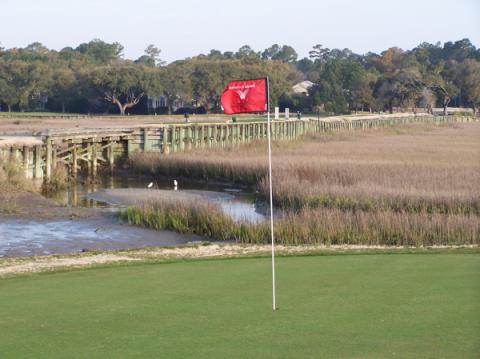
Today, we will play the 13th at Pawleys Plantation from just 69 yards (this shot from the back of the tiny green). Given a choice, a full swing with a pitching wedge from, say, 115 yards, is much easier than a flip sand wedge from 69 yards. If the wind is blowing, both shots are problematical, but at least we will have four shots at it today in our scramble format.
 Home On The Course newsletter
Click here to sign up for our Free monthly newsletter, loaded with helpful information and observations about golf communities and their golf courses.
Reserve deal falls through
More than 93% of the club's current members had voted in favor of the sale. The McConnell Group, which owns other private courses in North Carolina, had pledged to renovate the course immediately upon the sale and to keep the club private for a minimum of 10 years. Reserve members, like members at the other McConnell courses, would have received reciprocal privileges at the group's other clubs, which are within a 3 1/2 hour drive of The Reserve.
The Litchfield course was designed by Greg Norman. Other McConnell courses were designed by Nicklaus, Fazio, Palmer and Donald Ross. With the deal now seeming to be dead, Reserve members will likely have to choose among a range of alternatives to keep the well-conditioned course and nicely apportioned club up to snuff. Stay tuned.
Grip it, rip it and cry
While trying to think of a topic for this space today, I stared out the back window of our condo in Pawleys Plantation. The window faces the rear tee on the 15th hole, the toughest driving hole on a tough, South Carolina Low Country course (see photo below). The fairway is the narrowest on the Jack Nicklaus layout, a gentle dogleg left with dense trees and out of bounds guarding the entire left side and a few live oaks and out of bounds encroaching down the right. They are there to protect the string of condominiums that runs from the tee box almost to the green. The only good drive on the 15th is a controlled draw of about 220 yards on the fly from the tips, and how many of us can do that on command. The 15th, at 391 yards from the back tees, is one of the shortest par 4s on the course but, nevertheless, has ruined many a good round.
I have noticed that many times a day, a foursome from out of town, down in the Myrtle Beach area to
There are good reasons why courses make multiple tee boxes available (and even better reasons why some clubs suggest players play from certain tees). Over nearly 20 years, I have never played the back tees at Pawleys Plantation, even when I had my brief flirtation with a single-digit handicap. The course plays to over 7,000 yards from there, and a round of nothing but fairway wood and utility club approach shots is not my idea of fun. The blue tees at 6,700 yards, a course rating of 72.5 and slope of 137 is plenty of challenge, thank you very much.
I understand the thinking of a decent player on vacation who only gets one shot at a tough course like Pawleys Plantation. "Let me play it the way Nicklaus set it up to be played," the thinking might go. Breaking 90 from the tips for a 10 handicap would be a moral victory, for sure. But breaking 80 from the blue tees would be within the realm of possibility, and certainly more memorable. Trust me, it does not happen that often.
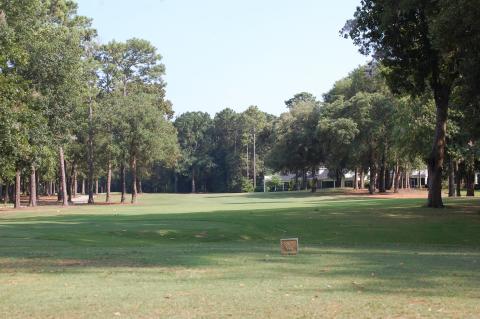
The 15th tee at Pawleys Plantation. The green is beyond the trees on the far left.
No vacation from the news
But there is one thing we haven’t escaped -– Mark Sanford, the wandering governor of our adopted state. The Myrtle Beach Sun News, whose front pages are typically filled this time of year with tourism-related stories, has mentioned the Appalachian Trail the last few weeks as much as written about the Grand Strand. Unless you have been deprived of all Internet, newspaper, and television access in the last week, you know
According to my neighbor in Pawleys Island, a full-time resident of the state, Governor Sanford had been a fairly good golfer early in his political career, certainly fitting in a state that depends so heavily on golf tourism. I wonder if he cheated at golf. There may be a natural connection between cheating at the game and treating cavalierly the women in your life. We have only to look back to William Jefferson Clinton, who notoriously dropped a few extra balls in the rough during friendly matches, for the archetypal example of cheater at the games of golf and relationships. Or the James Bond character Goldfinger who blatantly cheated at golf and painted his women to death, in gold leaf.
During Clinton’s troubles over the Lewinsky affair, then Congressman Sanford called for the President to resign, saying Clinton lacked “moral clarity.” Many South Carolinians are willing to forgive the governor his lapse of fidelity and are pulling for him to repair his marriage. But his hypocrisy – preach one thing, do another – is a different story. Within a few days or months, a suddenly ex-Governor Sanford may have to practice what he preached during the Clinton impeachment hearings. He may soon have a lot of time to recapture his golf skills.
Dataw Island Golf Club to renovate two courses
The Dataw Island Golf Club near Beaufort in South Carolina's Low Country will renovate its Arthur Hills and Tom Fazio golf courses. Fazio's Cotton Dike layout will close in March for nine months of work, followed by Hills' Morgan River course a year later. All but one of the courses' 36 greens will be planted with MiniVerde grass; club members had been "testing" one of the greens planted with the hardy grass.
Former Augusta National superintendent Billy Fuller will handle the renovation projects. At Augusta National, Fuller supervised the change from Bermuda to Bentgrass greens. Previously, he worked with Bob Cupp's design group.
I reviewed the Morgan River course and the community after a visit in March. To read the review, click here. If you would like more information about Dataw Island, please contact me.
Moving argument: Migration, cost of living studies encourage moves south
In 2008, United Van Lines, one of the nation's largest shippers of household goods, relocated nearly 200,000 customers. Most of them went south and west, many with golf clubs in tow.
United Van Lines has conducted a migration study for 37 years, and with such a large database of moves, the patterns among its customers reflect
On the other side of the coin, the "highest outbound" states among United Van Lines' customers were mostly across the northeast quadrant of the nation, and included Maine, Rhode Island, New York, New Jersey, Pennsylvania, Michigan, Indiana, Illinois and North Dakota. A "highest outbound" designation reflects 55% of moves leaving a state. All other states are considered "balanced" by the study; that is, moves into or out of the state make up no more than 55% of total. (Note: The highest inbound "state" was the District of Columbia -- the study looks at the continental 48 states and the nation's capital district -- with a 62.1% rate. I will leave to others any political comments about increases in the size of government, or Republicans following Dick Cheney's lead and sticking around Washington).
Of course, there are many reasons people move, but generally it is safe to say they do so for what they perceive as a better life. People in their

A serious golfer moving from, say, Long Island, NY to Roanoke, VA, could join the new Ballyhack Golf Club, and help pay for it, in part, by saving 38% on their costs of living.
Those leaving Boston, for example, according to a chart by ACCRA (American Chamber of Commerce Research Association) and published in Where to Retire magazine, will decrease their costs of living by moving to 64 cities across the nation, and increase their costs by moving to only two -- Honolulu (by 22%) and San Diego (by a mere 1%). A move from Boston to Savannah, for example, will drop costs by 30%, according to the ACCRA data, which measures costs of food, clothing, real estate, healthcare, transportation, utilities and a range of goods and services. Other COL improvements moving from Boston: Asheville, NC (25%); Austin, TX (28%); Charleston, SC (28%); Charlottesville, VA (19%); Greenville, SC (31%); Hilton Head Island (17%); Knoxville, TN (34%); Mobile, AL (30%); Myrtle Beach, SC (31%); Raleigh, NC (23%); Phoenix, AZ (25%); Wilmington, NC (24%). Note that the data does not include taxes, information which is easily available on the Internet. Suffice to say, however, that these cost of living "raises" moving from Boston to the south are significant.
Those moving from New York City, New York's Nassau County, Washington, D.C., and some cities in California where home prices appreciated wildly in the 1990s and early 2000s will enjoy larger cost of living decreases than Bostonites who relocate south. Those leaving Chicago, Philadelphia, St. Paul, MN and other northern cities will find slightly smaller decreases than those from Boston but the improvements are still double-digit percentages.
So what does this all mean? It means a lot for those who are flexible and have considered relocation to a warmer climate. First, if migration patterns
Second, the ACCRA data argues that for those who live in the high-priced states up north, a move south will put more money in their pockets. A 30% improvement in cost of living means more house for your money and the
I know; I am a broken record, repeating what I have written here before; and because I make my living from helping people find their dream home on the course, it seems I have a vested interest in getting people to sell and buy. Okay, fine, don't believe me; just check the numbers. You can find the United Van Lines data by clicking here. Unfortunately, Where to Retire does not offer the ACCRA chart at its web site, although they offer a "free" sample issue there. Otherwise, you will have to plunk down $4.95 at Barnes and Noble or some other store with a large magazine stand. Or, better yet, contact me if you want to compare a city near you with a city you might be considering. I will be happy to share the data and my advice, which is always objective and always free.
Coming attraction: July Home On The Course newsletter
If you missed out on our first issue, just fill out the subscribe information at the top left of this page and I will send you a copy and sign you up to receive the July issue and all future issues. The kind of unique advice you will find in Home On The Course is not cheap; it is actually free. And we will never share your personal information with any other person or business...unless, of course, you ask us to.
If you have any suggestions for topics we should cover on this blog site or in our newsletter, please let me know. All you need to do is click on the contact button at the top of the home page. I promise to respond quickly, and with my thanks.
Good golfing.
-- Larry
Educated prices: Study provides rundown of college town real estate pricing
That is why I appreciate a study by real estate firm Coldwell Banker which charts average house prices in many college towns. I first wrote about the study a couple of years ago (read here) but I was thinking about it again today as I toured a few college campuses with my daughter, who will be applying to schools in the fall.
For the most recent Coldwell Banker press release and charts on college town pricing, click here. When I am off the college tour, I will take a closer look and comment about where the best college golf courses are located.
Easin' on down The Road Hole
It has been exactly a year since my first golf trip to Scotland, my one and only round at the Old Course at St. Andrews, and one memorably played hole. I am feeling a bit nostalgic, not just because I would love to be back on the Old Sod right about now, but also because the 17th at the Old Course may be the last golf hole where I made three excellent swings in succession.
I birdied The Road Hole at St. Andrews, my only birdie on a day that saw me almost miss the widest fairway in golf -- heck, it's two fairways wide -- at the first hole and struggle to break 90 on a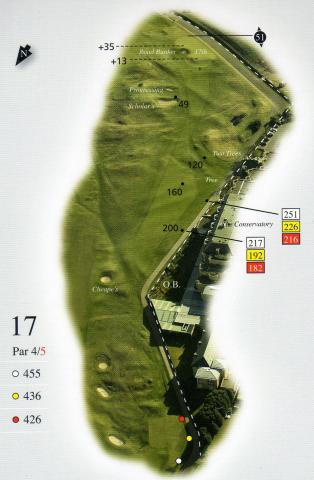 course that, for all the celebration, is not that difficult. Even though my drive off the tee at #17 needed to skirt the edge of the Old Course Hotel, rather than clear it, nevertheless the possibility of pushing one onto the roof was staring me in the face. I aimed well left, actually hit a slight fade, and wound up on the left side of the fairway, about 175 yards from the pin. From there I punched a five-iron, aiming about 10 yards or so in front of the green (I was finally getting the hang of that type of shot after 16 holes), and the ball bounded to about eight feet from the cup. I was happy to have a pretty sure par in the bag, and I stroked my putt confidently and into the hole for the 3.
I didn't play very well on my one and only tour around The Old Course. But I will always have The Road Hole.


Just maneuvering the ball around the Old Course Hotel and to a piece of fairway (top photo) was triumph enough at #17 on the Old Course. But when my approach wound up just eight feet right of the pin at the famous Road Hole, I was set for life with a great memory.
Houses at Thornblade's fine Fazio course are close...and that's not such a bad thing
A few years ago, I reviewed the Thornblade Club, the home course of new U.S. Open champion Lucas Glover (see yesterday's article below). I published the review in the original Home On The Course newsletter and included reviews of other golf communities on the south end of Myrtle Beach's Grand Strand as well as the three top communities in Aiken, SC. If you would like a copy of that newsletter emailed to you, send me your email address by clicking here and I will forward it to you.
Some of us may not want to spend our retirement days in an "organized" golf development where we pay extra for amenities we do not want. We are content to join a private club with a fabulous golf course and purchase a house nearby that has quick and easy access to all the things we want in a community. Thornblade, since 1987 one of the Greenville, SC, area's finest country clubs, provides an excellent reason to customize your golf-oriented-living situation.
The Thornblade Club is actually located in Greer, just 15 miles from Greenville and less than that to the Greenville/Spartanburg Airport. The club is intimate with the surrounding community of mostly brick houses on mostly small lots, which is a gentle way of saying the homes are in view and occasionally just out of play. The Thornblade course might feel claustrophobic to some, but we found that windows and roofs are substantially out of harm's way.
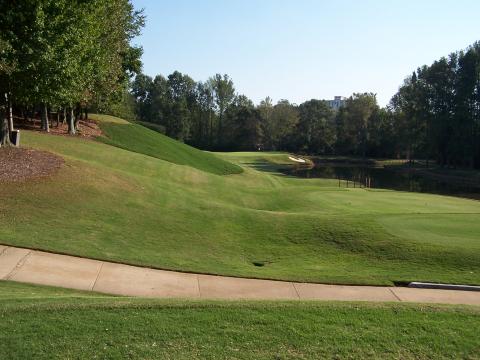
The par 3 11th at Thornblade is an all or nothing-at-all affair.
All homes available in the Thornblade community are re-sales, and the most upscale -- those abutting the golf course with ¾ acre and larger lots --exceed $1 million, but not by much. Champions Tour player Jay Haas lives in one of those. There are some three-story townhouses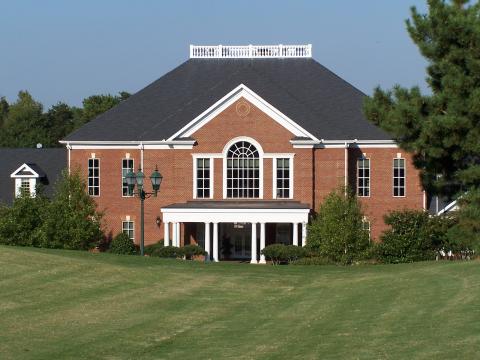 with golf course views available in the mid-six figures, and nice single-family homes on small lots for about the same. Many of Thornblade's members own houses in the neighborhood and can walk (or ride a cart) to the club. [Editor's Note: Although this article was written in 2006, prices today have receded to about the levels at the time of this review.]
The golf course is a classic mid-1980s design by Tom Fazio, with all the distinctive Fazio features we have come to love, including the funneled fairways, large multi-shape bunkers and amply sized, challenging green complexes. Built on 130 acres, the course appears to have been constructed after the houses were in place. Yet Fazio has created an unfussy design, tucking away the cart paths through the woods and behind mounding. It is a clean, sleek track, but by no means easy. The "Thornblade" tees play to a mild 6,300 yards but carry a rating of 71.6 and a chesty slope of 137.
For the low handicap player, distance from the Haas tees, named in honor of their noted member, is 6,700 yards with a slope of 143. Still, we saw many women on the course, enjoying the routing from the "Rose" tees at 5,000 yards. The club emphasizes active ladies and junior golf programs, as well as the customary men's golfing get togethers. If you are looking for organized golfing activities, you'll find them at Thornblade, which also offers such customary country club amenities as a large swimming pool complex and a tennis center with 11 lighted courts, seven of them Har-Tru. The clubhouse is large and well appointed, and judging from one Wednesday night buffet, the food variety and quality is at the high end. (We couldn't help but notice a choice of more than five main dishes and a dozen desserts on the buffet.) This is a family-oriented golf club, and if you are looking for the company of adults only, look elsewhere. But if you want the extra vibrancy of a country club atmosphere that includes young members, Thornblade is worth a look.
As you might expect, membership fees are much more reasonable than at golf-oriented developments that provide more amenities and multiple golf course choices. Full golf initiation for an equity membership at Thornblade is $29,000, $20,000 for non-equity, and dues are $395 per month. [Editor's Note: Dues have been reduced by about $2,000 in each category.] There are other levels of social memberships available at lower initiation fees and dues.
Bottom Line: Okay, so you'll have to work with a real estate agent and you'll have to settle for a nice house with "only" a golf course view (no breathtaking mountain views here). But the Fazio course is the equal of any in the Greenville area, and you will be able to walk from home to the clubhouse (and your neighbor's house). Initiation fees are $125,000 lower than at the nearby Cliffs Communities, but Thornblade has just one terrific 18-hole layout as opposed to The Cliffs' seven.
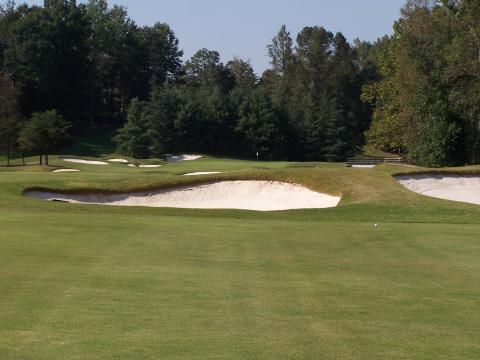
Thornblade compensates for its relative lack of length, in modern terms, with an abundance of strategically placed and quintessentially Fazio-shaped bunkers. From the tips, the course plays to just 6,700 yards.
The Thornblade Club, home of champions

Now on Sale

- The only book about golf communities in the last 10 years.
- 156-page step-by-step guide to finding your dream golf home.
- Info on nearly 100 golf communities the author has visited.
- Paperback version costs less than a sleeve of Pro VIs.
Here is what the experts are saying:
“The book is chocked full of information…applicable to anyone looking for a move to the Southeast regardless of whether they are looking for a golf community or not.” — John LaFoy, golf architect (Linville Ridge CC, CC of Charleston, The Neuse GC)
“Larry has done a tremendous amount of work and anyone — like me — who is looking to search for a golf home now or in a few years needs this book.” — Brad Chambers, golf blogger, ShootingYourAge.com
“Wow! What a thorough piece of work…a must for anyone moving South. This book will help many people.” — Brett Miller, owner and founder of MMA, Inc, a golf industry consultancy
Buy It Now at Amazon.com or BarnesandNoble.com.