A quick tour of Vermont
I am traveling through southern and central Vermont this week, making short stops at golf clubs and resorts in the region to introduce myself and to choose the best places to revisit in the spring. This is "leaf peeping" season, and while rain on my first day in the area yesterday made the colors on the mountains look a little musty, I am hoping some light shines on the tableau the rest of the week. I know the thousands of folks who plunk down higher prices for hotel stays and sometimes clog the roads in New England this time of year are hoping for the same. I have not seen very many cars pulled over on the sides of roads with cameras (and tongues) hanging out. Could be the economy or the weather or both. Not many people are going to pony up $150 per night at a Holiday Inn Express to look at trees through a mist.
Yesterday I stopped at Brattleboro Country Club, Haystack Mountain, and Mount Snow, the latter two with significant adjacent residential communities. Today I am planning stops at
Quechee Lakes, a huge 36-hole golf community; The Woodstock Inn; Okemo Valley; and at Green Mountain National Golf Course and Killington Golf Club, both in Killington and near the famed ski slopes. The rest of the week will include stops at Rutland Country Club, The famed Equinox, and the Stratton Mountain Resort. I'll squeeze a few more stops in between, so if you have one in central or southern Vermont that you want me to check out, just click on the Contact button above and send me a note.
Cheers.
 Home On The Course newsletter
Click here to sign up for our Free monthly newsletter, loaded with helpful information and observations about golf communities and their golf courses.
Sweet charity: How to play one very private course
During my visit to Cape Cod last week, after two glorious rounds at the private Oyster Harbors Golf Club, I noticed this ad in a local newspaper. It provides one way to play a great golf course and support a local library. If you play below your handicap level at this outing, you will be doing well, and also doing good:
October 19 - Want to Play at the Exclusive Oyster Harbors Club, well here is your chance!! 15th annual Autumn Classic, Oyster Harbors Club, to benefit the Osterville Village Library, 11 a.m. registration, 12:30 p.m. shotgun start, best ball of foursome, $225 entry fee per player, registration forms at www.ostervillevillagelibrary.org or by calling the Osterville Village Library at 508-420-5757.
Please note that Oyster Harbors is slated for some modest reshaping by Tom Doak in the coming weeks. It would be best, if you plan to play in this outing, to contact the course for an update on exactly when they intend to start the work. I understand that play will continue as the workmen go about their business.
What's in a name? A better future for one North Carolina mountain golf community
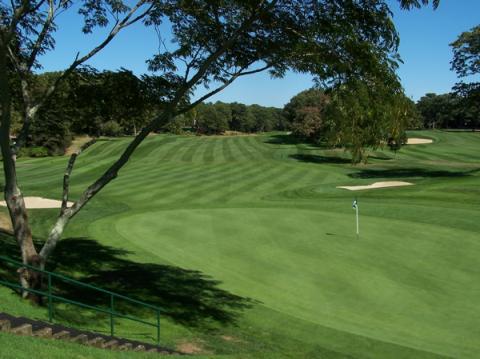
The folks who developed the standard in southern golf communities, Reynolds Plantation in upstate Georgia, are putting their mark -- literally -- on Laurelmor, the high-end community near Blowing Rock, NC, that the firm took over in the wake of Ginn Resorts' major loan default. Laurelmor is now Reynolds Blue Ridge. The company announced the change, along with other information about plans for the community, in a posting in the last few days at the community's web site, according to Toby Tobin, who has followed the Ginn saga closely at his web site GoToby.com.
The announcement comes as a mixed blessing for those unfortunate souls who plunked down an average of $625,000 per home site during the ill-fated Ginn era. Reynolds is a sharp outfit by
In order to encourage property sales, Ginn had waived initiation fees for the golf course for the first 179 property owners. Reynolds announced it will honor that agreement, and that memberships current and future will have a "generational" option, which includes grandparents, children and grandchildren in the membership. Reynolds is offering other incentives, including a home site exchange program, to assuage the pain of those first owners, which is more than owners in other bankrupted communities are getting. The cautionary note here, as always, is to proceed very carefully when buying the promise of future amenities in a new golf community. And to know the difference between hype and solid, sustainable performance.
You can read Toby Tobin's article at GoToby.com.
Taking stock of golf club equity deposits
Maybe you read about it in the New York Times the other day (here's the link). Club members who resigned from Bonita Bay, the ultra-upscale golf community and club in Florida, are demanding from the developer a total of $245 million in refunds for their equity memberships. According to the developer, this will push him into bankruptcy.
I am not a big fan of most equity arrangements. In limited cases, equity memberships are justified if the initiation fee includes a say in how the club is run. But those who pony up three to four times the amount of a non-equity fee just to eventually get their money back are asking for trouble. If they eventually do get their fee refunded, it could take years.
Recently, I stopped at an exclusive club in New England where the top "fully refundable" fee is $190,000, and the non-refundable fee is $40,000. No voting privileges are included with either. The refund plan, which is better than most, repays the fee whenever a like amount of money is collected from new members. That is, when new members pay a total of $190,000 in initiation fees -- regardless of the type of membership they sign up for -- you get your money back. Other plans pay off when a specified number of new members join, typically three or four new members in order for the first former member on the waiting list to be paid.
I was not a math major, but it strikes me that "throwing away" the $40,000 is a better deal. You don't join a private club with the idea of leaving in a year or two; you join for multiple years. Give any halfway savvy investors the $150,000 difference between the refundable and non-refundable fees and let them invest it over five to eight years, say, and they will probably make the $40,000. Put the money in a plain old CD for the eight years and you will get pretty close, without the risk of a market collapse (or the collapse of the golf club).
Or you could do something my brother wrote me about the other day after reading the piece on Bonita Bay. "The wife of a friend," he recounted, "was recently relieved of her employment and occupied her time by converting their backyard to a three-hole mini golf course. She said she learned how to do it by watching a YouTube video.
"Now they have a golf course with no refundable membership fee, no non-refundable membership fee, no green fees, no waiting for tee times, no one asking to play through, no gophers (yet), and no warring club members.
"They just play the course six times in a row and call it 18 holes."
Shooting birdies is okay, though
Cape of Good Golf
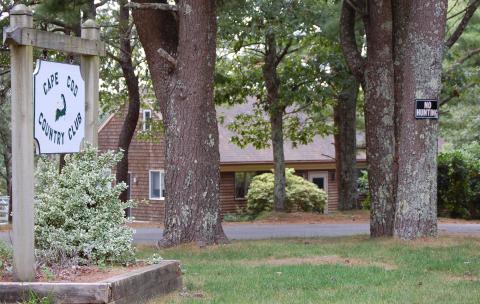
I am spending the week on Cape Cod, MA, visiting golf courses, resorts and communities. I am convinced that, in the coming years, more and more golfing couples will decide to live in two homes, north and south, to be able to play in balmy weather year round. In coming months, you will see more and more reviews and articles in this space about New England golf communities, private golf courses and golf resorts that double as residential developments.
I was somewhat unprepared for the density of courses on the Cape. They are every few miles and range from the strictly private to the municipal, although these are not typical muni goat tracks.
At the top end are those very private clubs, like Oyster Harbors, which I reviewed yesterday (see below), and Cape Cod National, which I visited briefly today. Both are pure golf clubs, with only a few incidental homes scattered at their peripheries. Cape Cod National's membership fees range from $40,000 (non-refundable) to $190,000 (fully refundable). It must be good, and it looked it.
I drove through the Ocean Edge Resort today. The fairways were extremely lush and well populated by residents and a few resort guests trying to catch that last flush of summer (it was about 72 degrees). I stopped as well at the Wequassett Resort in East Harwich. Guests who pay the price to be pampered by the resort's enthusiastic and professional staff will be doubly pampered if they play golf; Wequassett reserves a few tee times at the aforementioned private Cape Cod National.
Cranberry Valley in Harwich has long been recognized as one of the premier daily fee courses in the country, but it has plenty of competition on the Cape. Ballymeade, Bass River, Falmouth Country Club, Cranberry Valley and many others could keep even the most finicky traveling golfer happy for a week and more.
During the golf boom that began a few decades ago, some towns on the Cape got into the golf business. The town of Dennis owns Dennis Pines and Dennis Highlands, which are separated by a few miles. Ditto the two outstanding Captains Courses in Brewster, where a local commission overseas the club (and prints minutes of their meetings on the Internet). Cape Codders, as independent a breed as there is, do not seem to mind a little government interference, as long as it means reasonable green fees. Residents of Dennis, for example, can play their courses for just $617 per year.
Safe Harbors: Ross course on Cape helps your golf game but can ruin your score
"Drink it," your mother used to say. "It's good for you." She was right, of course, but it tasted awful. That's a little like the way I feel about one of my favorite golf courses ever, Oyster Harbors. Your score may leave a lousy taste in your mouth, but the experience is good for you and your golf game.
I was invited to the 28th annual Fall Frolic at Oyster Harbors Golf Club in Osterville, MA. The company of 46 fellow golfers, many of them from the Hartford (CT) Golf Club, the gentlemanly stewardship of Frolic organizer Dick Farr, the perfect fall weather, and the classic, stunning golf course made for two days of sheer delight. As we teed off in balmy weather this morning, I was tempted to ask my golfing partner, "Is this heaven?" "Nah," he most likely would have responded, "it's just Oyster Harbors."
I know what you're thinking. This kind of sentimentality is unbecoming of someone who touts his objectivity about the courses he plays and reviews.
Oyster Harbors is both fair and, at
times, brutal. There is not a
single out of bounds stake on the course...or on the entire surrounding
island. Skitter your shot across a
road onto someone's front yard, and go ahead and take your swing. I played one from beside a row of
hedges on one hole and saved a couple of strokes. The course's generous fairways keep you in the game off most
tees, and the amply endowed greens are typically wide and inviting also. But like an old fool smitten by a young
beauty, be careful what you wish for when you go at the pin. Once you arrive greenside, vertigo can
set in. As one of the presenters
at dinner remarked, if you have not played Pinehurst #2, a tour around Oyster
Harbors gives you a good idea of what that is like.
someone's front yard, and go ahead and take your swing. I played one from beside a row of
hedges on one hole and saved a couple of strokes. The course's generous fairways keep you in the game off most
tees, and the amply endowed greens are typically wide and inviting also. But like an old fool smitten by a young
beauty, be careful what you wish for when you go at the pin. Once you arrive greenside, vertigo can
set in. As one of the presenters
at dinner remarked, if you have not played Pinehurst #2, a tour around Oyster
Harbors gives you a good idea of what that is like.
No chip shot is straight to the hole, and neither are virtually all the putts. Just a couple of greens are severely elevated, but most have false fronts and, in too many cases when you forget to play short, you'll be faced with false backs as well. Short is always better than long at Oyster Harbors, and on most holes I preferred a 20-yard pitch shot up to the hole to a 30-foot putt from pin high. None of the breaks on the greens are dramatic like, say, from rear right to the final-day pin position at The Masters. But every putt at Oyster Harbors from outside three feet must be worked over, looked at from all angles and never ever taken for granted.
Oyster Harbors can pick you up and drop you down, and not necessarily in that order. I was despondent after I carded an 8 on the par 4 9th on our first day (we started at #5). But generously wide fairways beckoned on the following holes, and I am an okay putter, and my partner was counting on me to snap back. I carried an 11 handicap into my rounds at Oyster Harbors, shot 86 and 84 and thought I played those two rounds better than any others in the last year. The 86 included the snowman, and the 84 included four missed putts from inside five feet, but that was not because I over-read or under-read any of them. It was more the worry about the following putt if I missed and whether a too-aggressive stroke would result in a three putt from five feet. (Two of my three playing partners today, also 11 handicappers, four putted.) If you worry about the following putt before you stroke a five-footer, you will surely miss.
But Oyster Harbors is good for your golf game. The green complexes force you to think on every approach shot and, in many cases, to dial back your notions about getting the ball to the hole from 150 yards away. When the wind kicked up today, I was channeled back to Scotland, where punch shots into or beneath the wind work best. Thirty feet below the hole is much better than 10 feet above. Great golf courses challenge and teach and revise our laziest notions about the game.
Note: In a month, Tom Doak will commence some tweaking of all the holes at Oyster Harbors. Doak has great respect for the classic architects and their work, and he likely will do no harm. But how do you improve on heaven? If I am lucky enough to be invited back next year -- Oyster Harbors is private -- I will let you know how the tweaking worked out.
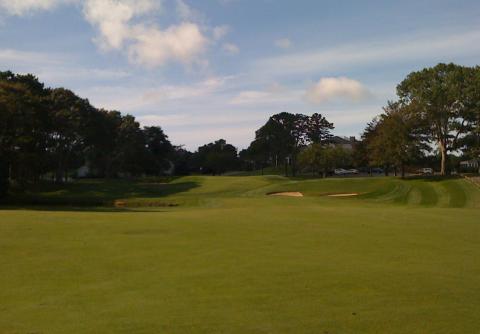
The dogleg right 9th at Oyster Harbors is one of the few that features a water hazard. But the customary Ross bunkers and elevated green are more worrisome, especially into the prevailing winds.
Seen one, seen em all: Hershey course layout repeats itself
Taken individually, the holes at the nicely conditioned Hershey Golf Resort's East Course are classics, echoing the parkland U.S. courses built in the decades from the 1920s and through the 1960s. Just one problem: The par 4s and 5s share one consistent, and eventually boring design conceit: Elevated tee box to tree-lined fairway below and then up to elevated green. A variation of greenside bunkering and one or two doglegs thrown in do not do enough to change a feeling that grows over the first nine and reaches the nagging stage on the back nine: Haven't I seen this all before?
Apparently the owners of the golf course, the same folks who run the Hershey Resort, have heard it before. Rumor is that within the next year, the East Course will be closed for significant renovations, possibly even re-routing and the combination of holes from both the East and West courses (the latter a 1930 design credited to Maurice McCarthy). Architect Lester George, insiders suggest, has been tapped to do the work. If that turns out to be the case, expect drama and variation in the routing, and fewer elevated greens. Mr. George will shave down some tees and greens to make things a little more exciting.
I hope the photos below provide an idea of the nice canvas any architect will have to work with at Hershey, and show as well how beautifully designed some of the holes are.
This was my first trip to Hershey, and with its huge amusement park and what I perceived as a kind of cheap Disney World atmosphere, I thought I would find it tacky. But the town displays an air of refined fun, with very little neon to pollute the atmosphere, and enough good golf courses to keep an avid linkster well satisfied over a long weekend.
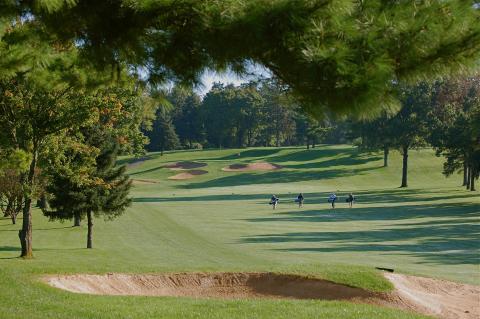
The first hole at Hershey East is a beauty, a reachable par 5 that dares you to fly the deep bunkers that guard the green.
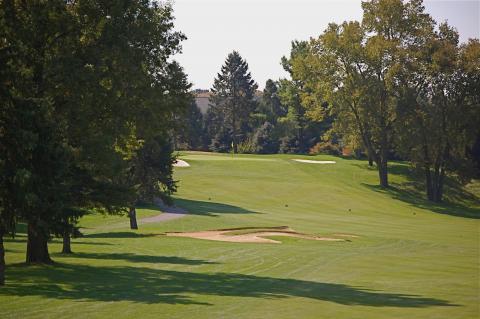
The green at #9 is among the most elevated among Hershey East's many elevated greens.
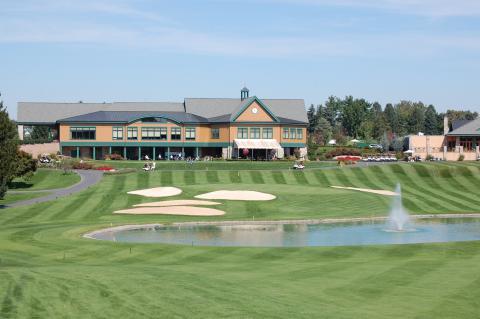
If you don't hit your tee shot down the hill in the fairway at #18, your shot to the green will not be elevated. It will just be about 200 yards on the par 4. If you make the hill, you have a shot you can look up to.
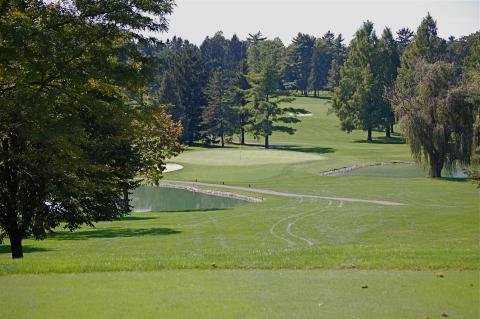
A couple of par 3s at Hershey East are actually downhill, including the challenging 17th.
Sweet dreams: Hershey Links serves you just desserts
The town of Hershey, PA, doesn't smell like a candy bar anymore; all manufacturing has moved to Mexico (what else?), but Hershey Corporation's headquarters remain in town along with the eponymous Hershey Park and its large amusement area. For fun and games, try the excellent local golf courses.
Today I followed a group of collegiate golfers around Hershey Links. It is worth a trip off the interstate if you are traveling through central Pennsylvania looking for a challenging, well-conditioned course. Formerly known as Wren Dale, the nearby Hershey Resort added the track to its two resort courses and changed the name to Hershey Links. The course, by Hurdzan and Fry, is seven years old and was carved out of beautiful former farm land with many deep ravines that split some dramatically contoured holes. The course is very well tended, quite manicured for a public facility. Those who can't get the ball airborne on every shot are in for a day of frustration. Others who can take advantage of generous fairways and find the greens in regulation will need a confident putting stroke to have a sweet day.
If you can tolerate the traffic around Hershey when the amusement park is in full swing, and if you don't mind waiting in line at many of the local restaurants, stick around for a few days and play Hershey Links as well as the Robert Trent Jones East and West Courses at The Hershey Resort. I'll be walking the East Course tomorrow and will report back later.
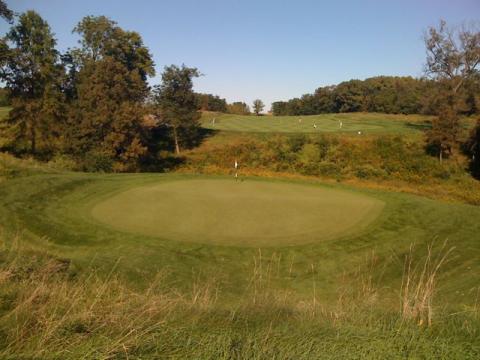
Hershey Links is characterized by forced carries over deep ravines to sloping greens.
Thaw in market: Golf Community Reviews may be a leading indicator
Numbers don't lie, but the data about the housing market can be confusing. What does it mean, for example, that housing starts improved month to month? Are we seeing more new homes because of buyer demand or because builders are trying to keep their employees working before they leave for a more predictable industry (like hamburger flipping, perhaps)? Do any of us really care about home sales volume if prices are not recovering?
Foreclosure issues still hang over the housing market (and over the recession, which ended
According to my inbox and telephone, those in this latter group are coming off the sidelines. I never thought of this humble blog site as a leading indicator, just a place for honest information about golf real estate where I throw a few ideas and honest reviews of golf communities out there and if someone connects to what I've written, they might send me an occasional question or comment.
Over the last few years, those have not exactly flooded in, or even petered in...until now. In the last few weeks, no more than a few days have gone by without some contact from a couple asking for ideas about their next stop in the housing market. They are generally within a couple of years of age 60; retired or a year within retirement; typically looking for a home in a golf community in the Carolinas and Georgia (not Florida, at this point); and ready to take whatever the market will give them for a price on their primary homes up north (although I am working with one Florida couple looking to move to the Carolinas).
Maybe the knowledge that winter is just around the corner is driving most of them, but I think something stronger is at work here. Baby boomers, who have worked hard to reject the Depression mentality and sacrificial personalities of their parents, may have reached the point at which they realize that deferring their dreams while they wait for the value of their primary homes to come back is too steep a price to pay. Some, like the nice lady from New Jersey I spoke with yesterday, have also figured out that waiting is a fool's economy when taxes on your primary home are $16,000 a year and taxes on the home you have looked at in North Carolina are just $2,000.
There are plenty of good personal reasons for people to defer a move, such as family issues, part-time job prospects, and other important aspects related to lifestyle. But in this market, at this time, and with more boomers starting to begin again the migration south that was interrupted in 2005 with the collapse of the market and many stock portfolios, waiting for one home to increase in value before you buy another that is likely to appreciate faster could be a costly game.
What's new at Old Trail near Charlottesville
Morton's Fork, NC not a great place to be
Now on Sale

- The only book about golf communities in the last 10 years.
- 156-page step-by-step guide to finding your dream golf home.
- Info on nearly 100 golf communities the author has visited.
- Paperback version costs less than a sleeve of Pro VIs.
Here is what the experts are saying:
“The book is chocked full of information…applicable to anyone looking for a move to the Southeast regardless of whether they are looking for a golf community or not.” — John LaFoy, golf architect (Linville Ridge CC, CC of Charleston, The Neuse GC)
“Larry has done a tremendous amount of work and anyone — like me — who is looking to search for a golf home now or in a few years needs this book.” — Brad Chambers, golf blogger, ShootingYourAge.com
“Wow! What a thorough piece of work…a must for anyone moving South. This book will help many people.” — Brett Miller, owner and founder of MMA, Inc, a golf industry consultancy
Buy It Now at Amazon.com or BarnesandNoble.com.