When the pros come to town
I spent Friday at the TPC of River Highlands golf club in Cromwell, CT, watching the PGA tour pros tackle one of the most interesting and popular courses on tour. Although the likes of Tiger Woods and Phil Mickelson were not there, such major titleholders Harrington, Cink and Goosen brought out the crowds. In the crowd and wearing the red shirts of the hundreds of Travelers Championship volunteers were residents of the surrounding community, a combination of traditional neighborhoods and a planned group of homes adjacent and above some of River Highlands’ fairways.
Across the nation, some excellent golf courses in planned communities play host to annual pro tour events. Some residents are not crazy about having their course closed for a couple of weeks – and trampled by spectators – but most appreciate the opportunity to rub elbows with the pros and see how they perform on the course the members play all the time.
In the case of River Highlands, the pros are doing quite well. Justin Rose leads at 14 under par after two rounds. You can follow the action on CBS this weekend. In the coming weeks, I'll have more to say about golf tour events inside golf communities.
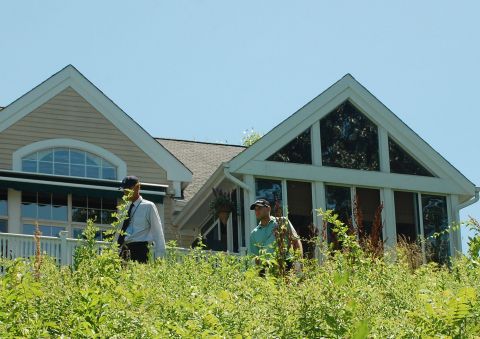
PGA Tour player Bill Haas (right) and a tour rules official begin their descent from above and beside the 15th green at TPC River Highlands. Haas hit his tee shot on the driveable par 4 into the weeds, declared his ball "unplayable," and elected to take a drop at the top of the hill, in a resident's backyard (the normal out of bounds line did not apply during the tour event). Haas wound up with a double bogey 6 and missed the cut.
 Home On The Course newsletter
Click here to sign up for our Free monthly newsletter, loaded with helpful information and observations about golf communities and their golf courses.
Carolinas rule in baby boomer survey
Baby boomers at both ends of the generational spectrum have their favorite states for relocation, and the top two both have Carolina in their names.
In the annual Del Webb survey, two age categories of baby boomers were asked to name the states to which they intended to
Among 50-year old boomers, 49% of those who expected to move during retirement intended to relocate to a different state. Among the 64-year old retirees, 52% said they would move to a different state.
Both age groups of boomers agreed that the most important consideration for relocating in retirement would be cost of living at the destination. Access to healthcare, climate and cultural/recreational amenities also ranked highly in both age categories. The 64 year olds in the survey who actually had moved in retirement confirmed that they indeed had ranked cost of living as the most important criterion in their choice, followed by the other considerations listed above.
When asked the question, “If you were to move, which of the following best describes your preference regarding moving to a new community?” 9% of 50 year olds and 20% of the 64 year olds responded “age restricted” community. The rest in both categories either had no preference on age or preferred a mixed group of residents.
Click here for access to the Del Webb survey results.
A Donald Ross gem in Connecticut
I spent the last two days walking the up and down course of the Country Club of Waterbury in Connecticut during qualifying for the state amateur golf championship. The club dates to 1899, and in 1927 it commissioned the famed Donald Ross to develop 18 holes on newly acquired land on the western end of Waterbury, an industrious city that once contributed much of the brass used for early lighting fixtures and clock making in New England. Clock making was also a big industry in Waterbury.
Indicative of most Ross-designed courses, CC of Waterbury is not long, playing to just 6,556 yards from its back tees and 6,120 from the
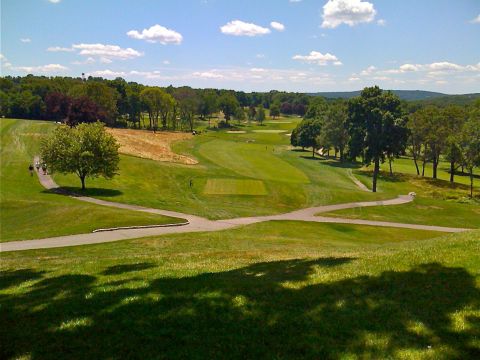
Below are two holes indicative of the artistry of Donald Ross at Waterbury. At top is the starting hole, 423 yards from an elevated tee box just below the clubhouse with a sloping fairway left to right. The approach is long and best made from the center to left of the fairway to avoid the bunkers right and left. However, the fairway slopes left to right making a challenging shot selection to most areas of the green. The safe play is to below the mildly false front of the green, leaving a mild chip shot. The 11th hole is another par 4 of just 359 yards, a dogleg right that is downhill from the tee. Balls that go through the fairway on the right (the orientation of the bottom photo) make it tough to stop an approach shot on the front half of the green. A more restrained tee shot may leave a longer approach, but it is likely to have a better chance of stopping on the medium-sized but firm green.
I picked up a membership package for the club and noted that they are waiving initiation fees “for a limited time”; dues for a single ($480 per month) and family ($735) are pretty steep given that a current assessment of $150 per month is tacked on. But the Country Club of Waterbury course is more interesting than most of its competition, in superb condition and its pure Ross pedigree make it special.

Keeping up with the Joneses: A revisit to the Duke Golf Club
It is fitting that one of the best (and best endowed) universities should have a fine golf course. I had played the Duke University Golf Club a few years ago, but when I had the opportunity to give it another go last week, I jumped at the chance. The course is public and the green fees are surprisingly reasonable ($75 with cart on weekdays, but you can walk at $55). If you find yourself in the Chapel Hill/Durham, NC, area for a couple of days, book tee times at both Duke and Finley Golf Club, the University of North Carolina’s course. They are not only fine golf courses but they will also give you an education in the contrasting work of Tom Fazio (Finley) and Robert Trent Jones, Sr and Rees Jones (who renovated his father’s original design at Duke).
The Duke course is characterized largely by blind tee shots to often tilted and tree-lined fairways and by mostly elevated greens well protected by bunkers. The premium at Duke, whose course rating and slope from the blue tees (6,565 yards) are 70.9 and 129, respectively, is on course management. The longest holes tend to play downhill; length off the tee is not nearly as important as calculating the correct side of the pin at which to aim. Short-siding yourself tends to be especially penal at Duke.
Course conditions were excellent, although a little more speed in the smooth greens –- they were medium speed -– would have made for some especially interesting downhill putts.
Duke Golf Club, Durham, NC. Men’s par, 72; women’s par, 74. Yardage: 7,136/6,868/6,565/6,182/5,460. Rating: 73.9/72.6/70.9/69.6/66.6. Slope: 141/135/129/122/118. Designed by R. T. Jones, Sr (1957) and Rees Jones (1993). (919) 681-2288. www.golf.duke.edu.
Note: The Triangle area of Chapel Hill, Durham and Raleigh offers as much to golfing retirees as any area of the southeast, including major universities, a large international airport, world class shopping and restaurants, and convenient escapes to mountains and oceans. If you would like more information about the golf communities in the area, please contact me.

The par 3 12th at Duke has been redesigned a few times in the last two decades.

The approach to the par 5 9th, with the Washington Duke Inn behind.
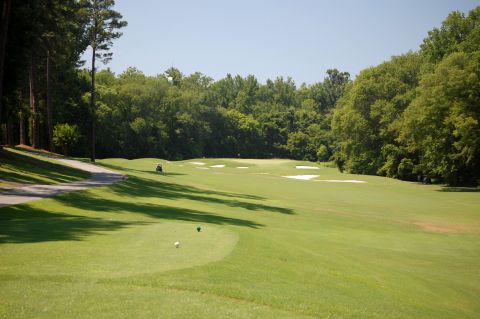
From the tee at the par 4 3rd hole at Duke.
The Myrtle Beach kid tries to win it
Myrtle Beach arguably has the densest concentration of golf courses in America, but in 50+ years of watching the majors on TV and reading about them, I cannot remember anyone from the Grand Strand area having a shot at winning. That changes today as Dustin Johnson, who was born in Columbia, SC, but lives in Myrtle Beach, enters the final round of the U.S. Open three shots up.
Johnson looked unflappable yesterday, as if he were out for a casual round with his buddies from Coastal Carolina University, but we have seen that look before from guys named van de Velde and Hoch and Sanders (Doug). If he is leading or tied as he plays the 18th hole today, Johnson will face a pressure unknown to virtually all other competitive athletes -– and he will face it utterly alone, unshared with teammates or coach. Sure, his caddy will toss some grass in the air and whisper something like “trust the club,” but days, weeks and years after the stroke is made, we will remember the player only, and he will never forget the shot he played, for better or ill.
Go Dustin!
“Well, do ya punk?”: If golf fairways could speak, oh the things we might hear
by Rick Vogel
Arriving at the club for a round of golf, you meet your buddy in the parking lot, and as the two of you are headed for the clubhouse, he stops, pulls a black cigarillo out of his top shirt pocket, cups a lit match in both hands, and then affixes you with a squinty stare. He says, "You've got to ask yourself one question: 'Do I feel lucky?' Well, do ya punk?"
If you are a golfer in Carmel, CA, you might just be at Tehama Golf Club, Clint Eastwood's Carmel bayside course designed by Jay Moorish. Getting a tee time is problematic since the club's membership is by invitation only, and should you choose the path of home ownership to achieve membership, lots start at $2.5 million.
To walk the fairways of the rich and/or famous, other choices abound. If you are of a certain age, you might recall the exploits of those
If you like your martinis shaken, not stirred, you could try a round at The Stoke Park Club in Buckinghamshire, England where James Bond teed it up against Goldfinger and his lethal caddy Oddjob. Bond inventor and author Ian Fleming had a passion for golf. If not any old Brit will do as your partner for a round of golf on native soil, there's The Royal Household Golf Club. Sited on the grounds of Windsor Castle, it is veddy British and very, very private. For an early tee time, you had better know Queen Elizabeth II or her husband, Prince Philip, Duke of Edinburgh!
Should AOL founder Steve Case invite you to play 18 holes, get ready for a treat at Case’s own private Robin Nelson designed course in Puakea, Hawaii. The golf course was used as a setting in the movie Jurassic Park so beware of raptors if you chase your ball too far into the thicket surrounding the layout.
Enjoy rubbing elbows with the rich and famous in the world of politics and sports? Liberty National Golf Club, Jersey City, NJ, and Shadow Creek Golf Club in Las Vegas just might fill the bill. At Liberty National, the Cupp/Kite design that cost $250 million to build and will set you back a cool $500K for initiation fees, you might find yourself teeing off with the likes of Rudolph Giuliani, Phil Mickelson or Eli Manning with the Statue of Liberty and Manhattan skyline as a backdrop. The Tom Fazio designed Shadow Creek won’t charge you an initiation fee, especially if you are a high roller at one of Steve Wynn's casinos, but at $500, the green fees are rich enough. For some, the price may be reasonable for a chance to see the likes of Dubya Bush, Michael Jordan, or John Elway on an adjoining fairway. When he wasn’t otherwise engaged, the late Wilt Chamberlain walked the Shadow Creek fairways as well.
"Gentlemen, start your engines!" Motor racing and golf combine at Brickyard Crossing in Indianapolis. In 1929 it was called "The Speedway Golf Course" but took on the new name after a Pete Dye redesign in 1991. Most of the course plays adjacent to the famed Indianapolis Motor Speedway, but holes 7 thru 10 play on the racecourse’s infield. Things get a little crowded on Memorial Day during the running of the Indianapolis 500.
You probably won’t see too many Jeep Cherokees in the parking lot of Cherokee Plantation in Yemassee SC. Annual dues compare with the cost of a Porsche, and joining fees equal a Bentley or two. What do you expect from a course whose designer, Donald Steel, is the only one permitted to tweak the Old Course at St. Andrews? Cherokee Plantation was once owned by RB Evens, president of American Motors and, yes, your Jeep Cherokee was named after the Plantation.
Golf is an international game, and if you would like to capture its worldwide nature in just one round, head for Portal, ND, and the Gateway Cities Golf Club. The clubhouse and first hole start in the U.S. and the remaining eight holes play north of the border in Canada. We trust they serve Molson at the 19th hole (actually the 10th at Gateway Cities).
Rick Vogel is a resident of golf community Wolf Laurel north of Asheville, NC where he lives with wife Lynne and retriever Goldie (who has as much golf ball retriever as Golden Retriever in her). Rick has written for us before, most notably a popular piece on how he and Goldie have rescued thousands of golf balls from the weeds and creeks at Wolf Laurel.
Second nine at Windermere CC saves day
Who are you, and what have you done with Pete Dye? This was the question I silently asked as I made my way around the front nine at the Windermere Country Club course in Blythewood, SC, near Columbia. The course design is credited to Pete and P.B. Dye and, naturally, I was expecting fairway moguls, some pot bunkers and maybe a few railroad ties thrown in for good measure. Instead, the front nine played as if it were designed by, oh, George Cobb, or Clyde Johnston, or Willard Byrd -– which is to say quite competent and enjoyable, but not exactly a feast for the eyes or a challenge to club selection.
The layout takes a dramatic turn on the back nine, as if someone slipped P.B. a hallucinatory drug and he metamorphosed into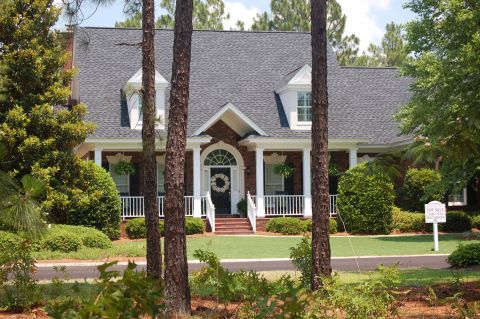 Seth Raynor or Mike Strantz. Hints at the revolutionary turn begin at the par 4 8th, with a pond at the right front of the green, simple enough to maneuver around but the first true hazard of the round. At the par 3 #9, water is in full regalia from tee to green but there is nothing dramatic or revolutionary about its positioning.
Then, at the turn, things indeed turn, with the earth gouged from the middle of the fairway at the 10th, the sandy bottom waiting to catch a slightly thinned shot (I obliged) and turn a short par 5 into a large headache. The elevated green, with a nearly two-story cliff along its right side, bunker at bottom, adds to the misery index. The hole is a real jolt after such a mild front nine.
At #11, a large waste bunker extends from tee to even with the 150-yard post, the largest waste area to this point. It seems utterly disharmonious with what has come before (but not what comes after). Pot bunkers guard the front of the green at #12, but the eye goes to the huge mounds that, from the tee box, appear to front the green but, in reality, are background to it. And so it goes in terms of design variety and eye appeal the rest of the way –- pot bunker directly in front of the green at the par 3 13th; huge mound blocking most of the green from the right half of the fairway at #14; hard dogleg right around a lake at #15; a blind, straight-up-the-hill tee shot at #16, with a nasty tall pine tree guarding the right side of the green; all carry over water to a crowned green at #17; and then the par 5 18th, which mimics so many finishing holes at professional tournaments (Harbour Town, Pebble Beach) with water down the entire left side to the edge of the green.
Columbia is about the hottest spot in all of South Carolina in summer, and I played in 100-degree heat. I was tempted to head for the air-conditioned safety of the car after nine. I am glad I didn’t.
*
The community that surrounds the private Windermere Country Club is mature, well organized and landscaped, with mostly large brick homes priced in the mid-six figures. It is part of the larger Longcreek Plantation, which comprises the 27-hole Ellis Maples designed Columbia Country Club as well (a very nice traditional layout that was totally renovated in the early 2000s). Many of the Windermere homes feature nice views of fairways and greens but, with few exceptions, they are set well back on well-treed lots. If you would like more information on Windermere or the Columbia, SC, area, please contact me.
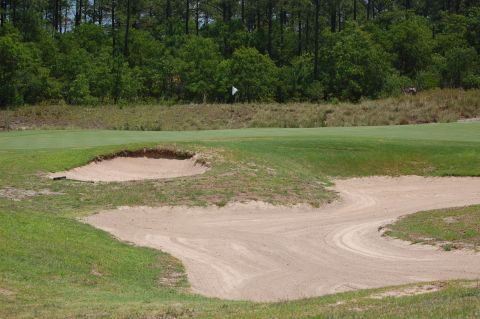
The bunkers fronting #8 at Windermere are about as tough as it gets on the front nine.
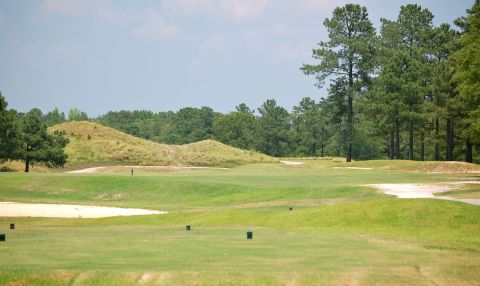
From the tee box at #12, it appears the large mounds might be in the fairway and blocking the approach to the green. However, they form the background for the green.

Somehow we never tire of those finishing holes around water that demand caution but reward prudent risk.
June issue of our free newsletter all set
I just signed off on the June edition of Home On The Course, our free monthly newsletter. This is the biggest one we have published, loaded with advice for anyone contemplating a vacation home or retirement home in a golf community in the southern U.S. It features a list of the “hazards” we face when we look for a home on the golf course, and what we can do to avoid “bunker mentality.” We consider such issues as proximity to airport, state tax rates, distance from nearby cities, the climate and Internet marketing of golf developments, with some traps to avoid along the way.
This may be our most provocative issue yet. Don’t miss out. Sign up today at the top left of this page. Even if we mail the issue before you sign up, I will personally send you the June copy, and you will receive all future issues automatically.Practice makes perfect, but perfect practice ranges are rare
There are a couple of reasons I don’t hit more than just a few limbering shots on a practice range before I head for the first tee. One, I really do leave all the good ones on the range. Unfettered by the pressure to hit a shot exactly where I want
Fully outfitted ranges are far and few between, but when I find one I am impressed. The golf community of Fawn Lake, which I visited for the first time this week, has one of the best. Wide enough for a full outing of golfers to practice and with pins stuck in shaved areas that look like putting greens, the Fawn Lake range is a great place to practice before or between rounds. And if you keep your head down, you will see clearly marked yardage blocks on the Fawn Lake range, spaced at intervals of about five yards for the 25 yard depth of the hitting area.
I rarely use a practice range on days when I don’t play. But if I lived at Fawn Lake, I might make an exception.

Great ground game: Fawn Lake's clearly marked and frequently placed yardage markers makes its practice range among the most helpful anywhere.
Golf club wastes dollars in national ad
As daily fee golf courses try to balance their need to attract new golfers with the equally important goal of reducing expenses, every marketing dollar is precious. The balance is even more delicate for those courses in far flung northern areas where the season is short and the competition intense. It demands special creativity to attract new blood to their golf courses.
An ad in today’s USA Today shows that some clubs don’t get it and are throwing good money after bad. A club called Manistee National, which I had never heard of, took a quarter-page ad in the national paper today at a retail cost of probably $25,000 or so. At the minimum rate that Manistee advertises for green fees, that is the equivalent of 297 rounds of golf. The ad squanders many opportunities. It mention’s only the club’s web site and phone number under a single “wow-‘em” line, “Golf Package Special” starting at $84.
The ad makes no mention of Manistee National’s location; it could be in Canada, or Zimbabwe for that matter. A check of the web site indicates the golf club is in Northern Michigan. Are they ashamed of the location, or afraid folks won’t go to their web site if they indicate “Northern Michigan?” If that is the case, do they think a person who visits the web site will change her mind about a trip that likely includes a few changes of planes to get to Muskegon and then a drive of about another hour?
If this ad was produced by its ad agency, Manistee National should fire them. If Manistee’s own people produced and placed the ad, well, you know the old line that the man who represents himself in court has a fool for a lawyer. The same is true for advertising.
Ironically, at least I now know what and where Manistee National is.
Tower Ridge holds the line
Mr. Strantz’s Wild Ride at Tot Hill Farm
Fortune smiles on Greenville, SC
On the road again

Now on Sale

- The only book about golf communities in the last 10 years.
- 156-page step-by-step guide to finding your dream golf home.
- Info on nearly 100 golf communities the author has visited.
- Paperback version costs less than a sleeve of Pro VIs.
Here is what the experts are saying:
“The book is chocked full of information…applicable to anyone looking for a move to the Southeast regardless of whether they are looking for a golf community or not.” — John LaFoy, golf architect (Linville Ridge CC, CC of Charleston, The Neuse GC)
“Larry has done a tremendous amount of work and anyone — like me — who is looking to search for a golf home now or in a few years needs this book.” — Brad Chambers, golf blogger, ShootingYourAge.com
“Wow! What a thorough piece of work…a must for anyone moving South. This book will help many people.” — Brett Miller, owner and founder of MMA, Inc, a golf industry consultancy
Buy It Now at Amazon.com or BarnesandNoble.com.