An expert's take on Cape Fear National
Bradley Klein is the respected golf course reviewer for Golfweek magazine, and he recently made a tour of Cape Fear National, the one year old course in the Leland, NC, community of Brunswick Forest. Leland is just 10 minutes from downtown Wilmington, NC. Brunswick Forest has suffered few of the problems of other communities up and down the coast and, indeed, the community's sales agents like to boast that it is the fastest selling golf community on the east coast. I believe it, based on visual evidence when I visited (much construction underway). If you would like to check out Brunswick Forest, you can start with a current listing of golf homes for sale in the community, at GolfHomesListed.com.
The golf course certainly cannot be hurting sales. When I played it earlier this year, I found it challenging, enjoyable and a delight for the eyes, with much care taken with the landscaping around the course. (Designer Tim Cate is a landscape artist by training.) You can read my review by clicking here.
Mr. Klein seemed only slightly less impressed. You can read his fair and detailed review at Golfweek's web site.

The 12th hole at Cape Fear National. Photo by L. Gavrich
 Home On The Course newsletter
Click here to sign up for our Free monthly newsletter, loaded with helpful information and observations about golf communities and their golf courses.
A weekend at Wintergreen
The golf is darn good too. We followed our son around during the Virginia State Intercollegiate tournament held on two of the three Rees Jones designed nines at Stoney Creek at the bottom of the combo ski and golf resort’s mountain. I haven’t played the resort’s other golf course at the top of the 3,500-foot mountain, the Ellis Maples-designed Devil’s Knob, but most who have played both prefer Stoney Creek for golf and the Knob for views. Devil’s Knob, whose first tee is a couple hundred yards from the top of the resort’s ski lift, will close for the season in a few weeks. Stoney Creek will remain opened for the winter and, as residents like to brag, there will be a few days in January when you can ski in the morning and play golf in the afternoon.
For active retirees who enjoy two season’s of sports and those who live and work in the D.C. area, Wintergreen has the wide selection of real estate at a wide range of prices to suit every interest and pocketbook. The local town of Nellysford isn’t exactly a metropolis, but we stopped for breakfast in a terrific bakery, tasted a wonderful selection of beers at a local brewery in nearby Afton, VA, and are looking forward to breakfast early tomorrow on the top of the mountain.
If you have more interest in Wintergreen, let me know and I will provide more information for you. Right now, a round of golf with cart and range balls included is just $49 at either course. Homes like the one we are renting run $200 per night, a little less for the one bed units and a little more for three or more bedrooms.


Take your pick: The Stoney Creek golf course (photos above) at the Wintergreen Resort is surrounded by mountains (Blue Ridge). The Devil's Knob golf course (not shown) is on top of the mountain.
The Kinloch community: Surrounded by golfing options, and more
After a weeklong visit to Richmond, VA, I am struck by how under-appreciated that metro-area is as a retirement golf destination. It is on no “best of” lists for retirement and, yet, the area is rich in history and culture, and the rolling farmland that surrounds the city is perfect for both equestrian and golfing pursuits. And the golf courses are open year round. It has plenty more going for it as well.
One small area west of Richmond is home to multiple golf courses and real estate options. Kinloch Golf Club, the best golf course in the state and in the top 50 nationwide, is located in the town of Manakin-Sabot, about a mile from the front gate of Hermitage Golf & Country Club, whose 36 holes of golf, plus tennis, swimming and other amenities should appeal to retirees and families alike. And just down the road is the classic Richmond Country Club which, at 53 years old, can stake a claim as the “traditional” club in the area.
Both inside and outside the beltway that surrounds the city, Richmonders have access to more golf clubs than you
In short, Richmond is worth a look by any golfer contemplating relocation for retirement or job change. I’ll have more to say about Richmond in this space in coming weeks, but today I want to share some notes about Kinloch, the community adjacent to Kinloch Golf Club (see my earlier review), because for those looking for a home in the mid- to high-six figure range and a golfing lifestyle to match, Kinloch can fill the bill.
Partly as a marketing tool, local businessman C. B. Roberston helped fund the creation of the Kinloch Golf Club in 2001, even before the first residential lot was sold in the adjacent community. Robertson owned hundreds of acres nearby that he was developing for office parks. His thinking was that a sophisticated community with a world-class golf course could help sell executives on relocating their corporate headquarters and law firms to the oddly named Richmond suburb of Manakin-Sabot, two formerly separate towns that had merged (and were named for the Monocan Indians and a French clog, the sabot). It worked; today the office parks are home to the national headquarters for such major companies as Capital One and Car Max as well as dozens of other smaller companies.

Kinloch still has plenty of lots to make available for sale in the future (those in yellow). Note that the entrance to the 36-hole Hermitage Country Club is out the northwest gate. Graphic courtesy of Landvest.
The 345-acre Kinloch community’s most dominant feature is a 72-acre manmade lake, circa 1997, whose shore is dominated on one side by large homes and on the opposite side by lots that are not for sale yet. At its southeastern end, a few of the community’s larger homes peek from across the lake well behind Kinloch Golf Club’s unique par 3 19th hole. The entire lake is pretty much tucked away in the woods that surround it, and the developers of Kinloch like to say that many of the folks who live nearby were not aware of the lake’s existence before development began.
During my round at Kinloch, I did not see a single home until the 19th, and yet the Kinloch “conceptual” plan includes a string of lots along the par 4 first.
“Club members bought all the lots along the first hole to protect the club from any homes,” says Marshall Bowden, the LandVest executive in charge of Kinloch. That is a strong indication of how seriously golf is taken at Kinloch Golf Club, where club members also purchased the club from Robertson and his partners two years ago.
Kinloch opened its first phase of 46 1/3 to 1/2 acre lots in 2003, most of them along the lake’s waterfront. At first, local builders purchased lots and built spec homes, which sold in the $1 million range. Later, LandVest assigned specific builders to specific lots.
“We selected the builders as a way to ensure the quality of the homes,” Bowden wrote me, “to leverage their reputations and ease the ARB [architectural review board] process [because] if the builders have ‘good taste,’ then the ARB has an easier job. Not all the builders build at the same price point, so it segmented by price and product.”
Although this locked-in purchasers to a particular builder if they fell in love with a particular lot, customers still had
Kinloch is considered a desirable place to live within the Richmond metro area. In all, seven sections at Kinloch, a total of 192 lots, have been developed, and only 16 remain, at prices ranging from $130,000 to $325,000 (although LandVest is holding dozens more, waiting for an economic rebound). Count on about $200 per square foot to build a nice home. Of the 122 homes that have been built to date at Kinloch, 120 of them are occupied, which seems like vindication of the strategy to sell home/lot packages and keep out the speculators. According to Marshall Bowden, the developers carry no debt on the property. Carrying costs in the community are modest, especially since there is no gate. Property owner fees are $412 per year with another $348 for trash removal. The Coach Homes neighborhood of “low maintenance” dwellings assesses owners a $2,000 annual fee to handle all exterior maintenance, everything from “curb to rooftop.”
Bowden adds that Kinloch was originally conceived as a community for empty nesters, and today just a few young families live in the community. A few of the residents who play golf belong to Kinloch Golf Club but most opt for the full country club atmosphere and the two golf courses at Hermitage, where membership initiation fees are $20,000.
The town supplies Kinloch’s underground utilities, including natural gas, which should impress those of us who understand that is the best way to cook. The town of Short Pump’s large mall is a mere 10 minutes away and features Nordstrom, Macy’s and other big name retailers. Such conveniences in an ex-urban setting are the lure for many who move to Kinloch, some of them former owners of large family farms and horse farms that populate the Virginia countryside.
“It is a good community,” says Bowden of Kinloch, “for a low key rural lifestyle without the hassles…”
*
LandVest is holding a considerable number of nice lots at Kinloch, waiting to release them when the economy improves. But the economy puts plenty of power in the hands of those who are serious about purchasing. If you think the Kinloch lifestyle might be right for you, contact me and I will be happy to put you in touch with Marshall Bowden. You never know.
Kinloch: Best golf course you may not know
Most golf raters believe that Kinloch Golf Club is easily the best golf course in the state of Virginia, its chief competition for the title the ultra-exclusive Robert Trent Jones Club in Manassas. Golf Digest ranks Kinloch in the top 50 of all golf courses nationwide,
You will have to wangle an introduction to play the member-owned golf course or get to know one of its members well, but although exclusive, the club is by no means stuffy. The two members I had the good fortune to be matched with reminded me of the many guys I’ve met at daily fee courses over the years, which is to say these two were funny, unpretentious and inoffensively salty in their language. (They apologized a few times but I took no offense, pleased they felt comfortable enough with me to be themselves.) They had beer personalities with the champagne pockets necessary to join a club like Kinloch. (Note: The club does not publish its member fees but count on them being somewhat above average.) I also played with Ian Sikes, Kinloch’s former golf professional who is now in charge of membership recruitment activities.
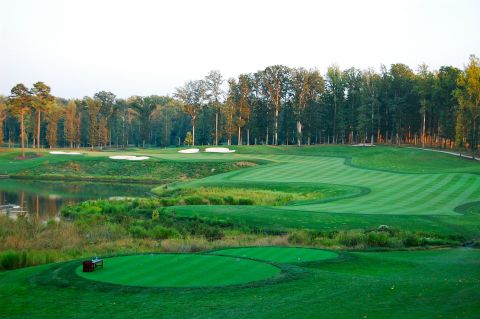

A well-played tee shot to the right side of the fairway at Kinloch's 16th hole, a long par 4, will leave the best angle into a well-protected green.
Actually, Kinloch was originally conceived as a public golf club in the 1990s when local businessman C.B. Robertson, who owned the land on which the golf course and real estate sits, was encouraging development of office parks nearby (also on his land). Robertson thought a golf club would be a lure for companies to relocate to Manakin-Sabot. The companies did come, and today the national headquarters of Car Max and Capital One, as well as dozens of law firms and insurance companies, populate the nearby office parks.
But somewhere along the line, plans for the public golf course were scotched.  Amateur golf legend Vinny Giles had been asked to conceive the course, and he invited Lester George, a little known but well respected architect, to join him in the task. Giles and George, who last year debuted the terrific Ballyhack golf course in Roanoke, developed a layout and vision for a club that they, Robertson and other partners in the venture considered too special for compromise to accommodate the heavy play and pounding the course would take from daily fee golfers.
When it opened in 2001, Kinloch was named the best new private course in the nation by Golf Digest. After a recent round there, I understand. With only a few spots of turf browned from the severe summer drought in Virginia, conditions were stellar, the more remarkable for the bent grass that runs from fairway to green at Kinloch and requires special tending in the south’s summer heat. I have not putted on better greens in recent years, easy for me to say since I made four putts from beyond 25 feet, which is three or four more than my typical round. I couldn’t wait to get the putter in my hands on each hole at Kinloch. (Note: A rarity these days, Kinloch maintains its own caddy program. Props to my caddy Dan who helped me read some of those long putts.)
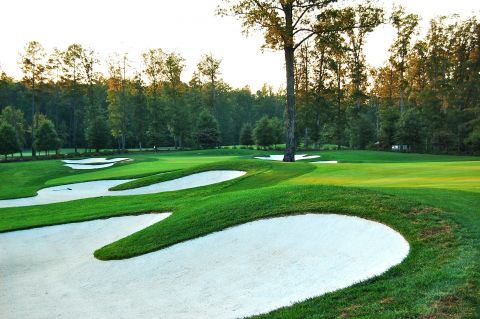
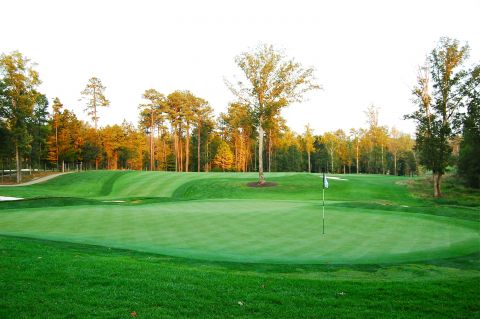
A lone tree appears to be dead center in the fairway at Kinloch's short par 4 15th hole, but actually is in the left-hand rough. The safe route is around to the right but daring long hitters will have a go at a fade around the tree, with the lure of a two-putt birdie, or better.
The George & Giles layout is filled with all kinds of traps, and not just the sandy kind; the grip-it-and-rip-it sort will find only a few holes with fairways wide enough to forgive overly aggressive plays. The strategy maven, on the other hand, will delight in the choices among the multiple routings on some of the longer holes, including the 9th, where the designers conspired to offer head-scratching choices for the first and second shots on the par 5 (yardage ranges from 540 to 586). Assuming a good drive to one of the two fairways –- left of the stream is safer, but right of it offers a much better angle for shot number two –- the lay-up must negotiate a “palisade,” or bluff, in the middle of the fairway about 80 yards from the biggest green on the golf course. Those who find the safety of the fairway within short iron range of the green will have a good birdie opportunity; others will scramble for par or bogey.
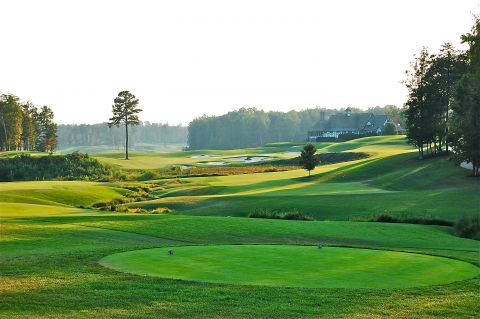
The par 5 9th at Kinloch presents two options from the tee box; left is safer but demands a challenging lay-up to the fairway at upper right. A play down the narrower right side, assuming it winds up on the short grass, makes a lay-up to the mown area short and left of the green (below the single tree) an alternate possibility.
I would be hard pressed to identify a breather hole at Kinloch or one that would not rank among the best of the 18 at virtually any other golf course. I especially loved the short par 4s at Kinloch. As I get older and my distance off the tee shortens, I look forward to 300-yard two shotters like the 15th, where the choice is between driver and something like a 5-iron. A tall single pine tree on the left edge of the snaky fairway lies directly between tee box and green, about 200 yards from the tee. Hit a perfect fade on the driver just to the left of the tree and the second shot will be a routine chip, or possibly even a putt. An imperfect shot too far left of the tree brings gnarly rough and a small piece of wetlands area into play. The safe play is to aim right of the tree with a mid- or long-iron, catch a bounce toward the green on the slightly tilted fairway, and have a solid chance at birdie with a wedge in. I went that way and was happy with my two-putt par.
The equally short 4th hole provides some early-round temptation that is hard to resist. At 310 yards downhill from the tee, the par 4 plays even shorter than the 15th. A stream runs from the midpoint of the split fairway to alongside the right edge of the green. The aggressive play is over the stream to the left half of the fairway, but the three bunkers that protect the far left side are there to both prevent an errant tee shot from the woods beyond and to punish the impertinence of such a risky tee ball. A conservative play down the right side provides for a short iron, albeit over that greenside creek, the green protected as well by a small deep bunker short and a big one just beyond.

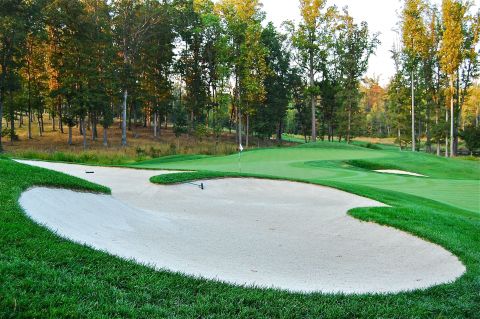
The par 5s at Kinloch are a treat, none more so than #11, where a split fairway with a stream running down its middle dares you to drive down the right side, leaving a long iron or wood second shot to the green. The green, however, is not deep, and greenside bunkers at front and left argue for a more conservative play down the left side and a lay-up for the second shot.
Kinloch is a unique experience, not least of all because it offers a real 19th hole, a par three over water where many a bet has been settled since the course opened a decade ago. (The customary 19th hole in the clubhouse is as you would expect, warm and inviting and festooned with plenty of dark wood and leather.) The 19th plays from 152 to 184 yards, all carry and to a wide green protected by bunkers in front, at left and behind. The Tudor-style clubhouse sits just off to the right and a couple of hundred yards beyond the green are a few large homes, the only structures I saw during the round. (More about Kinloch real estate in the coming days.)
You get the picture (literally) about Kinloch from the accompanying photos. You may not have heard much about the course but then you would not have heard much of Augusta National either if it weren’t for a certain golf tournament the first weekend of every April. Kinloch may get a little bump in publicity next year when it hosts the U.S. Senior Amateur and when the sentimental favorite tees it up, a 68-year old local boy who knows Kinloch backward and forwards -- Marvin “Vinny” Giles. For those angling for an invite to Kinloch there should be plenty of members in the gallery during the event, cheering for Giles. It will also be a great time to check out the real estate in the surrounding community, which I will cover here in the next few days. Contact me and I will be pleased to arrange for you to meet with the developer of the property.
*
Kinloch Golf Club, Manakin-Sabot, VA. Web: KinlochGolfClub.com. Phone: (804)784-8000. Designers: Vinny Giles and Lester George. Yardage/Rating/Slope: 7,203/76.5/140; 6,810/74.5/137; 6,405/72.3/135; 5,818/69.9/128. Membership fees on request.
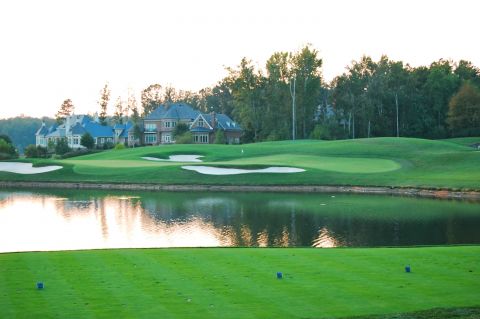
A true 19th hole at Kinloch where many a match has been settled. The homes in the adjacent neighborhood are the only ones you see from the golf course.
The lonely Hunter in all of us
On the world’s biggest golfing stage, an accomplished professional golfer like Hunter Mahan made a couple of swings that broke a lot of hearts, not the least his own and yet reminded millions of golfers why we love the game. After staging a stirring comeback against Graham McDowell in the Ryder Cup’s final and deciding match, Mahan left a
Mahan’s muff provided a few stark reminders to all of us who play this maddeningly frustrating and wonderful game. The effect of stress on the golf swing is incalculable. It is tough for muscles to have memory when all their nerve endings are under assault. Golf is the most “mental” of games, and an assault on the brain is an assault on the body. Now add the pressure of the Ryder Cup, which is unlike the pressure of having to make a decent chip shot at a typical PGA Tour event. Walking toward such a chip shot at, say, the Traveler’s Championship, Mahan would feel much less pressure than he did today, able to rationalize that he was playing for himself not his teammates and country.
Golf is also the loneliest of sports; when it is your turn to play, no teammate can throw a block to spring you for a long run or pass to you for an easy lay-up. You rise or fall on your own lonely efforts.
Announcing the Ryder Cup, former U.S. Open winner Johnny Miller said something so simple and so true just after Mahan’s poor shot -– “We have all been there.” Because we have all been there, we feel Mahan’s pain but we also know that, at some time or another, we have hit a better shot than he did from precisely the same position. Okay, so it may not have been under any more pressure than that of a $2 Nassau. But golf is the greatest game of all because, on any given shot, we amateurs can play just like the pros, for better and worse.Review: Creighton Farms, Aldie, VA
And, for a time, they were right. But in the current economy, it takes more than great golf and sophisticated big new homes to sway prospects anxious about their financial portfolios. The high end of the market is hurting, and the competition for the rare million dollar buyers is intense. Today, it takes eye-catching extras and some unique accommodations to push the undecided into making big real estate investment decisions.

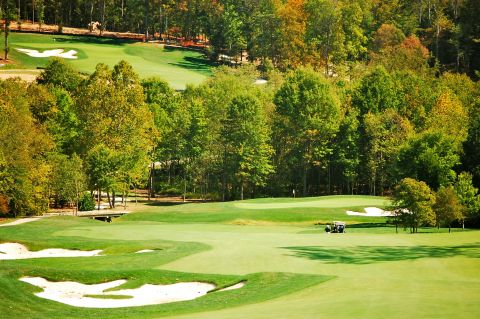
The Golf Club at Creighton Farms gets off to a rousing start with a generous fairway but challenging approach, elements that characterize the rest of the course. All photos by L. J. Gavrich
Southworth Development, the newest owners of Creighton Farms, appears to understand the reality of the upper end of today’s marketplace, and the company has adjusted accordingly. The $87,500 membership in the Aldie, VA, golf club is being waived for new residents, at least for the duration of 2010. Fees for other levels of membership are well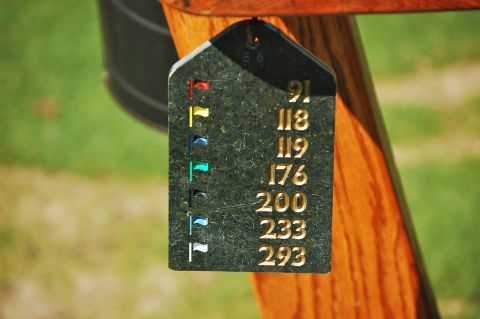 off their pre-recession highs. The restriction to build a home within two years of a lot purchase has been lifted. Construction is underway on a 29,000 square foot clubhouse (dedication next August), and an up-scale sports and fitness center will follow (coming in late 2012); however, membership in the amenities package is no longer mandatory for residents, nor is social membership. The clubhouse will include nine suites to accommodate members’ guests and visiting families. For the busy executive who has neither time nor patience for shopping malls, the club offers a unique concierge service that includes made-to-measure clothes and a wide range of other extras that would make Jeeves blush (including party planning and car detailing).
Creighton Farms can also now boast of something a rare few other communities have -- Jack Nicklaus. Nicklaus, who designed Creighton Farms’ highly regarded golf course, recently committed to live in one of the community’s 25 Villa homes when he and his family are in the D.C. area.

Bunkers at Creighton Farms are not superfluous. Nicklaus puts them in places that make you plot a strategy and grit your teeth.
Nicklaus’ reputation notwithstanding, Southworth Development itself may be Creighton Farms’ key asset. Though the company is just six years old, founder David Southworth started his career in residential development in 1992 as CEO at the Willowbend golf community on Cape Cod. He and business partner Joe Deitch, founder of the Commonwealth Financial Network ($50 billion under management and the largest privately owned broker/dealer in the U.S.) stepped in when the original managers of  Creighton Farms, Ritz-Carlton, suffered the slings of a falling economy and the arrows of too much competition in the D.C. area (the nation’s capital is 45 minutes away and Dulles International Airport a mere 20 minutes). Creighton Farms was Ritz’ second foray into golf community management (Jupiter in Florida was the first), and it may be their last, given their rocky experience. Southworth concluded that Creighton Farms fit its sharply honed portfolio of high-end golf properties, including Machrihanish Dunes on the west coast of Scotland, Renaissance Club near Boston, PGA Village on Cat Island in The Bahamas and Costa Caribe Golf & Country Club in Puerto Rico, all clubs that offer reciprocal privileges for Creighton members. Ritz-Carlton and its partners were only too happy to turn it over to Southworth a year and a half ago.
The 900-acre site at Creighton Farms includes just 184 home sites, a couple of dozen on one-acre lots in The Villas section (priced at $1.4 million and up) and the majority on properties that range from three to seven acres, with views of the golf course or the rolling countryside (some owners will be lucky enough to have both views). Just 13 homes will comprise a section called The Enclave, with lot/home packages starting at $1.69 million. Home sites in a section called Legacy begin at $620,000 and run to $1.3 million on the golf course. The Legacy II neighborhood, when it opens, will offer home sites in the mid six-figure range. Mandatory minimum size in The Villas is 3,000 square feet and maximum of 4,500 square feet. In the other sections, minimum square footage runs from 4,000 to 5,000, depending on whether the house has one or two stories.
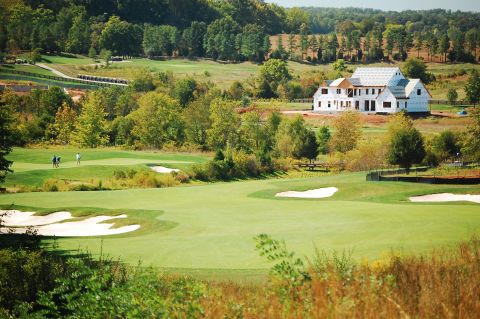
Home construction is well under way again at Creighton Farms now that Southworth Development, whose portfolio of communities and courses include the David McClay-Kidd stunner at Machrahanish Dunes on the west coast of Scotland, has restored a sense of equilibrium. Members of Creighton enjoy reciprocal privileges at Southworth's other clubs.
From the outside, Creighton Farms’ homes are impressive both in size and design but by no means repetitive, even though the developer uses just five builders. The 14 homes built or under-construction span the styles of French Provincial, English Manor, English Romantic, Colonial Revival and American Vernacular (craftsmen-style) and co-exist harmoniously, owing mostly to the separation the large properties gives them and the mostly natural and rustic exteriors.
The golf course is everything you would expect in such lavish surroundings and lives up to its billing as one of the best new courses of 2008 (Travel & Leisure Golf actually named it the best new private course that year). I have played a dozen or so Nicklaus-designed golf courses, including my home course at Pawleys Plantation in Pawleys Island, SC, but Creighton Farms may be the best from a pure design standpoint. Right off the bat on the first tee box, Nicklaus presents a set of challenges and a look that will characterize the rest of the round -- large bunkers, small bunkers,

And so it goes throughout the round at Creighton Farms, the bunkers supplemented with areas of “scrub” in name only; these areas combine colorful combinations of grasses and goldenrod that seem almost composed. The few greens that provide a welcome front door entrance also present steep upgrades and treacherous bunkers tucked close in left and right. Sightlines from tee to fairway and fairway to green are uncluttered at Creighton Farms; Rick Bechtold, the membership director and retail manager at Creighton Farms, provided excellent guidance for the course’s finer points, but if he had not been my guide, I still would have understood what shot needed to be played on virtually every hole, no yardage book necessary, even for a first timer. Executing those shots at Creighton, though, is quite another thing.
The deluxe experience at Creighton Farms begins even before you tee up on #1. Caddies are mandatory before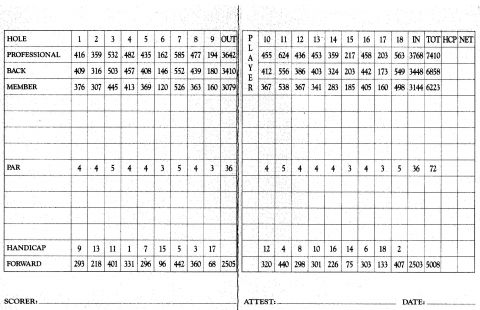 noon even if you choose to take a cart, and our caddy Brian greeted us at the practice range, wet rag in hand to keep the clubs spotless. Gleaming white triangles of stacked Callaway golf balls await you at the practice range, but the real treats are the wooden hang tags at each driving station that display precise yardage to the flags in the distance. The club stores multiple sets of these tags to reflect the change in positions at the range; the wood for the tags, by the way, is from trees that were cut on the property, as are the yardage markers at the tee boxes, the beams in the golf center’s ceiling and the temporary lockers in the pro shop. Back in the good old days, high-end clubs might have pushed the envelope and imported the wood from Ireland or some other place. These days, though, luxury is being redefined, and Creighton Farms seems to do that as well as any golf community we have encountered.
If you would like more information about Creighton Farms or would like to arrange a visit, please contact me.
*
The Golf Club at Creighton Farms, Aldie, VA. Designer: Jack Nicklaus. Yardage: 7,410, 6,858, 6,223, 5,008. Ratings and slope: 77.0/152; 74.1/145; 71.2/135; 70.3/127. Homesites from $400,000; homes from $1.4 million. Full golf membership: $87,500, waived with purchase of home.
Review: Dominion Valley, Haymarket, VA
According to a recent survey, U.S. homebuilder confidence in the housing market remains at a low ebb, with a rating of just 13 where 50 is average. A component index of the survey that measures expectations about the next six months was unchanged. This would all be news to the sales staff at Dominion Valley, a Toll Brothers golf community in central Virginia where sales are defying national trends and staff is brimming with confidence.
When you visit as many golf communities as I have –- well over 100 in the last five years -– you can feel the difference between real enthusiasm and faux enthusiasm among the staff you meet. In the places that are struggling, the on-site real estate agents either try too hard to paint a picture that just hasn’t materialized yet, or they hardly try at all (they point me to the golf course and say “have a good time”).

Hole #1 at Dominion Valley.
But in the rolling hills of Haymarket, VA, the gated Dominion Valley is on a roll. Sales of homes this year are up double-digit percentage points over the same period in 2009, and the community’s visitor’s center is welcoming an average of 25 to 30 prospects each weekend. Frequent hammering of nails into wood may interrupt concentration on the golf course but it is music to Dominion Valley’s sales agents. Confidence in the community is running high: The developer just built a new clubhouse restaurant called Mulligans (named not for a do-over shot but rather for Arnold Palmer’s dog); the small and stylish restaurant features TV screens in the booths and plug-ins for children’s game players, a clever touch.
Dominion Valley’s recent success in the face of a withering housing recession is a consequence of location and pedigree. A mile and a half from I-66 and just an hour and 15 minutes from the nation’s capital -- but much closer to the many office parks west of the city -- Dominion Valley counts a wide range of business people among its residents, including consultants, lobbyists, military personnel and many other government officials who don’t require daily commutes to the city. Haymarket offers plenty enough services and Dominion Valley enough amenities. More importantly, the community is just 20 minutes from Dulles International Airport, one of the easiest to use large airports in the nation.

The approach to the 3rd hole at Dominion Valley.
Surprisingly for a community with year-round golf, just 15% of Dominion Valley's residential population is retired. The age-restricted (55+) Regency community across the street is the option for those who have raised their children and would just as soon live in a place free of school buses. Both Dominion Valley and Regency residents benefit from a huge shopping complex, Merchants Square, just outside their gates, that was originally developed by Toll Brothers.
Philadelphia-based Toll Brothers takes a rather conservative approach to its properties, which is the right personality trait to weather the housing mess of the last three years. At Dominion Valley, you won’t find any vacant lots because the company only sells lot and home packages. When you buy, they build -- no speculators thank you very much. This approach has helped Dominion Valley control the way it looks to prospective buyers; unlike many other communities, you won’t find “vacant” lots in Dominion Valley.

Although the Dominion Valley golf course is open year round, Mother Nature intrudes every once in awhile.
With 2,200 homes already built in Dominion Valley’s first nine years, the development is about 70% complete. The community offers four different types of “product,” ranging from the “neo-traditional” single-family homes of the Village Collection, with prices beginning just under $400,000, to the Estate Collection whose homes begin in the high $600s and can range up to nearly 5,000 square feet and seven figures. The Carolina and Executive Collections anchor the mid-range selections, at prices from the $400s to the $600s. Dominion Valley really doesn’t have much local competition in its price ranges; homes at the lush and consciously sophisticated Creighton Farms, about a half hour up Highway 15, start above $1 million and other golf communities in the area do not offer private golf or the range of mid-six figure homes of Dominion Valley. (Note: Watch this space for a review of Creighton Farms in the coming days.)
Palmer, who has received the bulk of Toll Brothers’ golf course commissions, was responsible for the sprawling layout at the heart of the community, as well as a shorter course (par 62) across the street at The Regency, an age-restricted Toll Brothers community. Although golf membership is not required of residents of Dominion Valley, a dedicated golfer will find one of the club’s two golf memberships a good deal. Full-family golf initiation fees for a resident are $5,500, with $2,500 paid by Toll Brothers (or a homeowner who is a member) at the time of a house purchase. Dues are $385 per month. Dominion Valley’s unique “preferred” membership is just $300 for initiation, and $150 per month, but play is restricted to after 1 p.m. on weekdays and after 3 p.m. Friday through Sunday. However, “preferred” members have access to the club’s fitness center and are permitted to play unlimited golf at the Regency course.
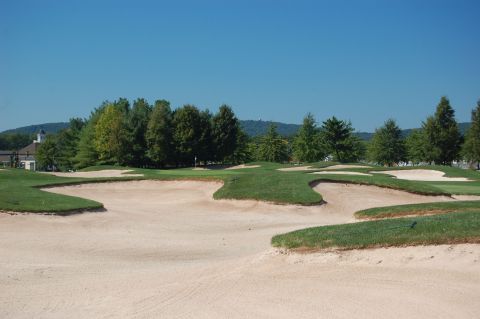
The 8th at Dominion Valley reminds us that it is an Arnold Palmer design and, therefore, must have large bunkers.
Dominion Valley members also have access to the 26 other golf courses Toll Brothers manages across the U.S. A member of any one of the courses has playing privileges at all others with payment of a cart fee only. A few days after my visit to Dominion Valley, I met a member of a Toll Brothers sister course, Belmont, in Ashburn, VA, just 40 minutes from Dominion. He told me the reciprocal arrangement with Dominion was a great feature, although he lowered his voice to say “our course (Belmont) is better.”
That is saying something because the Dominion golf course is excellent, well manicured and fun to play. All the customary Palmer Design touches are in place, including the wide fairways, large bunkers and large, sloping greens. But as a nod to a wide range of golfers including the many juniors who use the course, the customary Palmer bunkers-on-steroids are more visual elements than in-play hazards. Still, some pieces of marshland and other scrubby areas between fairways and greens make club selection especially important. The Little Bull Run Creek also comes into play on a few holes.
The greens at Dominion Valley are approachable in large part because they are big, with plenty of opportunities for challenging pin positions. On the day I played, the greens were still recovering from aeration a week earlier. This turned out to be fortuitous in a way, saving me from certain three-putts when I wound up above the hole. Bunkers around the greens were very much in play, with many guarding the center front, leaving no option for run-up shots. I played the blue tees and thought the course played a bit easier than the 70.7 rating and 137 slope suggested, but when the greens recover and roll much faster, the course will toughen up significantly.
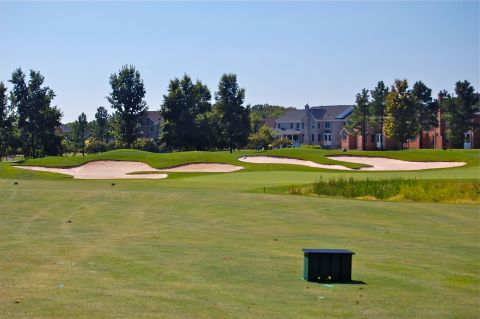
To encourage members to fix their fairway divots, Dominion Valley puts large sandboxes at mid-fairway about 100 yards from the greens on some holes. The boxes interrupt the attractive sweep of the fairways up to the greens.
Otherwise, I found only a few things to quibble with on the Dominion Valley course. The most egregious were the wooden boxes filled with sand that dot the middle of a few fairways, the first time I have seen such a bulky reminder to fix divots. Since every golf cart at Dominion Valley includes canisters filled with sand, one has to wonder how tough it is for members to grab a can and fill a divot. Also, I noted most green complexes did not have the customary “carts exit here” signs. That is a good thing; private club members ought to know where to leave the fairways in their carts. The club should consider removing the cart signs from the few holes where they interrupt the flow of the fairways to the greens.
Those modest criticisms aside, Dominion Valley is an under-rated destination for retiree golfers. It provides excellent golf at fair prices, a vast array of shopping options within a few hundred yards of the front gate, convenient access to a large international airport, and an easy drive to interesting destinations like Washington, D.C., Colonial Williamsburg and the Shenandoah Valley. Most of all, for those who consider a developer’s financial stability among the most important criteria when shopping for a golf community home, Dominion Valley offers the rock solid backing of Toll Brothers, one of the most respected national developers in the nation.
If you would like to know more about Dominion Valley or would like me to arrange for a Toll Brothers representative to provide you with detailed information about the golf club and real estate opportunities, please contact me.
Quick preview of central Virginia golf
There are plenty of choices in golf communities in central Virginia, and I have not encountered even a mediocre one of the five I tested. I am working on my reviews of each, trying to find a way to say “outstanding” in five different ways because all the courses I played have been in peak condition, fun and challenging. I played what most Virginia golf raters believe to be two of the top five courses in the state (Kinloch and Creighton Farms) as well as another that was conceived as an upscale private community and course (Federal Club) that went into bankruptcy and was recently purchased by a local developer who plans to take it private again in 2012. For calculated risk takers, a property at the Federal Club could turn into a good bet. A much safer bet is Dominion Valley, a sprawling community in the tidy town of Haymarket, which features a rolling Arnold Palmer design and the security of backing by one of the most respected national developers, Toll Brothers. I also revisited Glenmore, just east of Charlottesville, to play its up and down and mogul-ridden John LaFoy layout.
As I work on the reviews of these fine golf communities and courses, here is a visual taste of each.
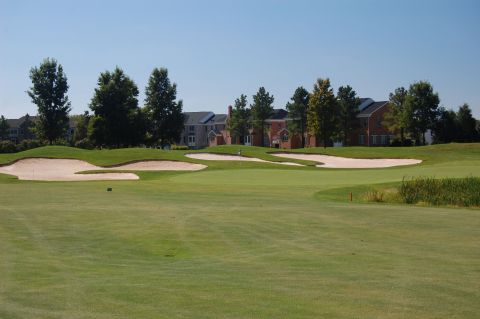
Dominion Valley, Haymarket, VA

Creighton Farms, Aldie, VA

Federal Club, Glen Allen, VA

Kinloch Golf Club, Manakin-Sabot, VA

Glenmore Country Club, Keswick, VA
Review: Old Marsh, Wells, ME
New England is known as “The Land of Steady Habits,” and one of those habits for natives is to live from cradle to grave in the region of their upbringing, venturing forth for visits to friends who live in warmer climes and for the occasional Myrtle Beach buddy or Florida family golf vacation. The prospect of local golf from March to November and skiing during the winter months is more than enough recreation year in and year out for a New Englander.
If I fell into the New England skier/golfer category –- I don’t ski – my ideal living arrangement might be a home near the ocean and one in the mountains just a couple of hours apart. With one place at sea level and another a few thousand feet up, I would not think twice during the summer months about bouncing between the two places as temperatures and the flood of tourists at the shore dictate. And to be able to shuttle between links style and mountain golf would be pretty cool as well.
Vermont and New Hampshire are rife with combination ski and golf communities that lack only one key element to make them perfect year-round venues for the skier/golfer/beachgoer –- no nearby ocean. One of those communities I previously visited was Owl’s Nest, where Mark Mungeam has fashioned a combination mountain and farmland layout that rivets your attention from first tee to last green. Homes at Owl’s Nest, which is just 15 minutes from challenging ski slopes, are available starting in the $200s. After a recent visit to the reasonably priced community of Old Marsh in Wells, ME, I got to thinking that a New Englander can own homes near the beach and in the mountains for $600,000 in total, or less.

Despite the implication of water in a name like Old Marsh, the layout features wet hazards at only a few, but strategically challenging, points, such as the par 3 15th.
Dennis Page, a veteran real estate agent and builder from Massachusetts, and his partners bought at auction the fledgling development beside the Old Marsh Golf Club. A bank had taken the property back from another developer who had purchased it in 2006 but, familiar story, had run out of money and time. More about online pokies site on onlinecasinokiwi.com! Page and his team plan 131 homes for the small community, including 85 single-family homes of between 1,535 and 2,100 square feet. Nearly a dozen homes are built or in various stages of construction, with six current full-time residents in place.
“We expect to appeal to couples splitting their time between Maine and Florida,” Page told me.
The cost of living at Old Marsh will certainly appeal to those who are looking for a vacation home near the beach 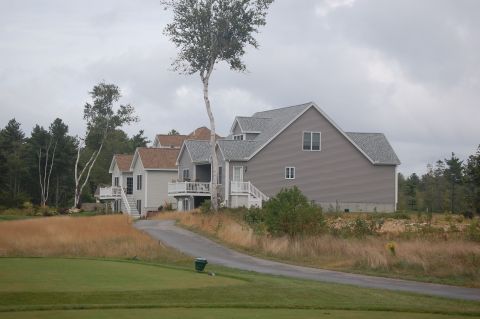 and on a golf course, and those as well who are looking to downsize their primary home. The basic 1,535 square foot model at Old Marsh is priced at $299,000, with homes strung out beside the 10th, 11th and 16th holes available at a slight premium. The largest model sells for $369,000. Property taxes run below $3,000 annually. A social membership in the adjacent club, which includes access to pool, tennis and the fitness center at the attractive shingled clubhouse, is mandatory for residents but only $600 per year (green fees at the public course are reduced for social members). Full-golf memberships are $2,300 for a couple and include everything, including green fees. The community is just three miles from Wells Beach and five miles from Kennebunkport. Bostonians can drive to Old Marsh within 90 minutes.
The long-term viability of the Old Marsh Golf Club does not seem to be an issue. The course is managed by the Harris Golf Group, the region’s premier multi-course operator. Architect Silva is also very popular in these parts, having cut his teeth, as did the above-mentioned Mark Mungeam, with the legendary Geoffrey Cornish, the dean of New England architects. More than 100 golf courses in the northeast carry the 96-year old Cornish’s stamp.
Old Marsh was not a cheap course to build given that the “marsh” is actually swampland that needed to be raised before it could function for golf. That gave the architect something of a blank canvas, plenty of land to push around to suit his eye. You might think that with the watery base to the property, Old Marsh would be studded with many ponds and lakes, yet they come into play only rarely. But when they do, they are imaginatively used and a real challenge to negotiate. On the 485-yard par 5 3rd hole, named “Double Turn,” the second shot is the critical one, whether you play the safe lay-up or go for the green. At 230 yards out, you face water left and right, and a narrow isthmus of fairway (maybe 15 yards wide at about 150 yards from the green) that opens up a bit and turns right the closer it gets to the end. You can wimp out on your second shot and hit a short iron to just short of the pond at right, but then your third shot (another short iron) must carry entirely over water and avoid the bunkers that surround the angled green. The 3rd at Old Marsh is a textbook example of a risk-reward par 5.
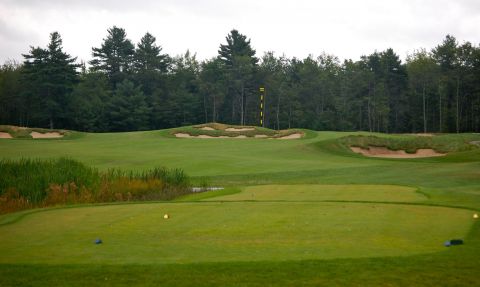
The C.B. McDonald inspired "Alps" hole at Old Marsh provides a bit of aiming help from behind the hidden green.
My favorite hole was the C.B. McDonald inspired “Alps,” the short par 4 2nd hole (I played it at 347 yards). The drive is no big deal as long as you stay short of the bunkers that cross the fairway 100 yards from the green. The green is totally obscured from the fairway; a large striped pole behind the green guides you, but since the green is two-levels and wide, you need to drive up and take a look before making your second stroke.
Silva clearly makes some nods to the classic designers, especially Seth Raynor and McDonald, but his most obvious nod is to Donald Ross, at the 7th hole, a par 4 of 381 yards that is named simply “Pinehurst.” The fun starts on the tee box where, if you choose driver, you had better draw the ball or you can run off the fairway into the marsh. The safer play is a fairway metal, leaving about a 160-yard approach to a crowned and severely sloped green that is surrounded by a huge collection area. From beneath the green, and depending on pin position, the angle of attack can run from a lob wedge to a putter and virtually every stick in between. The design of the hole may not be harmonious with the rest of the layout, but it is a lot of fun to play…just like the entire Old Marsh Golf Club.
If you would like more information about The Homes at Old Marsh, please contact me and I will put you in touch with the community’s developer, Dennis Page. Ditto if you would like more information about Owl's Nest in New Hampshire.
Why did the beer-drinking golfer cross the road?
I encountered the sign below at Blue Ridge Shadows Golf Club in Front Royal, VA, today. The golf course, designed by Tom Clark, was next to the Holiday Inn where I am staying tonight. I’ll share some photos of the challenging and distinctive course in the next day or two.

Many golf choices in best small towns
Yes golf home seekers, there is a Virginia
Golf Discovery Package: No price, no visit
First look at Wells, ME's Old Marsh club

Now on Sale

- The only book about golf communities in the last 10 years.
- 156-page step-by-step guide to finding your dream golf home.
- Info on nearly 100 golf communities the author has visited.
- Paperback version costs less than a sleeve of Pro VIs.
Here is what the experts are saying:
“The book is chocked full of information…applicable to anyone looking for a move to the Southeast regardless of whether they are looking for a golf community or not.” — John LaFoy, golf architect (Linville Ridge CC, CC of Charleston, The Neuse GC)
“Larry has done a tremendous amount of work and anyone — like me — who is looking to search for a golf home now or in a few years needs this book.” — Brad Chambers, golf blogger, ShootingYourAge.com
“Wow! What a thorough piece of work…a must for anyone moving South. This book will help many people.” — Brett Miller, owner and founder of MMA, Inc, a golf industry consultancy
Buy It Now at Amazon.com or BarnesandNoble.com.