Wilmington, NC, area’s Brunswick Forest plows through economy’s headwinds
Leland, NC’s, Brunswick Forest, which I first visited in 2008 just after its initial houses had gone up, is defying the gravity of a plummeting housing market. I hardly recognized the golf community
“We are the fastest growing community in the coastal south,” said Brandy Marshall, Brunswick Forest’s marketing coordinator. “And we had our best January [in sales] since we opened [in 2007].”
In the teeth of an awful market, especially for leisure residential sales, how has Brunswick Forest managed to buck all the negative trends? The answer is simple -- deep pockets. Brunswick’s owner/developers, Lord Baltimore, a Maryland private investment organization, has paid “out of pocket” for all the amenities in Brunswick, incurring zero debt. Lord Baltimore, newbies at the golf community development business but well experienced in commercial development, understood that, in a brutal economy, buyers care first about the financial security of the developer.

Many houses in Brunswick Forest are on small patio lots, but one home behind the 5th green gives a hint of what is possible in the community's "custom home" neighborhoods.
To signal their financial might, Lord Baltimore built the community’s wellness/fitness center and Community Commons during Brunswick Forest’s first few months, and followed by putting the earth movers to work on the golf course. The Commons includes gardens, a glass-enclosed meeting room with fireplace and kitchen, and a fishing pond with dock, a quiet place for residents to contemplate their smart purchase decisions. The developers also made it clear early on that they had secured tenants for The Villages, a 160-acre commercial and retail district at the Brunswick Forest entrance, where recently a new medical center joined a supermarket, drug chain store, bank, coffee shop and motel. For those who need a wider array of services, the city of Wilmington is just 10 minutes away.
Brunswick Forest also managed to find the sweet spot of recessionary residential leisure pricing, which is to say below the mid-six-figure mark. The average home price in the community is about $350,000, although you can go as high as $600,000 for a house adjacent to the golf course, or as low as $240,000 for an “entry-level” town home in one of the three (of nine total)
At 4,500 acres, Brunswick Forest is large, and it took me almost 10 minutes to drive from the front entrance, which is not gated, to Cape Fear National, the golf course at the back of the property. At full build out, 180 homes will adjoin the current 18-hole golf course; plans are to build a third nine that will have the “character of a Pinehurst course,” according to Brad Walker, director of sales and marketing for the golf course. All told, according to Brandy Marshall, Brunswick Forest expects to have “around 8,000 roofs” at completion.
Although some of the smaller homes seem close together, Brunswick Forest is not an especially densely populated community. About a third of the community will remain natural. Already, 100 miles of walking and biking trails, including wooden bridges, snake through Brunswick Forest.
“About 90% of our residents say they are into walking regularly,” said Marshall. Baby boomers, who indicate consistently in surveys that walking is their number one activity, have gotten the message about Brunswick Forest; the average age of residents in the community is 52 years, according to Marshall. Still, plenty of families have moved from elsewhere in the Wilmington area, and those who have an issue with school buses and squeals at the community pools might find Brunswick less than paradise.
Do financial stability and low prices combine to make Brunswick Forest the rare perfect community? Obviously, the community strikes a chord for many buyers, but those looking for a
The second issue for this observer was the absence of hardwood trees, especially the live oaks so prevalent and characteristic of true Low Country settings. The lack of trees in most yards emphasizes the proximity of homes in the patio-lot neighborhoods, although many front yards had been planted with attractive dogwoods. Small though they still are, the dogwoods were in full blossom in mid-March and, given a few years, should provide the neighborhoods of Brunswick Forest with ample cover. For now, however, there is not much separation neighbor to neighbor.
That said, Brunswick Forest gets our vote for hitting just about every high note for stable, organized, fairly priced and well-located golf community. And the new Cape Fear National Golf Course, which we will review in this space in the next few days, does nothing to diminish those qualities.
*
Brunswick Forest offers a generous “discovery tour” package at a great price of just $179 for 3 days and 2 nights for two. Included are accommodations in downtown Wilmington, a round of golf at Cape Fear National (a $200+ value alone), a dining certificate for a restaurant on the waterfront in Wilmington, and access to all of Brunswick Forest’s amenities. Of course, a tour of the property is required.
If you would like us to arrange an introduction to the sales staff at Brunswick Forest, or have any questions, please do not hesitate to contact us. Home On The Course newsletter
Click here to sign up for our Free monthly newsletter, loaded with helpful information and observations about golf communities and their golf courses.
Cliffs should choose another number
An article in today’s New York Times by Ken Belson about The Cliffs Communities and Tiger Woods ends on a strangely ironic note.
“I can’t find 12 percent guaranteed income in any other thing these
Mr. Tucker goes on to say that, “It [the loan] also provides me with an insurance policy that I will not all of a sudden be placed in a position where the country club is managed by some capitalist vulture who washes out my equity.” If residents don't come up with the $60 million in financing, Anthony has indicated he will have to seek the money from external sources, and at higher rates, with the prospect of losing his impressive roster of amenities to an investment bank in case of default.
It strikes us that if the income is truly “guaranteed,” then worries about “capitalist vultures” are unwarranted. But the greater faux pas is the reference to “12 percent guaranteed” which has become one of the most infamous numbers in the history of finance. It was precisely the return Bernie Madoff guaranteed his clients.
Pride of the Marines: College golfers get, give lessons
Each year in March, 32 college golf teams gather on the two golf courses at Paradise Point inside the gates of Camp LeJeune, the immense U.S. Marine base in Jacksonville, NC. Pairs of collegians are matched with current and former Marines in an ersatz pro-am format for two days. Then the college golfers are turned loose for a final round of competition on their own. Methodist University repeated as champions this weekend.
The golf seemed almost beside the point to this observer as I walked the two golf courses. It was a kick to see the kids giving lessons and encouragement to the higher handicapper, older Marines who seemed grateful for the tips. Thirty years of service, some of those in active combat, do not leave a lot of time to hone your short game. Ron, the ex-Marine who played in my son’s group, still travels the world training younger Marines to defuse bombs and jam enemy electronic signals. He knows he is not a good golfer, but his joy at playing with the kids was evident.
Many of the kids take the opportunity to ask the Marines about their careers and travels. For teenagers whose worldviews may be colored substantially by YouTube and Jersey Shore, it is an opportunity for a true reality show.
Without getting too sappy about it, the collegians -- indeed, all of us -- are able to play golf because someone else is out there on the front line doing the tough work. I was pleased that, on the 18th hole of the second day, when Ron and the college kids shook hands and said their goodbyes, my son Tim said to Ron, “Thank you for your service.”
Indeed.
Great balls afire: Golf ball hunting story drives comments
Rick Vogel’s story about his golf ball hunting walks with wife and dog struck a chord with our readers. (Read it by clicking here.) Most comments reflected an environmental theme.
“Rick is making a statement against a form of pollution that needs to be addressed,” wrote one reader, “and he has ‘the guts’ to do it. Keep it up, Rick.”
“My father is an avid golfer,” wrote another, “and I am an environmentalist, so I found this article to be fascinating from both perspectives.”
From time to time, we hear complaints from homeowners who live adjacent to a fairway and resent golf balls landing on their property. We are always perplexed at why they chose to live on a golf course in the first place. But one reader saw the glass -– and his backyard –- half full.
“I am also a non-golfer [like Rick] living on a golf course and find dozens of balls in my yard,” he wrote. “A good place to donate these is a high school that has a golf program. The students and coaches really appreciate it.”
Thanks to Rick for the “donation” of his provocative and entertaining story, and we look forward to more such contributions. And while we are at it, we invite other readers to share their own stories about their homes on the course.
Bankruptcy courts determine fate of private golf clubs
A court in Charleston, SC, has cleared the way for the McConnell Group to purchase The Reserve at Litchfield Beach for $1, plus settlement of the golf club’s debts. Meanwhile, in Richmond, VA, another bankruptcy court may soon determine the fate of the formerly high-end Federal Club, which is now open to the public.
The Charleston judge, according to the Triangle Business Journal, approved The Reserve’s reorganization plan that gives the club to McConnell for $1 plus assumption of the club’s more than $500,000 in debt. Last year, club members voted overwhelmingly to sell to McConnell, a software millionaire who owns five other golf courses in North Carolina, but former members sued for recovery of a larger percentage of their initiation fees, a feature of membership included in the club’s bylaws. The judges ruling seemed to imply that the bankruptcy filing wiped away the equity status of the former members. McConnell, who was looking for another golf club near the beach for the use of his current and future members, does not offer equity memberships.
The sale of The Reserve is expected to close within 30 days.
Meanwhile, according to the online Richmond BizSense, time is running out for the owners of the Federal Club, who owe an area bank $8 million. The club, which cost about $9 million to build a few years ago, probably won’t fetch a third of that at auction in the next few weeks. A group of current members has indicated it will bid around $2 for the property, and they just might get it if no other bidders emerge. Members might have to pony up a reported $13,000 each to secure the club. Their notion is to keep the course publicly accessible until such time as it recoups enough members to return to private status. That could be a long wait.
Perhaps someone should have called John McConnell a couple of years ago.
A Good Walk’s Spoils: Non-golfer has the balls to prove it
by Rick Vogel
Rick Vogel is one of our most faithful readers and keeps us up to date on golf community news in the Asheville, NC, area. This part of an email exchange last night is one of many such entertaining exchanges we have had over the last year. Rick, his wife Lynne and his other faithful companion, Goldie, split their time between a home in Asheville and at Wolf Laurel, a golf community north of the city. He and Lynne are retired innkeepers of 25 years, and they enjoy their time hiking, sailing and collecting golf balls.
Since I started this email about two hours ago, our snow has gone and we just came back from a walk with the dog over to the small stream that cuts directly across the middle of the 13th fairway from rough to rough, with a nice wooden bridge across it for carts. The stream is maybe three feet wide, easy to step across but steep sided, six to eight feet below the fairway level. Lynne and I spent maybe 10 minutes picking golf balls out of the grass on both sides, 35 of them to be exact. I'm trying to train Goldie to retrieve them; so far all she does is stand on the edge above us looking perplexed. Needless to say, this deep gash across 13 is a ball magnet. Just for the hell of it, I'm including a breakdown of the brand names we picked up all within about 50 feet of one another:
11 Titleist, one with a Masters logo
4 Maxfli
3 Topflite
3 Wilson
2 Pinnacle
2 Callaway
1 Dunlop
1 Precept
1 Nitro Blaster
1 MC Lady
1 Nike
1 Slazenger
1 Srixon
2 Topflight X-outs (1 orange)
1 Maxfli Noodle (pink)
So, OK, it has been a long winter and, yes, maybe I'm a little bored, but I bet this bunch of balls are a microcosm of lost golf balls all over America. FYI, over the nine years we have owned this house on the Wolf Laurel course, we have collected over 1,200 balls while hiking the course. My brother and all his golfing buddies haven't bought a ball since 2002. Have you ever wondered how many lost golf balls are lying in the rough all across this country's courses?
I've done a little research and, according to John Calabria, VP of R&D at Maxfli, the number of balls produced in 1966 was 16 million dozen or about 192 million. In 1998, it was 90 million dozen or 1.08 billion. Go figure where all the billions of balls just from 1998 to 2009 are. In the same article in the Nov.99 Golf Digest, Scott Smith reported that the liquid hazard that surrounds the 17th green at Sawgrass costs players 120,000 balls that get dunked there each year during 40,000 rounds, which works out to each golfer losing a sleeve alone on that hole.
Bobby Ellis, superintendent of the Indian River Club in Vero Beach, Fla., estimates that the crown of your average palm tree rising anywhere near the line of fire holds as many as four-dozen balls. Scott says Florida's palm trees are lightweights compared to the cypress trees of California. One such specimen at the Olympic Club in San Francisco was cut down last year and disgorged 200 golf balls. The article says many abandoned balls get put back in play. Second Chance, the ball-retrieval outfit, says that more than 100 million golf balls are recycled from hazards each year.
In any case, can you imagine how many billions and billions of balls are out there all over the world's courses?
Thanks, Rick. Although I am way beyond the days as a 14 year old golfer whose allowance was too small to pay for golf balls, my own heart still goes pitter patter when I spy one abandoned by a fellow golfer.
First rank of second homes, per Barron’s
A recent article in Barron’s magazine identified its 10 top choices of the best places to buy a second home. With the exception of Aspen, CO (6%), all the magazine’s choices are in markets whose prices are off by double-digit percentages since the peak. Park City, UT, the article indicates, is down 45%.
We can’t quibble with Barron's two choices in the Carolinas, which include Kiawah Island (#2, and off 21% from peak) and Asheville, NC (#9 and off 38% from peak). The article’s author, Steven M. Sears, indicates that all market price reductions are anecdotal, the results of conversations with locals (our own informal research indicates Asheville prices have not dropped quite as much as the article indicates). So too are the median prices of homes he cites, $1.4 million and $700,000 on Kiawah and in Asheville, respectively.
Although you can pay as much as $7 million for a house on Kiawah Island, home to some of the best golf courses on the east coast, I know of some interesting buys at $700,000 and less, like a 3 BR, 3 BA contemporary-styled home with marsh views and a cul de sac setting that is listed at $695,000. If you prefer the higher altitude setting of Asheville and its surrounding Blue Ridge mountains, plenty of good choices are available under the $700,000 median. For example, at the highly rated Champion Hills in Hendersonville, a 2,800 square foot “arts and crafts” style two-story house with 4 BRs and 3 BAs is listed at $669,000. Champion Hills’ Tom Fazio designed golf course was recently rated by Golf Digest as the 5th best in North Carolina. I believe it; I thought the course was excellent when I played it four years ago, and it has been improved in the years since.
You can read the Barron’s article by clicking here. If you would like more information on Kiawah, Asheville or any other golf rich areas in the southern U.S., please contact me.

Tom Fazio lavished much care on his design for Champion Hills, which is located in the designer's hometown of Hendersonville, NC, about a half hour from Asheville.
Jekyll Island: Where millionaires once played, you can too
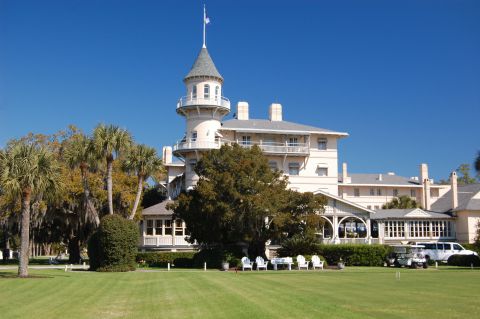
The Jekyll Island Club was built by millionaires as the core of their playground, but mere mortals can enjoy the croquet lawn and other amenities without being rich or famous.
The list of former residents of Jekyll Island reads like a Who’s Who of American tycoons: Goodyear, Rockefeller, Morgan, Vanderbilt, Pulitzer. Their progeny have now scattered to more secluded and international domains, but these captains of industry left behind a classic hotel, a few
The Jekyll Island Club offers three golf courses. I walked the Pine Lakes course during a college golf tournament, and it was in very nice shape after a pretty tough winter. Because the island is owned and run by the state of Georgia, government funds supplement golf revenue to maintain the courses. Pine Lakes was not especially tough - about 6,700 yards from the longest tees and flat – but the greens were tricky and well bunkered, making difficult pin positions possible. And few of the lakes on Pine Lakes were in play. Most golfers consider the Oleander course the best of the trio, which also includes one called Indian Mound.
Home prices on Jekyll Island run the gamut. Within walking distance of the beach, you can find condos that start in the $200s and single-family homes over $1 million. In 2047, the Georgia state legislature will decide whether to keep Jekyll Island essentially frozen in time, or turn it over to private developers. At that time, the entire character of the island could change, but for those who don’t have a 36 year time horizon, Jekyll Island is worth considering -- for a vacation at least.

Greens at the Pine Lakes course at the Jekyll Island Club are well bunkered making for some nasty pin positions, if the greenskeeper is so disposed.
Florida’s Palm Coast real estate on sale…distressed sales
More than 50% of all homes sold in February in Florida’s Flagler County and along the Palm Coast were either foreclosure or short sales, those in which the selling price is lower than the amount owed on the mortgage loan. According to Toby Tobin, a sharp observer of real estate issues in Florida, nearly a quarter of homes slated for foreclosure sales in April are in the “upscale” range. At his web site, Toby provides a list of those properties and their prices.
You can read Toby’s article on distressed properties by clicking here.
Jekyll Island: The good and bad of government run islandcare
The nation has spent the last few months debating – yet, again – the role of government in the lives of its citizens. I am listening to the final arguments about healthcare from Jekyll Island, GA, where I am following my son’s golf tournament at the Pine Lakes club, one of the island’s three and a half golf courses. Jekyll Island could be the poster story for government involvement in something many believe is best handled by private enterprise – real estate development.
Jekyll Island, for those interested in both golf and coastal living, has a history rich in controversy, a frozen in time beach ethos, and an ultimate fate yet to be decided, even after more
In short, the state of Georgia supervises Jekyll Island, and leases property there to others. A 100 year state law to oversee the island runs out in 2047 when, as has happened before, state legislators will debate whether to turn the island over to private interests for further development. That decision may hinge on how Jekyll is doing economically at the time, or the fight may resemble what we are hearing in Washington and across the nation today – whether the government can run anything better than private enterprise can.
I give the Jekyll Island experiment a mixed verdict from my casual observation of the last two days here. The good: The place is clean and orderly, the infrastructure seems solid (the roads appear adequate to handle even summer traffic), and the dozens of cyclists and beach walkers, even on cool March days, seem less like tourists than their counterparts in Myrtle Beach or on the boardwalks of the New Jersey Shore. Jekyll Island is about as laid back as a beach community gets. One more “good,” especially for tourists: The motels are strung out, Daytona Beach style, along the beach, so that the sand is a few strides from your doorstep if you choose to stay on Jekyll. The motel where I am staying is charging $100 for an oceanfront room, which seems fair even in the “off season.” (It will be 72 degrees today.)
On the other hand, Jekyll Island is frozen in time. The housing and motels appear to be circa 1950s and ‘60s, not exactly a high point in the history of residential architecture. Oddly, there are only two restaurants open on the island, and not many more that will open in the high season. Ironically, when Rockefellers and Morgans and Carnegies played along these shores, high season was January through April. Take away the collegiate golf tournament at the three-course Jekyll Island club, with dozens of teams and parents in attendance, and Jekyll Island would be pretty much a ghost town.
One last minor irritant: As you enter the island, you are stopped at a gate and asked, nicely, to pay a $5 “parking fee” that is good until midnight each day. The only places I parked were at the motel and golf club. Parking fee is code for island entrance fee. Leave the island for dinner on nearby St. Simons Island or in Brunswick, and you will pay another $5 to get back to Jekyll. For those who don’t like the idea of a “use” tax, Jekyll may not be your kind of place.
I’ll be taking photos on the golf course today and hope to post a few here in the next few days. In the meantime, here is a link to a terrific article, written a decade ago, about the history of Jekyll Island with some of those elements of a good historical novel I mentioned above.

The Oceanside Inn & Suites on the beach at Jekyll Island is indicative of the motel and residential architecture that dominates the island.
Woods to return to tour at Masters
SC rating panel names top 50 golf courses

Now on Sale

- The only book about golf communities in the last 10 years.
- 156-page step-by-step guide to finding your dream golf home.
- Info on nearly 100 golf communities the author has visited.
- Paperback version costs less than a sleeve of Pro VIs.
Here is what the experts are saying:
“The book is chocked full of information…applicable to anyone looking for a move to the Southeast regardless of whether they are looking for a golf community or not.” — John LaFoy, golf architect (Linville Ridge CC, CC of Charleston, The Neuse GC)
“Larry has done a tremendous amount of work and anyone — like me — who is looking to search for a golf home now or in a few years needs this book.” — Brad Chambers, golf blogger, ShootingYourAge.com
“Wow! What a thorough piece of work…a must for anyone moving South. This book will help many people.” — Brett Miller, owner and founder of MMA, Inc, a golf industry consultancy
Buy It Now at Amazon.com or BarnesandNoble.com.