On windy day, Paradise Point Gold tough as a Marine
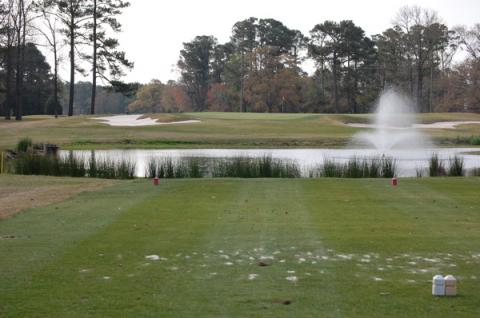
The water does not really come into play on the 163-yard 2nd hole at Paradise Point, but the wind certainly does when it is blowing in from the ocean, a few miles away.
If you think U.S. Marines are all workout and no play, a visit to Camp Lejeune on the North Carolina coast will disavow you of that notion. Two 18-hole layouts - one tough, the other a walk in the park - grace the enormous piece of property. Best of all, they are now open to the public which seems fitting, since we taxpayers help run the place.
I caught a few holes on the base's Scarlet Course Friday, a 5,900-yard flat layout designed by Fred Findlay, who designed the tougher and better regarded Farmington Country Club and the Keswick Club, both in the Charlottesville, VA, area. Yesterday, I walked the George Cobb Gold Course at Paradise Point, which was long (7,000 for the collegians competing in a tournament there) and tricky, with sloping greens and lots of protection from surrounding bunkers. Add a wind that gusted off the nearby ocean at up to 25 MPH, and some normal 6 iron approach shots played as four or three irons. Scores yesterday on the Gold were an average five to six strokes higher than Friday's scores on the Scarlet.
The terrain is Carolina coast flat, but Cobb added some nice contours around the green that make for challenging chips up or down slopes to smallish greens. The Bermuda fairways and rough were cropped like a Marine haircut, making clean ball contact and a slightly stronger grip an imperative. Greens were firm, sometimes extremely so; in many places, a good bump and run game seemed to be an asset. Big but wild hitters will enjoy the Gold Course especially; the fairways are quite generous, but they all narrowed severely on the way to the green. This is a course that rewards good iron play.
Water is rarely in play, although a waterway runs along the 12th hole, a terrific and difficult par 3 of almost 200 yards from the tips. The river also framed the view of the 11th green from the fairway. A few of the par 5s played downwind today and, therefore, the kids who hit the ball 275 off the tee - there are plenty of them, even at the Division III level - had a go at a few of them. But in the gusting and swirling winds, I saw few putts for eagle on any of the four par 5s. Greens were in excellent shape but a little slow, taking away some of the drama of downhill putts. In the gusting winds, you could almost see some of those slow putts blown off course.
The Gold Course at Paradise Point is a fine layout and, if you are in the area of Camp Lejeune, worth a stop. You could very well be matched up with a Marine.
Paradise Point Gold Course, Camp Lejeune, NC, 910-451-5445. Regular tees: 6,591 yards, Rating 72.3, Slope 124. Click here for map.
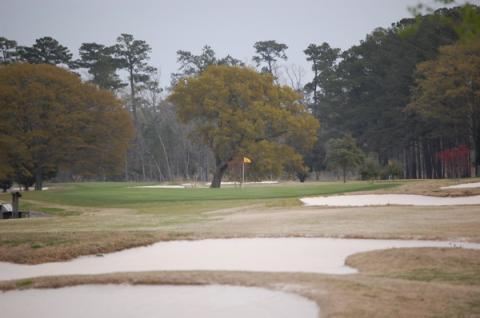
The par 4 18th at Paradise Point Gold is long (477 yards from the tips) and into the wind when it blows. With traps right and water left, a long iron or wood to the green should be approached with care.
 Home On The Course newsletter
Click here to sign up for our Free monthly newsletter, loaded with helpful information and observations about golf communities and their golf courses.
The Coves makes it official: Irwin to design course
Up in the air: Another rotten day of flight
I violated one of my principles of air flight yesterday: Never fly to a destination inside 16 hours drive by car. By the time you drive to your local airport, park your car, take the shuttle bus to the terminal, check-in, make it through security and arrive a comfortable 45 minutes or more before your flight is due to leave, you have gobbled up a few hours. Then, if your local
All things equal, that gobbles up about six hours in the best cases, and that is only if nothing goes wrong with your flight, such as a tire that needs changing, which forced a delay of 30 minutes for the second leg of my flight today to Wilmington, NC.
To avoid the petty indignities the airlines pile on you, I don't mind driving another few extra hours in the car. They are worth it. Yesterday's roster of indignities included a gate agent in Philadelphia who told me to eat my breakfast within 10 minutes and get back to the gate because we would be boarding the plane as soon as it arrived from the hangar. I dutifully wolfed down my food and made it back to the gate at 9; the plane (of course) arrived at 9:20 and I couldn't help but notice that it began disgorging luggage. Is USAirways now putting passengers up overnight in their hangars, I thought? Of course they aren't (that would be too clever and innovative for an airline). The gate agent had misspoken; the flight had arrived from Wilmington, not the hangar. A few minutes later I heard the agent complaining to her supervisor that she expected to be paid extra for having been asked to arrive five minutes earlier than her shift to post the flight information at the gate. Yikes.
Then, came the tire problem and the gate agent's admonishment to all passengers to be back at the gate in 30 minutes because the captain had told her it would be "at least 30 minutes." In airline fix-it parlance, that is typically code for an hour at least. Luckily I didn't wander too far; they started boarding in 20 minutes and pushed away from the gate 30 minutes after that first announcement. Do these people actually talk to one another?
A few other observations about flying: Flight attendants stand in the doorway of the plane to wish you a
As we finally pushed away from the gate in Philadelphia yesterday, the captain announced our flight time to Wilmington of just over an hour with an arrival at 11:35 a.m. We arrived at noon. For basically a one-hour flight, he was off by about 42%.
Proximity to an airport is always one of the things I include in my assessment of a golf community. Most of us have children and grandchildren, and a nearby, full-service airport can help get them to us and us to them efficiently, at least in theory. I have advised couples to be within 45 minutes of an airport if they fit that profile. But if airline service continues to deteriorate, I may change my advice to something like this: Find a community within a 20-hour drive of your children and friends, and encourage them to come to you.
Life is too short to spend even a modest part of it suffering the indiginities of air travel.
Where Michael Jordan plays
Marines keep communities spit polished
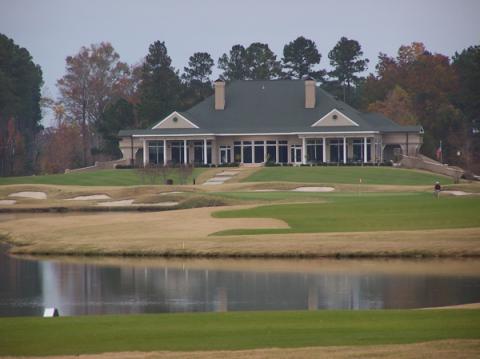
Taberna's golf course and community are neat, on a number of levels.
A couple of years ago, a local real estate agent took me for a drive around the community of Taberna near the North Carolina port city of New Bern. Taberna is not the most lavish community; the homes are generally smaller than in many golf communities in the south and, consequently, home values run in the low to mid six figures.
But what Taberna may lack in heft, it more than makes up for in neatness, especially on one street we drove along. The homes were small, all the same distance from the street, all designed in the same general manner, but every one of them and their surrounding yards were manicured, with nary an extraneous object on the lawns. I asked my real estate agent about it, and she had a one-word answer: "Marines."
Taberna is within a half hour of the Cherry Point Marine Corps Air Station. A fair number of active-duty marines live in Taberna and decide to stay there after retirement. What's not to like? New Bern is an interesting small city, the birthplace of Pepsi Cola and home to nice restaurants and modern conveniences. Beaches are within a half hour. Golf is year round, and a new community, Carolina Colours, is adding 18 holes designed by the respected Bill Love. Taberna's own golf course is inexpensive to join and a treat to play; its owners, a green superintendent and his wife, have lavished attention on the course since they purchased it a few years ago. I enjoyed it when I played it.
I thought of Taberna yesterday when I made arrangements to fly to Jacksonville, NC, this weekend to watch my son play in a college golf tournament at Camp Lejeune, the huge Marine base nearby. On Monday, weather permitting, I will play the golf course in the community of North Shore in Sneads Ferry, about a half hour from the base and close to Topsail Beach. I hadn't heard of North Shore before I started doing some research about the area. Look for a review here next week, as well as photos and comments about the two courses at Camp Lejeune. Comments I have read about the base's Gold and Scarlet courses, which are open to the public, are that they are always in terrific condition, the grass nicely trimmed and everything in perfect order.
It figures.
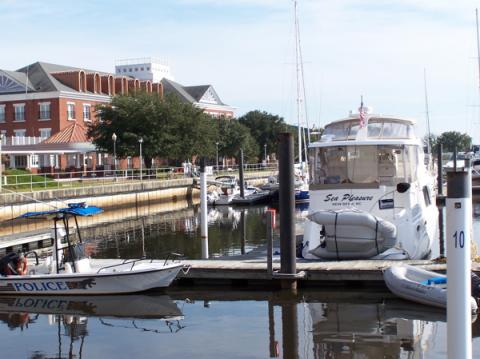
New Bern, NC, is a port city with much to do for those who like boating, as well as golf.
Lawrence Yun's snake oil cure for the shanks
For those unfamiliar with Mr. Yun, he is the chief economist for the National Association of Realtors, which essentially means he has a real estate
The most recent irrational exuberance by the NAR was a response to the February report on home sales, released Monday. "...the improvement [in sales] is another sign that the market is stabilizing," said the unsinkable Mr. Yun, who for balance added the limp caveat that existing home sales won't show a "notable" gain until the second half of this year. Even when he is negative, he cannot help being irrationally positive.
Is he kidding? In February, existing home sales rose for just the first time since last July. Compared with the same month a year ago, February sales were down nearly 24%. And median home prices dropped by more than 8%. A ton of new condos are coming on the market in cities like the already suffering Miami and Las Vegas and lenders are acquiring more new foreclosure properties faster than they can sell the ones they already have. Mortgage lenders are tightening their criteria for loans, and corporations are starting to slow down their transfers of existing employees and their hiring of new ones. In the face of all this, by what logic does anyone, let alone an economist, see a "notable" turnaround just four or five months from now?
When I used to watch my kids play peewee soccer, I marveled at how their coaches could keep encouraging the kids on the team no matter how many times they kicked at thin air or ran toward the wrong end of the field. Mr. Yun, I suppose, would make a good little kids soccer coach. He has no business coaching anyone about economics. It would be nice if the Wall Street Journal and other respected media outlets would finally understand that and stop using him as a source.
Open houses: Vacancy rates put pressure on prices; rentals challenge neighborhood cohesion
The latest vacancy rate data from the U.S. Census Bureau are ugly. Nationwide, the rate rose to 2.8% in the fourth quarter of 2007, up from 2.7% in the third quarter. In formerly hot markets, the numbers are considerably worse. In Orlando, for example, 7.4% of all homes are unoccupied, the highest such rate in the nation. Miami/Ft. Lauderdale (4.4%), Las Vegas (4.9%), and Phoenix (3.7%) are bad too.
The story of how these markets got to this point is well documented.
Many of the vacant units have been rented which, on the face of it, would
"[Our] neighborhood was going downhill as people had been buying the homes and renting them out to some real [expletive deleted]," said one former Orlando resident on a real estate discussion board, congratulating himself on selling his home in 2005. He complained about "people who do auto repairs in the street in front of their house and then throw used motor oil in the grass in their front yard..."
That is certainly an extreme case, but hints at an unintended consequence of filling vacant homes with renters. If you are contemplating the purchase of a home in a new community in one of the areas hit by high vacancy rates, the advice here is to proceed with caution. You might insist on a contingency with the developer that covers you in the event a certain percentage of the community's homes are rented. That may have seemed farfetched just a few years ago, but these are desperate times, and these are desperate developers.
The Wall Street Journal has a recap of the national vacancy rate crisis, including an interactive map that shows rates in selected metro areas. Click here to see the article.
Recession mentality: Tough times can be gratifying for some
During a recession in the late 1970s, I worked for the J.C. Penney Company in its corporate office in New York City. I was interviewing a buyer for underwear and socks for an article in the company newspaper. He told me that, during a recession, the Penney stores loaded up on things like cosmetics and expensive socks (expensive, at least, for socks). Experience had taught the buyers that, during a recession, people buy more fancy socks, as well as perfume,
It made a lot of sense to me at the time and, recalling that eureka moment over the last few days, I considered how it might apply to the housing market. Everything is relative, and for those of us who are hurting but have some disposable cash socked away, this may be a good time to make ourselves feel better. I wrote the other day about one of our readers who just bought three pieces of property in the North Carolina hills as an investment (which will make him feel a lot better if they appreciate the 20% he expects over the next three years). He paid around $90,000 for one of them at The Coves, just north of Hickory, NC; not too far down the road, the equivalent-sized lots at The Cliffs Communities or one of the other high-end communities near Asheville with a similar view are priced as much as five times that.
Developers, especially those offering lots in recently opened communities, are eager to make deals to support their cash flow needs. The Carolinas are the hottest states in the southeast in terms of population inflows, and cities like Charlotte and Raleigh have held their own in terms of housing values. When the housing market does regain its footing - our guess here is not before 2010 -- the migrations from north to south, and especially to the Carolinas, will intensify. For anyone with just a little cash, instant gratification is a small down payment away.
Baby boomers on the cusp of retirement might want to consider making a calculated investment now. That generation - my generation - has always wanted what it wanted when it wanted it. This would be a good time for developers to target that group with special deals. Ultimately, it might make everyone feel better.
Once lost, now Founders Club adds new polish to old neighborhood
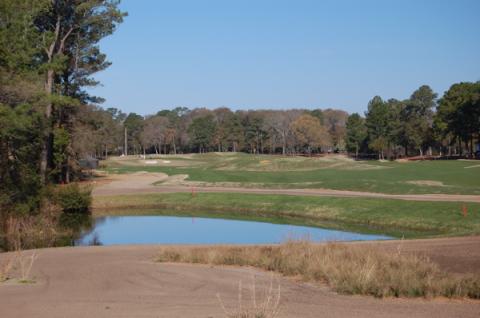
The par 5 12th hole at Founders features a hill that splits the fairway and contains a few nasty little bunkers. The green is in the distance at left with two spyglass bunkers in front.
Sea Gull Golf Club had become something of a joke. One of the first 20 courses to open in the golf happy Myrtle Beach area, Sea Gull anchored the bottom end of the Grand Strand in Pawleys Island...bottom in more ways than one. With a flat, boring and outdated layout on turf that had seen better days, and adjacent to a motel that had gone through several ownerships (and looked it), Sea Gull could not keep up with the sleek and modern layouts nearby. Even though Sea Gull charged the lowest green fees in the area, all but the first time visitors to the area knew you got what you paid for. They beat a path to the pricey but much better Caledonia, Pawleys Plantation and True Blue.
But now, after a $7 million investment and a dramatic makeover that kept Sea Gull's footprint but little else, the renamed Founders Club is keeping company with its classy neighbor courses as part of the Waccamaw
Thomas Walker, who came out of Gary Player's design shop, was given a nice budget and, apparently, a whole lot of sand, to remake the old Sea Gull. In the manner of the local True Blue Golf Club, Walker lined most of the fairways with waste bunkers, using them as cart paths rather than building the ugly and tougher-to-maintain asphalt or concrete paths. Waste areas are cleaner looking, but some locals whine about having to take too many shots from sand. Yet the fairways are still quite generous, as they were in Sea Gull's days, and the sand is compact enough to make most lies no big deal. One piece of advice; play earlier in the day if you can, before golf shoe marks and cart tracks increase the odds of a bad lie.
The other most noticeable feature at Founders, especially if you recall Sea Gull, are the moguls and pot
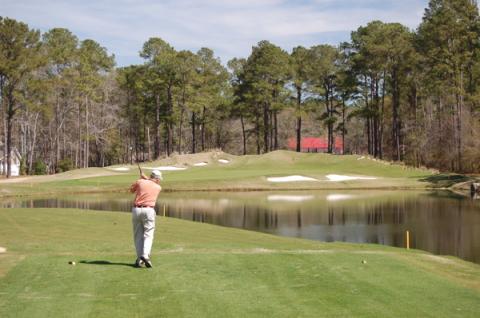
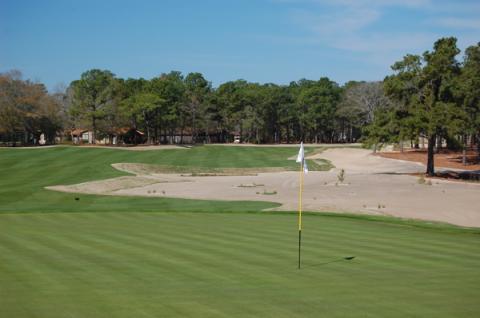 bunkers. For the most part, the pot bunkers are window dressing, set well behind greens to create attractive horizons for approach shots. The ninth hole, a par 5 with a lake that runs the entire length of the fairway, features a green that tilts forward and is backed by an array of bunkers, some small and some medium size. Any play from back there is straight downhill onto a slick green. On the par 5 12th hole, however, a few of those little beasts are snuggled into the hill that forms the split fairway; the lower part of the fairway is the shortest path to the green, but the high road provides the best angle for the lay-up shot, before an approach over a large pond at the front of the green.
Conditions at Founders Club were wonderful on a beautiful breezy day. Except for once when my ball found a deep fairway divot hole, I did not come close to needing to roll the ball over. Fairways and tees seemed to be in late spring condition, a testament to the wise decision of the Founder's owners, the locally based Classic Golf Group, to push off opening the course from last September, during a drought, to the end of February. The greens, though, were the highlight for me, featuring an innovative heat-resistant Bermuda Emerald grass that has the properties of bent grass. I thought they putted wonderfully and were shaved to a fairly quick speed, especially for a public course. Founders Club is one of only two courses in the U.S. that uses that particular strain of grass (the other is in the Arizona desert).
The homes that surround the golf course rarely encroach on it, with most just beyond lakes and streams. Out of bounds stakes were well away from the fairways. The Hagley Estates neighborhood shows the kind of hodgepodge of housing styles you would expect from a community developed separately from its adjacent golf course. Some houses are small and old, not much more than 1,000 square feet, while others are more modern and would fit comfortably in a local planned community, like Pawleys Plantation.
The Hagley homeowners must love what has been done to the golf course. On one hole, I skulled a
 sand shot through the green and down the hill into the woods. My ball came to rest just beyond a for sale sign on an empty lot. A box next to the sign invited me to take a brochure. I did and was shocked to see a price of more than $200,000 for the half-acre lot. Just two years ago, at the end of Sea Gull's days, such a lot would have barely fetched $100,000. Resale homes are bumping up into the $400,000 territory, still reasonable for the golf-rich Pawleys Island area and the proximity to the interesting town of Georgetown, just six miles away. With reasonable home prices and an annual bargain membership of just $1,500 at the Founders Club, you might even have a few dollars left over for one annual round at Caledonia.
The Founders Club, Highway 17, Pawleys Island, SC. Phone: 1 (800) 833-6337 / (843) 237-2299. Web: TheClassicGolfGroup.com. Architect: Thomas Walker. Par 72. Back tees: 7,007 yards. White tees: 6,394. Gold tees: 5,506. Rating and slope not available.
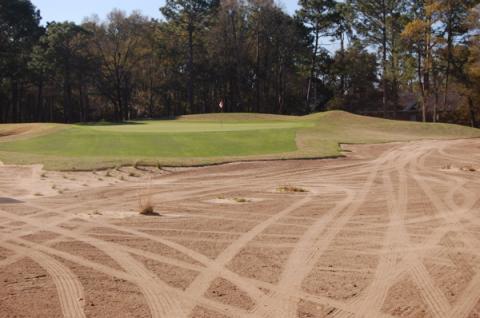
Waste bunkers are the cart paths at the Founders Club. Play early before carts and feet chew up the sand.
Executive decisions: Stupid is as stupid does
In an interesting online Wall Street Journal piece about how nationwide
"A lot of these executives are $300,000 to $400,000 under water on their house," said Mr. George. "Do they sell it at a loss or stay put? That's something we see on a daily basis."
If Mr. George is seeing that on a daily basis, then the pool of talent waiting to take the corner office in America's corporations is not ready to run a 7-11. How much smarter are these MBAs than the folks who were hoodwinked by Angelo Mozzila and his merry band of thieves at Countrywide? What does an executive whose house is way under water say during his first interview with Mr. George? "Glub glub?"
Perhaps Mr. George's comments were taken out of context and missed the salient point that he would be embarrassed to send such a manager to one of his clients for an interview.
To read the Journal's piece online, click here or send me an email and I will forward it to you ("Contact Us" button at top of page).
Foothold in foothills? Our reader buys lots
Jones Trail course leaves me breathless
What couples want (in a golf community)
Impressive par 5 gives taste of Silver Lakes

Now on Sale

- The only book about golf communities in the last 10 years.
- 156-page step-by-step guide to finding your dream golf home.
- Info on nearly 100 golf communities the author has visited.
- Paperback version costs less than a sleeve of Pro VIs.
Here is what the experts are saying:
“The book is chocked full of information…applicable to anyone looking for a move to the Southeast regardless of whether they are looking for a golf community or not.” — John LaFoy, golf architect (Linville Ridge CC, CC of Charleston, The Neuse GC)
“Larry has done a tremendous amount of work and anyone — like me — who is looking to search for a golf home now or in a few years needs this book.” — Brad Chambers, golf blogger, ShootingYourAge.com
“Wow! What a thorough piece of work…a must for anyone moving South. This book will help many people.” — Brett Miller, owner and founder of MMA, Inc, a golf industry consultancy
Buy It Now at Amazon.com or BarnesandNoble.com.