Fly AirTran, but bring back brace or chiropractor
The best news was the price, just $212 total to fly from Newburgh, NY to Atlanta and then, next Saturday, from Atlanta to Charleston. That was about half of what it would have cost me from Bradley. Low price and simplicity of fare structure is where the discount airlines excel because they base their fares on one-way trips. With AirTran or JetBlue, you avoid those mind-boggling algorithms that penalize you for not flying round trip between two cities, or for adding another leg to your trip.
For folks in Connecticut and the northern suburbs of New York City, Newburgh and Westchester County Airport (White Plains) offer flights on AirTran, JetBlue and those operated by the larger airlines. Newburgh's Stewart Field is easy to get to, just off of Interstate 84, modern without being fancy, and efficient. Long-term parking is available for around $50 per week, although I did not test it (my wife dropped me off).
There was no wait at the ticket counter to drop off my golf bag and no wait at the security line either on a Sunday night, typically a busy time at an airport (it sure was in Atlanta, where I was squeezed onto one of those automated shuttles). The AirTran Boeing 717 loaded efficiently and quickly, and it took off on time.
One nice feature with AirTran is that you can reserve online for one of those roomy exit row seats. I was amazed that only two of us sat in the exit row, leaving even more space to stretch out. (Note: The 717 is configured with two seats on the left and three on the right.) Roominess was about the only thing positive to say about the seating experience. Cushions on the aisle and middle seats on my side had become so misaligned that plastic showed throw where the seat cushion met the back cushion. It felt as if my butt was pushed against the back of a toilet seat. Also, the seat back was slightly misshapen; a couple of hours of that would have realigned my spinal column. The seats came complete with crumbs from their last occupants - no frills means quick turnarounds which means no time for vacuuming - and the floor at the window seat was sticky; I thought my shoes would come off a few times when I lifted my legs to readjust my position. With the help of a blanket supplied by the friendly flight attendant, I was able to bolster my back and avoid emergency chiropractic intervention in Atlanta.
Now for the good news: The flight was smooth, arrived on time in Atlanta and, incredibly, my bags preceded me to the carousel in baggage claim. Well, maybe not incredibly, since the trip from gate to terminal at a behemoth airport like Atlanta takes at least 20 minutes under good conditions. Golf club sets apparently do not fit onto the carousel but are hand carried from tarmac to baggage claim; I was impressed to see one of the airlines handlers standing by the carousel with my precious clubs, waiting for me. It was a nice touch and almost made me forget the slight ache in my back.
Would I fly AirTran again? Absolutely. The price was right, the service was no worse than what you get on the major airlines, and the small but efficient Stewart Airport was easy in and easy out. Next time I will strap on one of those back bolsters, though.
 Home On The Course newsletter
Click here to sign up for our Free monthly newsletter, loaded with helpful information and observations about golf communities and their golf courses.
Callaway Gardens could make you pine for Georgia
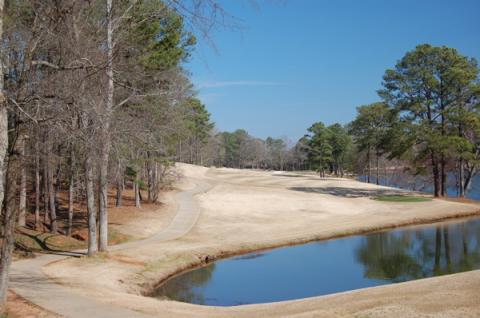
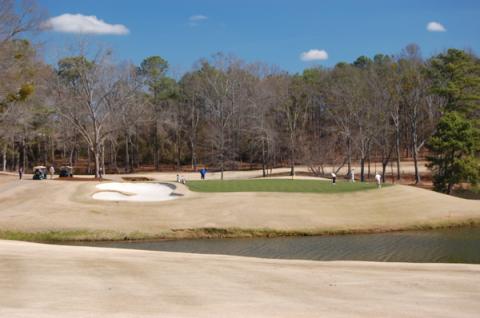
On a difficult Mountain View course at Callaway Gardens, no hole is tougher than the par 5 15th, with the threat of water on all three shots to the green. The lake intrudes on the fairway 150 yards from the tees and in front of the green (see bottom photo), but a sloping fairway makes the lake on the right the real hazard.
One of the sad ironies of travel is that places where we feel the most relaxed aren't at the top of our list of communities to live permanently. We may want to "get away from it all" for a week or two during our careers and child care days, but when it comes time to retire, the only remote most of us want is the one that controls the TV and other electronics.
But for those of us who want to be on a permanent relaxing vacation, and don't mind sharing a little space with those who come to relax for a week or two, there are communities cum resorts like Callaway Gardens in Pine Mountain, GA. But beware if you need the attraction of night life and shopping nearby; the nearest town of consequence is LaGrange, and that isn't exactly Charleston. Pine Mountain's commercial district is about three blocks long, with one modest sized supermarket.
The golf at 14,000-acre Callaway Gardens is almost as manicured as the renowned gardens themselves. As
The course is devilish, especially with wind gusts to 25 mph as the area gets ready today for a severe band of storms making their way across Alabama and Mississippi. I followed a group of college golfers competing in the Callaway Collegiate Invitational. Half the field did not break 80. Greens were firm and fast, and it was clear many of the kids hadn't putted on such fast greens for some time. Just because they are young, they show their nerves the way the rest of us do, and I saw a lot of missed four footers and a number of delicate chip shots hit too delicately.
The toughest hole on the scorecard, the 520-yard par 5 15th, actually is indisputably the toughest hole on the
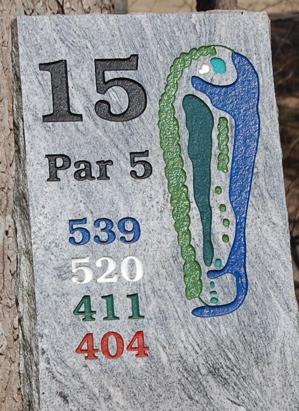 course (that isn't always the case). You must play defense on your first two shots because the fairway slopes hard from left to right and down into trees and lake. The lake cuts in front of the elevated green making a go in two, especially into the wind, foolish indeed. You do well to hit a four or five iron lay-up shot high on the fairway inside the 150 yard post and let it scoot down to a collection area about 125 from the green. A sadistic greens keeper has a number of options for pin position, with front being the toughest, the right third of the green with a sharp drop off down toward the water almost as tough, and everywhere else just plain hard. Bunkers surround the green except for directly in front, where the water lurks at the bottom of the hill. Add wind to the equation, and the 15th at Callaway is probably as tough as the par 5 15th at a much more famous course up the road a piece in northern Georgia.
I'll include a few more photos of the course over the coming days and some information about homes and other activities in Callaway Gardens.
Callaway Gardens Mountain View Course, Pine Mountain, GA. Designers Joe Lee and Dick Wilson (1963). Tournament tees 7,057 yards, rating 73.7, slope 139. White tees 6,630, 71.9, 134. Green tees: 5,789 yards, 68.2, 126. Ladies: 4,883, 69.4, 120. (800) CALLAWAY.
High & low prices of golf community homes
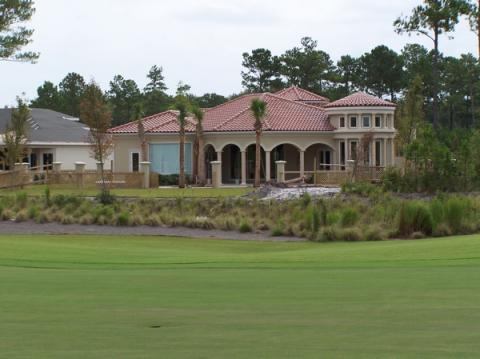
Tuscan-style homes at Grande Dunes are set well back from the Members Club and about a mile from the ocean.
A few days ago, I posted the highest and lowest current prices for homes in a few communities I have visited. Here are a few more.
Wild Dunes, Isle of Palms, SC
High: $2.9 million, 2,800 sq. ft, 4 BR, 4 BA, penthouse corner unit overlooking ocean, 18th Green (see note below).
Low: $320,000, 1,800 sq. ft., 3 BR, 3 BA, ocean view, 1/5th share
Mother Nature isn't a big fan of Wild Dunes. The beach resort just north of Charleston took a nasty hit from Hurricane Hugo in the late 1980s, slicing off the last couple of ocean holes on the excellent Tom Fazio course (the second 18 at Wild Dunes threads its way among older homes and does not have the panache of the ocean links). After reconstruction and a decade of relative peace, the ocean began to eat away at the 18th fairway and green. Last August, the green lost and fell onto the beach. When we played the course just a few weeks earlier, waves were lapping at the base of the seven-story condo behind the green; it was hard to imagine how the greenside condos would survive the encroaching seas. Anyone interested in oceanfront property at Wild Dunes should proceed with caution.
River Towne Country Club, Mt. Pleasant, SC
High: $1.5 million, ½ acre, 3,650 sq. ft., 4 BR, 3 ½ BA, dock on a deep tidal creek leading to Wando River.
Low: $400,000, NA, 3,000 sq. ft., 4 BR, 2 ½ BA, pond view.
River Towne is one of the Ginn properties, perhaps not as posh as developer Bobby Ginn's renowned Florida properties but at the highest end in Mt. Pleasant, a thriving and growing town nestled between Charleston and Isle of Palms (see above). The course, designed by Arnold Palmer, includes 13 holes along the Wando River and Horlbeck Creek and hosts an LPGA event each spring. Ginn, ever the aggressive marketer, engaged Annika Sorenstam to be the host of the tournament. Although I don't know what it looks like on the inside, the price tag of $400,000 for the single-family home listed above does seem like a bargain for this community, which is close to shopping, the beach and a great American city.
Grande Dunes, Myrtle Beach, SC
High: $3.75 million, 11,100 sq. ft., 4 BR, 4 BA
Low: $449,000, 1,400 sq. ft., 2 BR, 2 BA
Grande Dunes covers a wide swath of area in the heart of the Grand Strand, with properties on the ocean and the Intracoastal Waterway a couple of miles inland (prices above are for the properties near the river). With a well-regarded resort course and a newer Members Club, also available to guests staying at Grande Dunes hotel, the community offers its residents upscale golf to go with the upscale prices on the homes. I thought the Members Club layout, by Nick Price and local boy Craig Schreiner, was a bit wimpy, with wide fairways and, for the most part, easily accessible greens. I prefer the daily fee course by Roger Rulewich. In any event, homes inside the gates are beautiful, and land is still available for those who want their Tuscan style homes built to their own specs.
Debordieu Colony, Georgetown, SC
High: $5.2 million, 8,225 sq. ft, 6 BR, 5 BA, ocean frontage, wine cellar, media room, elevator.
Low: $725,000, 3,000 sq. ft., 3 BR, 3 BA, villa, private pool, short cut to beach.
An independent study last year determined that Pete Dye-designed golf courses have the most positive affect on house values in a community, more so than Nicklaus, Fazio and R. T. Jones courses. Dye's Debordieu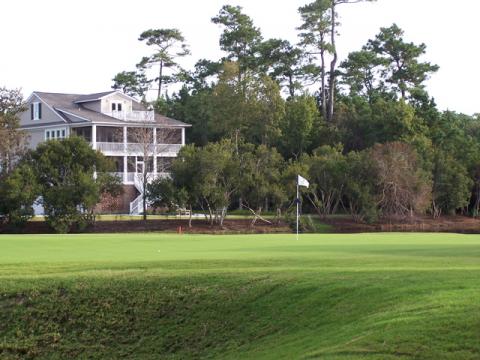 course lacks some of the drama of his other more celebrated layouts, but his restraint lets the low country terrain do the talking. Unfortunately, he was called in well after all the good beachfront property was sold so you won't see the ocean from anywhere on the course (although you can hear it and smell the salt air). Everyone in the community is, at most, a short, inside-the-gates bike ride from the beach, the only golf community on the south end of the Grand Strand that can boast that.
Ford Plantation, Richmond Hill, GA
High: $4 million, 3 acres, 8,000 sq. ft., 4 BR, 4 ½ BA, lake view.
Low: $900,000, 2.4 acres, 3,000 sq. ft., 3 BR, 3 BA, equestrian oriented, paddock views.
Dye again, and also somewhat restrained for him, but the magnificent piece of land along the Ogeechee River was all he needed. Ford Plantation was Henry Ford's southern home (one of them), and the main house has preserved his and wife Clara's bedrooms. Those looking at property at Ford can stay in the main house and take breakfast in the dining room where the Fords did. The plantation is loaded with history - Sherman spared most of it during his savaging of Savannah - and live oaks, and my experience was that developer and golf course staff are down to earth, even if prices are not. If you can afford it, there are few better places.
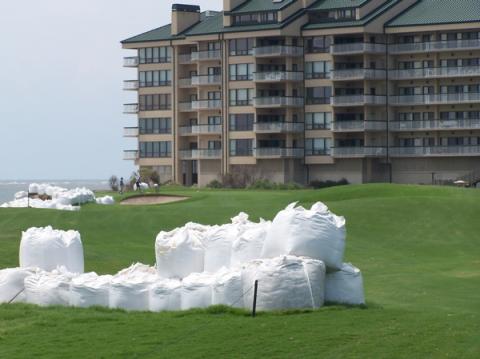
Last August, sand bags were all that was holding up the 18th fairway and green. By September, the sand bags had lost, and water was already lapping at the base of the condos behind the green.
Gas prices may be tipping point for going green

The residents of Bald Head Island, NC, will not have to worry about the high price of fueling their cars; there aren't any cars on Bald Head. But all groceries must be ferried in, or residents have to leave the island, start up their cars on the mainland to drive to the supermarket in Southport, and then tote their groceries back home on the ferry. Now that takes a lot of energy!
I was listening to President Bush's press conference Thursday. He was asked what he thought about reports that the price at the pump for a gallon of gasoline could reach $4 soon. He said he hadn't heard that.
Well, many of the rest of us have. And as if the economy is not bad enough, the $4 a gallon prediction may actually be
Higher energy prices will have a profound effect on everyone here in the U.S. Those of us contemplating a move to one of those lovely but remote southern communities 25 minutes from the nearest supermarket had best think twice about our choice or at least prepare to amend our shopping habits. (Might be a good hedge to buy stock in a company that makes solar-powered food freezers, if there are such things.) We are going to have to be a lot better organized to make one trip a week or fewer; each round trip will amount to about four gallons of gas, or a $20 "surtax" on our groceries.
But that is only the tip of the iceberg lettuce. The trucks that bring the produce to the supermarket run on gasoline, and their own dramatically higher costs will get passed along to the rest of us, a double whammy. And of course there will be the costs of keeping our homes warm in winter and cool in summer. Solar panels are starting to look more attractive to this correspondent, even though the architectural review boards in many communities chafe at the thought of reflective roof panels versus, say, slate or terra cotta tiles. They had better start rethinking their opposition.
A few days ago, I wrote here about residential developers and builders being slow to catch up with the move toward green. You can count on that changing, and quickly, in proportion to the rise in energy costs.
Of course, there is one way to avoid the impending energy crisis. You could move to Caracas, Venezuela where a gallon of gas sells for less than 20 cents.
I didn't think so.
Price gauging: With a little research, you can live with the Joneses, if not like them
The first decision any of us make when contemplating a move to a new home is how much we are prepared to pay for it. There is no sense looking at a community of $1 million homes if our budget is $500,000. But sometimes first impressions of a community are deceiving. The price ranges are wider and the options more diverse than might meet the eye.
I have been conducting a little informal research over the last few days. I scanned the web sites of some "high-end" communities that I have visited and reviewed in recent years, looking at the highest priced and
What follows are some brief notes on a few communities and the prices of their homes at both ends of the market, including comparative details like square footage, number of bedrooms and bathrooms, and other distinguishing characteristics (where available). I'll follow up with a few more examples in the coming days. I've also added a short list of other communities in the area that are worth investigating and not as pricey at the top end.
By the way, if you want further information about these communities or any others in their areas, please contact me. I have excellent relationships with qualified real estate agents in these areas and am happy to refer you to them. They have sold homes in all the golf communities and can provide you details on each, as well as answer questions about the surrounding area. There is no cost or obligation to you whatsoever.
Governor's Club, Chapel Hill, NC
High: $1.6 million, 1 acre, 7,400 sq. ft., 5 BR, 5/2 BA.
Low: $299,000, town home, 1,640 sq. ft., 2 BR, 2 ½ BA, 2 car gar.
The first thing you notice after you enter Governor's Club, besides the tight, well-organized security at the front gate, is the topography of the place. You literally drive up the main street and then down and then up again, passing homes perched on sizable lots with many large rock outcroppings dominating the front yards. I have not visited a community that looks quite like it. The 27-hole Jack Nicklaus Signature course is tough and well tended by an involved membership. I would not have expected any real estate in the community to fall short of $300K, but there it is, a town home that could serve as a second home or great way to test the community for a while. Governor's Club is the type of community that should help you make friends quickly, whether on the golf course or in the amply appointed clubhouse. Loners need not apply.
Also consider: Chapel Ridge, The Preserve at Jordan Lake.
Mount Vintage Plantation, Aiken, SC
High: $830,000, unknown acreage, sq. ft; 4 BR, 4/1 BA, golf view
Low: $419,000, unknown acreage, sq. ft: 3 BR, 2/1 BA
I have a soft spot for Mount Vintage. It was one of the first golf communities I visited, professionally speaking, three years ago, and the first with a combination of equestrian and golf amenities. The rolling landscape cut
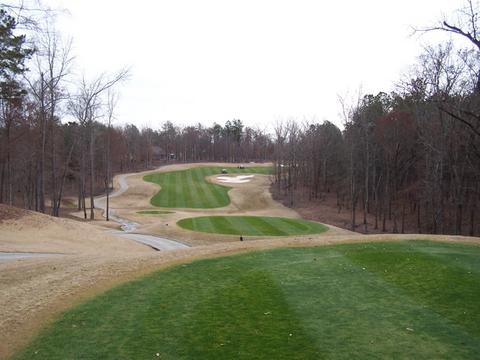 and framed by long lines of white fencing, the
horses grazing on front lawns, the enthusiastic sales staff and the
pioneering spirit of the early residents impressed me. The course was
a sleek Tom Jackson layout, and the local developers have since added
another nine holes, with nine more on the drawing boards. Aiken itself
is straight out of central casting for small southern town, but make no
mistake, the town is no backwater. Some Mount Vintage residents rent
their homes out during a week in early April for thousands of dollars
to PGA tour millionaires and well-heeled spectators in town for the
Masters 20 minutes away at Augusta National.
and framed by long lines of white fencing, the
horses grazing on front lawns, the enthusiastic sales staff and the
pioneering spirit of the early residents impressed me. The course was
a sleek Tom Jackson layout, and the local developers have since added
another nine holes, with nine more on the drawing boards. Aiken itself
is straight out of central casting for small southern town, but make no
mistake, the town is no backwater. Some Mount Vintage residents rent
their homes out during a week in early April for thousands of dollars
to PGA tour millionaires and well-heeled spectators in town for the
Masters 20 minutes away at Augusta National.Also consider: Cedar Creek Plantation, Woodside Plantation, Pine Ridge Plantation (nearby Edgefield).
Landfall, Wilmington, NC
High: $7.5 million, 1.3 acres, 7,800 sq. ft., 6 BR, 6/2 BA, in-ground pool, 230 feet on Intra-coastal waterway, boat slip.
Low: $529,000, ¼ acre, 2,475 sq. ft., 3 BR, 3 BA.
I was not a fan of Landfall after its golf director had an assistant tell me I was not welcome to visit and review their community and its two private golf courses (Nicklaus and Dye). It was some bs about ruining their "non-profit" status if I promoted their course. (Hmmm, presumptuous and arrogant all in one.) That has only happened one other time in four years and 90 community visits. But I have my ways, and through a local Wilmington real estate contact, I was invited to play the Nicklaus course on a very cold January day (the hot corn chowder they served at the turn was fabulous). Landfall appears to be popular in spite of being one of the least self-promoting communities. That may be a sign of that same arrogance or maybe word of mouth works for them. In any event, the Nicklaus course was excellent and very difficult under the extreme weather conditions. I'd like a shot at it and the Dye course on a decent day, so if the Landfall nabobs are within the sound of my voice, here's your chance to make it up to me.
Also consider: Porter's Neck, Castle Bay, Magnolia Greens, River Landing (35 minutes away).
Governor's Land, Williamsburg, VA
High: $2.25 million, 4/10 acre, 6,000 sq. ft., 5 BR, 5/1 BA, private beach on river, William Poole designed house (a big deal in the south), river views.
Low: $595,000, ½ acre, 3,100 sq. ft., 3 BR, 2/1 BA
A river runs through Governors Land, and around it, and what a river it is, wide and historic, and flowing between Williamsburg and Jamestown. The community oozes history; Native American artifacts were found during construction of the course, some of which are displayed proudly in the Governors Land sales office; and an underground tarp covers some of the ancient grounds on the finishing holes near the river. The
 course is a fine Fazio layout, my only disappointment being that the river serves much more as eye candy than hazard. Daily fee golf in the area is spectacular, with the lauded Golden Horseshoe and Kingsmill Resort courses within 20 minutes. And the Arthur Hills layout at Colonial Heritage is a masochist's delight, the toughest in the area. Governors Land is just six miles from Colonial Williamsburg but feels as if it is 50, providing the best of both worlds - privacy and convenience.
 Also consider: Ford Colony, Kingsmill Resort, and Colonial Heritage (55+).
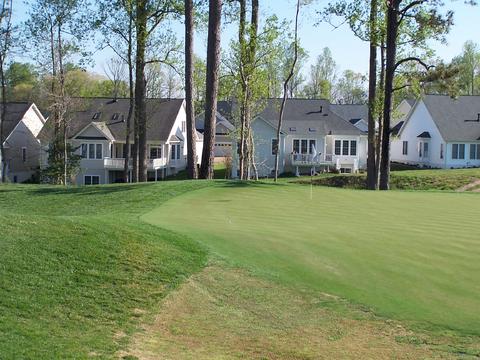
Homes at Colonial Heritage, an age restricted community in Williamsburg, VA, are close together and not McMansions by any stretch. But prices are in the low-mid six figures and the Arthur Hills course is a winner.
Tinkerer's dam: New home sales tumble, and Bernanke blocks consequences...for now
Meanwhile, a savvy piece on the housing market in the op-ed pages of the Wall Street Journal today offers
Yet instead of helping poorer households, lower interest rates actually disadvantaged them.
"For most low-income households," Mr. Jenkins wrote, "homeownership proved a bad bet, even in a rising market...Their capital gains were subpar or nonexistent even if they managed to hold onto their houses for a decade." Mortgage costs ate up their gains, the author reasons, and worse, tied them to subpar neighborhoods with bad schools and bad job prospects.
As for bailing out the hundreds of thousands of homeowners facing foreclosure, those who should have known better and those who didn't, Mr. Jenkins has a thoughtful if radical notion for the government on how to use our tax money.
"...buy up houses at foreclosure auctions and demolish them," he writes, "especially in neighborhoods likely never to recover." Doing so, according to Mr. Jenkins, would "nip in the bud the blighted, suburban slums of the future." That would be a harsh diet indeed, but at least it is one without artificial ingredients.
Charlotte led in 2007 housing prices
Charlotte, NC, was one of only three major metro areas whose home prices increased in 2007, according to the popular S&P/Case-Shiller Index, which reported the latest figures earlier today. At just 2.3% over the span of last year, Charlotte nosed out Portland, OR (1.2%), and Seattle (.5%). However, every one of the 20 markets assessed, including Charlotte, went negative from the third quarter to the fourth quarter in 2007.
Not surprisingly, Miami, at -17.5%, suffered the most severe price drops of all 20 markets in 2007, followed by Las Vegas and Phoenix, both at -15.3%. Prices in the Tampa, FL, market dropped 13.3% during the year.
Charlotte, whose home prices lost a slender .6% over the last two quarters of 2007, has benefited from solid business growth and stable employment. I haven't seen comparable data yet from other Carolina cities, such as Raleigh, Chapel Hill, Wilmington, Greenville (SC) and Myrtle Beach, but I am confident that any price erosion in those areas will not compare to losses in northern cities. For 2007, according to the Case-Shiller study, Boston's prices dropped 3.4%, New York -5.6%, Cleveland -6.3%, Chicago -4.5% and Minneapolis -8%.
The spread between falling prices up north and the more stable, if slightly falling, prices in the south add a sense of urgency for those considering a near-term relocation north to south -- or, especially, from Florida to the Carolinas. Even if prices in markets in the north and south and central Florida rebound, they are not likely to reach the appreciation levels of the Carolinas markets for some years to come.
Those waiting much longer to sell their home up north or in Florida before relocating may be burning the candle at both ends.
Home value appreciations to Dye for
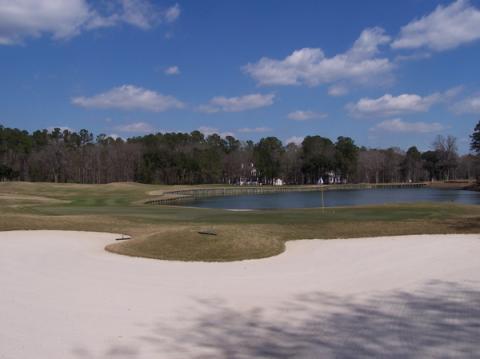
Pete Dye's golf course designs have the most positive affect on house values in the immediate neighborhood. Residents of Ford Plantation near Savannah, GA, can congratulate themselves on their wise choice.
If you care about nothing other than how well your house in a golf course community will appreciate over time, then Pete Dye is your man. Houses in communities with Dye-designed courses have outpaced the values over the last five years of those by Tom Fazio, Jack Nicklaus, Robert Trent Jones, Jr, Arthur Hills and Arnold Palmer.
So says a study published last year by the Longitudes Group, which specializes in market research for the golf industry, including the $10 billion golf real estate business. The data, which calculated market values over the last 20 years of 1,800 homes built adjacent to golf courses, was published
Homes in Dye golf course communities outpaced other local homes by a whopping 60% in the five-year timeframe. Trent Jones led everyone over the 10-year period. Only homes adjacent to Arthur Hills courses did not keep pace with homes in the same zip codes; however, Hills homes in the southeast and southwest, where the designer's reputation is unquestioned, outshone the local markets by more than 40%.
Hills courses I have played at The Landings at Skidaway Island, GA and at Colonial Heritage near Williamsburg, VA, may not have the same cache as Dye's courses at Ford Plantation (Richmond Hill, GA) and The Landfall (Wilmington, NC), for example, but they are every bit as challenging and handsomely routed. Fazio, Nicklaus and Jones need no defense here, and while I find Palmer's designs to be inconsistent and often ham-fisted (obscenely large traps on his worst layouts), I greatly enjoyed his sleeper design at North Hampton, near Jacksonville, FL.
The top architects are not getting any younger, but they are grooming their children to inherit their firms, so expect to see the Jones, Nicklaus and Fazio names on courses for a generation or more to come. Other new architects will emerge, and if you keep your eyes and ears open, you might just catch the wave of appreciation that comes with a design by a suddenly hot name. Among the candidates are names like Cate, Coore, Engh, Fought, Hanse, Hurdzan, Muirhead, and Smyers.
Besides Golf Digest and LINKS magazine, the web site GolfClubAtlas is a good source for information about all architects, living and dead. For a straight-up list of architects, including links to their web sites as well as lists of the projects they have designed, check out the American Society of Golf Course Architects site.
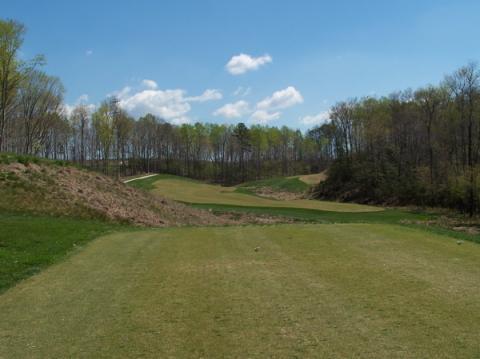
Homeowners on Arthur Hills courses in the southeast have seen nice appreciations in their homes. His design at Colonial Heritage, a recently opened 55+ community near Williamsburg, VA, is one of the toughest and best I've played in the last three years. The par 5 14th was a brute.
Membership committees key to clubs' future
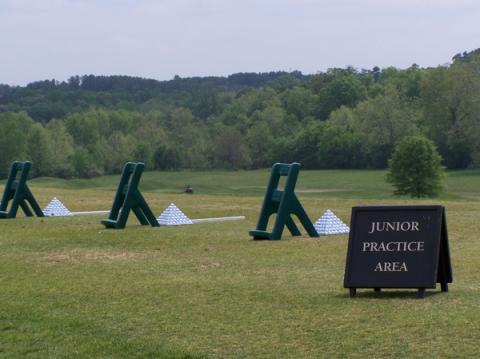
Some clubs, like Glenmore, outside Charlottesville, VA, know that their future membership depends on a vigorous junior golf program, and that if they can get Junior interested, they have the best chance of getting mom and/or dad to get out on the course more.
Mark Twain, not a great friend of golf, coined the phrase "a good walk spoiled" for the game many of us love. Today, another of Twain's famous bon mots, about himself, are equally appropriate for the game: "Rumors of my death have been greatly exaggerated."
The latest shovelful of dirt on the great game appeared in the New York Times last Thursday, under the headline "More Americans are giving up golf." The newspaper cited statistics about fewer total rounds played and fewer rounds by devoted golfers as signals of impending doom. The overall theme of the article was that
As we political junkies found out in the Democrat primary in New Hampshire in January, when the polls wrote off Hillary Clinton but the actual voters didn't, numbers mislead. Or, rather, what is true today may not be true at all next week.
Golf is hurting a little if you go strictly by the numbers. The National Golf Foundation reports those who have played a round or more annually have dropped from 30 million to 26 million so far this decade. And the serious golfers, those who play 25 or more rounds annually, are down about 30%, to 4.6 million. But if you take the number of golf courses nationwide, 16,000, and apportion all the serious golfers to each one, you have a theoretical "membership" of 288 dedicated golfers per course. Throw in the other 22 million or so casual golfers, and the game has a great base from which to build, or rebuild if you see the glass half empty.
A little negative hysteria may be good for the game long term. Some member-only golf clubs need to be shaken and stirred to get off their high horses and use more creative ways to attract and embrace new members. Times are changing, and the days of entitlement in the guise of "exclusivity" are coming to an end for many clubs. Some longtime members will not give up easily their entitlement to just walk up and play whenever
Here are a few ideas I've conjured for private golf clubs to reinvigorate their membership rosters:
- Start a junior golf program if you don't have one, or invigorate the one you do have. Do whatever you can to get the entire family out on the course. If the spouse is a non-golfer, arrange for a husband and wife scramble event (Captain's Choice) where the non-playing spouse putts on each green. (No, you don't need to put windmills out there.) Try other creative approaches to get the non-playing spouse or kids onto the course.
- Your course is not Augusta National or Pine Valley, so don't act like it. Host "Open Kimono" days. Invite local non-members to play the course, for a modest fee, and their families to use the pool and dining facilities. Have your pro give tips that day on how to play the course. Promote the heck out of the event, and consider holding it a couple of times year.
- Make "deals" with local real estate agents to provide every one of their buyer clients with an attractive package of club materials, including application, a coupon for dinner and a round of golf with a member. Make similar deals with listing agents; offer their clients a reduced initiation fee if they offer "free" private club membership to anyone who purchases their home. Check the newspaper listings of all homes sold in your town and send notes to new neighbors inviting them to check out the club.
- Instead of worrying about the local high school golf team encroaching on your course from 4 p.m. to 6 p.m on weekdays, encourage them to practice at your facility and play their home matches there. They are your members for the future; and their parents are potential members right now. The weekly items about the golf team in the local paper are constant publicity for the club. And a rooting interest in the local high school's team could bind the club's members.
- If you have no corporate membership plan, consider one. Make an initiation fee attractive to local small businesses to generate dues, which are more important to the cash flow and lifeblood of the club. Consider a Small Business Day golf outing to attract new company memberships.
- Develop an outreach program to the local community, and put your director of golf at the forefront (your golf pro if you don't have a golf director). If you are hurting for members, do you want your golf pro spending four days on a golf trip with four couples who already love the club or making presentations to the local Chamber of Commerce and others to talk up your course? Member retention is a worthy goal, but generating new members in crunch time is more important.
- Recruit your membership committee carefully. If you have any car dealer members, encourage them to participate. They not only know how to sell, but they will counter other committee members who see every creative idea as an attack on their birthright of belonging to an "exclusive" club. Pay too much attention to these nattering nabobs and you will indeed have an exclusive club...as in just a handful of members.
- Less may be more. If your club offers extras, like a fitness center or tennis courts, that a modest few members use, consider making some tough decisions to close down the money losers. Figure out the distractions to management, as well as the financial costs, of the lightly used amenities.
- Golf community clubs face similar challenges of attracting new members, but they do not have to look as far for a rich market. More than 50% of those who live in golf course communities do not currently play the game. Marketing and communication costs to get at them are so low it would be silly not to make every effort to promote the game to them. Consider adding a new set of forward tees to make the game enjoyable to these newcomers right off the bat.
You can find the Times article at the Times' web site.
Green in the gills: Developers have to play catch up with environmentally conscious customers
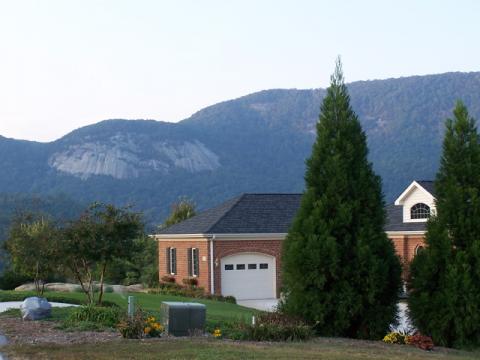
Older homes at The Cliffs at Glassy in South Carolina may soon join newer ones in being environmentally up to date. Developers at the Cliffs Communities have joined a small but growing group that promotes green construction.
Many of us building our dream homes in the coming years will be looking to include environmentally and financially sound materials and systems. Our objectives, though, may run up against developers stuck in the old way of building houses.
A friend of Golf Community Reviews found this out the hard way recently. (I'm not using his real name or that of the community in question since the issues could be resolved in the coming months.) A few years ago, Jay and his wife Kate bought a nice golf course lot in the community of Analog Mountain. They had always intended to build as "green" a house as possible, including environmentally neutral materials throughout. Recently, they
Then the couple ran up against a brick wall, in a manner of speaking (most of the homes in Analog are brick). The developer provided them with the list of its preferred builders, just a half dozen, one of the shorter lists I've encountered. Other communities maintain lists of up to 20 or more, if they have any such list at all. To make matters worse for Jay and Kate, Analog's "preferred" actually means mandatory. You must choose from among the limited number of builders on Analog's list.
Developers will tell you that they rely on a preferred list to ensure control of the building designs and exterior materials, to keep the architectural style of homes pure and indigenous. That is a bit misleading since virtually all communities maintain architectural review boards (ARBs) for such purposes. These boards comprise homeowners as well as the developer's representatives. The more likely explanation is that developers can control the contractors' pricing by restricting choice; the builders are virtually guaranteed work throughout the
The couple interviewed the six preferred builders at Analog. They were surprised to learn that none of them had ever built even a partially green home. A few said they would be happy to build the home but they would have to charge Jay and Kate a premium to call in more experienced green sub-contractors. As you can imagine, the couple wasn't thrilled to learn their builders would be learning on the job and being paid extra by Jay and Kate for the training.
Adam Ney thinks such contractors are way behind the times. Adam is co-founder of AuctoVerno, LLC, a green-building marketing services firm in Connecticut and promoter of sustainable construction.
"Residential green construction is gaining momentum," Adam says. "[Developers] think the cost is way too high, but it is not so and there is a ton of low hanging fruit...like eco-friendly paints, [which] are the same price as traditional paints. And while most developers think that going green will cost anywhere from 15-20% more than the traditional spec, the World Business Council on Sustainable Development released a report recently that says the upfront costs are really 5%."
Adam adds that the payback for an owner of a green house is 16 to 24 months, and that Moore's Law -- every 18 months technology costs are cut in half -- points the way to much more affordable green materials in the next few years.
Jay and Kate's initial pleas to the developer to bring in the couple's own green-savvy builder have been rejected. Although they have contemplated legal action, they know that even if they win the battle, they could face obstacles ahead from the developer and, potentially, their neighbors who might thumb their noses at the prospect of solar panels and other architectural details at odds with current community standards. That would be no way to start a life in a new place. A little patience may be on their side as developers catch up with more and more of their customers.
Indeed, a few golf course communities, like The Cliffs in the Carolinas, have extended their efforts beyond the Audobon friendly practices on their golf courses to green construction of their homes. Adam Ney thinks more and more communities will join them.
"If developers don't start building green," says Adam, "they will be out of business in five years because every development around them will be green."
If you are interested in learning more about green building, visit the AuctorVerno web site at BuildingCTGreen.com.
The home version of The Price is Right
Ocean erodes homeowners' net worth
Simplified airfares to southern markets
A way to buy yourself a giant COLA*

Now on Sale

- The only book about golf communities in the last 10 years.
- 156-page step-by-step guide to finding your dream golf home.
- Info on nearly 100 golf communities the author has visited.
- Paperback version costs less than a sleeve of Pro VIs.
Here is what the experts are saying:
“The book is chocked full of information…applicable to anyone looking for a move to the Southeast regardless of whether they are looking for a golf community or not.” — John LaFoy, golf architect (Linville Ridge CC, CC of Charleston, The Neuse GC)
“Larry has done a tremendous amount of work and anyone — like me — who is looking to search for a golf home now or in a few years needs this book.” — Brad Chambers, golf blogger, ShootingYourAge.com
“Wow! What a thorough piece of work…a must for anyone moving South. This book will help many people.” — Brett Miller, owner and founder of MMA, Inc, a golf industry consultancy
Buy It Now at Amazon.com or BarnesandNoble.com.