Buyers' remorse: "What do you mean you didn't represent me?"
Florida and a few other states recognize how difficult it is for one agent or a brokerage with multiple agents to maintain their fiduciary and statutory obligations to both parties when the interests are so different. The
In states where dual agency is permitted -- in the southeast, all but Florida and Alabama permit it -- all parties must agree to the arrangement in writing and must be informed that the agent's (broker's) duties of disclosure and confidentiality are limited by the consent of the parties. In practice, this "informed consent" alerts both the buyer and seller that they should be more vigilant about their interests than if they had independent representation.
Brokers cannot intend to create an undisclosed dual agency, but sometimes through the inexperience or zealousness of an agent, it can happen. For example, an agent may have acquired a house listing and scheduled an open house. At the open house, a couple wanders in and asks if the price is firm. The agent responds that she thinks the seller might take 10% less than asking price. This would lead the potential buyers to believe the agent is working for them ("implied agency") and could put both an eventual contract and the agent's license at risk because such an undisclosed dual agency violates state law.
The advice here is simple: Identify and engage a qualified real estate agent to represent you -- and only you
Here's one small but telling example from a couple in Louisiana about the potential consequences of being unrepresented in a real estate transaction (I've edited their online account):
We bought a house using a dual agent. We were pushed to close sooner than we intended even though, in order for the prior owner to sell the house, he had to install a new septic system to make it current with regulations (use of the old system had been grandfathered after new regulations). We were told that if we went ahead and closed, the owner would put the money in escrow for us and we could go ahead and move in, but we were not going to be able to transfer the electricity to our names until the new septic was installed. According to our agent, it wasn't going to be an issue because the owner would keep electricity in his name until the installation. Unfortunately three weeks later, it hasn't stopped raining and the septic still has not been installed. The prior owner has cut off the electricity. We are going on two weeks now with no electricity and no hope of installation any time soon.
Generally, it costs you nothing to retain your own "buyer's" agent; they are almost always compensated by the listing brokerage. Your own agent must disclose to you, up front, and in writing, any potential obligation on your part. Do not go it alone. To paraphrase a popular line, the potential buyer who represents himself in a transaction has a fool for a real estate agent.
Tomorrow: Dishing the dirt: Strategies for dealing with the developer's sales office.
 Home On The Course newsletter
Click here to sign up for our Free monthly newsletter, loaded with helpful information and observations about golf communities and their golf courses.
Maine man: Former journalist, avid golfer puts all into his golf site
Some of the most avid golfers I know live in places that have the shortest golf seasons. John Hangen plays at the unique Aroostook Golf Club; you can't get any farther north, and Aroostook actually uses two entrances, one for its Canadian members (no immigration stop necessary) and one for those from Maine. John cannot go through the winter without at least one pilgrimage to warm weather, typically Florida.
My son's former high school golf coach is another Maine native with a golf-at-all-costs attitude. He grew up and
Peter is a former business journalist who had a significant stint filling Maine newspapers with stories about golf. With a birth date of 1954, he can claim solid Baby Boomer status and has the AARP card to prove it. A few years ago, Peter decided to combine what he knows about golf with what he inherently knows about being a Baby Boomer golfer; he founded BoomerGolfNews, which covers items of interest to most 50- and 60-something golfers, including equipment, travel, apparel and news about golf communities. Articles in his monthly newsletter run the gamut from reviews of resort areas like the Turks & Caicos to treatments for varicose veins. To say the subject matter is eclectic is an understatement.
Peter writes frequently and well, and his site is a nice complement to GolfCommunityReviews. I recommend it to you.
Healthy altitude: One mountain community bucks trend
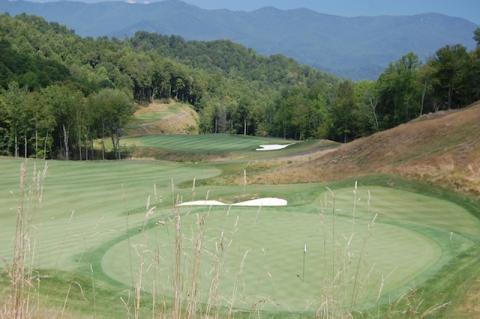
The views from the Arnold Palmer golf course at Balsam Mountain took my breath away. The course took about a dozen golf balls.
As reported here yesterday, Balsam Mountain Preserve near Waynesville, NC, has recorded its best first quarter sales performance in its eight years. Balsam Mountain caught the market wave early enough in 2001 and built its wide range of amenities before the economic storm. Now, with everything pretty much built and functioning smoothly, and with the track record and deep pockets of its developers, Chaffin & Light, it appears to be sailing along.
I don't typically do a lengthy follow-up to a review I published less than a year earlier, but those sales numbers piqued my curiosity. So I called and
Bruce Fine says that Balsam Mountain stands out in its appeal to a certain segment of the higher-end demographic who want a home in the Waynesville/Asheville area.
"We attract primarily family-oriented owners, some with children still at home, who like the range of family programs we offer," Fine told me. "Some of the little kids visiting their grandparents for the summer, cry when they have to leave." You can check out the list of amenities at the Balsam Mountain web site.
Oddly, most of the properties sold in Q1 were to southerners from Georgia, Florida and Texas who are looking for a vacation home in the mountains. If these folks were smart enough to conserve money during the stock market collapse, and they are betting on the leisure residential market, then maybe there is a glimmer of a hope for a housing market recovery, at least at one end of the market.
Balsam Mountain and other communities are stoking that redeveloping
"If someone falls in love with our community," Fine told me, "and they really want to live here, we will find out what is important to them and work with that." Although he would not share any specifics about price reductions on properties, he offered as an example the possibility of picking up one-third of the $75,000 initiation fee for the golf club, and possibly even a year or two of dues for those with no immediate plans to build on their lot (there is no requirement to build within a certain timeframe).
For current owners who want to purchase additional lots, Fine says some "excellent" arrangements can be made (again, no specifics but enough incentive for a few current owners to make another investment in their community). Two current owners purchased additional lots in Q1, betting on the market for high-end homes snapping back soon (again, smart and wealthy
Balsam Mountain's competitors threw the bit in Q1 (a bit of equestrian humor there). Local reports are that The Cliffs at Walnut Cove, Cliffs at High Carolina, and Mountain Air, north of Asheville, sold just a couple of properties each. Although dirt is being pushed around the site of the Tiger Woods golf course at High Carolina, it will be 2011 at the earliest before Tiger inaugurates the layout. And another sign of Balsam's relative health that Fine points to is the total number of resale properties among the total sold. He says Balsam Mountain's 15% is way better than the aforementioned communities.
Balsam's Q1 performance says something also about the importance of choosing a community as much for its developer as for the real estate, golf
Price points at Balsam Mountain are not skimpy, but compared with, say, The Cliffs at Walnut Cove, they may seem like a bargain to those whose net worth suffered just a glancing blow in the market collapse. Fine said someone looking for a nice-sized home on a two-acre piece of property with excellent mountain views will pay about $1 million at Balsam. That describes a typical $1.5 million+ home at Walnut Cove, although most golfers, I suspect, will prefer the Nicklaus layout at Walnut Cove to the Palmer layout at Balsam Mountain (see below).
For those who want to just dip their small toe into Balsam Mountain, one of the 40 timeshares in the units adjacent to the community's mountain lodge is "a great entry point" (there's that term again). Priced at just $250,000, they offer the owner a stay of 12 weeks per year -- two weeks per season and
Fine says the Arnold Palmer Signature Course, which plays at altitudes
Although the golf course they built at Balsam may be high on drama, Chaffin & Light's approach to marketing is almost sotto voce, relying on a relatively few discreet ads and word of mouth rather than glitzy launches and overstated performance figures. To be honest, I was a little skeptical about their Q1 press release, mindful that hype is the coin of the realm for many upscale communities; and that The Cliffs had announced last fall that Tiger and High Carolina had generated $40 million in sales, yet a local reporter could only find $25 million in property transfer records when he looked a few weeks ago.
But after talking with Bruce Fine and considering Chaffin & Light's history of success and a straightforward approach, I'm a believer. Like the developer's Low Country South Carolina communities of Callawassie Island and Spring Island, which I visited a few weeks ago, Chaffin & Light has built Balsam Mountain Preserve for the comfort of its residents and, as a side benefit, the endurance of a lousy economy.
Mountains of problems: Some Carolina communities travel rocky road to survival
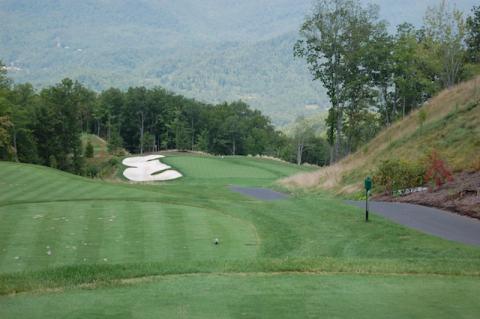
Balsam Mountain Preserve is backed by a finished Arnold Palmer golf course, an established developer, and a good first quarter of sales.
Draw a circle about a 45-minute drive around Asheville, NC, and you find some of the nation's most breathtaking home sites and golf course views, with prices that may also take your breath away. The current economy, however, is letting the air out of many ambitious projects once considered bullet proof. Even the customarily bullish high priest of high-end mountain development, Jim Anthony, according to a local newspaper account, appears concerned about the sales trends at his vaunted Cliffs Communities, and especially at High Carolina, where he has paid Tiger Woods a design fee some reports peg at $20 million.
"In January and February this year, we were really hit hard," Anthony told John Boyle of the Asheville Citizen-Times in an article published yesterday. "In March we've seen a little bit of a turn."
A little bit of a turn may not be enough for other communities, certainly not Grey Rock in the Lake Lure area. The community did not have a golf
Other golf communities in the Carolina mountains have slowed their progress considerably. River Rock's Phil Mickelson course, his first mountain design, has been delayed to at least 2012, two years beyond its originally planned opening date. The community, as of the beginning of the year, had only two homes in construction, one that was going to be leased back to the developers. At Seven Falls Golf & River Club, near Hendersonville, developers insist the Arnold Palmer course will be finished in August, despite the filing of liens against Seven Falls by some of its contractors. The largest lien, for $2.5 million, was by the contractor engaged to build the golf course.
Not every high-end community in the mountains is operating on the edge of a cliff. Balsam Mountain Preserve, near
For those contemplating the purchase of any golf community home in the current climate, the deep pockets and track record of a developer has never been more important. There are plenty of bargains available at the moment, in the mountains and everywhere else, but avoid any communities with unproven developers and un-constructed amenities. And take everything a developer says with a grain of salt. After a splashy event that featured Tiger Woods last November, Cliffs developer Anthony announced that the High Carolina project had commitments for $40 million in property sales. Five months later, land transfer records, according to the Asheville Citizen-Times, indicate $25 million had been sold.
Best golf course lists: The average golfer does as well as the experts
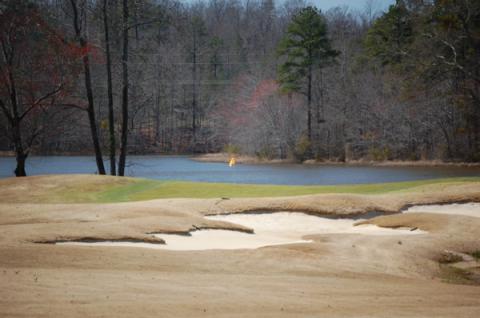
The Robert Trent Jones Trail in Alabama fared quite well in Zagat's 2009 guide to America's Top Golf Courses, including the Grand National course in Auburn, which was rated at a strong 26 of 30.
Spring is the season for golf course rankings. Golf Digest published its list a few weeks ago and Zagat's sent me its latest annual "Ultimate Golfer's Guide" the other day; Zagat asks me, as it does hundreds of others, to contribute my thoughts about some of the public courses I have played the previous year, in exchange for which they send me a free copy.
Golf Digest includes both private and public courses in its rankings, but of course the pampered private ones
One other key difference between the listings: As mentioned, Zagat's includes the opinions of the average Joe to build its rankings. Golf Digest uses "raters," low-handicap players who are well connected enough to be invited to play at some of the nation's finest layouts. The average Joes, actually, do quite well in terms of their judgments when you compare the two lists. For example, the top public venue on Golf Digest's list is almost a cliché, Pebble Beach, at #6 overall. Pacific Dunes follows at #14, the only other course in the top 20. Whistling Straits weighs in at #22 and The Ocean Course at Kiawah Island #25.
Zagat's guide differs only slightly, with its contributors agreeing that Pebble Beach is the best public course in the land, but putting Bethpage Black, site of this year's U.S. Open, at #2, and Pebble Beach's companion course Spyglass Hill at #3. The next three slots in Zagat's, in order, are held down by Whistling Straits, Pacific Dunes and The Ocean Course. Bethpage Black ranks #29 on the Golf Digest list. Rounding out the top 10 on Zagat's is Bandon Dunes (#7), Pinehurst #2 (#8), Kapalua Plantation (#9), and The Stadium Course at TPC Sawgrass (#10).
In its index, Zagat's includes a wide range of categories, such as those that will appeal to the budget conscious, those with the best clubhouses, the best 19th holes and the courses that are the most environmentally
Note: Golf Digest publishes its rankings online at golfdigest.com/rankings. Zagat's rankings are not available without paying a fee, but if you want me to look up your favorite course, send me a note and I will be happy to.
Left leaning: Oxford Greens' liberally tilted fairways not for hookers
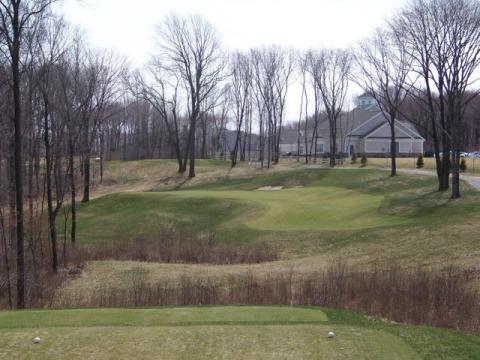
Oxford Greens offers up interesting doglegs, almost all off them tilting left.
by Tim Gavrich
My father and I journeyed 50 minutes from our home in Avon to Oxford, CT, to play the four-year old Golf Club at Oxford Greens on Wednesday. Designed by Mark Mungeam of golf course architecture firm Cornish, Silva, and Mungeam, the layout winds through acres of forest and Del Webb cookie-cutter houses.
Oxford Greens gives names to all its holes, including a "Redan," a "Punchbowl," and a "Double Plateau," all names of template holes fashioned by the classic designers C.B. Macdonald and Seth Raynor. Their design of the golf course at Yale University is one of my favorites; therefore, I was disappointed not to see some Yale-like features at Oxford Greens. The closest similarity to the Macdonald/Raynor style was the par 3 13th, the "Redan" hole, with a bunker guarding the front and left of a green that slopes from front-right to back-left, encouraging a running right-to-left iron shot.
There were a few other bright spots to go along with some noticeable weaknesses at Oxford Greens. The following are the good with the bad.
The Good -- The variety in the lengths of holes was a plus at Oxford Greens. From the back tees (just under 7,200 yards), the par fours range from the 335-yard 6th to the 458-yard 18th. Likewise, the par five 3rd is a true three-shotter that runs over 600 yards uphill, while the penultimate hole rewards a well-struck drive with the
The Bad -- There was very little variety in the movement of the holes. Oxford Greens is the only golf course I have ever played where the first 16 holes have the majority of the trouble on the left side, leaving the right side for bailout. Only the 17th and 18th holes provide room to miss on the left. Despite good variation in the lengths of the holes, the sameness of the movement of the land made the golf course feel monotonous until the home holes. Also, many holes are quite narrow, meaning that high-handicappers might lose a few more golf balls than typical. The only other significant quibble is that the greens were not in great shape when we played (see yesterday's post below), having been aerated a few days earlier. By the looks of the greens, even in their punched condition, they should round into very nice shape in the next few weeks. As always, be sure to ask about conditions when you call to book your tee time; we didn't ask when we called, and the Oxford Greens pro shop didn't offer.
We paid the early-season weekday rate of $45 (cart included). Beginning in May, the rate reverts to $55 weekday and $89 weekend. Oxford Greens does offer different annual membership plans, including one that
All in all, the Golf Club at Oxford Greens provides a nice mix of fun and challenge despite the relentlessness of holes with trouble left and relative safety right. The staff at Oxford Greens tries hard on and off the course to make you feel special, fetching your bags from the bag drop and satisfying a request for some forgotten pain relievers before the start of the round. Although the golf course might prove exhausting for those happy hookers who can't keep the ball on the right side of the fairway, Oxford Greens is worth a go for anyone traveling Interstate 84 just south of Waterbury, CT.
Tim Gavrich, a sophomore English major and golf team member at Washington & Lee University, has contributed articles to GolfCommunityReviews over the last few years. He is also a frequent contributor to GolfClubAtlas.com, a web site dedicated to golf course architecture.
The Village at Oxford Greens is a Del Webb community and is centrally located in the hills of Connecticut. Homes begin in the low $400s at 1,800 square feet and many feature views of the golf course. This is what is commonly referred to as an "active adult community," which means only those 55 and older need apply and the club arranges for a wide number of activities for its residents. The homes were without any architectural interest, and seemed almost pre-fabricated, surprising at the prices. We walked through the 14,000 square foot clubhouse, with adjoining indoor pool, and found a number of card tables filled by ladies who appeared to be well into their 60s and early 70s. Their ages and the layout of the clubhouse reminded me of the assisted living center where my late mother-in-law lived for a couple of years. For those who want most hours of their days planned and do not want to work too hard to get to know their fellow residents, I suppose places like The Village at Oxford Greens would be a fine choice -- but not for this 60 something. -- Larry Gavrich
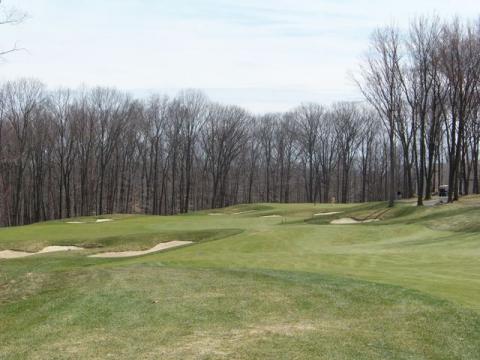
Landing areas and greens are well protected at Oxford Greens.
Spring golf bumps along in New England
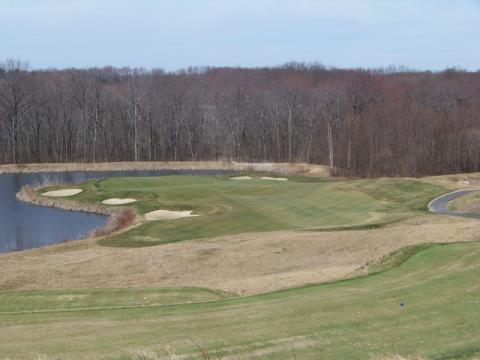 The par 3 2nd hole at Oxford Greens in Oxford, CT.
This is the time of year in New England when green fees at the best daily fee golf courses come pretty close to matching the temperatures -- say around 50. Managers of these golf courses need to start generating income two months before turf conditions reach their peak, and they are not going to risk turning away paying customers -- or ticking them off so much that they won't return when green fees are $100. If you just want to start to get your swing in shape in early April at a bargain price on a decent layout, this is your time, notwithstanding the bumpy, often freshly aerated greens.
To wit, my son Tim and I played 18 at Oxford Greens in central Connecticut yesterday. The swirling golf course, which definitely favors Lee Trevino types who move the ball left to right, is surrounded by a restricted-age community fashioned by the Del Webb organization. Tim will have a full golf review here in the next day or two, and I will include my thoughts on the surrounding homes (and maybe revisit the notion of age-restricted communities). The photo above, of the stunning second hole at Oxford Greens, should suffice for now.
The best $1,175 you might ever spend
I have been receiving my annual emailings from the Myrtle Beach Father & Son Golf Classic, set for this coming July. The three day event features hundreds of teams comprising mostly fathers and sons, but also fathers and son-in-laws and grandfathers and grandsons. My son Tim and I first played in the tournament 10 years ago, when he was just nine years old and was permitted to play from the front tees. When he was 11, his last year from the front tees, we actually won our flight of 17 teams. It was a hoot.
The entry fee is pricey at $1,175 ($900 if you have played in any previous Classic) but the memories are
The fee includes food and beverages during the event, including a festive barbecue at the awards ceremony, some golf paraphernalia (shirts, sometimes shoes, other stuff) and, maybe best of all, $400 in store credit at the enormous Martin's Golf and Tennis Superstore in Myrtle Beach. For those who feel the need the buy a new putter or 10 dozen Pro V1s, this is the time.
The roster of more than a dozen courses that host the event is impressive and includes the well regarded Tidewater, Barefoot Resort, the newly reconstituted Pine Lakes International and the three courses at The Legends Resort. The format is both fun and a little nervewracking; it includes one round of best ball, one of captains choice (two-man scramble) and -- this is the nervewracking part -- a round of alternate shot.
If any of our faithful readers intend to participate this year, please let me know and I will be sure to stop by and say hi (but not at the top of your backswing). And what better time to make a visit or two to one of the Myrtle Beach area's fine golf communities. I am happy to help with that.
More information on the Father & Son Golf Classic is at FatherSonGolf.com.
Deep in the heart of taxes: Revenue shortfalls likely to lead to state tax increases
If you are contemplating a relocation, especially one in which you have some flexibility in terms of geography, you might want to keep your eye on state legislatures' activities in the next few months. The states in the warmer weather areas that lost the most in tax revenue in the last quarter of 2008 (between 10% and 25%) include Virginia and Florida, with Tennessee, South Carolina and Alabama at 5% to 10% losses. Milder shortfalls (less than 5%) were felt in North Carolina, Georgia, Mississippi and Texas. Louisiana actually had a revenue increase.
I have preached in this space that taxes are only one component of the cost of living and depend largely on an individual's circumstances and lifestyle. Life in a zero-income-tax state like Tennessee, Florida or Texas, for example, could wind up being just as expensive as in the Carolinas, the difference made up by higher sales, property and use taxes. Still, the income shortfalls in the states bear watching before making a commitment to move.
For the Wall Street Journal's map indicating tax status state by state, click here .
Interior design: Inventive Norman layout makes most of trees and water
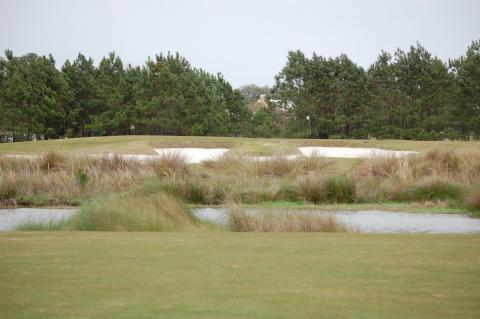
At Oldfield's short par 4 12th hole, the safe play is a long iron or five wood to the wide fairway (above). The tempting play is to go for the green from the tee. See schematic of hole immediately below (click on photo for larger view).
Review: Oldfield Golf Club and community, Okatie, SC
During my week in the Bluffton/Beaufort, SC, area last month, I played a spate of exquisite island golf courses that featured heavy doses of marsh, live oaks, palmettos and pines in their layouts. Don't get me wrong; the courses at Berkeley Hall, Belfair, Callawassie, Dataw and Spring Island ranged from good to outstanding, but their layouts, while imaginative, featured similar natural elements one to the next. At my last stop of the week, Oldfield, I eagerly anticipated a more open layout with, perhaps, a different set of challenges.
I was not disappointed, although the Greg Norman layout does thread its way around some beautiful live oaks and water, and eventually works its way out to the marsh along the Okatie River, but only fleetingly, the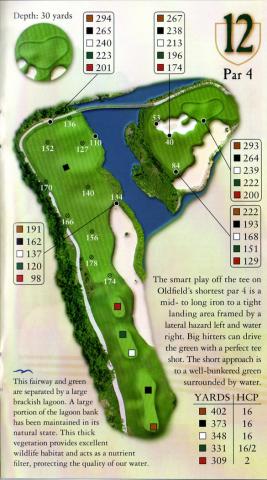 best views consigned to home sites. Norman's work, though inconsistent, can be as inspired as it is sometimes mundane. His original design at Tennesee National near Knoxville is creative, challenging and great to look at. It is hard to believe the same guy did the rework of a Bob Cupp course at Savannah Quarters, which doesn't show any spark from The Shark. Better is The Reserve at Litchfield Beach in South Carolina; in the quality of its design, The Reserve appears to fit somewhere in the middle of Norman's portfolio, not daring but a competent layout members can enjoy a few times a week.
I did not tee it up at the Oldfield course, having played 18 that morning. There is just so much a 60-year old body can take. But Oldfield's friendly pro shop staff loaned me a golf cart, pointed me toward the first tee, and away I went with camera in tow. In some ways, I get a better sense of a course by not playing, taking a lot more time to survey the layout than I would if I were with a playing partner and trying to stay ahead of the group behind. I had the course to myself on a Thursday afternoon.
Standing on the first tee, faced with a wide fairway on the par 4, I thought this might be one of those layouts that makes concessions to mid-handicappers. But as I made my way to the fairway landing area, it was quickly apparent that #1 was all about the approach, which must carry the edge of a pond and two nasty, sod-faced bunkers. Norman, whose only majors were at the British Open, fancies those sod bunkers; they surround one of the best par 3s he has ever designed, #12 at Tennessee National. A few other greens at Oldfield feature a similar combination of water and sand on one side, but most are well protected by bunkers only. Where sand is not a factor, as at the 9th hole, Norman creates a swirling green complex with large collection areas, making an up and down par save from these shaved areas as daunting as from the bunkers.
The long par 4 5th hole is a #1 handicap hole that actually merits the designation. (Too many toughest-hole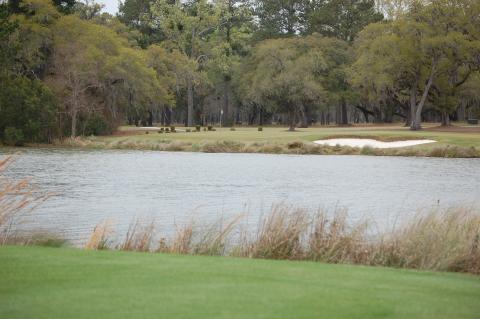 assignments are given over to a tricky layout with lots of trouble, rather than one where two excellent shots must be made in order to have a putt for birdie. But I digress...) At 417 yards from the middle tees and a robust 465 from the tips, the far end of a pond that extends down the right side from the tee box is in play for any squishy drive. You don't want any part of the right side anyway, as the approach will take you over a pond that arcs around the entire right side of the kidney shaped green, from front to back. With the wind kicking up, as it was during my visit, this is as challenging as a par 4 gets.
The green at #8 struck the first discordant note of the day, albeit a minor one. Protecting the front right side is a bunker without the sod facing. That seemed a little inconsistent but perhaps I am being too picky. The finisher on the front nine is the only one without a bunker its entire length, and it is of stunningly good design, using trees and out of bounds left as the only "hazards." At 424 yards from the middle tees, it requires two solid blows, but if your tee shot does not find the left center of the fairway, you could be shut out by trees that literally bend toward the fairway on both sides, beginning 150 yards from the green. The green is 44 yards deep and multi-tiered.
How often do mere mortal golfers have the opportunity to go for the green on a par 4? Norman tempts us at #12, which is all carry over water, 170 yards to clear for the mid-tee player, 195 yards from the near back tees, and 222 yards for the big bangers. Sounds manageable, but the landing area is surrounded by large, deep bunkers, in addition to the water; any drive that lands on grass must go "full flaps" quickly before it rolls into one of those bunkers. From the mid, next-to-back and back tees, the full carry to the green is 239, 264 and 293 yards respectively. The safe way is just a five wood poke to the wide fairway left before an approach over the water. The hole defines risk/reward.
In my notes, I use the word "brutal" to describe a few holes on the back nine, especially the wind blown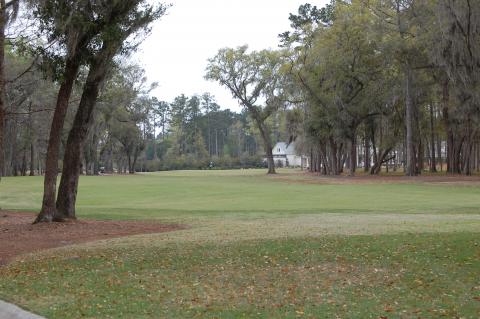 stretch from #13 through #16. Water is in play on three of the four holes -- two par 3s and two par 4s. The medium length par 4 15th, without water, provides two deep and menacing bunkers that cover virtually the entire front of the narrow green. The short par 4 17th is a bit of a breather after the previous four holes -- although the falloff just beyond the green is steep -- but there is no relaxing on the double-dogleg par 5 finishing hole, where bogey is just as accessible as birdie, water covering the entire left side of the green and deep bunkers at front right. It takes two good shots to position for the best angle for the wedge approach.
Turf conditions were excellent, the tee-boxes in especially great shape. I didn't have my putter with me but I walked the greens and they seemed smooth. On near misses around the greens, putting from as far as 10 yards off the surface might be the preferred play, a Norman trait in his designs. Except for just a few instances, the attractive Oldfield homes are well back from the field of play, although the player is certainly aware of them (many nice views of the golf course from the back porches, undoubtedly). The white fences that denote grazing land for horses in this equestrian- and golf-oriented community give the course a feel different from others in the area. Most of the encroaching fingers of marshland are not in play; a few long wooden bridges snake their way from tee-box to fairway across the wetlands.
Property owners at Oldfield are required to sign-up for club membership, at $3,450 per year, which gives them access to all non-golf amenities, including the River Club, where many of the social and dining events are centered, water activities on the river and in the community pools, six lighted Har-Tru tennis courts, and a basketball court. Initiation fee for membership in Oldfield is $60,000, with an equity membership plan that carries $5,350 in annual charges. Upon departure from the club, the member receives either a full $60,000 refund or 80% of the prevailing initiation fee, whichever is higher at the time. Full up, including common charges ("assessments") totaling $2,200, residents can expect to pay $11,000 a year, not unreasonable for a community with such a wide range of amenities and obvious care for its infrastructure.
Oldfield emphasizes its equestrian offerings as much as its golf club. The 12-stall barn and 20 acres of workout areas are located just inside the security gate and are framed by the community's distinctive white fencing. Horse owners may board their steeds for $600 per month.
Houses in Oldfield are both unusual and attractive, some painted in bright pastel colors. Although they might seem more suited for, say, a Charleston row house setting, the splash of color in the more or less monochromatic Low Country is refreshing and attractive. One other interesting note about Oldfield's homes; the vast majority along the golf course have separate garage areas connected to the main houses by breezeways -- some covered, some open. This is an intriguing trend in that the space above the garages can be used as guest suites or home offices. Of course, this type of design generally requires more land, but Oldfield does a good job of making things fit without one home crowding the next. Home prices at Oldfield range from the $500s to over $1 million. One current listing seems an especially good buy, given its size and location. It is a 3 BR, 3 ½ BA cottage with a screened porch that looks out to the 5th hole. At over 2,600 square feet, it is listed for $599,000. Similarly sized homes are listed in the high six-figures to over $1 million.
The community's Lakeside Village offers an alternative living style, more along the lines of a town center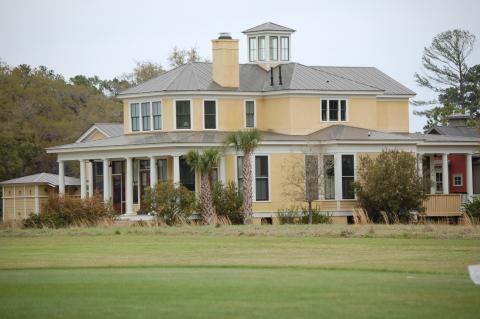 concept. With a range of floor plans to choose among, heated living space begins at a healthy 2,300 square feet. The Charleston-style homes may be cheek by jowl with their neighbors, but for those who want to live in an old style, intimate setting, they are attractive. Most range in price from the $600s to the $800s.
Oldfield may not have the dramatic marsh views of other Low Country golf courses closer to the ocean, but its Greg Norman layout, which snakes its way through and around live oak trees and plenty of water, is a stern test, especially when the wind blows. With water or sand dominating all holes except one, and with some par 4s well over 400 yards and one that is drivable, Oldfield presents a diversity of challenges for the single-digit player and plenty of potential for enjoyable rounds for all others.
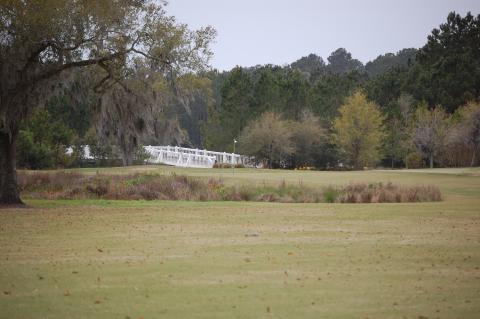
The approach to the home hole at Oldfield.
The Oldfield Club, Okatie, SC
Designer: Greg Norman
Gold tees: 7,142 yards, rating 75.2, slope 142
Black: 6,708, 72.9, 137
White: 6,223, 70.9, 129
Green: 5,746, 68.5, 122
Women: 5,746/5,046, 73.1/69.3, 131/115
For more information about Oldfield or any of the other golf communities in the Low Country of South Carolina, or to arrange a visit, please contact me.
Only human: Tiger win not quite inevitable
Burning bright: Tiger lurking
Just not fair: Tiger at the Masters

Now on Sale

- The only book about golf communities in the last 10 years.
- 156-page step-by-step guide to finding your dream golf home.
- Info on nearly 100 golf communities the author has visited.
- Paperback version costs less than a sleeve of Pro VIs.
Here is what the experts are saying:
“The book is chocked full of information…applicable to anyone looking for a move to the Southeast regardless of whether they are looking for a golf community or not.” — John LaFoy, golf architect (Linville Ridge CC, CC of Charleston, The Neuse GC)
“Larry has done a tremendous amount of work and anyone — like me — who is looking to search for a golf home now or in a few years needs this book.” — Brad Chambers, golf blogger, ShootingYourAge.com
“Wow! What a thorough piece of work…a must for anyone moving South. This book will help many people.” — Brett Miller, owner and founder of MMA, Inc, a golf industry consultancy
Buy It Now at Amazon.com or BarnesandNoble.com.