The lure of an enduring classic golf course
In the course of my research for this web site, the modern courses I play outnumber the classic probably 10 to 1. Rare is the Donald Ross or Tillinghast or Mackenzie layout that lies at the heart of a neighborhood of homes. Even though I walked the Country Club of Farmington (CT) course today during qualifying for the state amateur tournament, I felt the tug of the familiar.
I used to play Farmington, which was mostly designed by Devereaux Emmet in the 1920s, as guest of one of its members who moved on to another course some years ago. Fond memories floated by for me at Farmington today. I remembered the layout as keenly as I do that of my home course of the last 24 years. Farmington's rolling terrain, maddeningly small and sloped greens perched on hills, and two of the hardest par 3s in Connecticut are hard to forget.
The par 3 2nd hole, for example, is 190 yards of pure uphill terror, with a three-tiered narrow
The finishing hole, also a par 3, has been softened recently by widening a putting surface that had been shaped something like Betty Boop's waist. The one shotter plays downhill in more ways than one. Missing anywhere but short (who misses short on purpose?) means a lob wedge from thick rough and the possibility of playing fully across the green and down the other side. Getting close is only marginally easier than it was previously, the only compensation for a bogey being the patio and bar lurking above, welcoming the vanquished.
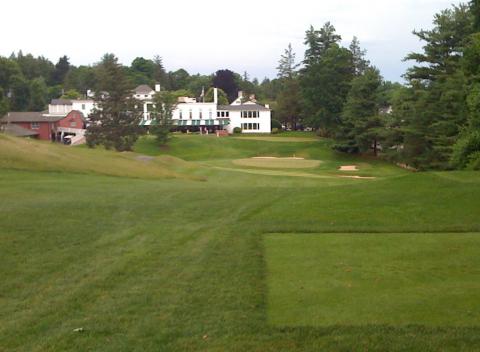

The finishing holes at Farmington begin with a tricky par 4 (bottom) that forces a drive well left of the reachable water. The approach is at an angle to the elevated and horizontal green. The finisher (top) is a par 3 whose green has been widened to accept a few more tee shots, but miss on either side, and your finishing score could widen as well.
 Home On The Course newsletter
Click here to sign up for our Free monthly newsletter, loaded with helpful information and observations about golf communities and their golf courses.
One dream realized, one deferred: A fable of two couples
Although they had seen recessions come and go during their time in Stabler -- that one in the early 1990s was especially scary -- the severity of the
But Bob and Carol were quite upset about the market collapse, emotional actually, and at backyard barbecues they lamented the timing of it
Ted and Alice broke things down into their logical components. The first was lifestyle. They were tired of winters, tired of paying for two-week trips to somewhere warm in order to play golf and lie on a beach in January. Although they loved their town of Stabler, they were tired of the traffic and some of the other stress-inducing aspects of life in a densely populated area. Long ago, they had decided the last third of their lives would be more meaningfully lived in a community that supported a more casual lifestyle.
Second, of course, was their real concern about whether they could
Although they would sell their home for less than they would have
Ted and Alice made their move in 2010. As for Bob and Carol, Ted and
A comment in the Wall Street Journal's Sunday pages, which are syndicated in newspapers across the country -- I read mine in the Hartford Courant -- carried a fundamentally important comment today. A financial adviser said of those trying to recoup their stock market losses of the past year, "What's important...is recognizing where you are right now and not trying to think about where you were in 2007." That should be as true of how we view the market value of our homes as it is the value of our portfolios.
If you would like another opinion as you think through your own plans, please contact me.
Millionaire's club...and other available extravagant golf properties
The Saturday Golf Properties advertising section of the Wall Street Journal features a few interesting offerings for anyone looking to live large next to a terrific golf course -- or to own an entire golf resort. Just bring more than $14 million and a heavy sweater.
LandVest, which is affiliated with Christies' "Great Estates" division, is offering the Thousand Islands Country Club, located on an island in the St. Lawrence River in New York State, for a cool $14.95 million. The almost 1,000-acre
Good luck, however, to any buyer trying to recoup the investment via green fees (the two courses are public). The top charge on the Castle Course is $35, and you can play the Lake Course for as little as $19. The far upstate New York golf season is about as short as Nova Scotia's -- think May to October, if you are lucky. However, the scenery is impressive, especially for those looking for water views. All that extra acreage provides plenty of room for future housing and a potential refuge for Floridians looking for a summer escape. More info is available at LandVest.com or contact me if you would like me to inquire in your behalf.
Saucon Valley Country Club is legendary among golf course aficionados. The Allentown, PA, club features 60 holes of golf, and its [name] course will play host to this year's U.S. Women's Open. The Still House and its 11 acres is adjacent to the club and is listed for just under $3.5 million. The 5 bedroom, 4 ½ bath home was built in 1936 by a former Bethlehem Steel chief financial officer and Saucon Valley president. The web site is StillhousePA.com or contact me for more info.
Last is a brand new 8,000 square foot home on the terrific Oyster Harbors Golf Course on Cape Cod in Massachusetts. I have played the Donald Ross designed Oyster Harbors twice and found its spacious fairways and crowned greens a delight. The home that will be auctioned by JJ Manning on June 27th features 5 bedrooms, 5 full baths and 3 half baths on a little over an acre inside a gated community and includes deeded rights to a dock and beach. For more information, see JJManning.com, or contact me.
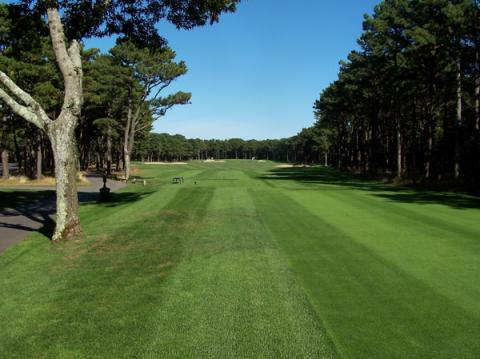
Oyster Harbors is a Donald Ross gem on Cape Cod.
Repeat performance: A look back at The Reserve Club of Litchfield Beach
Members of The Reserve at Litchfield Beach, a private club at the golf-rich southern end of Myrtle Beach's Grand Strand, overwhelmingly voted to sell the club to the McConnell Golf Group of Raleigh, NC. The trouble is that the sale is being held up by former members who have brought suit to recoup their equity investments. I played and reviewed the course a little over a year ago and thought this was the appropriate time to look back, especially since the McConnell Group plans to close the course for three months after purchase and redo the greens and some other aspects of the Greg Norman layout.
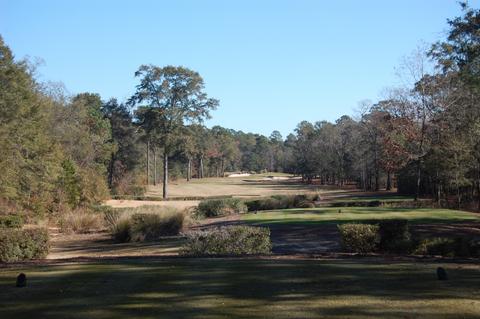
To have a decent chance at par on the tough 5th hole at The Reserve, a drive down the left side is essential.
Greg Norman designs golf courses the way he plays them - brawny and
all or nothing affairs that show little sensitivity to the needs of
double-digit handicappers. Playing from shorter tees doesn't really
help much when deep bunkers and hazards snuggle up to large and
significantly contoured greens.
But a mellow Norman design can provide quite a reasonable
challenge, as we found on New Year's Day at the private Reserve at
Litchfield Beach, a 1998 Norman design on the South Strand of Myrtle
Beach. The Reserve is one of just a handful of private courses along
the golf rich Grand Strand and among the three best, all on the south
end. The others include the Pete Dye designed DeBordieu and Tom
Fazio's design for Wachesaw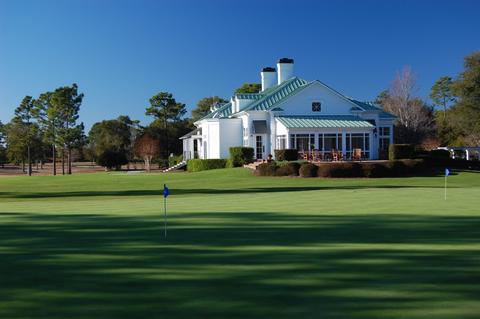 Plantation, both of which might be surprised - along with the Members
Club at Grand Dunes and the Surf Club in North Myrtle Beach - that The
Reserve's web site calls it "the only exclusive golf club on the Grand
Strand."
Plantation, both of which might be surprised - along with the Members
Club at Grand Dunes and the Surf Club in North Myrtle Beach - that The
Reserve's web site calls it "the only exclusive golf club on the Grand
Strand."
Price points for homes at The Reserve fit nicely between the other
two, with handsomely designed single homes on ample lots starting in
the mid six figures. Prices at DeBordieu Colony, which includes some
seven-figure homes on and near the ocean, average about 10% higher than
The Reserve. Wachesaw, like The Reserve to the west of Route 17, the
main thoroughfare through the Grand Strand, presents homes that begin
in the $400s and move up to the $1 million+ mark for the larger lots on
the Waccamaw River.
The Reserve's operators showed some restraint by not over-seeding
the fairways for the winter, and to my mind, that strategy worked to
the course's advantage. Rather than the tufts and inconsistent growth
of fill-in winter grasses, the dormant fairway Bermuda grass was as
tight as during the warmer months, although with a little rain in prior
days, tee shots did not roll far past their landing areas. The greens
were near flawless, especially for a January, but the grass mowers were
not out on New Year's morning so they lacked a little speed. Our hosts
assured us that earlier in the week, the putting surfaces had been
slick. I believe it.
Greens were enormous and crowned in some places. Norman has done a
wonderful job of channeling Donald Ross around the greens. Misplaced
approach shots typically find the depths of a swale and require either
a delicate chip shot or a long putt from up to 15 yards off the green.
We were impressed that even during the winter, putting from well off
the greens was not only possible but, in many cases, preferable.
I can't say that any holes at The Reserve are etched in my mind
forever, but some stand out. The best was also the #1 handicap hole on
the course, the par 4 5th, a dogleg right that plays to a modest 395
yards. A lone tall pine on the left side of the fairway forces a
slight draw off the tee. Pushed drives to the right side of the
fairway make it essential to fade your approach shot over two
sod-walled bunkers that guard the front and right sides of the green.
The par 3s all play over waste bunkers or marshland, but the large
greens are fairly easy to hit. (if difficult to putt, especially when
they are cut to roll fast). The 17th, at 175 yards, is all carry to a
large contoured green that makes being below the hole almost mandatory
to avoid three-putt possibilities. For a hole-by-hole description, click here for The Reserve's web site.
The Reserve offers two levels of golf membership. For an
initiation fee of $32,500 and dues of around $350 per month, full golf
members play unlimited golf and have the run of the club. A special
"Golf Membership" is geared toward second-home owners and provides 26
rounds of golf annually for an initiation fee of $22,000 and dues up to
$200. Members have a huge practice range and green at their disposal,
and the clubhouse, while not huge, is well appointed. The greeting at
the bag drop make guests feel like members.
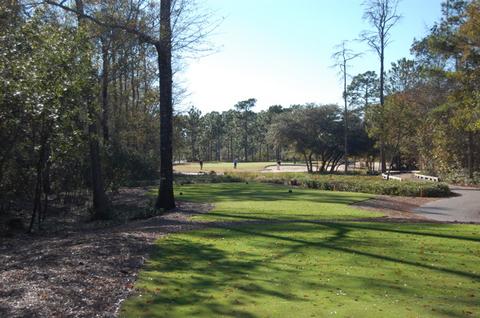
Par 3s at The Reserve are all-carry affairs. The 17th forces a high soft shot to an undulating green. Placing your tee shot below the hole is best.
High stakes gamble: NC developer going all in
chutz·pah (noun) -- shameless audacity; impudence; brass
In Texas Hold ‘em poker, the moment of desperation is reached when one player is down to a relatively few number of chips and goes "all in." Sometimes the player has a good enough hand to win, he thinks, but most of the time circumstances force him to make a last, desperate attempt to stay in the game.
In the mountains of North Carolina, Seven Falls Golf and River Club developer Keith Vinson is
The Seven Falls Arnold Palmer course was to open in December 2008 but an article at BlueRidgeNow.com on June 5 quoted Vinson saying he expected to complete the course in November and open it early in 2010. According to BlueRidgeNow, which is the online presence of the Hendersonville (NC) Times-News, construction at Seven Falls was halted late last year as Vinson fought off lawsuits from contractors who claimed they had not been paid for some buildings they had completed. Vinson is also contesting a suit by homeowners who claim his company took their money, stopped construction of their $895,000 townhouse and would not return their phone calls.
Infrastructure construction at Seven Falls started again in recent weeks as Vinson indicated he had secured additional financing to install sewer and water lines and to pave roads.
"It's not through an investor," Vinson told BlueRidgeNow about the financing. "It's through a very large national financing source."
You have to wonder about those large national financing sources and what logic trees they have fallen out of. At a time when his original community, Seven Falls, is in dicey shape, some bank (or banks) is lending Vinson $12 million to buy and build at the stalled Queen's Gap, including its Jack Nicklaus Signature golf course. The developer has indicated he plans to market Queen's Gap as a companion to Seven Falls. For the sake of those who are sitting on lots and promises in both communities, we hope he is successful.
Note: I have toured and played the courses at Champion Hills and Kenmure, two communities within 15 minutes of Seven Falls. All amenities are in at both communities and the courses are fine. Champion Hills, which is Tom Fazio's home course (he grew up in Hendersonville) is particularly sleek and mature, and features all the markings of a Fazio course, including cloverleaf bunkers and funneled fairways. If you would like an introduction to either community, please contact me.
Cliffs properties auction yields no bids
The $25,000 property, which had recently been on the market for more than $80,000, is located in the The Cliffs Valley community in the town of Travelers Rest. While not the most desirable lot in the golf community -- Cliffs properties with mountain and golf views can stretch into seven figures -- the $25,000 opening price was lower than virtually all other properties in The Cliffs.
Jon Ball, founder of UpstateBuyers, which conducted the auction, told me that the market for Cliffs homes is dry because those who might move to The Cliffs either cannot or will not sell their primary homes at current market prices. Some readers of Golf Community Reviews have told me privately that they are looking for "steals," properties either in foreclosure or in "short sell" mode (a short sale occurs when what the owner owes the bank is more than his home is worth). Ball is confident that opening bids for properties at his next auction on July 18, featuring Cliffs at Walnut Cove properties, will be considerably lower than fair market value. The auction web site is at UpstateBuyers.com.
Equity return issue holds up sale of The Reserve; Oldfield, Palmetto Bluff in trouble?
More than 90% of the members at Myrtle Beach area private golf club, The Reserve at Litchfield Beach, voted recently to sell to a North Carolina entrepreneur. Now, four former members are holding up the sale.
According to an article in the Myrtle Beach Sun News, the former members claim they are owed reimbursement of their initiation fees under terms that were in effect when they joined the 11-year old club. However, the former members claim that the proposed sales agreement with the McConnell Golf Group would eliminate their reimbursements.
As a rule, initiation fees at equity clubs are higher than those at non-equity clubs. In an equity arrangement, club members are reimbursed a percentage of their "deposits" when they resign;
The Reserve is a fine Greg Norman layout less than a couple of miles from the ocean. Homes in the community sell in the mid-six figures range and up. The McConnell Group has pledged to keep the club private for at least 10 years and intends to close the course for three months, if the deal goes through, and redo all the greens. However, if the current members and their former fellows cannot resolve their dispute, McConnell may look elsewhere for an addition to its growing portfolio of golf courses in the Carolinas. There are plenty of nice but financially strapped clubs to choose among.
I'll follow developments here, pardon the pun but, in the meantime, you can read the Island Packet article by clicking here.
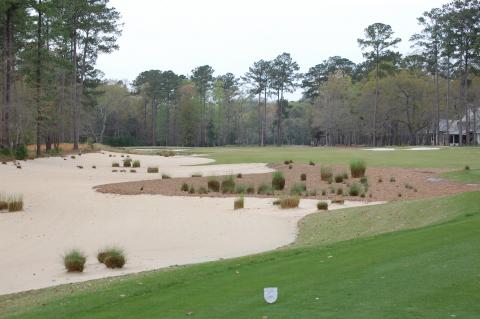
The Greg Norman layout at Oldfield features plenty of waste bunkers and pine trees, as well as an uncertain future.
Resident accuses us of being out of bounds
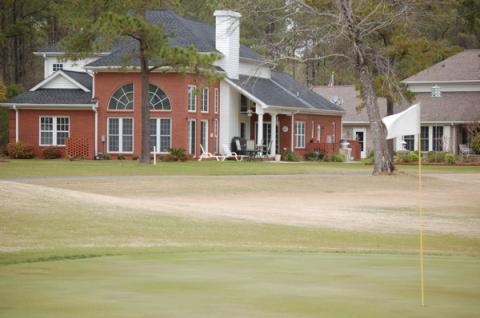
Out of bounds stakes do not protect the homes at the North Shore Country Club unless they are well behind the greens.
One of our readers, a resident of the community that surrounds North Shore Country Club in Sneads Ferry, NC, has taken issue with our review of the golf course a year ago. Below is her note to me and my response. For my original review of North Shore, click here.
Her email to me:
I saw your review about NSCC and noted your objections to the OB markers and "homes being built too close to the golf course". Hello - without the homes there would be no golf course. Our home is on the fairway and we have had our share of golf balls hit the house, break windows, etc., all by golfers who do not get it that when they pay their greens fee they are paying to play on the GOLF COURSE and not in and around homeowners' property. The fairways here are generous (I am a golfer) and your criticism of obtrusive OB markers is pathetic. If you can't play your ball in bounds (or at least be courteous if you do make an error - we all do) than you need to go hit balls on a public range and stay away from decent courses like North Shore Country Club. Feel free to respond although I doubt you will.
The response I sent to her:
First of all, thank you for reading Golf Community Reviews and for taking the time to respond to my review of North Shore. I appreciate the passion many people feel for their home course and community. You certainly feel that way about North Shore. I wrote about North Shore twice in the space of a couple of days a year ago, and my overall review was strongly positive. I recall receiving a complimentary email from your club's general manager a few days after I posted the article. I am a fan of North Shore, but no golf course or community is perfect, and it is the job of a reviewer to indicate the warts as well as the beauty marks for those who have not had the opportunity that I have had to play the course.
Given your obvious anger toward golfers whose shots hit your home or land in your yard, I wonder why you purchased a home directly adjacent to a fairway. Although there is no excuse for
After having spent virtually every day of the last five years talking with developers, researching, learning about and writing about golf communities, I know full well that many golf courses could not have been built without the homes. In many cases, though, developers provide the golf course architect with a footprint large enough that homes are set well back from the course, eliminating the need for out of bounds stakes. In some cases water hazards or other natural barriers provide buffers between the homes and the course. I understand compromises sometimes are necessary, but before one of my readers chooses to visit a golf community, they should be aware of how the real estate and the golf course fit one to the other. I see that as a fundamental part of my job.
I am sorry you doubted I would respond to your note. The points you raise are worthy of debate, even if your tone is more harsh than necessary. I intend to publish your note at my web site, with my response.
Thanks again for writing to Golf Community Reviews.
Oy of the Tiger: Woods beaten by four women, and Dubai project stalls
The Dubai project was to include palaces, mansions and luxury villas; only one-third of the properties have been sold, according to an article in Maktoob Business, an online publication. Although Woods and the project's developers insist the golf course will be completed in 2010, only three holes have been laid out.
"We're making sure we get the holes completed -- the holes we have," Woods told Golfweek.
On the Forbes list, which uses a combination of income and media "exposure" to rank the celebrities, Woods dropped from his #2 position last year. Movie actress and media darling Angelina Jolie topped the list, unseating Oprah Winfrey who fell to #2, just ahead of the Material Girl, Madonna, and Beyonce Knowles, the former member of the group Destiny's Child whose destiny seems to make lots of money ($87 million last year). Although Woods ($110 million) earned more than Ms. Knowles, she outranked him, demonstrating that old saw that money isn't everything.
More than $10 million of Cliffs Communities properties on auction Saturday
A new western Carolinas real estate auction service goes online Saturday with 27 golf community properties at the prestigious Cliffs Communities under the gavel. Add up all the minimum bids and more than $10 million is potentially up for grabs to the highest bidders. The operative word is "potentially" because the private sellers (no Cliffs developer properties are involved) are not required to accept the high bids. UpstateBuyers.com founder Jon Ball indicates that some after-auction negotiations are likely between the high bidders and owners. But with one property with a minimum bid of just $25,000, some offers are bound to be accepted without further ado.
You can bid or follow the bidding on the individual properties by registering at UpstateBuyers.com (it's free). Most of the properties, both home sites and re-sale homes, are part of the the Cliffs Valley community in the aptly named town of Travelers Rest, within a half hour of Greenville, SC. A second auction, scheduled for mid July, will feature re-sale properties from the Cliffs at Walnut Cove near Asheville. Properties from other developments, including those at Brights Creek, are expected to be included.
If you decide to register for the auction, please indicate you read about it here at Golf Community Reviews.
Wachesaw earns Club of the Year distinction

Now on Sale

- The only book about golf communities in the last 10 years.
- 156-page step-by-step guide to finding your dream golf home.
- Info on nearly 100 golf communities the author has visited.
- Paperback version costs less than a sleeve of Pro VIs.
Here is what the experts are saying:
“The book is chocked full of information…applicable to anyone looking for a move to the Southeast regardless of whether they are looking for a golf community or not.” — John LaFoy, golf architect (Linville Ridge CC, CC of Charleston, The Neuse GC)
“Larry has done a tremendous amount of work and anyone — like me — who is looking to search for a golf home now or in a few years needs this book.” — Brad Chambers, golf blogger, ShootingYourAge.com
“Wow! What a thorough piece of work…a must for anyone moving South. This book will help many people.” — Brett Miller, owner and founder of MMA, Inc, a golf industry consultancy
Buy It Now at Amazon.com or BarnesandNoble.com.