Crystal Springs Resort: Second-home paradise for golf and wine connoisseurs
Children change everything. For a couple whose working lives were pointed eventually toward a year-round home on a golf course in a warm weather climate, their mindset can change when their children have children of their own. For golfing grandparents in the population dense areas of the northeast, there are some fine options, especially for those who both ski and play golf, to live at least part of the year near family and friends. Consider some of the major ski areas of Vermont, like Stowe, Killington, and Sugarbush, all with golf courses of their own to fill their ski lodges in summertime. But there are viable options even closer to New York City and Philadelphia, for example, one not much more than an hour away from the Big Apple. We recently visited that golf community, the Crystal Springs Resort in northwestern New Jersey, where golf and -– Attention Oenophiles! –- wine share the spotlight.
Crystal Springs is just 47 miles from New York City, which makes it within a fairly easy drive from not only the suburbs ringing the city but also from Philadelphia and Boston. Real estate in the resort community struck me as reasonably priced, probably because property taxes are relatively high, about $2,200 per $100,000 of valuation. Golf club members share the seven layouts and most of the other facilities with vacationers, although a part of the main clubhouse is carved out for members only. For those who choose to live at Crystal Springs year round and enjoy winter sports, a ski area is a few minutes from most homes and included in one of the club’s various membership packages.
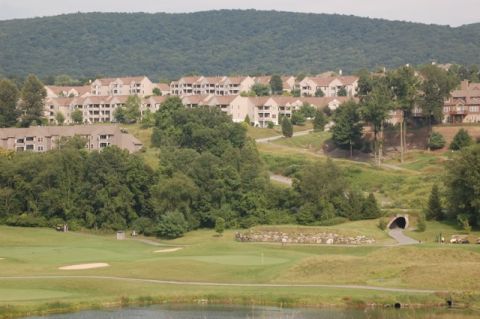
Most of the homes at Crystal Springs have golf course and/or mountain views.
The builder is the developer
Crystal Springs is huge if you total up all the parcels of land owned by Crystal Springs Builders, which purchased the land and facilities after the original owners suffered financial difficulties in the 90s. Over time, Crystal Springs Builders added many more surrounding acres; today, the resort’s property extends about six miles at its longest part.
Since Crystal Springs Builders is, as the name suggests, primarily a homebuilder, they do all the single-family house construction on the property from 13 pre-drawn designs, a practice that keeps building costs down but adds enough diversity of architecture to give each neighborhood a custom look. The condos and villa neighborhoods are similarly diverse, with some buildings comprising just a couple of units and others rising to mid-size in order to maximize mountain and golf course views. (Note: The vast majority of built homes of all types have at least some views of the golf courses at Crystal Springs.)
I’m always a little confused about the differences between a town home, villa and condominium. At least the town homes at Crystal Springs are clearly defined as “single-family attached” units where the owners of these attractive spaces overlooking the Cascades golf course have just one contiguous neighbor. The developer is currently building 22 of these units at prices between $309,000 and $449,000, depending on size -– they range from 1,600 square feet to 2,500 square feet. The best views at Crystal Springs, which means mountains and/or golf course, command slightly higher prices. Single-family homes on roughly 1/3-acre lots at Crystal Springs are priced in the high $300s to over $600,000. Few of the homes in the community are well back from the edges of the golf courses; most ringing the Wild Turkey golf course I played sit on high ridges and look straight down on the fairways (and a few ponds).
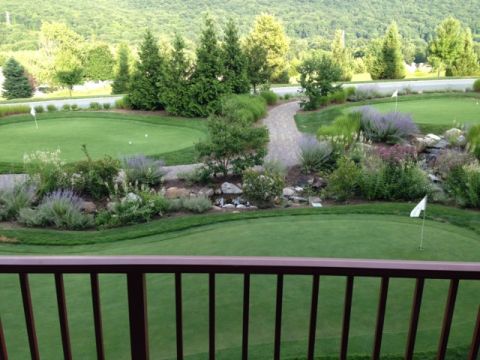
Some of the balconies at the Lodge at Crystal Springs look down on a series of practice putting greens.
Living lodge
I stayed for one night in the Grand Cascades Lodge, the center point of the community and viewable from many points on the golf courses. The one-bedroom apartment -- it included a full kitchen, living room, and large bathroom with whirlpool tub and stall shower -- featured a balcony that hung above a series of five small, beautifully manicured putting greens of varying shapes, well-utilized, I noticed, by those guests who had rented rooms in the Lodge. These apartments in the Lodge sell for between $225,000 (one bedroom) and $350,000 (two bedrooms) and can be rented out by the developer in behalf of their owners. The management fee is pretty stiff –- 50% of the rental income –- but the developer takes care of all maintenance, marketing and preparation for guests, and Crystal Springs has two high seasons for both golf and skiing. Although Crystal Springs won’t divulge the average number of weeks most units are rented out, they will say they maintain an average 60% occupancy year-round in the Lodge. Only March and November are considered slow months at the Resort –- and the joint was jumping when I was there midweek in late July.
One especially nice feature is that every home in Crystal Springs includes exterior maintenance; you can be out on the links or on the ski slopes while someone else is mowing your lawn or plowing the snow from your driveway. This is of special benefit to homeowners who live at Crystal Springs part-time; they never need to worry about whether the grounds are being tended. Homeowner association fees run generally between $200 and $300 per month, depending on what type of home you own. (The lack of a guarded gate at Crystal Springs, which would hardly seem necessary in such a remote part of New Jersey, helps keep the fees down.) For a condo in the Ferndown section of the resort and overlooking the Cascades golf course, monthly maintenance is $222. For single-family homes in the community, the fees are just $275 per month.
Ideal second-home potential
Couples looking for a laid-back lifestyle in a golf community may find Crystal Springs a little too active, typical of resort communities with activities like golf and skiing that cover almost the entire calendar year. The crowd of tourists staying in the gargantuan main lodge while I was at Crystal Springs was a rather eclectic group that included buddy golfers, honeymooning couples, families with young children and corporate managers attending meetings and retreats (work in the morning in one of the lodge’s many meeting rooms, play in the afternoon on one of the courses, and some cheerful camaraderie in the lodge’s tavern in the evening). Crystal Springs would make an ideal second-home location for couples whose primary homes are behind the gates of a private southern golf community but want to spend selected months near children and grandchildren who live in the North. They could also score major points with the grandkids who come to visit since Crystal Springs offers the number of diversions to keep even the most active child engaged.
Next: World-class golf, world-renowned wines
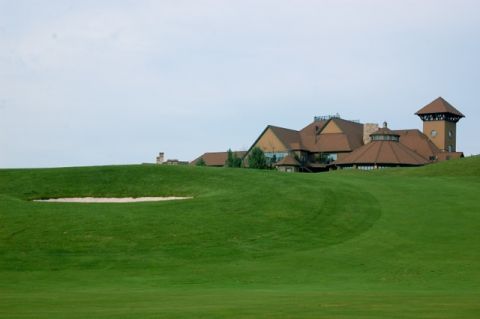
The Lodge at Crystal Springs dominates the scene, including behind the 18th green on the Wild Turkey golf course.
 Home On The Course newsletter
Click here to sign up for our Free monthly newsletter, loaded with helpful information and observations about golf communities and their golf courses.
Going aTwitter over golf community reviews
In recognition that many folks are on vacation this month and may not want to spend too much time online, the August Home On The Course newsletter -– subscribe for free by clicking here –- will feature short-form reviews of golf communities we have visited over the past half dozen years. It was quite the challenge to reduce our typically pages-long reviews to Twitter length – 140 characters, spaces included, or less.
The following is a taste of what you can expect in the August issue of Home On The Course, which will be ready by the end of the week. (Note: If you would like a longer description of any of these fine golf communities, please contact us.)
Callawassie Plantation, Okatie, SC
Refined yet unpretentious, off beaten path yet 20 minutes from charming Beaufort. 27 holes of Fazio golf. Couple of properties <$1,000.
Dataw Island, SC
36 holes by Fazio and A. Hills (one of our faves). Well-established; out there in the marshland, but still just 25 minutes to Beaufort.
Wild Dunes, Isle of Palms, SC
Walk to beach and two golf courses. Minutes from mega-shopping in Mt. Pleasant. Great seafood. Now if only #18 would stop falling into sea.
DeBordieu Colony, Georgetown, SC
Private golf, beach. Hear, smell ocean from P. Dye layout, but $3M homes command oceanfront. Short bike ride to beach from $500K+ homes.
The Reserve at Litchfield, Litchfield Beach, SC
Join private club – easy-walk Greg Norman layout -– and gain access to 7 other great clubs in Carolinas. Access to resort beach 1 mile away.
Spring Island, Okatie, SC
Old Tabby Links one of highest rated in SC. Live oak paradise minutes from Beaufort. Grandly appointed homes begin just under $1 million.
The Reserve at Lake Keowee, Sunset, SC
Beautiful lake, Nicklaus golf, big active clubhouse, all amenities, devoted members. Cottages in $400s a bargain. Wear orange; near Clemson.
Woodside Plantation, Aiken, SC
Multi-golf course (three layotus) community near charming inland town. Strong equestrian area. All the usual amenities keep residents busy.
Snee Farm, Mt. Pleasant, SC
Classic G. Cobb golf course in mature community, perfect for older-home lovers. World-class shopping, restaurants, services 5 minutes away.
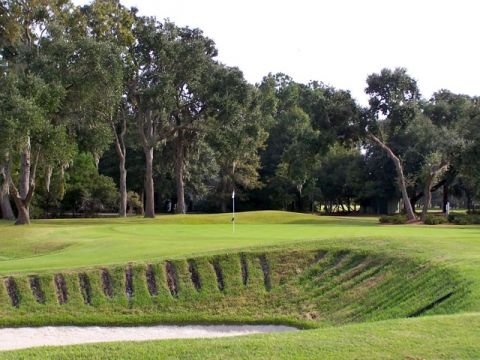
Pete Dye's unbiquitous railroad ties are on display at DeBordieu near Georgetown, SC.
Balls to the walls…and the roof, windows and backyard guests
The Camarillo, CA, Spanish Hills Country Club advertises on its website that “The Lifestyle You Deserve Is Just Around The Corner.” No one deserves the lifestyle at the midpoint of the golf course’s 7th hole.
It was there that one couple purchased a home and property that receives as much golf ball traffic as the 200 yard sign at a busy practice range. Despite having noted a hole in one of the home’s stucco roof tiles during an inspection of the house, and picking up 25 golf balls from the backyard during that same visit, the couple sued the sellers for fraud a year after they bought the home. The claim was that the sellers had not told them just how often the house was peppered with golf balls from the 7th tee.
If the three to four golf balls a day –- that’s more than 1,000 annually –- were simply coming to rest in the backyard, the purchasers might have welcomed the extra income from all those Titleists and Top Flites. (It would have at least paid for the pith helmets.) But apparently the damage to stucco and windows was way more than the couple had anticipated. They lost the suit, by the way, but more to the point is the cautionary advice for you, dear reader: Golf course view homes come at a premium price, but some views may come at an extra price.
Attorney Rob Harris’ entertaining and informative Golf Dispute Resolution website has a full accounting of the story. Click here for access.
The road back for Lido Golf Club (Part 2)
The fairways, sad to say, are what keep the Lido Golf Club from being more than an “interesting” golf course, at least for now. The current condition of the fairways does not permit of anything close to summer rules (i.e. play it as it lies), even though I played it in the dead of summer. Mother Nature, not the management of the club, gets the bulk of the blame. If you are not familiar with the geography of Long Island, understand that Lido Beach is just east of the Rockaways, only slightly farther from Breezy Point, communities you should know from headlines in late October 2012, courtesy of Hurricane Sandy. As the two young locals I played with explained, the ocean didn’t rise up to wipe away the Lido clubhouse and drown all the club’s golf carts and deposit salt water across the submerged golf course; the surge came almost entirely from the Reynolds Channel and adjoining bay, well away from the beach.
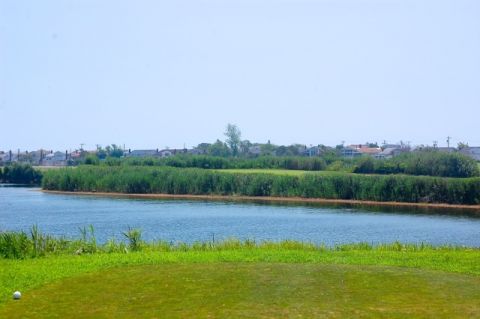
Hit or MIss: The par 3 17th at Lido, all carry, is one of three challenging finishing holes.
The overhead photos of the course in the wake of the hurricane are frightful and show more water than grass. (Click here for web site with photo.) The salt water must have lay on the fairways for days, eating away at the root systems and befouling the turf. Somehow, the golf course was able to reopen in March and, by my reckoning, club management has fought a brave but uphill battle to get Lido playable again. To be blunt, the fairways are a mess, a mix of weeds, patches of scraggly grass interspersed with patches of no grass. The tee boxes are marginally better. But one reason to be optimistic about the future of the golf course is the greens, which are uniformly excellent, if slow even by municipal club standards. Although the greens were grainy, and most of the grain always seemed to be working against the slopes (the ball wouldn’t break the way it looked), they were in outstanding shape considering the savagery of the storm and the amounts of salt water that came barreling across the 120 acres of so of links land. The elevation of the greens that might cause some players at Lido to curse occasionally helped them survive the flooding.
Scarred landscape with a nice finish
If you can get past the lies in the fairway -– don’t even think about playing the ball where it rests –- you can have yourself a fun day at Lido, especially if you haven’t played golf in Scotland for a long time –- or ever. Most holes really did remind me of golf in the Old Sod, where civilization encroaches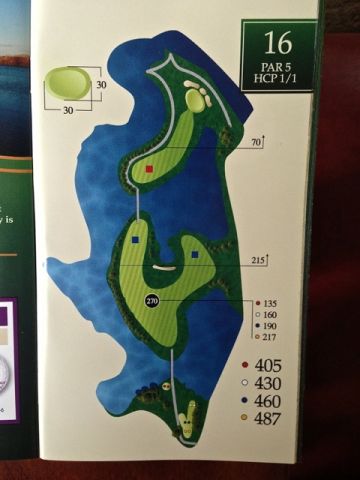 on in-town courses. Moreover, the three finishing holes could stand up to most finishers anywhere. The 16th at Lido is its signature hole, unlike any links hole I’ve played and not to everyone’s taste. A short par 5 at just 460 yards, the fairway is composed of two distinct landing areas that form the shape of a ‘Y’ as you look out over the marsh from the tee box. Play to the narrow left prong if you want a safe layup over the marsh on your second shot to an area about 60 to 100 yards short of the green. Play to the right prong about 210 yards if you want a go at the green in two, all carry over the marsh. Both landing areas look like a thimble from the tee box. I chose the alleged safe route, but it didn’t matter when I popped up my drive just over the marsh and then had to play my second with an eight iron to the end of the left part of the ‘Y.’ A well struck four wood for my third shot took me over the marsh to just short of the green from where I failed to get up and down.
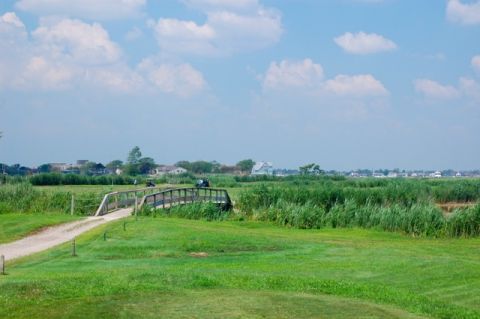
The par 5 16th presents two choices, the more progressive of them on the right (see yardage book above) and the more conservative on the left. Confused? So was I.
The 17th is a par three and a full carry of 185 yards over marshland. The hole plays toward the ocean, and if the prevailing winds are heading in off the beach, a 3-wood will often be the right play for many. The wind was not blowing more than 5 mph on the day I played, but the air was heavy and I choked down a little on a 4-wood. (I don’t carry a 5.) A good swing and green in regulation produced only my second par three of the day.
Keep your head down for a few reasons
The finishing hole, a longish par 4 slight dogleg left between three fairway bunkers and two ovule traps that guard the green’s entrance, is no relief after the 17th. The hole must have been a sight for sore eyes when the famous “Pink Lady” was mostly all that stood behind the green, a few hundred yards in the distance, and before that eyesore of a net separating the golf course from the football field and middle school and a yawning shed with three open driving bays at the base of the adjacent practice range. (Note: The Pink Lady was turned into condominiums in the 1980s and condemned in the wake of Sandy, which eroded its foundation.) As it is, the 408-yard finishing hole, which also plays into the prevailing winds off the ocean, is all about the bunkers; keep your head down to keep the eyesores out of sight and the drive and approach out of the sand, and your view of your score on the 18th might be pleasant.
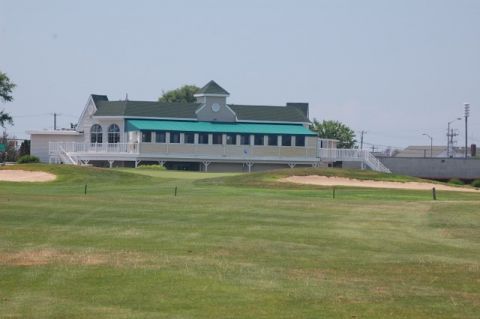
The former clubhouse was destroyed by Sandy, along with all of the club's golf carts, its computers and records and a lot more. The new clubhouse was built in a matter of months.
Lido had gotten beat up in some reviews, even before the storm, for its slow pace of play, up to 5 ½ hours on the weekend according to some reports. I played on a Wednesday of extreme heat –- it was 100 when I finished the round -- and clocked in at about 4 ½ hours. (I did notice some folks dropped out after nine.) We waited on virtually every shot from tee box and fairway but, in fairness, we were a threesome behind a few foursomes. I started off as a single, which I don’t mind when I am taking lots of photos, but the foursome behind me –- part of a sizable foursome men’s group -- became irritated that there was just a twosome in front of me. I got the hint and quickly joined the two young men in front of me. If you hate slow play, Lido is probably best scheduled for a weekday, and a Tuesday or Wednesday specifically. On the other hand, if you like links golf, live in the New York metro area, and can reconcile that this brave little golf club has a ways to go in terms of turf conditions, then pay the modest green fees, throw your bag on your shoulder and have a nice leisurely walk.
*
Lido Golf Club, Long Beach, NY. Designed by Robert Trent Jones, 1948. Par 72 from all tees. Gold Tees: 6,913 yards, Rating 73.4, Slope 127. Blue: 6,522/71.7/122. White: 6,125/69.8/121. Red: 5,291/68.8/115. Web site: www.lidogolf.com. Tel: (516) 889-8181.
Lido Golf Club history includes C. B. Macdonald, a Pink Lady, and Sandy
True links golf is hard to come by in the U.S., especially near urban areas like New York. With few exceptions, golf courses built on sandy soil near an ocean and within commuting distance of a big city were converted into real estate or public beaches long ago. Or, in the case of the early 20th Century masterpiece Lido Golf Club in Long Beach, NY, on the south shore of Long Island, into a crowded town beach and middle school.
The Lido club’s genes are as impressive as those of the most iconic American golf courses. Charles Blair Macdonald, he of Yale Golf Club, National Golf Links and Greenbrier White Course fame, designed the original Lido course in 1914, assisted by Seth Raynor, with some of the holes within sand wedge distance of the ocean. Shortly after it opened, famous golf writer Bernard Darwin described Lido as “the finest golf course in the world.” (Mind you, Shinnecock Hills and the National Golf Links were already open for play.) Macdonald described the making of the course for a news article at the time, and it was preserved in Golf Illustrated magazine. (Click here to access a copy.)
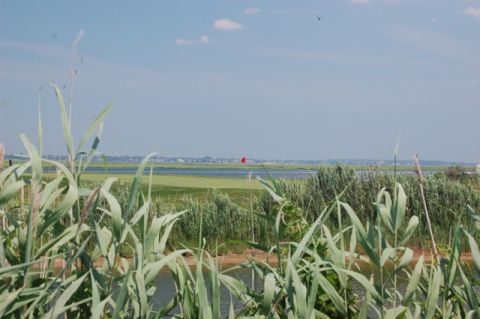
When you cast your eye in certain directions at Lido Golf Club, you might think you are on a links course separated from the rest of the world. Seconds later (below), reality sets in.
A Pink Lady rises from the beach
A New York state senator named Reynolds envisioned a “paradise” country club resort on the Lido beach and acquired 186 acres adjacent to the golf course in the late 1920s. The centerpiece of Reynolds’ paradise was a huge bubble gum colored Moorish-style hotel, which became known as The Pink Lady, but the hotel was about all the senator was able to complete before the Great Depression dashed his grander plans and may
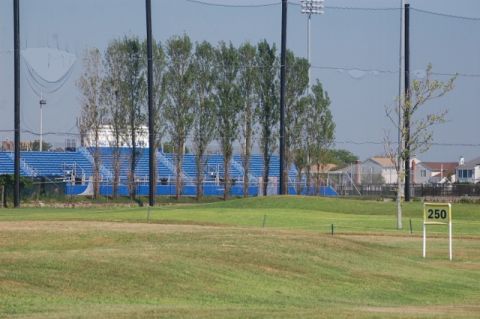
Lido has come a long way, but it has a long way to go. The golf course could be among the finest on the east coast if it weren’t for such pesky idiosyncrasies as civilization and Mother Nature. The adjacent middle school, for example, and a football field used by Long Beach High School line the 9th hole, necessitating the use of an obnoxious four-story high net to catch sliced drives. (It saved me a penalty stroke when I uncorked a wild drive, but still…) Along the southern boundary of the course is a fence that protects errant golf balls from Lido Boulevard and the modest row houses along the thoroughfare; the homes are barely an eighth of a mile from the beach, but you never see the ocean from the almost perfectly flat layout. As you make your way out toward the Reynolds Channel, which is punctuated beautifully by fingers of bright green marshland, smokestacks and other signs of commerce line the horizon. The pleasure boats that bob along the bay form a kind of odd counterpoint to the belching smokestacks and make you appreciate, even more, what the ocean views from the original Macdonald 18 must have been like.
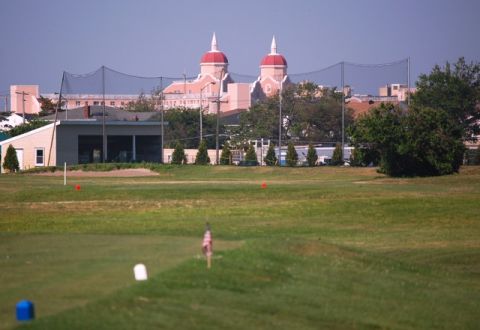
The view to the famous Pink Lady would have been uninterrupted when it was first built in 1929. The present day Lido Golf Club was not opened until 1948, but we like to think that the protective netting and practice range bays would not have been around to obstruct the views then, either.
Links golf on a budget
If it were possible to somehow silhouette out some of the visually unappealing adjacencies, Lido would be one of the finest layouts east of the Mississippi, given that it is the product of arguably the most skilled of all the Jones boy golf architects. From what one can tell today, Jones honored the idea of links golf by imposing bunkers only where it made perfect sense and not mimicking too much the round shapes and sod faces of traps on the classic Scottish layouts. The course is unfussy, the way a true links course should be, but certainly with potential for odd bounces and alternative shot choices, especially if the wind is blowing. It is hard to know what, if any, effects the intervening 65 years has had on the bunkering around Lido, but there are few penal high lips to contend with; and the sand –- my local playing partners told me much of it is from the Atlantic beach about 600 yards away –- quite yielding to a wedge.
I would not describe Lido Beach as a difficult golf course –- rating 71.7 and slope 122 from the blue tees at 6,522 yards –- because many of the fairways are adjacent and generous to pulled or sliced shots and, in typical links fashion, you have the prerogative –- sometimes it feels like an obligation –- to roll the ball up to the smallest of the elevated greens (more about the greens below). Of course, like any links turf, a well struck tee shot will bound down the fairway an extra 20 to 30 yards on all but the soggiest days. But a par 5 and a par 3 among the finishing holes may have you reaching for one club, and then another, before you settle on your final choice. More about that in the next part of the story.
Next: Great past, but what about Lido’s future?
Bright’s Creek’s future looks partly sunny
I had a good conversation today with a lot owner and member of the golf club at Bright’s Creek, the financially jinxed Mill Spring, NC, golf community a little less than an hour from both Greenville and Asheville. I was concerned after visiting the community’s web site and finding that interim owners who had defaulted a year ago were still listed as the “development team” at the site. I made some inquiries and left a message for the lot owner, who also had a management role at Bright’s Creek up until a few years ago.
Bright’s Creek has been victimized by bad luck and some organizational overreaching since its 2006 debut in a rather remote section of southwest North Carolina. The community was organized by the same team that put together Forest Creek, the heralded golf development in the Pinehurst area that has been the playground of such luminaries as Michael Jordan. Off that auspicious debut, the owners most have thought Bright’s would be another piece of cake after the acquisition of a sharply priced 5,000 acres with an array of creeks running through it and a semi-circle of ridges ringing the valley. But Forest Creek was built at a different time, and when the market began to collapse in 2007, the owners could not have imagined that this recession would take no prisoners among newly started golf communities like Bright’s Creek.
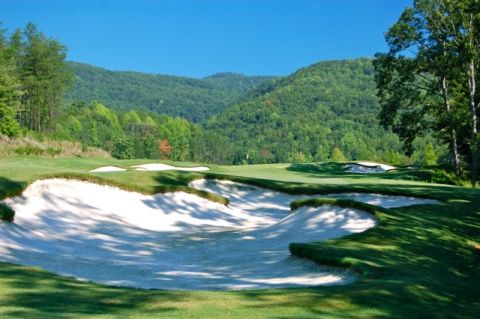
The Fazio layout at Bright's Creek uses all the elements valley and mountain terrain can offer, plus the creek itself.
After an initial spurt of 330 lots, sales turnover at Brights stopped dead in 2008. The 5,000 acres, which spans a valley that straddles the eponymous creek and slopes up to a 2,000-foot-high ridgeline, were carved into 1,300 lots that probably seemed only a slightly ambitious number in 2004; in light of the events of 2008 and since, it might be decades before those additional 1,000 lots are sold. (My contact believes that the next owners will almost surely reduce the overall inventory of lots for development.)
Ownership issues and a lack of resources have made it impossible for Bright’s Creek to do the kind of marketing it needs to be competitive. The original owners sold the community to a group from Miami in late 2011, but by the end of 2012, they were gone, unable to provide the financial resources necessary to pump new life into the development. Now, with the original owners trying to find yet another buyer, marketing and sales have both stopped dead at Bright’s Creek; what buyer, after all, is going to plunk down a couple of hundred thou for a lot in a golf community without a developer?
Down but not out
That kind of history should be enough to lay low even the best-organized golf community. But Bright’s Creek has some undeniable assets going for it that could make it an investment somewhat less risky than, say, penny stocks. Although it is totally rural in nature, and it will be years before the area around it grows in any significant way, Bright’s Creek has the aforementioned impressive bit of topography that some communities would lust after. The sleek Tom Fazio golf course plays mostly across a valley wedged between those surrounding hills, making it only mild exercise for those who prefer to walk their 18 holes. The surrounding ridgelines are perfect spots for the finest future homes in the community, with views across the valley and golf course to the other surrounding mountains. At 50 miles from Asheville and 60 from Greenville, Bright’s is remote, to be sure, but any emergency supplies -– or just routine groceries -– are much more accessible at nearby Tryon and Rutherfordton.
The golf course is a typical Tom Fazio modern design, which is to say both challenging and fun, the hazards mostly of the sandy variety, except for the stream of water that gives the course and community its name, and sporting the customary Fazio clovers and peninsulas.
Expect prices to drop with a new owner
I wish I could share some prices for real estate but because the temporary owners have stopped actively selling as they prepare to turn everything over to new proprietors, there is no marketing going on (including a web site that is at least a year out of date). But when Bright’s is sold, which my contact says could be a matter of days, weeks or, less likely, months, the new owners may have no choice but to offer lower priced lots. They will almost surely label them, accurately, “The Lowest Prices We’ve Ever Offered,” a signal for those with a little capital to risk that Bright’s time may have come.
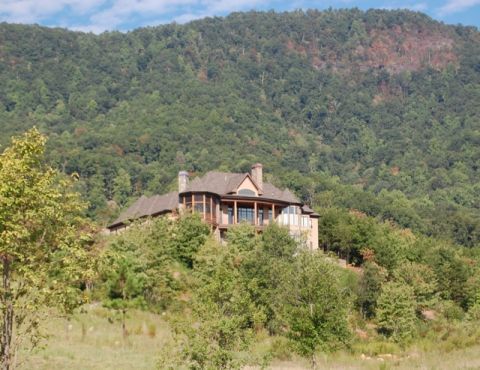
Some of the most dramatic homes at Bright's Creek occupy the most dramatic lots, along the community's many ridgelines.
And we thought golf was slow
Today’s Wall Street Journal includes an exposé of major league baseball that has nothing to do with steroids. An average baseball game, the article “Play Ball….Please” indicates, lasts 2 hours and 58 minutes, of which only about 18 minutes contains any action at all. Maybe that is an additional reason why it can be excruciating to watch a New York Mets game on television. You can read the Journal article here.
You may have noticed that the United States Golf Association has declared war on golf’s own problem with “slow play” –- some would say “finally” -- enlisting the likes of Arnold Palmer, Annika Sorenstam and other
Golfers will find that depressing, especially those “rabbits” who storm the pro shop after a 4 ½ hour round to complain about slow play. But ponder the following as you are strolling down some lush green fairway toward your tee shot a couple hundred yards away: Would you prefer to be playing golf or playing right field for some intramural team? At least when we golfers line up a 12-foot putt for par a good four or five minutes after our blast out of the bunker, having waited for our playing partners to line up their own birdie, par or bogey putts, and we eventually do strike the ball, at least we are not at a complete standstill, hand and glove on knee, waiting for a ball that may never come.
When one golf home just won’t do…
You have worked hard all your life and looked forward to a retirement of leisure and year-round golf. You don’t deserve the stress of having to choose between your dreams and your family, and yet many baby boomers face just that same huge lifestyle decision as they retire: Do they leave behind their kids and grandkids, or do they stay up North, resolved to put up with the cold winters, annoying traffic and higher costs of living?
I’ve been giving this conundrum some thought lately since friends are facing this decision now, and yours truly
Although a few compromises might be necessary -– one of the two golf homes almost surely will be a condominium or “cottage” in order to keep costs down -– we found it possible to purchase two homes for less than $500,000 and, in some cases, considerably less. For our main example, we chose the well-regarded Reynolds Plantation in Georgia and Owl’s Nest in New Hampshire (no-income tax state, by the way), both with outstanding golf courses, including six inside the gates of Reynolds Plantation. We also include 18 other examples of golf communities with homes ranging from $70,000 to the high $200s that can be mixed and matched for a North/South combination as low as $180,000. We could add thousands more examples east of the Mississippi alone.
We will mail the July edition of the newsletter later this week, so please sign up today by clicking here. If, in the meantime, you want assistance in identifying one or two golf homes that match your requirements, please contact us at your convenience and we will get to work in your behalf.
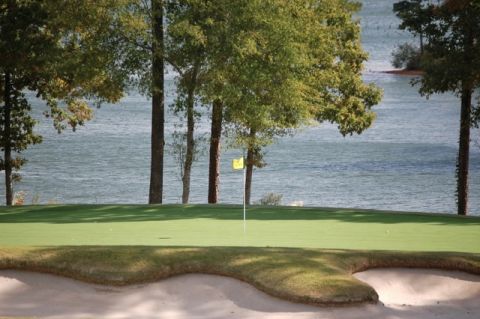
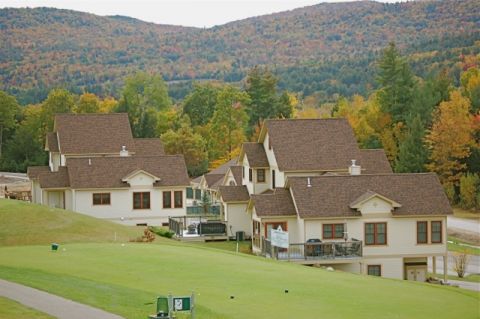
It is possible, for under $500,000, to enjoy a golf and lake lifestyle at Georgia's Reynolds Plantation (top) and a mountain and golf lifestyle at New Hampshire's Owl's Nest.
Mortgage interest rate rise not big issue for some buyers
The National Association of Realtors says hesitant homebuyers are pulling the trigger on purchases because mortgage interest rates are starting to rise. Their opinion is based on their own Pending Home Sales Index, or PHSI, which increased 6.7% from April to May, its 25th month-to-month increase in succession. The May index of 112.3 was its highest level since December 2006. The NAR also revised its 2013 median home price forecast upward by 10%, to $195,000, which would be the highest level since 2005.
Frequent readers of this site know we are always skeptical about the NAR’s motives in their communications, and this latest bit of guidance makes us no more comfortable. Buyers were already coming off the sidelines because of a generally improved economy, a rise in the stock market, and a dramatically reduced inventory of homes for sale. Rising
For this, however, the NAR does provide a bit of helpful guidance. The median price for homes sold in the Northeast region, according to the organization, was up 12.3% in May from the previous May, and in the Midwest, prices increased 8.2%. In the South, though, prices increased by 15%, indicating its continuing attractiveness to those looking for new lives in generally warmer climes. Significantly, 40% of all homes sold in May nationwide were in the South.
Of course, one can argue that the rise in interest rates could reduce the number of available buyers for properties put up for sale by couples looking to move to a southern golf community in retirement. But for the moment, inventories are low enough to neutralize the effects of slightly higher interest rates; and if the NAR and other real estate industry factions succeed in seeding the market with panic over the increased rates, those folks with their homes on the market now or soon will benefit.
Really, though, for a baby boomer couple in, say, Pittsburgh or Portland, ME, or Albany, NY, or Chicago, the multiple-percentage-point differences in home sale prices North and South should mean more than a fractional increase in mortgage rates, certainly in those situations in which couples will use the equity from the sale of their primary home to pay in full for their new, presumably smaller and less expensive, home in the South.
Country Roads Take Me Home to Berkshire Hills Golf Course Worthy of Long Drive
It was a glorious day, temperatures topping out at about 75 by early afternoon, and the ride from my Connecticut home was free of traffic or annoyingly slow drivers. Most of the trip is west on US 44, which runs through a combination of small towns still clinging to their farming roots as well as through a few larger towns of faded glory, like Winsted, CT –- hometown of everyone’s favorite windmill tilter, Ralph Nader. The last 10 miles of the trip wind through Berkshire foothills forests and pastureland before a steep hill brings you up to the unpaved Copake parking lot and a thoroughly unpretentious clubhouse, set at the highest point on the hilly layout.
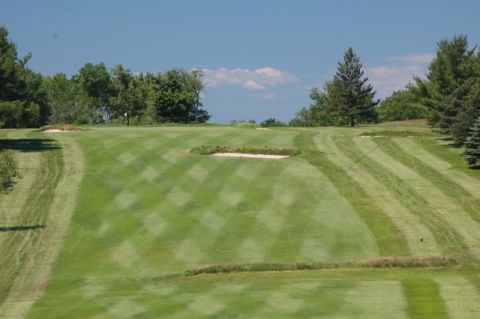
The first at Copake is an ideal starter, not too long at 369 yards, generous of fairway, but with some trouble, and straight uphill, a fair preview of the rest of the challenging course.
Copake and the Orchards Golf Club in South Hadley, MA, which I had played just 10 days earlier, were built originally within a year of each other -– Orchards in 1921 by Donald Ross and Copake in 1922 by Devereaux Emmet. Of course, thanks to the Ross name and having hosted the U.S. Women’s Open in 2004, The Orchards is much better known. But in terms of quality, condition, layout and attention to detail, I preferred Copake.
For one, Copake is a more visually interesting golf course with significant elevation changes –- often twice on the same hole, with elevated tees, sunken sloped fairways and elevated greens. Parts of the adjacent Copake Lake are within sight of at least half the holes but only as a pleasant distraction, since the water never comes close to the field of play. Like so many lakes that became vacation spots early last century, all the prime waterside real estate was taken up with houses, with the high ground reserved for golf. At just two hours from New York City, Copake Lake does not appear to have lost any of its glory; I heard plenty of squeals of delight from lake revelers as I made my way around the golf course (more background noise than distraction).
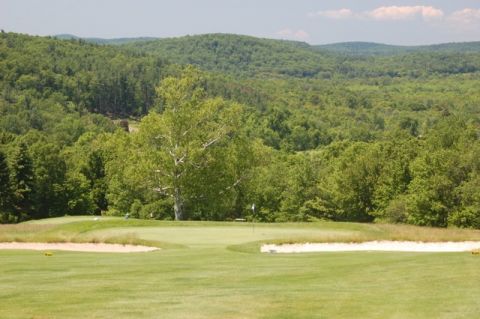
You know you are in the foothills of the Berkshires when you approach the par 4 2nd hole at Copake. Note that Copake's greenskeeper has resisted the temptation to "groom" the edges of the bunkers, adding even more to the "classic" feel of the golf course.
The course is beautifully maintained, although its lowest elevations did take on and hold a lot of water from heavy rains a few days earlier. Unfortunately, it was difficult to figure out where the soggy parts were in the rough until you were on top of them; in some spots, the deep tire furrows made by previous cart drivers was warning enough. The fairways are double cut into a crosscut pattern you expect from the best major league baseball stadia; instead of aiming at a tree or building in the distance, you can pick out a diamond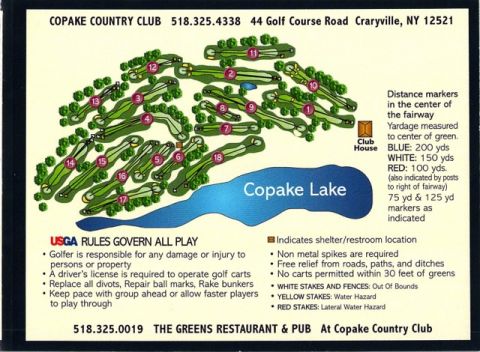 of grass in the fairway. Golf course owner Jon Urban shows a healthy reverence for the classic layout by keeping rough where most modern golf courses pave over with cart paths. The back edges of bunkers are rimmed in fescue, adding to the look of class (and classic). Suffice to say turf on tees and fairways are solid and worthy of summer rules; I didn’t have any sand or grass seed in the one divot mix container in the cart, but most divots came up clean and were easily replaced.
The greens at Copake are small, crowned, firm and speedy, and the greens keeper must have been in a foul mood early that morning because many pin positions were on little hills near the front or back of the sheer putting surfaces. That said, I didn’t note many flat places in which to punch in cups. I’ll take the back pin positions at Copake any day, even risking a potential downhill chip from just off the back rather than attempt to get close to the front pin positions set just over steeply faced false fronts; fall short and you are facing bogey or worse from below the green. I don’t recall more than a few level putts from behind the pins, even after a good approach shot landed on the front part of the green. The heavy rains of a few days earlier did little to soften the significantly elevated greens (they, of course, drain first).
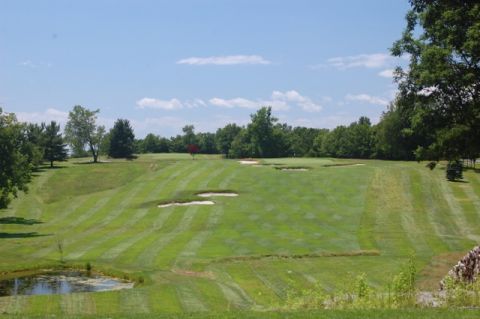
The 353-yard par 4 10th at Copake moves up the same hill as the opening hole, but its trouble mostly awaits pulled shots. Copake's owner is offering a building lot for sale to the right of the fairway, with an additional view of the lake.
I noticed golfers of all age groups out on the course, but Copake plays especially friendly for those of us who no longer hit our drives well beyond 200 yards off the tee but still want the thrill of playing from the tips. You can do that at Copake, where the back (White) tees are set at just 6,216 yards total, with a course rating of 70.3 and a slope of 131. The toughest holes on the card tend to be the longer par 4s, although the 472-yard par 5 4th hole is rated the 3rd toughest on the course, largely because the second or third shot to its green must surmount a two-story hill topped by a putting surface that reminded me of the Beatles’ haircuts in the ‘60s. (I will always have a soft spot for the 4th, largely because, after my blind hit-and-pray sand wedge, I made a six-foot putt for my only birdie of the day.)
Some flourishes at Copake are especially unusual for a country golf course, especially one that charges a mere $38 for us seniors (over 60), and just $45 for the rest of you. Virtually every tee box included a wooden bench behind it, and at one confluence of three tee boxes, a hammock was strung between trees, ostensibly for respite for those hearty few who choose to walk the extremely hilly layout. Every tee box included a functioning ball washer that, in the era of cost cutting, has become a rare sight. Since my ball picked up mud and grass stains on virtually every shot, this was a blessing.
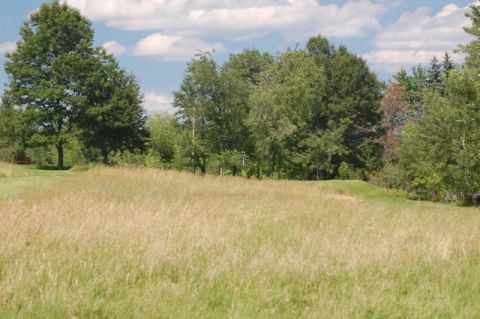
One of the par 3s at Copake, the 151-yard 8th, includes a blind tee shot. Here, at the challenging 188-yard 17th, you at least get to see the flag beyond the heather.
Copake is decidedly not a golf community; the only time you see a concentration of homes is along the 17th and 18th fairways, on the far side of Golf Course Road, which runs along the lake. There are no homes on the golf course itself, although owner Jon Urban has two large lots for sale, with views of both the golf course and the lake, for $575,000 each (contact us if you would like more information). One of them, set beside and above the fairway on the par 4 10th hole, is a short walk from the clubhouse where we spied some nicely filled plates being served to a lunch crowd; the public restaurant, called The Greens, is reported to serve excellent dinners as well.
There is nothing fancy about Copake Country Club, but then solidly classic golf courses don’t require fancy. Because of its location, Copake will never host a U.S. Women’s Open –- but its golf course could. If you are visiting the Berkshires or passing near the area on the Taconic Parkway, Copake is definitely worth a four-hour stop.
The par 5 18th at Copake finishes beside its namesake lake. Homes are only in sight on the 17th and 18th holes, across Golf Course Road.
*
Copake Country Club, 44 Golf Course Road, Craryville, NY, 12521, 518-325-4338. White Tees: 6,216 yards, Par 72, rating 70.3, slope 131. Yellow Tees: 5,510, 71, 71.2, 121. Red Tees: 5,329, 72,71.2, 121.
Mountain Golf Home for Sale near Asheville
Champion Hills celebrates the number 25

Now on Sale

- The only book about golf communities in the last 10 years.
- 156-page step-by-step guide to finding your dream golf home.
- Info on nearly 100 golf communities the author has visited.
- Paperback version costs less than a sleeve of Pro VIs.
Here is what the experts are saying:
“The book is chocked full of information…applicable to anyone looking for a move to the Southeast regardless of whether they are looking for a golf community or not.” — John LaFoy, golf architect (Linville Ridge CC, CC of Charleston, The Neuse GC)
“Larry has done a tremendous amount of work and anyone — like me — who is looking to search for a golf home now or in a few years needs this book.” — Brad Chambers, golf blogger, ShootingYourAge.com
“Wow! What a thorough piece of work…a must for anyone moving South. This book will help many people.” — Brett Miller, owner and founder of MMA, Inc, a golf industry consultancy
Buy It Now at Amazon.com or BarnesandNoble.com.