Great place to hone your short game
There are plenty of good reasons to visit Burlington, VT. The restaurants are outstanding, almost all of them serving food grown on local farms. Downtown Burlington's Church Street is a mall, closed to traffic along a five block stretch, with boutiques, restaurants, coffee shops and bars that attract a rather youthful crowd (the University of Vermont is just a half dozen blocks away). The beautiful Lake Champlain laps up against Burlington's western edge, with plenty of activites for those inclined toward the water. For the rest of us, a walk along the lake's shore is a great way to spend an hour or two.
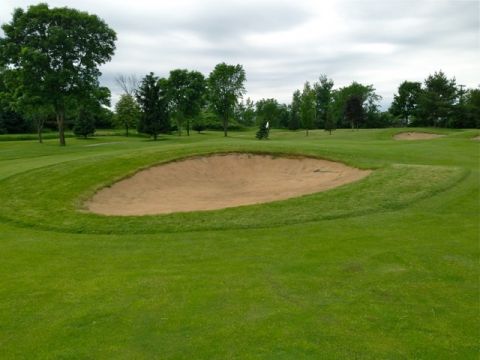
Links at Lang Farm may be short, but it also features some rather tricky pin placements behind menacing bunkers. And the turf was in excellent shape.
Golf options in Burlington are relatively few, the best of them the private Vermont National and Burlington Country Clubs. A few public options are just enough to justify bringing the clubs along, but for an unusual treat with a practical excuse, try The Links at Lang Farm, just 10 minutes outside town in Essex Junction. The practical is the chance to practice your short game, especially your play to par 3s, as Lang Farm is a short course, par 59 over its 18 holes and 3,900 yards, each one of them clearly distinct from the others. I used driver only twice on two of the course's five par 4 holes (there are no par 5s). The golf course is in excellent condition from tee to green, although the greens could be a touch faster. I bogeyed most of the holes on the front nine before getting my bearings on the back; with rare exception, there was not a pushover hole among the par 3s, and the par 4s were designed in the manner of short two-shotters on a regular 18 hole golf course -- trickier, with bunkers in play off the tee and on the approaches so as to compensate for the 320 or so yards. As for the par 3s, there is nothing short about them; they span 160 yards to more than 210 yards.
I played the course, which was designed by Michael Asmundson, with two friends from Scotland visiting the States for 10 days. We all enjoyed the option to rent pull carts (just $6) and have a good walk over the 2 1/2 mile layout. Since my short game has been in a funk lately, I especially enjoyed the number of chip shots I was forced to play, compressed into one pleasant 2 1/2 mile round.
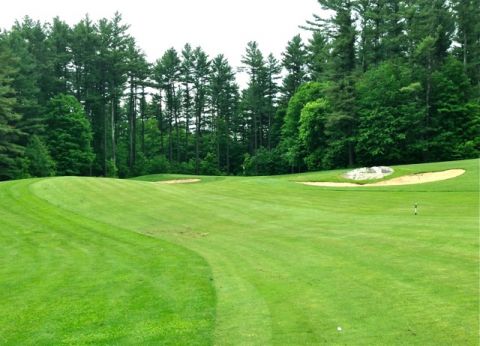
Lang Farm features just five par 4s, but they would fit neatly into most regulation 18 hole layouts.
 Home On The Course newsletter
Click here to sign up for our Free monthly newsletter, loaded with helpful information and observations about golf communities and their golf courses.
One way to own a home on Shinnecock, Pine Valley or Winged Foot
The neighborhood in New Bern, NC, known as Greenbrier preceded by a decade or so the Emerald Golf Club that wends its way through the golf community. The original streets of Greenbrier, developed in the 1980s by the paper company Weyerhauser, bore the names of spices like Basil Drive, Thyme Court and Rosemary Road. According to Steve Tyson, a New Bern real estate broker and builder of 60 of the early homes in the community, Greenbrier was so popular when it first opened that Weyerhauser decided to build a golf course on the adjoining tree farm it owned. That helped sell even more of the most upscale properties in New Bern at the time.
A top-rated course in its time
The Rees Jones layout opened in 1988 and was an immediate hit with residents, other area golfers and raters; Golf Weekly named it one of the top 50 golf courses in the Southeast, and the PGA used the course for its Tour Qualifying School in the early 1990s. With the attraction of the golf course and its status as the highest-end community in New Bern, Greenbrier essentially was completed by 1994 (only two lots remain available for sale today out of 700 home sites).
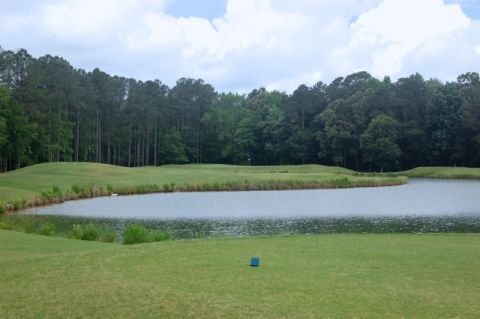
Unless you favor the left side of the fairway on the par 4 4th hole at Emerald, your second shot will be over water...again.
When the golf course was built, Weyerhauser decided to give prospective buyers the opportunity to live on a street named for a famous golf course. Today, a few families live at the intersection of Pine Valley and Shinnecock, and others on cul de sacs like Winged Foot Court. Rest assured that some of the kidders who live in Greenbrier wait for a reaction when they tell their friends that they live “on” Oakmont, Southern Hills or St. Andrews.
The golf club has been semi-private throughout its 25-years of operation; indeed, the only strictly private golf clubs in New Bern are Taberna, which was developed as a golf community but whose course has suffered some financial difficulties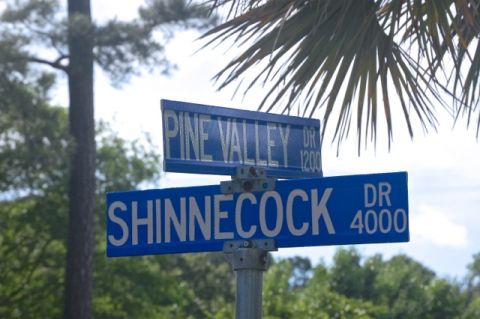 in recent years; and New Bern Country Club, a Donald Ross design along the Trent River which features older homes along its periphery. Steve Tyson, the local Realtor, sports a 2 handicap and thinks New Bern Country Club is the best course in the area but freely admits that could be because it is his home course and that at around 6,000 yards, and with tiny greens, “it suits my game.” He ranks Emerald #3 in town, behind the more modern Carolina Colours layout designed by Bill Love; I played Carolina Colours the day after I played Emerald and concur with the Realtor’s relative ranking of the two. Taberna and River Bend, a 1975 layout, would be tied for 4th in Tyson’s opinion.
Charity event drew a young Tiger
The Emerald golf course may not be championship quality, but it was good enough to host a professional charity event during the 1990s that, thanks to the drawing power of its sponsor, former tour player Curtis Strange, attracted some big names in golf. The last round played in the event in 2000 included Strange, whose wife was a New Bern native, Tiger Woods, Justin Leonard and David Feherty.
That may be an odd assemblage of golfing luminaries, but there is nothing odd about the way the golf course unfolds. Emerald is generously proportioned, reminiscent of a tree-lined New England course with a preponderance of doglegs. The pros probably ate it up from under 7,000 yards, especially if pin positions on the large, generally softly contoured greens were within a few yards of the middle and if the bent grass greens were not shaved low; they were a bit on the slow side on the day I played. But they were in very nice condition, smooth and just long enough to make the direction of the grain more a factor than the green contour. After a few over-read putts, I got wise to the fact they were not going to break as much as it appeared. Hitting the ball straight and putting well will work on any golf course, but at Emerald, it will result in an appreciably lower score. One can imagine the golf gurus at Weyerhauser reminding Rees Jones that a challenging layout was a good thing, but a course that played fast would be even better. Mr. Jones listened.
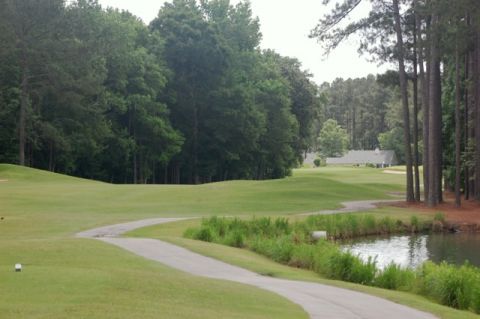
Off the tee, the fairway at the par 5 5th hole at Emerald appears narrower than it is, with woods on both sides.
If I play Emerald again, I will move back one tee box, from the blue tees -– at 6,123 yards and rating/slope of 70.2/126 –- to black at 6,483/71.7/129. It was tough to miss the wide fairways, even on slightly sprayed drives, and the large greens were easily accessible to all but the sloppiest approaches from the 150-yard markers and closer. After a morning rain, the course was virtually empty, and I was able to play the round, which included 150 photos and 78 strokes, in a leisurely 3½ hours. I noted a few hiccups out on the course -– the cart paths are in need of significant repair and the pin on #6 was in the far back, not in the middle as indicated on the pin position chart. But the friendly service at the snack bar and in the pro shop more than made up for those small lapses.
In fact, when I asked about a senior rate, club professional Catie Camacho said they didn’t have one but added that she would be “pleased to offer you a discounted rate of $40.” That was about 1/3 off the rack rate. The discount was a lot steeper than the bunkers, which along with one of my best rounds of the last year, played quickly and quietly, helped make for a gem of a day at Emerald.
Note: Resale homes in the Greenbrier golf community range from $155,000 into the high six figures. The $155,000 home for sale is on the 7th hole of the Emerald golf course and includes free membership as well as lawn maintenance courtesy of the community’s property owner’s association…I will have more to say in this space and in the June edition of Home On The Course, our free newsletter, about the “near” coastal town of New Bern, as well as Carolina Colours, a golf community with an engaged group of residents and members.
To sign up for the newsletter, please click here.
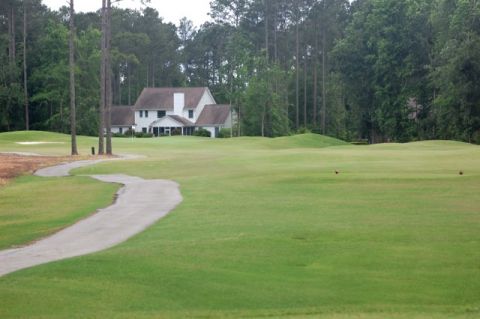
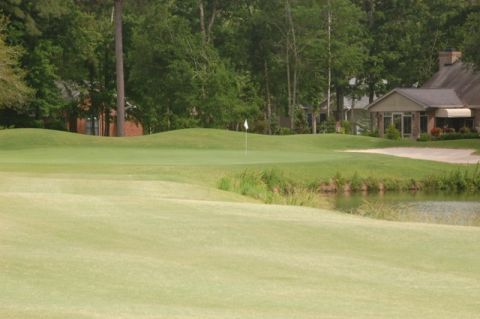
Above, homes along the Emerald golf course -- these are behind the green on the par 4 14th -- are vintage 1980s and '90s. Most sell in the $300,000 to $500,000 range. Below, the approach to the finishing hole is best made from the left side of the fairway.
Plenty in Reserve at Lake Keowee at the end of two couples’ searches for golf homes
Like life itself, the search for the perfect golf home often takes some unexpected turns. You should always have a plan and follow it when you are looking to invest hundreds of thousands of dollars but, as Yogi Berra once said, “If you come to a fork in the road, take it.”
Barry and Carol Hudson, most recently of Fayetteville, NC, learned the lessons of flexibility when they went searching for their perfect golf home. They knew they wanted to live in a golf community in the Carolinas, but they thought it would be on the coast. They went so far as to put in a bid on a home in the sprawling Dataw Island golf community after visiting 10 other golf communities in the Carolina Lowcountry. If their bid had been accepted, they might be living happily ever after in a marshland community that features two excellent golf courses by Tom Fazio and Arthur Hills. Instead, they find themselves a full five hours from the coast, on a beautiful lake in a community, The Reserve at Lake Keowee, with one fine Jack Nicklaus golf course.
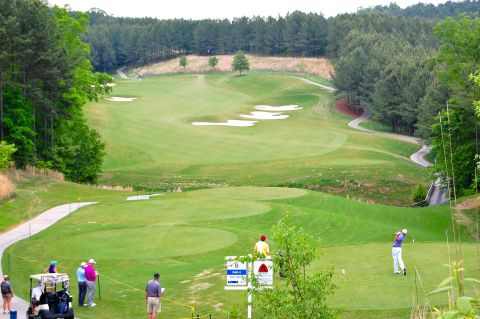
Competitors in the BMW Charity Pro-Am tee off on the 6th hole at The Reserve at Lake Keowee, one of three venues used on the first three days of the tournament. (The others are Greenville Country Club's Chanticleer course and Thornblade Club.)
Dick and Chris Bishop of Vienna, VA, just outside of Washington, D.C., had water on their minds, as well as mountains and good golf, when they began their search for a golf home, even though they were not boaters. “We just like to look at it [the water],” said Dick. There are dozens of golf communities that would have fit their ideal location, but as so often happens, friends who had purchased a property in The Reserve at Lake Keowee urged Dick and Chris to take a look there.
“We thought a golf course was the number one amenity we were after,” says Dick, “but when we found the perfect lot, that turned out to be our top amenity.” That lot, which has some of the best lake views in the community, has had a big beautiful house on it since 2008.
“We built it with our family in mind,” says Chris, referencing the three daughters, their husbands and nine grandchildren who visit at least once a year.
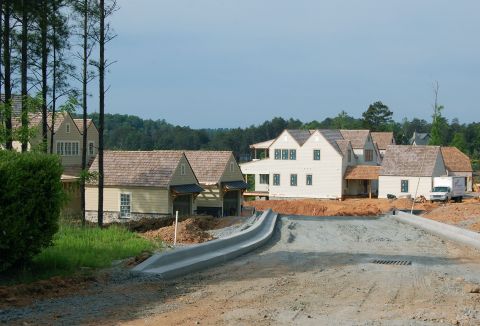
High-quality golf communities like The Reserve at Lake Keowee are seeing a resurgence of interest now that the economy is on more solid footing. Homes being built in the Village Point section, adjacent to the lake and Village center, start in the $600s.
When you talk with experienced golf home prospectors like these two couples, you understand that flexibility may be the most important characteristic in a golf home search. Both couples had lived suburban lives for decades, with plenty of services and conveniences nearby; and yet, they wound up in what, by most definitions, is a remote part of the South, Sunset, SC, a half hour from the town of Clemson and a full hour from Greenville. Such distances don’t lend themselves, say, to dinners out that include a couple of glasses of wine and then a drive along dark country roads. But you learn to make accommodations.
“If we know we are going out to dinner in Greenville,” said Dick Bishop, “we usually bring a designated driver along with us.” Grocery shopping also tends to be a communal exercise in a community like The Reserve; if the Bishops are heading to the supermarket in Easley, 20 minutes away, they’ll ask their neighbors if they need anything. The neighbors return the favor.
Carol Hudson confided that she would have been content to live in or near the city of Greenville itself; the Hudson’s son and wife and their young children live there.
“But it is so beautiful out here by the lake,” said Carol, “that I was convinced.” Both the Hudsons’ son and a daughter who lives in Oklahoma and visits once or twice a year have become “Legacy” golf club members who have all the club privileges of their parents without any additional dues payments.
“The Legacy membership is a nice benefit for our family,” says Barry.
Golf overall at The Reserve is a big deal, so much so that, despite what may seem a hassle at some other clubs was welcomed by most club members at The Reserve –- a professional golf tournament. Preparations by the PGA Tour closed the course for a week prior to the Web.com tour’s BMW Charity Pro-Am event last weekend, and then for the three days of the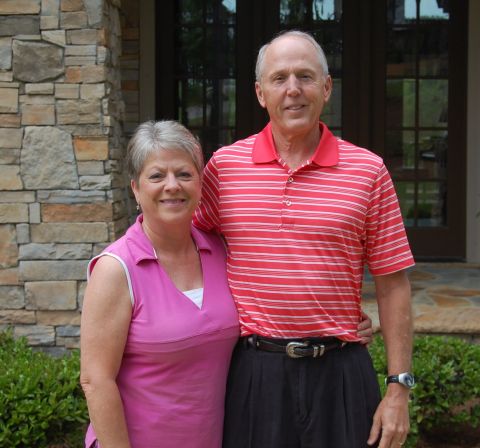 tournament itself, but few residents complained, according to the two couples.
“It’s a minor inconvenience,” said Barry Hudson, “but we are happy to have the tournament on our course.” (At 7,112 yards, The Reserve was the longest of the three in the tournament rotation. The course, which I’ve played, is no pushover, but suffice to say that the tournament winner finished 27 under par, most of those on the Thornblade Club course but 9 of them at The Reserve. Indeed, these guys are good.)
Dick and Chris Bishop not only welcomed the tour event, they also jumped right in to help run things at The Reserve. (The BMW Charity Pro-Am field plays the first three rounds on three different Greenville area golf courses, then at the Fazio-designed Thornblade Club for the fourth and final round.) Dick Bishop was named co-chairman of The Reserve’s part of the event and was glued to his golf cart for the three days, making sure things went smoothly. (They did.) More than 120 residents of The Reserve volunteered to be walking scorers, hole marshals, drive shuttle vans, serve food and drink and provide hospitality services for players and guests during the tournament.
“I loved to see the pros play the course I play every week,” said Dick.
Both couples supervised the building of their homes at The Reserve and tout the benefits of having things laid out just the way they wanted them.
“We were always going to build,” said Dick Bishop, who conceded that their project went smoothly in 2006, “and we enjoyed the process with the architect and builders.”
For the Hudsons, the process was not quite as smooth, with a number of “redos” necessary along the way, an issue that didn’t seem in retrospect to bother Barry too much.
“Carol wound up being the ‘foreman’ on the project,” he admitted.
New owners, experienced management put Carolina Colours in prime position
Prospective buyers love to see a golf community developer with deep pockets. A strong and steady backer, like Lord Baltimore Capital at Leland, NC’s Brunswick Forest, not only provides a sense of financial security but the extra cash the community can spend to market itself. That is a big reason why Brunswick Forest sales kept chugging along through the recession.
Catching up after a few glorious days of Lowcountry golf near Beaufort, SC
For those dedicated readers wondering why your correspondent has been missing in action for the past week or so, the excuse is that I have been in the Lowcountry of South Carolina for a few days of some of the best golf you can enjoy in the southeast. My Connecticut friend Larry, a former work colleague during our corporate lives, maintains a “national” membership at Secession Golf Club near Beaufort, SC (that’s the one pronounced “byooh-fert” as opposed to the town of the same name in North Carolina, which is pronounced “beau-fert”). Most of the more than 700 members of Secession hail from some distance, including other countries. (I heard a few Scottish brogues in the clubhouse bar.) But no members anywhere -– or guests for that matter -– are treated any better than at Secession, where a doting staff, excellently trained caddies (they are mandatory, no carts available) and golf professional Mike Harmon, straight out of central casting for gregarious old pro, are well in evidence.
LPGA in eclectic Virginia resort golf community this weekend
All blossoms should be in bloom this weekend in Williamsburg, VA, where the LPGA tour is making its annual spring visit to the Kingsmill Resort. The bustling golf community, which appeals both to vacationers, second-home owners and year-round residents, is ideally suited to host a professional tournament, given the amount of resort housing on site; the three excellent golf courses, including the River Course that was originally designed by Pete Dye in the 1970s, and then redesigned by Dye 10 years ago; and the built-in corps of volunteers who live around the golf courses.
Richmond golf community gets its fix
As we have noted here a few times before, smart money is on the prowl for quality golf courses with surrounding real estate potential. Golf communities are being seen as good investments not just by developers experienced in building and managing such developments, but also by deep-pocketed investment firms who look at all areas of investment and put their money where the opportunities seem best. The benefit to buyers is that home prices in a formerly “damaged” golf community are still low, but they won’t be for long once the owner invests in a meaningful and visible way.
Golf home lots to sell at online auction
Included in our mailbox last week was a flyer from Auction.com touting an upcoming online auction of lots in some very familiar golf communities in the Carolinas. Coincidentally, stuck among lots in the Cliffs Communities, The Reserve at Lake Keowee, and Bear Lake Reserve near Sylva, NC, were a couple of properties just 1½ miles from our Connecticut home.
The customers speak, and we thank them
The best way for an Internet-based service like ours to convince potential customers to become real customers is with testimonials from satisfied customers. We received a wonderful, unsolicited note last week from a customer who wrote us from her new home at The Landings, near Savannah, GA. She and her husband participated in our first couples “discovery” weekend 1½ years ago, enjoyed the golf, the food in the clubhouse and the general ambience of The Landings. With our assistance, they bought a beautiful golf home there last August and will take up residence full time once their home in upstate New York is sold.
“We feel that finding you, filling out your questionnaire, and talking with you was the best thing we did!!” she wrote. “Your knowledge and guidance was what we needed!”
We also helped an oil company executive and his wife last year purchase a lot at Bluffton, SC’s Berkeley Hall, home to two outstanding Tom Fazio golf courses.
“Thanks for lining us up with Tom [our Realtor in Bluffton] and his
Of course, the greatest compliment of all is to be referred by a satisfied customer to a friend or relative. “My brother Steve is interested in possibly purchasing a golf property in SW Florida,” wrote a customer we helped purchase a beautiful lot perched above the Jack Nicklaus golf course at Governors Club in Chapel Hill, NC. “I told him all about you and your service, and he is very interested in speaking with you. I took the liberty of giving him your office and cell phone number.”
That is a liberty we are always happy for our customers to take. If you would like an idea of which golf communities match up the best with your requirements, please fill out our online Golf Home Survey. There is no fee for our services and no obligation to purchase a property. And we will never share your personal information without your express permission. Click here for our questionnaire.
This is a great time to be looking for a golf home, as prices in many golf communities have hit bottom and are starting to rise. We look forward to assisting you.
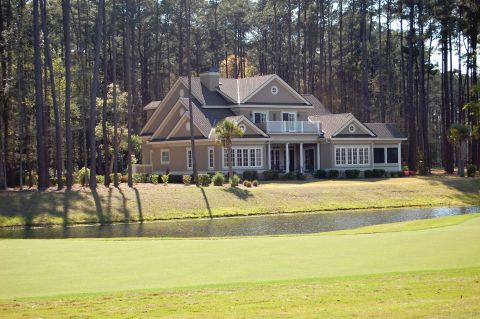
Last year, one of our customers purchased a lot like this one, with a view of one of the Tom Fazio golf courses as well as a lake at Berkeley Hall in Bluffton, SC. He and his wife are building their own dream home now.
Deep in the Heart of Taxes: The best tax situation for you
I read an interesting and accurate comment earlier today by a contributor to a discussion forum at TopRetirements.com. She wrote: “We are also looking at…South Carolina. The property in SC appears to be much less than FL as they only assess property at 4% of the market value. We compared a $220,000 home in SC to one in FL, and the difference is nearly $2,000. Has anyone else found this to be true?”
It’s a good question…and a good point. As we have counseled here many times, taxation is relative to a couple’s personal situation. If you have a million dollar income in retirement, a golf community in a no-income-tax
There are some scenarios in which a state with an income tax is cheaper to live in than a state with no income tax at all. According to the tax calculator at the web site dollarology.net, a couple with an annual income of $100,000, annual “non-food” expenses of $50,000, a grocery bill of $10,000 a year, a home worth $800,000 and a car driven 10,000 miles per year at 22 miles per gallon would pay a total of $8962.17 if they lived in Delaware, which assesses an income tax, and $9556.36 if they lived in Florida, which assesses no income tax. The Delaware couple would pay almost $6,500 more in state income tax, but that would be more than offset by lower sales taxes (Delaware does not charge any) and property taxes (much lower in “The First State”).
Interestingly, couples that live more modestly will find Florida slightly more advantageous than Delaware and most other states. (Since income would be lower, you would think the effects of income tax would be disproportionately less significant in Florida, but it is not so.) When you lower income to $60,000, non-food expenses to $30,000, groceries to $8,000 and the house value to $225,000, the result is an advantage of $55 per year in taxes for Florida over Delaware.
Yes, it is a negligible difference, and not enough in itself to turn a couple from considering a higher income tax state. Indeed, when you take our first example above –- the couple with a $100,000 annual income –-
By the way, the most advantageous tax state of all is Alaska. We understand the golf there is excellent -– in July.
Random Thoughts on a Spring Day
Market updates, Twitter style
Horton hears a future at Cobblestone Park
Contrarian’s view of Florida market
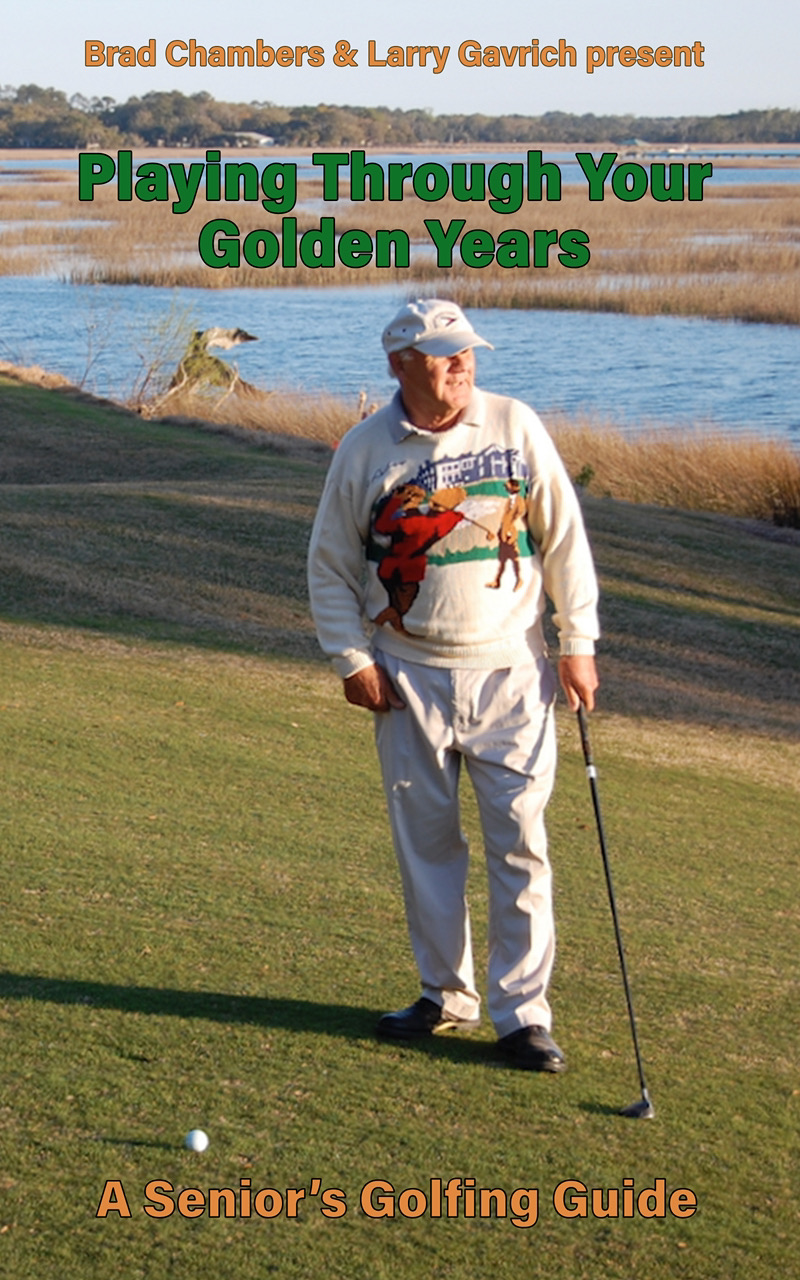
Now on Sale

- The only book about golf communities in the last 10 years.
- 156-page step-by-step guide to finding your dream golf home.
- Info on nearly 100 golf communities the author has visited.
- Paperback version costs less than a sleeve of Pro VIs.
Here is what the experts are saying:
“The book is chocked full of information…applicable to anyone looking for a move to the Southeast regardless of whether they are looking for a golf community or not.” — John LaFoy, golf architect (Linville Ridge CC, CC of Charleston, The Neuse GC)
“Larry has done a tremendous amount of work and anyone — like me — who is looking to search for a golf home now or in a few years needs this book.” — Brad Chambers, golf blogger, ShootingYourAge.com
“Wow! What a thorough piece of work…a must for anyone moving South. This book will help many people.” — Brett Miller, owner and founder of MMA, Inc, a golf industry consultancy
Buy It Now at Amazon.com or BarnesandNoble.com.