Why Live in Pinehurst...and Why Not
This week, the eyes of the golfing world have been on the Pinehurst Resort in the Sandhills of North Carolina. (Side brag: I picked Martin Kaymer to win the U.S. Open in my fantasy golf pool.) The USGA held its men's championship event last weekend and will conduct the women's event this weekend at Pinehurst #2, the iconic Donald Ross designed layout that was restored by the hottest golf architect firm today, (Bill) Coore & (Ben) Crenshaw, and is getting wide acclaim from pros, golfers and the general public. It looks terrific on television, that's for sure.
If you are looking for a break and mild introduction to National Golf Club's layout, forget
about it. From the start, Jack Nicklaus' design is a sculpted challenge. National Golf Club
was recently purchased by Pinehurst Resort and has become Pinehurst #9.
Golf is plentiful and excellent in the Pinehurst/Southern Pines area, some of the highest quality courses, and some of the most famous, on the east coast. The Pinehurst Resort now can boast nine courses in its rotation after it added a few months ago the National Golf Club just down the street, an established golf community we visited and reviewed here. (Click for our review of National Golf Club.) Blue-collar golfers with a zest for travel rave about the unforgettable Tobacco Road, just a half hour away and about as wild and exciting a layout as you will every play. Back closer to Pinehurst, Mid Pines, another Donald Ross classic, and Dormie Club, a new course by Coore & Crenshaw that adheres to old principles of design, help give visiting and local golfers more than a month of golf courses they can play without repeating a single one. For those serious about a golf retirement, there are myriad options in the Pinehurst area, both golf and real estate related.
 Home On The Course newsletter
Click here to sign up for our Free monthly newsletter, loaded with helpful information and observations about golf communities and their golf courses.
Harbor Club, alternative to Reynolds Plantation, debuts new home model
For those caught up in the glow –- and marketing power -– of Reynolds Plantation on Lake Oconee in Georgia, it is easy to ignore the 1,000-acre Harbor Club, less than five miles up and around the lake. But anyone visiting the wonderfully appointed Reynolds would be well advised to make a stop at Harbor Club, which may not boast six golf courses, multiple clubhouses, and an ownership the likes of Metropolitan Life Insurance, but then how many golf communities do?
Now, there is an additional reason to add that stop at Harbor Club to the Reynolds visit; a new model home of more than 3,000 square feet with an open floor plan popular with baby boomer retirees. The price of the spacious new model should prove popular, starting at $489,000. Dubbed The Pine Lake, the new home plan features three bedrooms, a two-car garage and some extra touches, such as arched windows and natural stone details on the foundation. An extra 800 square feet on the terrace level and 400 square feet upstairs can be finished off to provide another bedroom, media room or storage space. Prior to building, the dining room area can be redesigned as a study.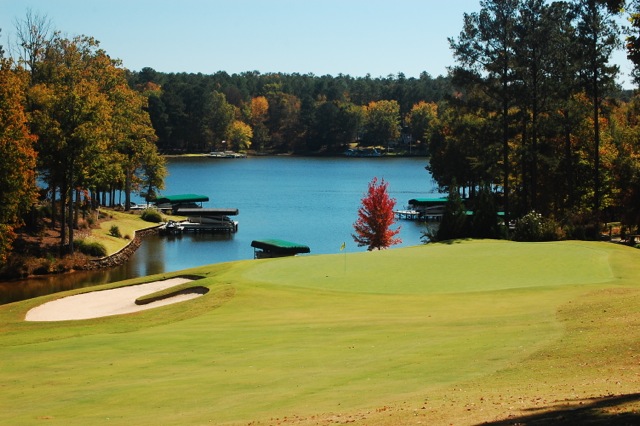
A good piece of the Weiskopf/Morrish golf course at Harbor Club bumps up against Lake Oconee.
A bit more than half the planned golf homes in Harbor Club have been built. Home sites start at a mere $20,000, with those with lake views priced correspondingly higher. Single-family homes start in the $200s and run into the millions for the best views down the lake. Harbor Club has a few townhomes as well, starting in the mid $100s.
The golf course, designed by Tom Weiskopf & Jay Morrish in 1991, is a honey and winds its way through the community and along parts of the lake. Although the golf club is semi-private and, therefore, open to the public, green fee rates are pretty high -- $105 at the peak morning hours –- and ensure the member's have full access.
Mindful that its golf community overlaps with Reynolds offerings, Harbor Club has been investing in improvements, including a new marina and boat storage facility on Lake Oconee and the opening of a new neighborhood of homes in April, which generated 63 sales over a single weekend. For more information on Harbor Club, or to arrange a visit to both Reynolds Plantation and Harbor Club, please contact us.
Footnote, especially for Yankees fans: Legendary baseball star Mickey Mantle was an active member at Harbor Club once his baseball playing days were over. Something of a shrine to The Mick occupies a small rotunda in the 15,000 square foot clubhouse.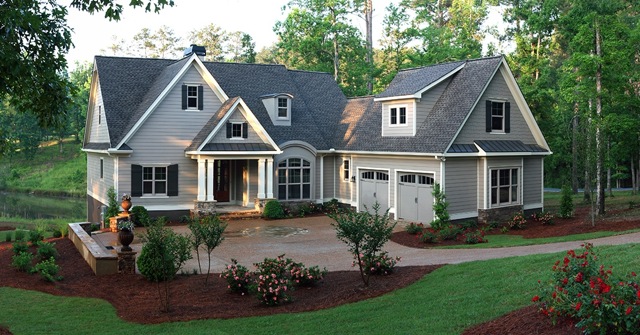
The Pine Lake model at Harbor Club is their newest, and starts at $489,000.
5 Things Not to Worry About in Your Golf Home Search
The thoughts of moving to a new location and spending hundreds of thousands of dollars to do it can cause stress and anxiety. There are plenty of things to worry about, such as costs of ownership that might not be apparent on first look; proximity to services you count on (supermarkets, medical facilities, a decent airport); and seemingly small things that might be especially important to you (e.g. easy access to the golf course, a men's or women's golf club). We can help you sort through these criteria; fill out our confidential Golf Home Survey, and we will provide you with some initial observations about which golf communities match up the best.
In the 10 years we have been working with people moving to a Southeast golf community, we have found that some people add unnecessary worries to their considerations, increasing the anxieties of the search. Here are five anxiety-producing questions that you should ignore as you do your research for your golf community home.
Will we make friends easily (or, "Are the people friendly there?")
Are you friendly? Then you will make friends in whatever golf community you move into. In general, the larger the community, the easier it is to make friends quickly because of the number of clubs and programs available and the opportunity to play golf with a wide variety of players of your own ability (through the men's or women's golf club). In virtually every one of the 150 or so golf communities we have visited, people hail from all over the country. They have faced the same issue you do, moving to a new place filled with "strangers." The residents you find in your new community have been through exactly what you have, and unless they are raging hypocrites (the vast majority are not), they will greet you with the understanding that comes from having had the same experience.
Is this community & house a good investment?
With apologies for answering a question with a question: Do you intend to live in your new golf community home for more than 10 years? Then, yes, it should be a good investment, assuming you have done your homework about the community itself and it is financially stable. (We can help with the homework.) But don't even think of the home you will live in as an investment. If you choose wisely, you will derive years and years of pleasure from your new home and community, which is payoff enough. When the time comes to move and you have made some money on your golf home, consider that a wonderful bonus.
June Newsletter: Investing for Retirement
The June edition of our free monthly newsletter, Home On The Course, will be emailed to hundreds of our subscribers shortly. If you are not yet a subscriber, now would be a good time to sign up. This month's issue features an overview of investing for retirement by Connecticut financial advisor John Ruocco that includes advice on how much income you should be taking from your retirement portfolio, as well as some thoughts about inflation and real estate. Since the theme of the issue is investment, your editor weighs in with a few thoughts about golf community properties that could very well appreciate in the coming few years. Also, in recognition of Forbes magazine naming Bluffton, SC, and Brevard, NC, among its top 25 Retirement Places for Retirees, we contribute a few words about the golf communities located nearby.
Speaking of investments, you won't find a better one than the Home On The Course newsletter, since it's free and loaded with information helpful to any couple searching for a golf community home. If you want proof, click here to check out our archived issues. Subscribe today. (Even if you sign-up after we send our newsletter, we will personally send you a copy of the June edition.)
Bay Creek Golf Community: Bad News Could Yield Good Buys
Investors in contrarian stocks typically react counter-intuitively to bad news. Bad news scares away the timid, less savvy investors. But bad news drives down prices and leaves the door open for the smart money to step in, take some calculated risks, and grab a bargain or two that will pay off in the future.
It can work the same way with golf communities. If Bay Creek golf community in historic Cape Charles, VA, were listed on the New York Stock Exchange, some analysts would be touting it as a good "contrarian" investment. The hallmarks of a contrarian play, say investment advisors, is that it have inherent positives but also some notable flaws. Some negative news just makes the investment even better for the counterintuitive. The par 3 4th hole on Bay Creek's Jack Nicklaus course has a links style air to it, with classic bunkering and the wide Chesapeake Bay behind looking for all the world like an ocean.
"Contrarians recognize future benefits that the crowd has so far ignored," says John Ruocco, a Connecticut-based financial manager whose advice we occasionally post in this space. "This could be due to a general slow market, as there is now in real estate, and also to the fact that a community [e.g. Bay Creek] might not be well known in real estate circles."
Golf Community Discovery Weekend/Greenville, SC
This is the first in a continuing series of weekend itineraries for those considering a golf community home in the southeastern U.S. If you would like us to develop a customized itinerary for you, please contact the editor.
No one southeastern city attracts more interest at our golf homes listing site than does Greenville, a sophisticated upstate South Carolina town whose economy took a lasting shot in the arm in 1994 with the opening of BMW's North American manufacturing plant in nearby Spartanburg. With an excellent regional airport, a bustling cultural scene anchored by the Peace Center in the city, good restaurants, higher-education options like Furman University, and a wide range of golf communities ringing the city –- and one excellent one with two top-notch golf courses inside the city limits –- Greenville deserves the attention it receives from those looking for the best combination of real estate and lifestyle.
Thursday afternoon: Assuming you are flying into Greenville/Spartanburg International airport -– flights arrive directly from 18 other airports –- pick up your clubs and bags, head to the car rental counter before proceeding to your hotel (plenty to choose among, contact us if you need a recommendation). Unwind from your flight with a stroll through downtown Greenville and along the Reedy River, debate over a craft beer or cocktail at Larkins on the River whether native son "Shoeless" Joe Jackson got a bum deal in the 1919 Black Sox scandal aftermath, and then stick around for dinner (or head to any of the other good choices within walking distance). Return to your hotel to rest up for your remaining three big days.

Gary Player's course for The Cliffs at Mountain Park features acres of strategically placed
sand. The Black Knight's golf design firm is located just off the course.
Friday: After breakfast, head toward the Cliffs at Mountain Park, a still developing high-end golf community where Gary Player has built a home and relocated his golf architecture design firm. Tour the evolving community with our local expert, Wanda Reed, who once worked for The Cliffs, and then tackle the unique Mountain Park golf course, where the Black Knight, Mr. Player's nickname, has used bedeviling starkly white bunkers to trap slightly errant golf balls. For a bit of a splurge, consider a drink and dinner at Hotel Domestique's Restaurant 17, adjacent to nearby Cliffs Valley; we especially like the sound of the Braised Short Ribs with Anson Mills brown rice, smoked onion peanut miso, Asian greens and braised daikon.
Saturday: The fresh air and elevation at Mountain Park helped you sleep soundly. That's good, because a long day awaits even though it begins with a short drive to the eclectic community of Green Valley. Unlike Mountain Park, where golf and real estate are superintended by the same development company, Green Valley is more a neighborhood that just happens to have a golf course adjacent to it. Homes run the gamut from small, tidy, old and relatively inexpensive to mansion-like, and priced that way. The Tom Jackson layout echoes the classics; Michael Kaplan, a local industrialist, purchased the club a few years ago and has thrown his heart and soul –- and a few million dollars –- into building a world-class private country club. After spending 18 holes with Kaplan, we are confident he has a good shot at it.

The par 3 3rd hole at Green Valley shows designer Tom Jackson's desire to create a classic
looking one-shot hole which reward a straight tee shot and punishes a slightly errant one.
Sunday: Start your day with a tour of the Pebble Creek community in Taylors, which puts you back close to the airport for your return flight. Pebble Creek spells economy all around –- in the prices of homes that span condos to larger single-families, the cheap cost to join two golf courses, and the relatively lower cost of living compared with your current northern lifestyle. Golf course designer Tom Jackson lives in the community, a telling sign that he is proud of the golf courses he fashioned there. If time permits, play on one of its two 18-hole golf courses (one public, one private, both available to members), possibly with club owner Lyn Young, a veteran golf club operator in the southeast.
If you can extend your visit by a day, we encourage a visit to Greenville Country Club, actually two golf clubs under one membership but separated by about three miles inside the city limits. The Chanticleer course, typically ranked in the top five of all courses in South Carolina, is magnificent and challenging and all about golf (no pool and tennis), surrounded mostly by homes priced beginning in the high six-figures. The Riverside course, redone totally about six years ago, is the more popular among members for its classic, Seth-Raynor-like routing and the expansive clubhouse and extra amenities for the entire family. Other golf community choices in the area include two Cliffs Communities -– Cliffs at Glassy and Cliffs Valley –- both among the most established Cliffs communities and offering among the lowest home prices of the group; and Thornblade Club in nearby Greer, with a Tom Fazio that is lovingly maintained by its members.
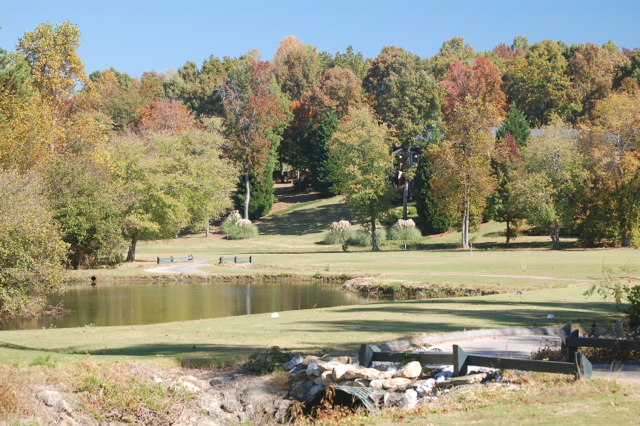
Pebble Creek features two 18 hole golf courses by Tom Jackson, who lives in the community.
The dogleg par 4 13th promotes a risk/reward tee ball over a large pond on the private
Linkside layout. The Creekside golf course is open to the public; members can play both
layouts for zero green fees, and the initiation fees and dues are quite reasonably priced --
as is the surrounding real estate.
Total Travel Time Among Communities: 1½ hours
Click here for map
Cliffs at Mountain Park
Home sites from $170,000
Homes from $390,000 (townhome) and $1 million (single family)
18 holes by Gary Player
Green Valley
Home sites limited
Homes from $499,000
18 holes by Tom Jackson
Pebble Creek
Home sites limited
Town homes from $140,000
Single-family homes from $165,000
36 holes by Tom Jackson
Greenville Country Club
Home sites limited
Town homes from $399,900
Single-family homes from $439,000
36 holes by R. T. Jones and W. Langford/B. Silva
Cliffs at Glassy
Home sites from $69,000
Homes from $425,000
18 holes by Tom Jackson
Cliffs Valley
Home sites from $199,900
Homes from $549,000
18 holes by Ben Wright
Thornblade Club
Home sites limited
Homes from $490,000
18 holes by Tom Fazio
If you are interested in exploring Greenville or any other golf-community-rich area of the South, please contact us for assistance.
"Worst" States Share One Thing In Common
We happened upon a couple of lists recently that were both titled, more or less, "Worst states for retirees." The two lists –- from MoneyRates.com and TopRetirements.com -– used entirely different methodologies but were awfully consistent in their results. Half of the states in each top 10 list were the same –- Illinois, New York, Massachusetts, Ohio and Rhode Island. But more to the point, virtually all the states that made the list were northern states; just California and Nevada, which appear only on the Top Retirements list, are not classic cold winter weather northern states.
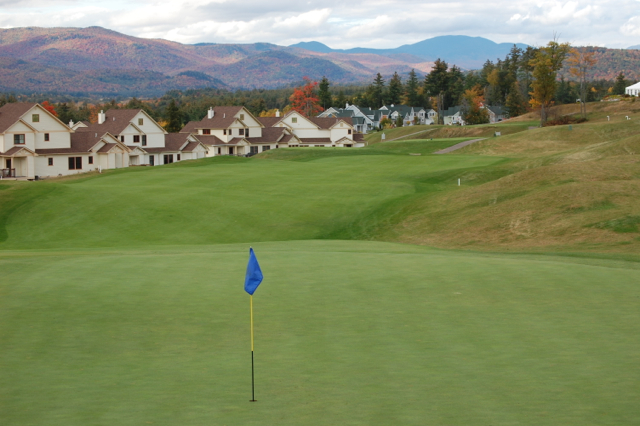 Owls Nest, a fine golf and ski resort in New Hampshire, could be one of many reasons state residents say they would never move to another state.
It is getting more and more popular for people to bash states north of the Mason-Dixon line as expensive, crowded and increasingly inhospitable in a number of ways. Indeed, my hometown newspaper, the Hartford Courant, has been fielding animated letters to the editor ever since they posted the results of a Gallup survey indicating almost half (49%) of Connecticut residents would rather live elsewhere, topped only by Illinois residents, exactly half of whom would cut and run from their state if given the chance. (Illinois is in the 4th position on the Money Rates list and the top dog -– i.e. "the worst" –- on the Top Retirements list; Connecticut ranks 9th on the Top Retirements list.)
But lest we consider that the migration from north to south by baby boomers is either a reflection of antipathy toward the north and/or a strong preference for southern living, the Gallup poll found that the states with the highest percentage of residents who would not leave for another state were virtually all in....WAIT FOR IT... the North (except for Hawaii). Fewer than a quarter of those who live in Montana, Maine, Oregon and New Hampshire said they would leave their states if they had the chance.
What does this all mean? For one thing, it seems to indicate that cost of living is not an indicator of happiness with a state. After all, Hawaii is about the most expensive state to live in the nation. And as Hartford Courant columnist Dan Haar wrote recently, "when we look at the actual numbers of people uprooting from Connecticut to other states, New York [on both worst-state lists] is by far the biggest destination. And get this news bulletin: They're not moving to low-cost Utica or Syracuse." New York City, certainly among the most expensive places to buy or rent a home, is the magnet.
The lack of any southern state on either worst state list could reflect the fact that the southern states have so many recent transplants living there that people are straddling the fence until they have a few years of residence behind them before having an opinion. Or it could indicate native southerners don't have strong opinions about their states, one way or the other, or have no perception that other states are any better...or worse.
Here at GolfCommunityReviews, we focus most of our attention on golf communities in the south. But if, for family reasons or regional loyalty or because you like playing golf wearing two gloves and a ski jacket, you prefer a golf community in, say New Hampshire, we have an app for that. Contact us and we can provide you with a few examples of fine golf communities north of the Mason-Dixon Line. But if you prefer to spend next winter wearing a golf shirt and, at worst, a light sweater on the golf course, we have dozens of suggestions for you. Contact us.
Paradise Lost: Some "guaranteed" investments are not sure things
by John Ruocco
This is the first in a series of articles by John Ruocco, a Connecticut-based financial advisor.
Retirement havens like Florida are a paradise for financial advisors. The investment industry has designed many programs to assure people, especially retired people, that they won't lose their money. Investment professionals know that fear is a great motivator, and retirees fear running out of money. And because financial advisors are looking for an audience and most people are looking for a free lunch, advisors touting guarantees that you won't lose your money are everywhere retirees are. But are "guarantees" really a financial paradise for older investors?
Safest: U.S. Government Guarantees
The U.S. government borrows money by issuing treasury notes, bills and bonds. These are just names of loans with different maturities. We now have some 17 trillion dollars in these treasury debt securities outstanding. The repayment of the principal and interest to lenders of this debt (individuals, institutions and foreign governments) is backed by the full faith and credit of the U.S. government (aka you and me, U.S. taxpayers). Since the U.S. government has never defaulted on its debt, U.S. Treasury debt is the most trusted and secure form
Mostly Safe: Bank Guarantees
A certificate of deposit (CD) issued by an FDIC insured bank is the second safest investment for the average investor, but the reality is that there are some limits. One is simply the amount of money in the insurance fund backing these bank deposits. This fund was never fully drained but we came extremely close in 2008. At that time there was some discussion as to whether or not the Federal Government would back the banks after the FDIC ran out of money. Fortunately, we didn't get that far. Another consideration is that investors must
CD rates compare favorable with U.S. Treasury yields, but not by much. The recent 1-year yields were around 1% and the 10-year rate was just over 3%.
Taking on Risk
Anything other than a U.S. Treasury debt or an FDIC certificate of deposit carries some element of risk. A corporate bond from IBM or General Motors is only as good as the corporation issuing it. An insurance product such as an annuity is only as good as the insurance company backing it. Anyone who tells you his investment is guaranteed is forgetting something.
Don't worry, be happy, regardless of state income tax
There is an interesting discussion going on at TopRetirements.com about which places are best for retirement (not just golf communities but all communities). Some participating in the discussion have clearly done their homework and have thought deeply about what issues are important in searching for a home and which issues might be best ignored.
One participant, for example, looked at dozens of communities in the southeast before buying a property at Dataw Island "because the grounds are pristine, no unsightly junk anywhere, all of the common areas are beautifully maintained, all houses are reviewed by a board of residents to make sure that setbacks are met...to maintain privacy and a common standard of maintenance of properties. The homeowners own the community and the clubhouse and all amenities, so all decisions are made by elected residents, often with votes of the whole community."
Another participant weighed in on one of my top bugaboos, the obsession of some golf home seekers to focus on no-income-tax states.
"I'm not sure why NH is on the list as a best place. Don't get me wrong, it's a great state, been here for a little over 30 years. But it is not a state to retire in. Sure there is no state income tax or sales tax. But when retired, income is usually less and you're not buying big ticket items. The property tax can kill someone on a fixed income.
"We're in the process of moving to Shallotte, NC," he continued, "where Brunswick County is one of the fastest growing counties in the country. Our property tax will go from 7K to 2K. I'm sure that will easily account for any income or sales tax additions we make."
We work with top real estate professionals in Brunswick County, Dataw Island and dozens of other top golf community destinations in the southeast. If you would like more information about the top golf communities in the southeast, please contact us.
Out With The Old? Some developers push dirt over re-sale homes
"People aren't stupid." That was what my wife said to me during a recent discussion about competition between a Walmart supermarket and the Whole Foods store across the street near our Connecticut home. Most of my wife's friends, careful shoppers all, had stopped at the Walmart for its perceived deep discounts on foodstuffs and found that, almost across the board, Walmart was more expensive than Whole Foods. The assumption on my wife's and her friends' part was that Walmart thought they could slip a fast one by those used to paying premium prices for their groceries at Whole Foods. But people aren't stupid.
It reminded me of a discussion I had recently with the sales manager at a well-respected golf community in South Carolina. My customers told me after they visited the community that they felt "steered" away from resale homes and toward
A week ahead with A. W. Tillinghast

Now on Sale

- The only book about golf communities in the last 10 years.
- 156-page step-by-step guide to finding your dream golf home.
- Info on nearly 100 golf communities the author has visited.
- Paperback version costs less than a sleeve of Pro VIs.
Here is what the experts are saying:
“The book is chocked full of information…applicable to anyone looking for a move to the Southeast regardless of whether they are looking for a golf community or not.” — John LaFoy, golf architect (Linville Ridge CC, CC of Charleston, The Neuse GC)
“Larry has done a tremendous amount of work and anyone — like me — who is looking to search for a golf home now or in a few years needs this book.” — Brad Chambers, golf blogger, ShootingYourAge.com
“Wow! What a thorough piece of work…a must for anyone moving South. This book will help many people.” — Brett Miller, owner and founder of MMA, Inc, a golf industry consultancy
Buy It Now at Amazon.com or BarnesandNoble.com.