On Daufuskie, you can't eat atmosphere
Our friends at Golf Vacation Insider visited Daufuskie Island, SC, recently and report in their latest email, and on their web site, that the food service at the local resort left a little to be desired. That's too bad, because when I visited over a year ago, everything seemed to be buttoned up. The golf was especially impressive; I enjoyed my round at the Jack Nicklaus designed Melrose Course (I didn't play the second resort course, Bloody Point). My breakfast in the main dining room was okay but certainly did not match the view out to the Calibogue Sound. You can read the GolfVactionInsider report at GolfVacationInsider.com .
For those special few who consider it an adventure to live on an island reached only by ferry, Daufuskie offers an alternative to the Daufuskie Island Resort. Haig Point is a small enclave of homes and a 27 hole Rees Jones layout that runs through the marsh and, for a few holes, along the Calibogue Sound. You can see Hilton Head and the lighthouse at Harbour Town across the sound. Lots and homes at Haig Point are reasonably priced, but fees for golf and beach membership are comparatively high, and homeowner dues are high as well (the owners subsidize the ferry to Hilton Head, which runs frequently). If you are interested in visiting Haig Point and Daufuskie Island, let us know. We have some excellent real estate contacts there.
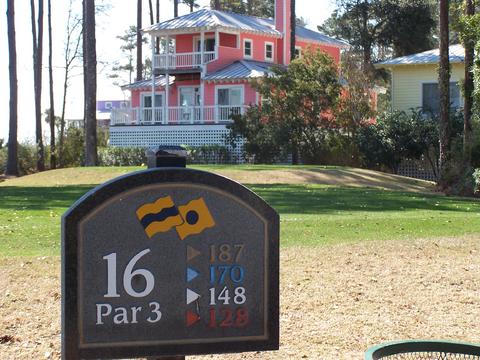
Serve yourself: If you live at the Daufuskie Island Resort, you can skip the capricious schedule in the resort's clubhouse.
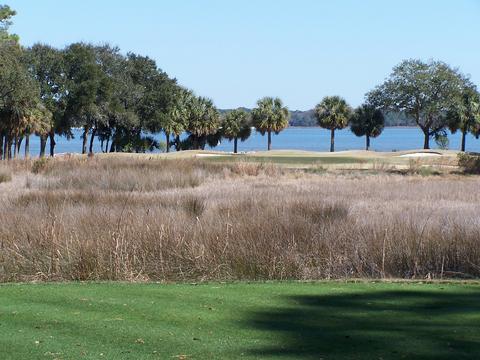
Marsh, sand and the Calibogue form beautiful framework at Haig Point.
 Home On The Course newsletter
Click here to sign up for our Free monthly newsletter, loaded with helpful information and observations about golf communities and their golf courses.
Worthless forecasts
If your local weatherman forecasted sunny days for five days running, and it rained on every one of them, you would start carrying an umbrella, no matter how rosy the forecast. Then if he started forecasting light rain, you'd probably carry a bigger, stronger umbrella and wear a rain suit. You'd expect the worst.
The forecasts by National Association of Realtors economists are consistently all wet. Month after month they make the wrong call on the pace of existing home sales, then they revise and - wrong again - revise yet another time. Yesterday the group amended its prior month's prediction of a 2.2 percent drop in existing home sales for this year; they now are expecting a 4.6 percent drop. In terms of new home sales forecasts, the NAR amended its forecast from a 14.2 percent drop to 18.2 percent. It is a good thing for NAR members that, like politics, real estate sales are essentially local, and that they can ignore their own trade organization's misleading predictions.
The NAR also predicted yesterday that the median price for existing homes will drop 1.3 percent this year, almost double their .7 percent forecast in April. In the grand tradition of NAR's recently departed chief economist, David Lereah, winner of our Pollyanna Award for consistently wrong and overly optimistic guessing on the housing market, NAR Senior Economist Lawrence Yum said yesterday that sales of homes in lower-priced markets have been stronger, which dragged down median prices; he expects this "temporary distortion" to be neutralized by next year, when he calls for a 1.7 increase in median prices. Keep your galoshes on.
Footnote: All real estate is local, and the southeastern markets are still holding up pretty well, especially homes adjacent to or near a golf course. Our oft-repeated advice if you are considering a relocation from north to south - or from the UK to the U.S., for that matter - is to compare sales data in your market with sales data in the market you might want to move to, and check the spread. Our radar says the northern markets will take longer to regain their footing than the southern markets, and the spread between them may never be as narrow as it is now. Depending on your personal circumstances, you may not want to hold out for the best possible price on your primary home. You might get it eventually, but the price of the next home you want could have appreciated faster.
Tell me where to go
I'll be planning visits soon for the rest of the summer and into the fall. I have a few places in mind - The Texas Hill Country between Austin and San Antonio; the Gulf Coast area around Mobile, AL; the Blue Ridge Mountains and the areas of Cashiers and Brevard, NC; Reynolds Plantation in Georgia (enough golf to keep one occupied for a week); and Santa Fe, NM.
If you have a favorite choice among these or have another area in mind, let me know and I will do my best to get there to cover it in depth in the HomeOnTheCourse Community Guide. At the very least, I will do research on the area and post my thoughts here.
In Jacksonville, you can have your golf and eat well too
My wife and I often talk about a retirement that would have us in two homes - one in a city with entertainment, culture and restaurant options within walking distance, and the other in a golf course community where the course and clubhouse could also be reached by a walk or short drive.
LandMar, the development company headquartered in Jacksonville, FL, must be mind readers. The company just announced a golfing incentive for residents of their Shipyards complex along the river in downtown Jacksonville. For those who purchase at Shipyards' first tower, which is currently under construction, the company is offering free membership at its North Hampton course, an Arnold Palmer design that is the best of the King's courses that I have played (Note: We review it and other golf course communities north of Jacksonville in the current June issue of the HomeOnTheCourse Community Guide).
By joining Shipyards' "InnerCircle," residents of the high-rise condominium will receive membership without the customary $6,000 initiation fee. And because the course is just outside the 30-mile limit that defines non-resident dues status, Shipyards residents will pay reduced monthly dues. In addition, members will enjoy reciprocal golfing privileges at Landmar's seven other courses within 45 minutes of Jacksonville, an attractive feature of all LandMar course memberships.
Shipyards offers homes that range from 800 square feet to 3,900 square feet in one, two and three-bedroom configurations at prices from the $300s into the millions. Hotels and retail establishments are also planned for the complex.
Buffet of communities' amenities look great until you have to pay for them
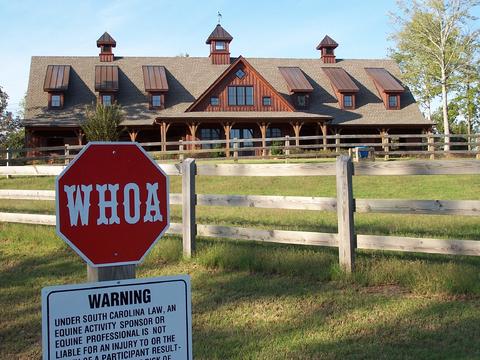
Non-equestrian golfers might want to stop and ask who will pay eventually for equestrian centers in communities like this one at The Cliffs at Keowee Vineyards.
I like horses, especially at Kentucky Derby time. I would not mind living in a community with horses. When I toured Mount Vintage Plantation in Aiken, SC, last year, the sight of the stallions behind the white fences in someone's front yard was picture postcard perfect.
I have nothing against physical fitness either, and admire those who jog, pump iron and work the treadmill on a regular basis. I am jealous of their discipline (and their lack of body fat).
In the push to be competitive, new golfing communities are loading up on the amenities, not just lavish equestrian and fitness centers, but also spas, swimming pools with waterfalls, full-time naturalists and marinas. This is great stuff, but raises some questions: How many amenities will you use on a regular basis? How much will they cost you (if not today then down the line)? And will the extras affect positively the value of your home when it comes time to sell?
If you are a fit-as-a-fiddle, three-day-week-golfer who rides horses another three days a week, works out four days as well and takes contemplative walks with the community's naturalist, then a place like The Cliffs Communities or one of the other amenities-loaded developments will have strong appeal. But, come on, how many of us have the time, dedication and discretionary assets to indulge in so many passions? If you are "just" a golfer, do you want to subsidize the activities of others in exchange for the prestige of living in a community with a wide range of activities?
Someone has to pay for the amenities. Initially it is the developer, who uses them as a lure to sell lots and homes. A wide range of amenities will appeal to the widest possible market of potential buyers. You can't blame them from a marketing standpoint and, certainly, no one minds sharing space at this point with those who have passions other than our own.
But someday the piper must be paid. Developers will turn over the community to the homeowners - it is required by state law in most places - and then comes the day of reckoning. In well-planned transitions, the owners know what to expect in terms of increased dues, and the process is relatively painless (but the dues always rise). But in other cases, sticker shock sets in, with some tough choices needing to be made about who pays for what and how much. Sometimes the alternatives are to turn the activity over to some outside manager who then charges an extra fee to use the facilities. Whatever the outcome, the discussion can pit golfers against horse lovers, boat owners and nature lovers. All those amenities that gave the community a certain cachet start to look like expensive luxuries.
The effect of the amenities on the value of your home is a tougher question. If you have faith in the wisdom and business acumen of developers, then you can count on the value of the amenities being built into the initial price of the home you buy in an amenities-loaded community. In that case you hope when it comes time to sell that some golf nut, horse nut or fitness nut interested in your house will be happy to pony up a price for the value of the amenities and won't be daunted by whatever the homeowner association dues are set at.
A few simple things to keep in mind when looking at property in one of these amenities-loaded communities:
Ask how the amenities are paid for. What is the history of dues increases for the homeowners? If the developer is subsidizing the amenities, what is the plan for turning them over to the homeowners or a management company? When will the turnover occur?
Golfers who don't want to subsidize the passions of others have a viable alternative that could shave a few hundred thousand dollars off their home price and a few hundred a month in dues. Consider purchasing a home that is not inside a gated or golfing community but is close to a good private or semi-private country club. Many of the nation's nicest country clubs are hungry for new members. I've visited and played some excellent private courses, including the Fazio-designed Thornblade Club in Greer, SC, a sleek layout set right in the middle of an unaffiliated community (pro golfer Jay Haas lives in a house overlooking the course). Homes run anywhere from about $400,000 for a condo overlooking the course to $1 million or more for a large single-family home.
Fox Den Country Club in Farragut, TN, near Knoxville, is set within a neighborhood of older homes that are quite reasonably priced. Fox Den is a classic that plays host to an annual Nationwide Tour event. So too does Rock Barn in Conover, NC, home of the Senior Tour's Greater Hickory Classic. Rock Barn offers two 18-hole courses, one by Robert Trent Jones, Jr, and the other by Tom Jackson, and membership confers use as well of the community's spa and health facilities.
One other option is to join a golf club that is inside a community without actually living in the community. Many in-community clubs offer non-resident golf memberships. Should you lose that $5 Nassau to a fellow member who happens to live inside the gates, you can hand over the money with a smile, content in the knowledge that you may have paid a lot less for your comparable home than he did.
Note: As a service to our readers, we would be happy to put you in touch with a real estate agent whom we have qualified as knowledgeable about golf course communtiies in these areas.
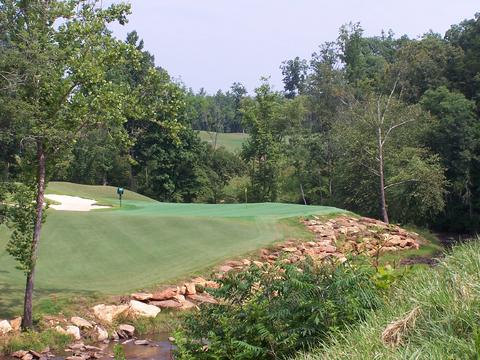
One of the two Rock Barn golf club courses sports plenty of rocks and typical Trent Jones, Jr. sand bunkers. The course plays host to a Senior PGA event.
Playing poorly but learning something
My friend and subscriber to HomeOnTheCourse, Bill Miller, and I are playing in our club's major member/member tournament this weekend. After losing our first nine hole match on Friday, we won the next two and started thinking good thoughts. Then yesterday we had bogeyitis in our first nine-hole match of the day and then lost the last hole of the second match to give our opponents a tie. We will be pretty much playing out the string in today's final two matches.
Yesterday was not a total loss. It never is when you learn something, and I learned two things related to rules during our first match against Bob and Jeff. On hole 15, the sixth of our match, since we played the back nine, Jeff took a practice swing from under a tree. His club nicked a branch, a single small leaf fell to the ground as a result, and he called a stroke penalty on himself. Later on the 17th hole, Bob hit Jeff's ball to the green, thinking it was his; Jeff did not stop him because he thought his ball was farther down the fairway, not realizing that was my partner Bill's provisional ball (Bill thought he had hit his second out of bounds but found he had not).
When I returned home last night, I did a little research. In the first case, Jeff actually called an unnecessary penalty on himself. Yes, Rule 13-2 indicates that you may not improve your lie by consciously removing leaves, branches or other indigenous growing things. But the rules of golf are subject to "decisions" that are made on the tough grey areas, and Ruling 13-2/22 points out cases in which accidentally knocking down leaves would not improve a player's lie and, therefore, no penalty would ensue. Jeff clearly had not intended to improve his lie, nor had he done so even unintentionally (What is one small leaf in a forest of them?). Jeff's honesty to a fault did not affect the outcome of our match; I just hope he didn't have any side action on his score.
In the other case in which Bob hit Jeff's ball, Bill and I were convinced the hole was ours by default (although winning the hole would not have affected the outcome, just the margin of the loss). For hitting the wrong ball, Bob was definitely out of the hole but, according to Rule 15-2, Jeff could replace his ball at the spot from which Bob hit it and proceed without penalty. The sins of one partner are not visited upon the other, although given the way I've played this weekend, Bill might argue with that.
Golf Community Review: RiverTowne offers chance to live where pros play
More and more communities are hosting professional golf tournaments. A couple of weeks ago, the massive Cliffs Communities hosted a Nationwide Tour event, the BMW Charities Pro-Am, at three of their courses. We've played courses at Rock Barn Golf Club in Hickory, NC, and Fox Den Country Club, outside of Knoxville, TN, that also play host to Nationwide events.
This weeknd, the RiverTowne Country Club in Mount Pleasant, SC, is getting its turn with an the LPGA event co-sponsored by The Ginn Company and Annika Sorenstam, who is just back from some time off to nurse an injury. We haven't played the Arnold Palmer course at RiverTowne, but we are familiar with Mount Pleasant, a bustling, rapidly growing town just north of Charleston. The immediate area has a nice collection of courses available for a daily fee, including the resort courses at Wild Dunes, the George Cobb designed Snee Farm, Willard Byrd's Patriot's Point and Rees Jones' Carolina National. The closest private club is Bull's Bay in Awendaw, designed by the late Mike Strantz whose firm is located nearby.
RiverTowne is a public access course as well, so anyone can play it, but only a relative few can walk to it from their homes. The Ginn Company, whose customarily high-end communities are spread throughout the southeast, built RiverTowne and offers a wide range of homes around the course and at RiverTowne on the Wando, the name of the local river. Preservation Row, for example, are attached units that start in price in the $220s. Single-family homes in both neighborhoods can run into seven figures for views of the river and/or golf course.
The main road through town and on the way to Charleston is Route 17, and our experience is that at certain times of day, and during the tourist season, things can get pretty clogged. Shopping centers line one side of the route, and a few of the communities line the other. But services and conveniences, restaurants and access to the great city of Charleston are neutralizing factors. The Charleston area is a great place to visit and, who knows, you may want to live there.
BestPlaces.net has some interesting data on Mount Pleasant if you would like more information.
Of unique communities, Mountain Air is up there

You just don't see this every day on a golf course, as you do at Mountain Air.
I won't easily forget the day I spent 18 months ago at Mountain Air near Burnsville, NC, just about 35 minutes northwest of Asheville. It isn't every day that you wait for an airplane to land before you can cross a runway to get from green to next tee. Or hit a six-iron 200 yards (assisted by thin air and about five stories of elevation). Or watch a plane set down not 60 yards away from your table at the 19th hole. Or drive your golf cart about a half-mile to the practice tee. This kind of experience at almost 5,000 feet is cool, literally and figuratively (about 15 degrees (F) cooler than down in Asheville on a July day).
The landing strip and golf course share the top of the mountain at Mountain Air. The course, by little known architect Scott Pool, is a roller coaster affair, with unusually small greens, some of them perched on the edge of the mountain. The golf is not for the faint of heart, but the views out along the Blue Ridge Mountains are dramatic and exhilarating.
The developers, the local Banks family, are adding another nine holes to the original 18, to be named the Banks Creek Nine. A new development of maintenance-free single-family homes, called Spring Rock, will look out over the new course. Each home will feature almost 2,600 square feet of living space and three or four bedrooms. Although prices were not available, we'd expect them to come in from the mid to high six figures. The community's Cabins at Creekside, slightly smaller detached single-family homes, run $400,000 to $650,000, and the Hawks Ledge Cottages, slightly larger, from $650,000 to $1 million.
Mountain Air has done a great job of situating home sites with commanding views. Not surprisingly, the community appeals to well-heeled professional and amateur pilots. It also employs a full-time naturalist to take club members on discovery walks amid the wide range of flora and fauna; I was  particularly impressed by the list of animals that local home owners had spotted, indicated on the blackboard outside the nature office.
On the busiest days of the summer season, a dozen planes might take off and land on the airstrip, triggering warning lights and alarms between the fifth green on one side and the sixth tee on the other side of the runway. Yet in the dead of winter, the mountaintop can be a little lonely with as few as 10 percent of owners staying on property, although the clubhouse will make special arrangements for those who desire the romance of a dinner by the fireplace; the club will even call in a chef for the evening.
For a pilot and/or naturalist and/or golfer, Mountain Air is high and mighty.
Note: The Mountain Air website isn't long on information, especially about the golf course, but they do offer to send a DVD if you are interested. Overnight stays in one of their mountain lodges is $199 per night which includes breakfast for two and the obligatory tour of the community's real estate offerings.
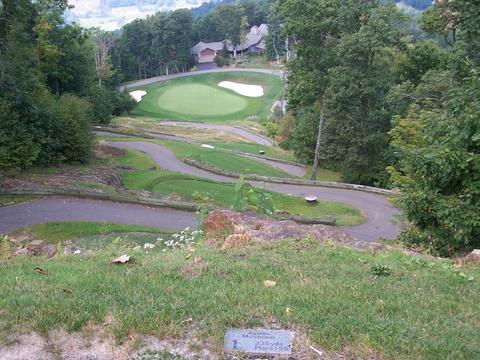
The plug at the tee box says "215 yards, Plays like 155." And it did.
High life, Low Country: Choice living, best golf on Grand Strand is south of Myrtle Beach
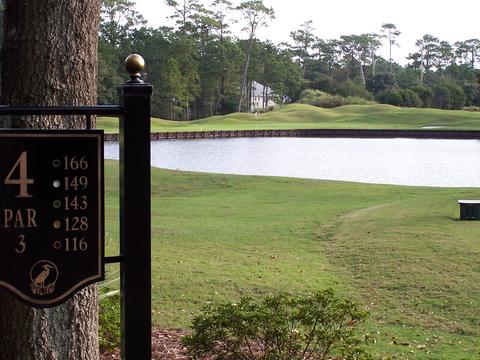
They may not be building more railroads, but Pete Dye is keeping the railroad tie manufacturers in business. He uses them to advantage at DeBordieu.
NOTE: A technical glitch sent this two part review past the front page of the site in the last two days and to the reviews section. We didn't intend that. For those who may have missed it, we include it here today (and the second part tomorrow) and apologize to others for any duplication.
They have torn down the locally famous boardwalk pavilion in the golf supermarket of Myrtle Beach. No more roller coasters, cotton candy and cheesy door prizes for knocking down a few bottles. But that's not quite enough to take the honky tonk out of the southeast's Coney Island. There is still plenty of neon both on the beach and off, but for thousands of golfers each week, it is a small price to pay.
If you are looking for a permanent place within striking distance of 120 golf courses, the best choice is 30 minutes south of Myrtle Beach, in the towns of Litchfield, Murrells Inlet or Pawleys Island. You will have easy access to the beach and the Intra-Coastal Waterway, and the collection of golf courses are consistently ranked among the best on the Grand Strand. So too are the restaurants; some rival those in foodie-town Charleston for quality and originality.
The best golf course communities on the South Strand are DeBordieu Colony, Pawleys Plantation, The Reserve at Litchfield Beach and Wachesaw Plantation, although there are numerous other choices to fit virtually every budget. DeBordieu, the farthest south, features a Pete Dye course and the most expensive homes in the area, owing to its location on the ocean. Homes facing the Atlantic have sold for upwards of $5 million, but just a few hundred yards inland, you can still find a single-family dwelling for under $1 million. The Dye course is not his most revered and, disappointingly, none of the holes approach the ocean (although you can hear it and  smell it, and the breezes make the otherwise open routing a bit of a challenge). But the links-style course stands in nice contrast to some of the parkland courses in the area. DeBordieu is just five miles from the charming old southern town of Georgetown, whose Rice Paddy restaurant, in an old bank building, is one of the best in the area.
Pawleys Plantation, the only one of the four communities whose golf course is not private, was opened in the late 1980s and is a good example of how a residential community can double as a quiet resort community. A nice mix of condominium units and single-family homes, Pawleys Plantation runs from Route 17 to the marsh that separates the mainland from the beach. Single-family homes rarely exceed $1 million, except for those with spectacular marsh views. Condos start around $300,000, but the best bargains might be the "patio" homes, set on just ¼ acre, which start in the mid $300s. From Jack Nicklaus' dramatic marsh holes on the back nine, you could see the ocean if it weren't for the three rows of houses on Pawleys Island, America's oldest beach resort community. But you can certainly feel the effects. The course is tough, long and necessitating high-entry approaches to the well-trapped greens. The short 13th hole, about 125 from the men's tees and virtually surrounded by marsh, may be a tougher challenge than #17 at Sawgrass. The green is tiny and hard, and when the wind blows and the tide is out, the intimidation is intensified by a view of hundreds of golf balls lying in the muddy bog below.
Coming tomorrow: The Reserve at Litchfield Beach (Greg Norman) and Wachesaw Plantation (Tom Fazio), as well as the fine array of daily fee courses on the South Strand.
We maintain an excellent network of real estate agents throughout the southern U.S. The are knowledgeable about all the golf course communities in their areas. One of our pre-qualified agents can help you cut through all the marketing hype and see any houses you want...at no cost or obligation to you. Contact us if we can help.
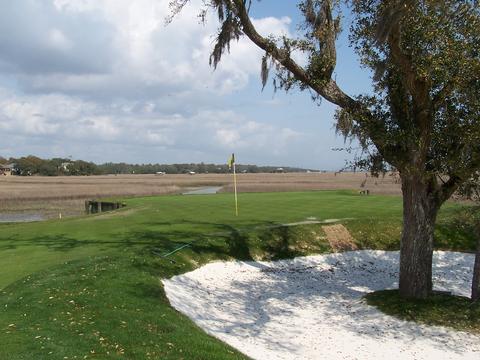
The short par 3 13th at Pawleys Plantation, with its tiny green, has ruined many a round.
Two provocative items in today's WSJ
The Wall Street Journal 's Personal Journal section today includes two front-page articles that should be of interest to readers of this site. One is about golf and one is about real estate. (Note: Full text of the articles is available only to subscribers).
Tara Parker-Pope, the editor of the paper's Health Journal column, has some sobering news and advice for those of us who play the game. Her contention is that our golf swings can tell us something about our overall health. What, for example, does an inconsistent swing tell you about your health? Parker-Pope's contention is that such a swing indicates we "lack strength in our 'core' muscles." These are the deeper muscles in places fundamental to a smooth, repeatable swing, such as thighs, hips and buttocks. What about accuracy issues? The problem, the author contends, may be a sign of looming neck arthritis and shoulder problems. I have both physical issues as well as the consequent misdirected hits. Indeed, in my younger days, I either drew or, when I mishit, pulled the ball. Now I spray right almost as often as I go left.
The accompanying chart, attributed to a 2006 Golfer Health Study commissioned by Golf Digest, comes to some depressing conclusions. Eight-percent of golfers suffer from pain, injury or illness; 27% have back pain; 66% are overweight; and 30% have played with a hangover. We really have to love the game to put ourselves through all that (the drinking aside).
The other Personal Journal article indicates that more and more young people -- those barely out of their 30s -- are purchasing second-homes in anticipation of using them as retirement homes later. Most of the examples highlight properties on lakes, and most of those are within a few hours driving distance of the young couples' primary homes and workplaces. In the more reasonably priced golfing communities we have visited in the southeast, we have noted that young couples -- some without children -- are buying their primary homes in golf course communities, and those who can afford it, are buying second homes a reasonable distance away, some with golf courses on site or nearby. This developing phenomenon could continue to help prices stabilize in the south even as they wobble in the north.
Find Your Spot does, and then again doesn't
Myrtle Beach's South Strand continued...
Graduation advice
Horses for courses

Now on Sale

- The only book about golf communities in the last 10 years.
- 156-page step-by-step guide to finding your dream golf home.
- Info on nearly 100 golf communities the author has visited.
- Paperback version costs less than a sleeve of Pro VIs.
Here is what the experts are saying:
“The book is chocked full of information…applicable to anyone looking for a move to the Southeast regardless of whether they are looking for a golf community or not.” — John LaFoy, golf architect (Linville Ridge CC, CC of Charleston, The Neuse GC)
“Larry has done a tremendous amount of work and anyone — like me — who is looking to search for a golf home now or in a few years needs this book.” — Brad Chambers, golf blogger, ShootingYourAge.com
“Wow! What a thorough piece of work…a must for anyone moving South. This book will help many people.” — Brett Miller, owner and founder of MMA, Inc, a golf industry consultancy
Buy It Now at Amazon.com or BarnesandNoble.com.