Foreclosure sales in golf course communities
Meadows BlackHawk Golf Community, Pflugerville, TX (Austin area), 3 BR, 2 BA, 1,673 square feet, 10 years old. On market for $152K "as is," expected to sell for as low as $140K at foreclosure auction. BlackHawk Golf Club is semi-private course designed by Charles Howard and Hollis Stacey; it plays 7,000 yards from the back tees. Full family golf membership is $1,375 annually. http://www.blackhawkgolf.com/
Hampton Creek Golf Community, Cumming, GA (northeast of Atlanta and near Lake Lanier), 4 BR, 4 ½ BA, square footage unspecified, seven years old. Bank owned and on the market for $289,900 (listed as "fixer upper"). The Hampton Golf Village was designed by Clyde Johnston; full family golf membership is $2,800 per year. http://www.hamptongolfvillage.net/
Bella Collina, Montverde, FL, waterfront/golf lot, size unspecified. "Pre-foreclosure" listing indicates owner purchased for $655,000 but is selling for $329,000. The Ginn Company's Bella Collina is a high-end golfing community, with a private Nick Faldo course, west of Orlando. Homes range well into the millions. http://www.bellacollina.com/golfcourse.aspx
 Home On The Course newsletter
Click here to sign up for our Free monthly newsletter, loaded with helpful information and observations about golf communities and their golf courses.
Your editor defends community golf courses
I've played some golf courses in residential communities that had greed written all over them. The houses alongside the fairways were close to the course, as well as close to each other, so much so that someone with a big slice or hook could expect the occasional gift bounce off vinyl siding back onto the course. Out of bounds stakes were an eyesore.
But that has been the exception rather than the rule on most courses I've played in the last two years. So I took a little umbrage at the hyperventilation of Brandon Tucker, a writer at the WorldGolf.com web site, who tried to make sweeping generalizations out of one or two experiences. I'll let you read it for yourself at WorldGolf's web site; my comments follow his article.
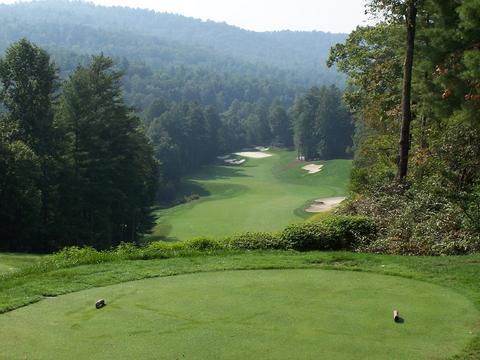
At Champion Hills in Hendersonville, NC, Tom Fazio used the dense forest to ensure houses were concealed well above the fairways he carved.
Developers had nice day on Wall Sreet
No one did better than the Bluegreen Corporation , whose one-day rise of 1.27 points (or 18.1%) to 8.29 per share was the 7th largest percentage increase of any stock selling for $2 or more on the New York Stock Exchange.
Lennar Corporation posted a decent gain, rising .94 to 30.96. The Del Webb organization, which specializes in age-restricted communities with appropriately designed golf courses, was flat yesterday, but as I write this today, their stock has opened up almost 8% today. It is always a fool's paradise to figure out what the "Street" is thinking, but investors must like some of the cost cutting going on in the industry, as well as the thought that maybe things will stabilize soon, baby boomers will be able to sell their homes in the north and continue the march south to their dream retirements.
I'm planning to profile some of the development companies in the future; the three mentioned above are all well regarded in real estate development circles. Last year, I visited Bluegreen's Chapel Ridge development in Chapel Hill, NC. The community was in its second year of operation, with a fair number of lots and homes available at the time. Prices were in the mid-six figures. The course was a nice Fred Couples design that wasn't too taxing but had enough trouble, in the form of streams and angled doglegs, to make you think a few times. The community seemed well suited to a mix of families and retired folks who want to take advantage of one of the most vibrant, university oriented towns in America.
Bluegreen's other golfing communities are located in Georgia and Texas. The organization also owns golf resorts across the country.
Blood in the water: Housing starts at decade-long low
I'm not an economist, nor do I play one at this web site. But I do own two homes and a piece of "unimproved" property, as well as a few shares of this and that company, and I suppose that gives me the right to offer some thoughts and whine a little. So here goes.
I wouldn't show one scintilla of mercy to those idiots who gave away free money in the form of sub-prime loans. Let them fend for themselves the way a potential seven million people who face foreclosure on their over-leveraged homes will have to (a prediction by the loud but savvy Wall Street sage, Jim Cramer). Ditto the equally dumb but exceedingly greedy hedge fund managers who bought and consolidated the dopey loans, and then fed the rotten paper to their customers. Greed is not good...
Read the feature on the Montes family of California in today's Wall Street Journal. Tired of renting an apartment, Mario and Leticia Montes signed on for a sub-prime loan two years ago for a $567,000 house in California. Their payments will rise ("reset") in December to $50,000 annually from $38,400 this year. The couple makes a combined $90,000 per year. They already had two car loans and a loan to pay for a daughter's education. What were their lenders thinking? What were the Montes' thinking? Yet there are tens of thousands of Montes' out there.
I don't know if the Federal Reserve lowering interest rates will re-stimulate the housing market, but instinct tells me no. It is too late for the Montes' and the others who were suckered by low interest and no down payment. The poison may just have to flow out of the patient for a while.
I have my own take on the unemployment numbers. As I have traveled through the southeastern U.S. and stopped to look at many homes under construction, Spanish is the dominant language at the sites, and I have always suspected that many of those workers were undocumented. As new home construction began its descent, the first ones laid off were undocumented, and so the official unemployment numbers were unaffected. But now as new construction grinds pretty much toward a halt, we can expect the unemployment numbers to escalate.
It is hard to see anything too positive in the near term, although in the housing market, like the stock market, pain often provides excellent buying opportunities. When we hear of some, we will pass them along...and hope you do the same.
Woods getting high in the Carolinas
Tiger Woods' first foray into golf course design is in the desert terrain of Dubai. His second one will present an entirely different challenge.
Yesterday, the world's best golfer confirmed that he will design a mountain layout for the Cliffs Communities at High Carolina, between Asheville, NC, and Greenville, SC. The course, which will be laid out especially for walkers, will sit at an elevation of 4,000 feet amid a community of homes priced well into the millions of dollars. Scheduled opening is sometime in 2010.
Tiger, who is chasing Jack Nicklaus' record 18 PGA victories in major tournaments, will have to do some catching up at the Cliffs as well, where Jack has his name on two courses. Other designers in the Cliffs portfolio of built and planned courses include Gary Player, Tom Fazio, Ben Wright and Tom Jackson, whose Cliffs at Glassy design is at about the same elevation as the property where Woods will work his magic.
Membership in one of the Cliffs courses confers membership in all. The current initiation fee is $125,000, with dues nearing $500 a month. The longest drive (car drive, that is) from the Cliffs at Walnut Cove (Nicklaus) to the Cliffs at Keowee Vineyard (Fazio) is about an hour.
Anything Tiger does stimulates interest in the golf world, and it will be interesting to see if his designs in Dubai and South Carolina reflect his own style of play the way Nicklaus' early designs did. The Nicklaus designs of the mid to late 1980s tend to force us commoners to hit high, Nicklaus-like approach shots to well-protected greens, as at the Melrose Course on Daufuskie Island, SC, and Pawleys Plantation in Pawleys Island, SC. In announcing the Cliffs venture, Tiger said he wants to design a course his "friends" would enjoy playing. Given the company he keeps, High Carolina should be tough.
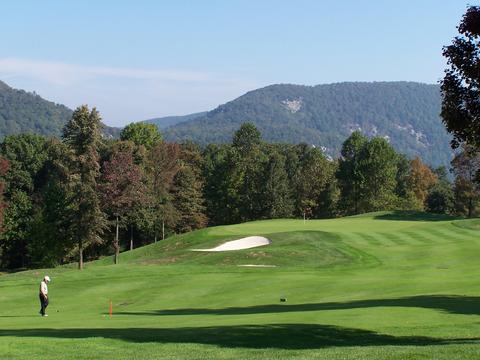
Tiger Woods' course for the Cliffs at High Carolina will be at an elevation similar to the nearby Cliffs at Glassy, an intriguing layout by Tom Jackson.
Money magazine's former "best places" still rate
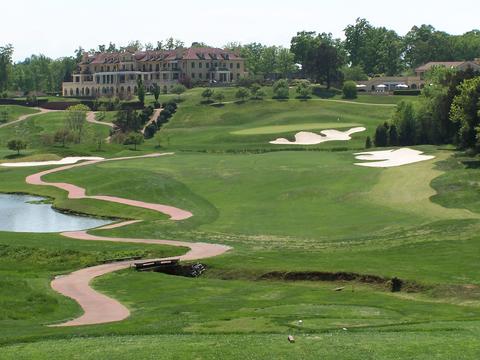
The central focus of the golf course and resort community at Keswick near Charlottesville, VA, is the imposing, 100-year-old mansion.
Money magazine features its new list of "Best Places to Live" in the current (August) issue. This year's best place is Middleton, WI, not exactly a hotbed of golf course communities but it seems like an ideal community in which to live in summer after wintering in southern Florida, for example. A sidebar article caught my attention; in it, the editors recall some of their former selections as "best places," and a couple of them I know fairly well.
Raleigh/Durham/Chapel Hill, N.C., for example, earned the best distinction in 1994. The area is a hotbed for engineers and other techies because of Research Triangle Park and ideal for those who want to be near a cluster of great universities, including Duke and North Carolina. The area also offers a wide variety of golf course communities. At the top of the list is Governor's Club, with 27 holes of Jack Nicklaus Signature golf, an involved membership, and beautifully manicured properties. Homes start in the mid six figures and rise to the millions, with many nice views of the golf course.
Less expensive but still close enough to Chapel Hill to take advantage of all the cultural and sports activities at the major universities are Chapel Ridge and The Preserve at Jordan Lake. Chapel Ridge includes a very playable Fred Couples designed course, featuring a number of challenging doglegs and large, undulating greens. The Preserve, like Chapel Ridge, features a nice balance of families with young children, empty nesters and retirees. House prices in both communities run from the mid- to upper-six figures.
For those interested in a new but classically appointed private club outside a community, Old Chatham Golf Club, which is focused entirely on golf, has received rave reviews. And there is always the sleek Robert Trent Jones course at Duke University, which is open to the public but is always in private-club condition.
Charlottesville, VA, was Money's best community in 1998, and its character also relies very much on a local university, in this case the University of Virginia, the invention of Thomas Jefferson. The town has become immensely popular largely because of a low tax rate and its setting at the foothills of the Blue Ridge Mountains; traffic and housing prices have increased signfiicantly in recent years, but that is pretty much the story in many hot towns in the south.
For those willing to play sweater weather golf two or three months a year, a nice array of communities are available. We liked Keswick for its opulent feel and imposing mansion/clubhouse on the hill overlooking an Arnold Palmer golf course; Glenmore for its Scottish-links-like course and well manicured community; Old Trail, where the recent film Evan Almighty was shot, for its fair pricing and small-town ethos; and Wintergreen, the mountain resort just 40 minutes out of town where, on a few days in January, you just might be able to ski in the morning and play golf in the afternoon.
And for a classic and historic golf club, get to know some local members who can vouch for you at the historic Farmington Golf Club. The course is a charmer and part of the clubhouse an original plantation home designed and built by Thomas Jefferson himself.
Couple living Florida community horror story
With a nod to Yogi Berra, yesterday I had one of those moments of déjà vu all over again (Yogi Berra, for our European readers, is a former baseball player known for such malaprops as, "No one goes to that restaurant anymore; it's too crowded.") On Sunday, I wrote about how some golf course operators are working with builders and developers to increase revenue for their golf operations. Afterwards, I met a 70-year old couple who are living a nightmare in a golf course community where the golf course owner and residents could not be farther apart.
Pat and Fred live in a condominium in Connecticut during the summer months but, like many retired couples in the northeast, spend the winter months in Florida, at a condo they own in Vero Beach. The condo has a nice view of the eighth green of the Vista Meadows Golf Club and is within five minutes of the ocean. Their community, which is called Vista Royale, is restricted to people 55 and older and offers a full range of activities on site. The couple love their neighborhood and neighbors, think Vero Beach is a great place to live and have been enthusiastic members of the Vista Meadows Golf Club.
Things changed three years ago after two hussies named Frances and Jeanne came to town. The hurricanes wreaked havoc in Vero Beach, the torrential rains they brought combining with extremely high temperatures to create black mold on the insides of many units. According to Pat and Fred, the interiors of some condos were so black that they appeared to have suffered fire damage. As if that wasn't bad enough, the insurance company that covered the community went belly up. Of necessity, the state of Florida had to step in but is still trying to figure out how to deal with insurance coverage for Vero Beach and other places affected by the hurricanes. The insurance checks have not come close to meeting the reconstruction costs.
In the last three years, some of Vista Royale's residents have passed away or moved to nursing facilities. Many of their units have been on the market for well over a year. Currently, more than 300 of the community's 1,200 units are listed, a quantity that is depressing the values of all the units in the community. The company doing the mold removal work and other repairs has been overwhelmed by the magnitude of the work and has been fending off accusations of overcharging. Pat and Fred say they have paid $10,000 to have a wall of sheet rock torn down, mold removed, and the sheetrock replaced. To complicate matters, asbestos was found in the walls of some of the older units, requiring special, and of course more expensive, handling.
But the thing that seems to gall Pat and Fred and their fellow residents the most is the state of the golf course whose current owner, the residents accuse, is trying to force them into a rewrite of covenant restrictions to permit development of land adjacent to the course. The residents are resisting any change to the original covenant, even though Vero Beach has a height restriction on construction (just two stories) and, Fred and Pat acknowledge, any new units would not affect the views from existing condos.
Last year, according to the couple, the course was in exquisite shape, attracted lots of outside play, as well as member play, and everyone was happy. But for reasons unexplained to the residents, the owners of the course ran out of money and the mortgage holder foreclosed on the course, which was auctioned off last December for $2.8 million.
This year, the new owner has decided to test the resolve of the residents; he is keeping the lawn mowers in the tool shed, and the course has become overgrown and unsightly, according to letters written to local papers ("a cow pasture," one writer described it). The owner, a local lawyer, is also threatening to turn part of the clubhouse into an "arcade" for people from outside the community to play games of chance and win gift certificates offered by local retailers (casino gambling is not legal in Florida except on offshore boats). These arcades are popular throughout Florida, and Pat and Fred worry that their community will become host to a steady flood of "gamblers."
Vista Royale's owners had the opportunity to purchase the course two decades ago, but the golfers could not convince the non-golfers in their midst to ante up. Now, of course, the price will be a lot steeper, but the cost of doing nothing might be even higher as the values of Vista Royale's condos spiral downward in a glutted market. And with all the golf courses and condos in Florida to choose from, why would someone look at a unit next to a ratty looking golf course?
Our bet is that there will eventually be some accommodation that both sides of this ugly argument can agree to. One solution could be that the residents will make a generous offer to purchase the course and hire a management company to run it. That offer would have to be well north of the $3 million the owner has invested in the course already. The other, more reasonable alternative is for the residents to let the owner build homes along parts of the golf course as long as they meet certain architectural standards consistent with the rest of the community. Vista Royale's residents, many of them well past 60 years old, should not want to go into the tough business of supervising the running a golf course.
In the end, money will force a solution, as it almost always does. The course owner will get some return on his investment, and the residents' will be comforted that the values of their condos will be restored, and that they can once again play golf on their own course. We plan to follow this story to what we hope is a happy conclusion.
Trends
Mandatory memberships help courses survive
Some golf communities in the southeastern U.S. try to make membership in their golf clubs as enticing as possible, either through free or discounted initiation fees, or the ability to transfer membership from one homeowner to the next. Still, only an estimated 10 to 20 percent of those who live in a U.S. golf course community are golfing members of the adjacent club(s). That could change in coming years as the financial realities of running a golf club drive some operators toward innovative deals with local developers and builders.Last year the net number of golf courses in the U.S. decreased, as the overheated housing market - remember when? - was in full steam mode. Developers eager to take advantage of real estate demand waved some pretty enticing deals in front of strapped golf course owners. In Myrtle Beach alone, a dozen courses were closed to make way for condos and single-family homes.
It is expensive to operate a golf course unless you are a municipality that can build operating costs into the local tax burden. Operational costs are unpredictable year to year. On top of the costs of routine maintenance, which have been negatively affected by increased energy and labor costs, add the unpredictability of irrigation-stressing droughts, especially in the south, bug infestations, bad winters (in the north) and all the other vagaries of Mother Nature and fickle markets. Private golf course operator is not the most secure profession...
...unless you have enough dues paying members to ensure proper maintenance and financial viability. An article in the current (August) issue of Golf Business magazine, published by the Golf Course Owners Association of America, features a former past president of the PGA of America who now owns a golf course. He has developed a reasonable strategy to generate the kinds of profits that can support his club's facilities.
Will Mann, according the article, is partnering with local builders in the new community adjacent to his course, Cedar Forest Golf Club in Swepsonville, NC (Swepsonville is halfway between Greensboro and Chapel Hill). Home buyers in the community will be required to purchase at least a social membership, for $3,000 initially and $80 per month, which gives them access to the clubhouse, pool, tennis, dining room and other amenities. Those who want access to the club's exercise facilities will have to pay $5,000 and $175 per month. Full golf members, with access to everything, including the 1969 Ellis Maples/Ed Seay course, will pay $10,000 and $300 a month. More than likely, in the now topsy-turvy housing market, the builders will foot at least part of the initiation fees to help unload inventory.
Mann predicts that up to 50 percent of residents will eventually upgrade to full golf membership, enticed by the opportunity to transfer the membership with the eventual sale of their homes. Home prices in the neighborhood range from $450,000 to $1 million. Mann will start a $2 million upgrade to the course and club this fall, a clear indication of confidence in his model to generate ongoing revenue for Cedar Forest. Other golf course operators will be watching closely. For those of us contemplating purchase of a home in a golf course community in the coming years, this type of arrangement could offer extra negotiating power with developers or builders who want to move their stagnant inventory quickly.
Break Point: The value of private club membership in the intangibles
I must love my home course because, when I divide the number of rounds into the total dues I've paid this year, each of those eight rounds has cost me - gulp - more than $500. Stated another way, I could have played the Ocean Course at Kiawah Island this summer more than a dozen times for what I've paid in dues.
I was warned many years ago by a friend and fellow club member not ever to calculate the per-round costs of my private club membership. This was during a year when we had two toddlers at home and I felt guilty about leaving my wife Connie alone with the burden. I played only a handful of rounds at Hop Meadow that year. Dues, I figured then, would have paid for a few rounds at Pebble Beach, airfare included.
On more or less a fixed income over the last two years (subliminal message, please sign up for our HomeOnTheCourse community guide), I've taken to thinking more and more about the cost vs. usage equation of private club ownership. I've decided there certainly are intangibles that you can't put a price on but what they are worth is a purely personal calculation. The civilized approach to making a tee time, for example, is certainly worth something. The sense of ownership your fellow members feel will make it more than likely that pitch marks are fixed on the greens and divots replaced (or reseeded) in the fairways.
Your private course will be in better shape than the muni across town and is likely to have a board of directors that will hear your grievances about club management and even about fellow players who might not be treating the course and the club's facilities with due respect. There is also some comfort in seeing the same faces on the practice range and in the dining room time and again, assuming you have chosen a club with likable members. Your golf pro is more likely to be out on the practice range or green imparting free advice, or telling stories, than the pro at a public facility, who is likely anchored behind the desk in the pro shop. The list of intangibles goes on and on...
In the end, each of us will decide what exclusivity and the extra measure of "civility" and pride of place is worth. As you consider possible relocation to a golf course community with a private club inside the gates or nearby, have an idea of how often you are going to play, but also consider what value you put on the intangibles. Consider joining as a social member first, but make sure that golf privileges are available at that level, and check out how easy or difficult it will be to upgrade your membership if you find the club and course to your liking. You might also play a few rounds at the local semi-private courses, looking closely at whether ownership and golfers appear to have pride in the course. My over/under on course maintenance is two un-repaired pitch marks per green; more than two signals that boorish golfers play there, and fewer shows at least some modicum of respect for the course.
Most important, resolve before you join a private club that the pro rata costs of each round are beside the point. In that way, you will spare yourself the ugly calculation that you could have played at St. Andrews, or Ballybunion, or Whistling Straits instead.
The last two years...
In researching golf courses and the communities that surround them, I have been fortunate to play more than 1,350 holes of golf over the last two years. To ensure my objectivity, and lest anyone think I have an elaborate scam going, I paid for every round, often arguing with pro shop staff that had been instructed by their real estate counterparts to provide me with complimentary greens fees. My comments at this site and in the HomeOnTheCourse community guide are happily free of any marketing hype.
Overall, I have gotten my monies worth in these two years. I have played very few clunker courses, and some courses and golf holes have been memorable. Below are photos and short descriptions of some of the best holes I've encountered.
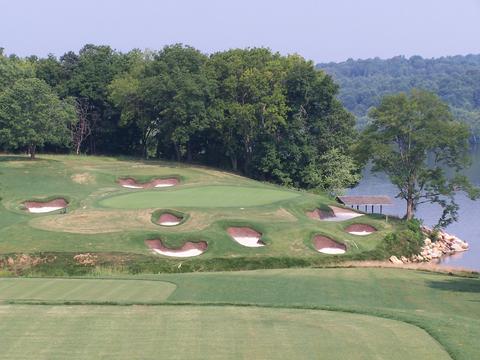
The signature par 3 12th at Tennessee National certainly is one of the best holes that Greg Norman has ever designed.
Some memorable holes in unforeseen places
The most memorable hole of my last two years on the road actually was one I did not play. The course at Tennessee National, a high-end community with lot prices in the mid six figures and about a half-hour from Knoxville, TN, was about two months short of being open for play, but it was clear that the Greg Norman layout had the makings of a classic. Its signature hole, as most signature holes are, is a par 3 that maximizes the twin features of water and sand. Wisely Norman and his fellow developers from the Medalist Company placed the tee box close to the main drive into the community. It is impossible to drive by without stopping for a look (and in my case, the photo above). Not surprisingly, the community's web site and promotional literature feature Mr. Norman about to strike his tee shot on the 12th toward the green below.
From the back tees, the hole plays downhill 209 yards, with the shorter tees playing to 187, 166, 142 and 123. Eight deep bunkers, with sod faces, surround the green, four of them pot sized and built into the face of the slope in front. Hit short, and you could fall back down the slope into a creek that feeds the Tennessee River, which runs along the entire right side and below the green. Any pushed tee shot will be lucky to find one of the two bunkers there; hit the slope between the bunkers, and you will be playing your third shot two club lengths from the water. The only bailout opportunity is to the slope left of the green, but that will necessitate an uphill pitch shot to the pin. In two years, I've seen no finer, or intimidating, par 3 than the #12 at Tennessee National. Norman's organization has a nice array of photos of Tennessee National and his other courses at www.shark.com .
I'd love to have another shot (literally) one day at the 17th at Tom Fazio's Keowee Vineyards course for The Cliffs Communities. A few years ago, the par 3 was the toughest hole on the Nationwide Tour in relation to par (closer to playing as a par 4 than a par 3). Although I had no business playing the hole from the tips, I had to try the 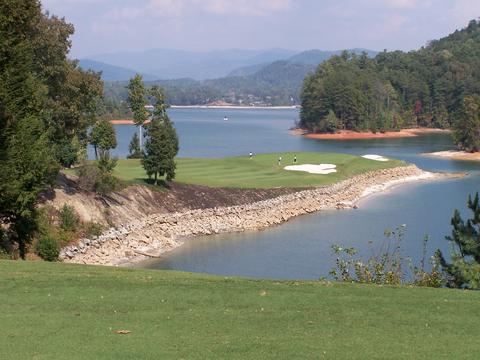 downhill shot to the green some 270 yards away (the elevation probably made it play about 250). I hit driver short and left of the green, away from the lake on the right, and considered myself lucky to be left with a 20-yard pitch to a pin that was front left. I made the putt from inside 10 feet for par but fought back the urge to sign up for the Nationwide Tour right then and there.
Another memorable hole was perhaps the quirkiest, a par 5 at Red Tail Mountain in Mountain City, TN, located between Boone, NC and Knoxville. The par 5 12th at Red Tail starts from a tee box framed by a chute of trees. A large hump runs 50 yards down the landing zone area in the fairway; anything on the left or right side of the fairway will continue in that direction and into the rough. It almost doesn't matter, since the next shot is a 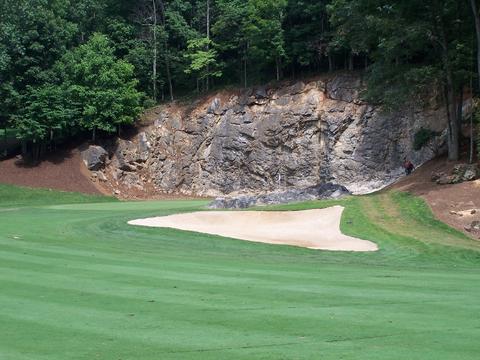 medium iron lay-up to the right angle of the fairway, just 100 yards from the green. Hit too far, and you wind up in a sand bunker at the elbow. Hit too short, and a tall, dense group of trees blocks your access to the most unusual green I encountered in two years (maybe ever). Guarding the right front of the putting surface is a large rock outcropping; hit it and you could wind up anywhere, including straight back in your direction. Behind the entire green is a rock wall about 30 feet high; it is an unreliable backstop as balls hit over the green bound in most directions other than onto the green. As you stand in the fairway awaiting your approach shot, you wonder what mad genius conceived the hole. (The answer? The typically mild mannered Dan Maples).
I played only one 9 hole layout in the last two years, during a visit with my son to look at the University of the South in Sewanee, TN. The Sewanee Golf Club course, which was built by faculty, students and local residents in 1915, traversed a hardscrabble, up and down routing that I found a bit of a trek on a cold February day. Sewanee was golf au naturel, with no more than a half dozen sand bunkers, but what it may have lacked in modern touches it more than made up for in its classic use of terrain. Few fairways were level, and Sewanee's small greens were all best approached by run up shots; the turf on the greens was almost as firm as that of the fairways (the course has no irrigation system). Two putts were a blessing on any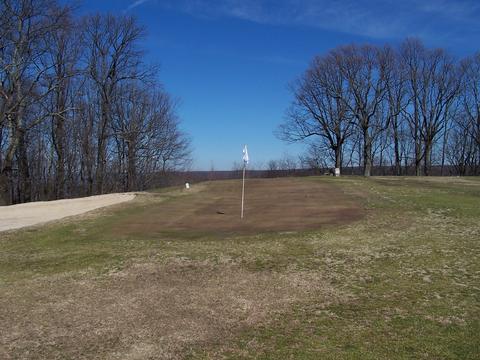 hole, none more than the unforgettable 4th, a 160-yard uphill par 3 to the narrowest green I had ever played, less than 20 feet across its front and not much wider at any other point. We were fortunate the pin was up front; the very back of the green was a mere four paces to the edge of the mountain. The only benefit to hitting the ball over the green would have been the breathtaking views of the valley below and the Smoky Mountains dead ahead. It was an unforgettable hole on a golf course that time has forgotten, but I won't.
The private, gated community of Mountain Air in Burnsville, NC, is a favorite of well-heeled pilots because an airstrip runs through it, and through the heart of the golf course as well. At more than 4,000 feet, there is plenty to distract the golfer's eye, but nothing more so than the sight of an airplane taking off below your tee box or beside the green you are putting on. The strip is not exactly in play, but a dramatically pushed or pulled drive on one of the adjacent holes could, ahem, really take off.
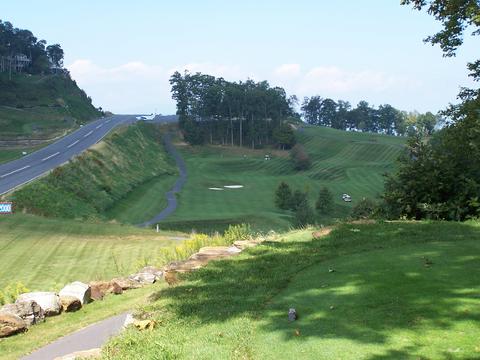
There is a fine line between quirky and dramatic along the runway at Mountain Air.
Tiger to burn bright in Carolinas?
Two years of observations
Random Shots
Moving Day

Now on Sale

- The only book about golf communities in the last 10 years.
- 156-page step-by-step guide to finding your dream golf home.
- Info on nearly 100 golf communities the author has visited.
- Paperback version costs less than a sleeve of Pro VIs.
Here is what the experts are saying:
“The book is chocked full of information…applicable to anyone looking for a move to the Southeast regardless of whether they are looking for a golf community or not.” — John LaFoy, golf architect (Linville Ridge CC, CC of Charleston, The Neuse GC)
“Larry has done a tremendous amount of work and anyone — like me — who is looking to search for a golf home now or in a few years needs this book.” — Brad Chambers, golf blogger, ShootingYourAge.com
“Wow! What a thorough piece of work…a must for anyone moving South. This book will help many people.” — Brett Miller, owner and founder of MMA, Inc, a golf industry consultancy
Buy It Now at Amazon.com or BarnesandNoble.com.