Golf Course Review: Rock Barn Golf Club, Hickory, NC
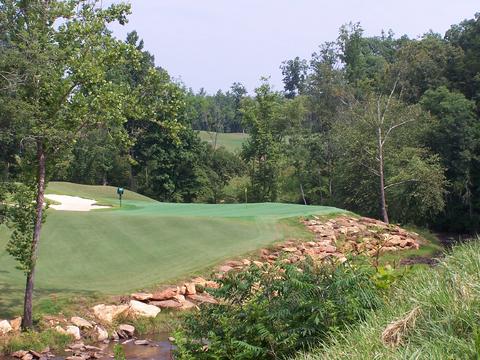
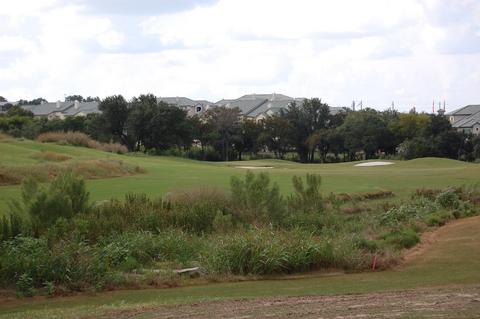
The 6th hole at Rock Barn, a long par 4, brings a creek into play in front of the green.
R.W. Eaks won the Champions Tour event at Rock Barn this past weekend. I had the opportunity to visit the community and play the course in 2006. Part of the experience was good, another part not so good.
First the bad. The woman in the real estate office blew me off after promising to be there to answer my questions and show me around. The receptionist greeted me with "Oh, she's not here, and she won't be coming back today." Since Hickory is fairly rural, about 90 minutes from Asheville, Winston-Salem and Charlotte, I was ticked off, but a round of golf on the Hickory, NC, course, which is open to the public, assuaged my anger.
I played the Robert Trent Jones Jr., 18 holes and left the shorter Tom Jackson course for another day. I liked the Jones course from the first hole which was what an opener should be, a fair driving hole where you can let out a little shaft if you want, clearing the bunker on the left for a mid iron approach. Choose the right side, and fairway bunkers come into play and you could be faced with a long iron over bunkers at greenside. Nice opener.
The risk reward formula was characteristic of the rest of the driving holes at Rock Barn, with fairway bunkers generally in play where approaches were shortest to the greens, but sometimes covering the edges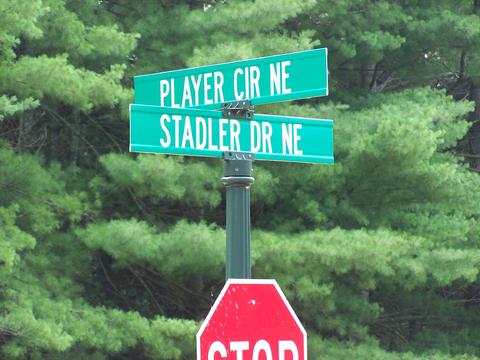 of the "safer" landing zones. Water, in the form of ponds and a stream that runs throughout a good part of the course, come into play on significantly offline shots and on a few of the par 5 approach shots. Overall, the most compelling featue of the well conditioned and beautifully designed classic course is the bunkering. Jones ran up the bill on sand, and to good visual and playable effects.
Rock Barn, whose homes are generally in the mid six-figure range with some impressive views of the golf course, also maintains a world class spa, as well as the customary amenities of country club living. But the place is serious about golf. Not only do they offer 36 holes of excellent golf, but also most of the street names honor legendary golfers. Now if they can only improve the sales office.
If you would like a local real estate agent to show you around Rock Barn, please let us know and we will arrange it without any cost or obligation whatsoever to you (all we ask is that you register here at GolfCommunityReviews, which is also free and without hassle). We will never share your personal information with anyone.
Rock Barn Golf Club, 3791 Rock Barn Club Drive, Hickory, NC. Tel: (828) 459-9279. Web: www.rockbarn.com
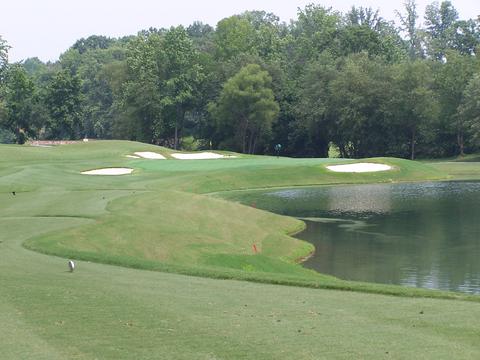
The par 3 17th at Rock Barn is vintage Jones Jr, water kind of in play, bunkers definitely so.
 Home On The Course newsletter
Click here to sign up for our Free monthly newsletter, loaded with helpful information and observations about golf communities and their golf courses.
Review: Rock Barn Golf Club & Spa
The 6th hole at Rock Barn, a long par 4, brings a creek into play in front of the green.
Senior PGA professionals are making their annual stop at Rock Barn Country Club and Spa this weekend. I had the opportunity to visit the community and play the golf course in 2006. Here are some of the observations I made back then about the community and its public-accessible golf course back then. Coverage begins early this afternoon on The Golf Channel.
I played all 18 holes of the Robert Trent Jones Jr., layout and left the shorter Tom Jackson golf course for another day. I liked the Jones course from the first hole, which was what an opener should be, a fair driving hole where you can let out a little shaft if you want, clearing the bunker on the left for a mid-iron approach. Choose the right side, and fairway bunkers come into play leaving you potentially with a long iron over bunkers at greenside. Nice opener.
The risk reward formula was characteristic of the rest of the driving holes at Rock Barn, with fairway bunkers generally in play where approaches were shortest to the greens, but sometimes covering the edges of the "safer" landing zones. Water, in the form of ponds and a stream that runs throughout a good part of the course, come into play on significantly offline shots and on a few of the par 5 approach shots. Overall, the most compelling featue of the well conditioned and beautifully designed classic course is the bunkering. Jones ran up the bill on sand, and to good visual and playable effects.
Rock Barn, whose homes homes for sale start in the $300s (was mid six-figure range back in 2006) for nice views of the golf course, also maintains a world class spa, as well as the customary amenities of country club living. But the place is serious about golf. Not only do they offer 36 holes of excellent golf, but also most of the street names honor legendary golfers.
If you would like a local real estate agent to show you around Rock Barn, please let me know and I will arrange it without any cost or obligation whatsoever to you (all we ask is that you register here at Golf Community Reviews, which is also free and without hassle). We will never share your personal information with anyone.
Rock Barn and the town of Hickory are about 90 minutes from Asheville, Charlotte and Winston-Salem.
The par 3 17th at Rock Barn is vintage Jones Jr, water kind of in play, bunkers definitely so.
Golf Review: Hunting Hawk, Glen Allen, VA
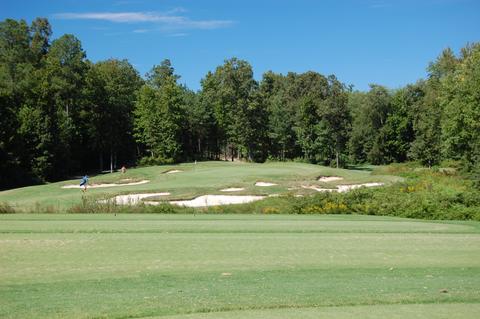
The par 3 6th at Hunting Hawk demanded an all carry shot to a sucker pin position.
Hunting Hawk, an inexpensive daily fee course about a half hour northwest of Richmond, VA, is tougher than it looks. I know this because scores at an annual college tournament there this weekend were pretty high under ideal scoring conditions.
The tournament is hosted by Randolph-Macon College in the nearby town of Ashland. A dozen small colleges competed in the event, including Washington & Lee, which is why I was there: My son Tim, a freshman at W&L, was competing in his first collegiate golf tournament, and I was not going to miss it. I followed Tim's threesome yesterday for the 18 holes and was impressed with the layout of the golf course, if not the conditions of the greens, which the players complained were a little bumpy. That might be more sour grapes than anything, because I saw a number of shots played from the ample woods that run along the perimeters of many holes, as well as balls dropped from hazards. The Bermuda rough grabbed and held offline shots, and the lies from the rough were generally pretty thorny. Bumpy greens did not seem the issue to me.
Indeed, the course, designed by Bill Love, five years ago, provides a number of opportunities for lost strokes. The layout runs to 6,882 yards from the tips, which is where the collegians played it, but the middle tees at 6,480 yards, a rating of 71.6 and slope of 135, is be more than enough for the rest of us. Water came into play on a few holes; on the par 5 16th (545 for the collegians), for example, the lake down the left side proved to be the undoing for a number of the kids off the tee. Marshy grassland areas formed most of the other hazards, but well placed bunkers in fairways and at greenside were high-lipped, deep and hazardous themselves.
The par 3s were nice, especially with pin positions both front and back. A couple of them were severely bunkered, with no good bailout opportunities except for the back or front of large undulating greens, leaving up to 60 feet of difficult putt remaining in some cases. Three of them were short, under 170 yards, but two exceeded 200 yards.
The amenities at the club are fairly bare bones but certainly enough for the daily fee player (including a good hot dog). Greens fees are a more than reasonable $52 weekdays and just a little more on the weekends. Memberships are available. Telephone: (804) 749-1900. Website is www.huntinghawkgolf.com, but only the home page was displayed.
As a footnote, my son Tim did quite well for his first college tournament, shooting 76/78 and finishing tied for 15th overall among the 60 players. Unfortunately, Washington & Lee finished a disappointing third behind Hampden-Sydney College and Wesley, Next tournament is at Bryan Park in Greensboro, NC, with 36 holes designed by Rees Jones. If Tim plays, I'll be there to report back on that well-regarded layout.
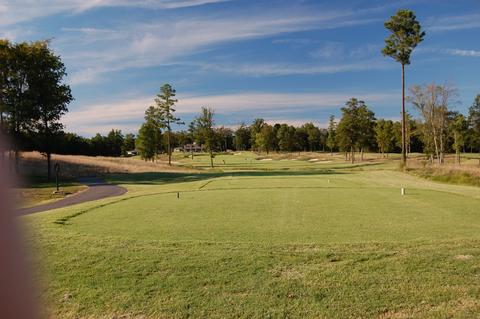
The 18th at Hunting Hawk demands a long drive to the left (but not too far left) of the fairway bunkers, leaving a mid-iron to a narrow opening in a well-protected green.
{mosmap width='400'|height='300'|lat='37.71044257039145'|lon='-77.62012481689453'|align='center'}
Weird and wonderful: Austin wrap up
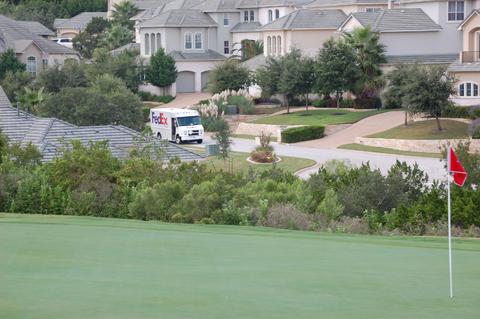
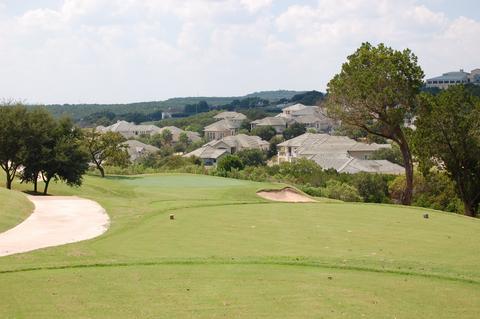
At River Place, fairways look either up at or down to the surrounding houses.
Here are some observations about Austin, Texas and its golf communities after my weeklong visit:
Topographically, the Texas Hill Country is reminiscent of San Francisco, with some of the hills looking more like small mountains. Every golf course I played was surrounded by the hills, most with homes perched along the ridgelines. House styles are mostly a meld of Southwestern and Mediterranean, but Tuscan is coming on strong in many of the communities. Stucco appears to be the dominant housing material Home prices, even for those with the nice views, tend to be 10% to 20% less than similarly situated homes in places like Asheville, NC (and Austin's summers tend to be 20 degrees hotter on average). Fair warning: Texas has no income tax and generates much of its revenue from property taxes, which are considerably higher than many other areas (count on an average of $15,000 in taxes for property valued at $500,000). Yet Austin is still enough of a bargain in terms of real estate that retired Californians and Floridians are moving there in significant numbers. I saw houses going up in every community I visited.
Like most university towns, this one home to the huge University of Texas, there is plenty to do in Austin; as I was leaving town, the annual music festival, Austin City Limits, was starting, with Bob Dylan and other more modern acts featured on numerous stages around town for 12 hours a day the entire weekend. The comparison to San Francisco goes beyond similarities in topography; the rallying cry in town is "Keep Austin Weird," a slap at the pretensions of the newly wealthy citizens in the high tech industry. Dell Computer, for example, is headquartered in Round Rock, just north of town; there is concern that some of the city's notorious funkiness may be at risk. In recent years, two new magazines devoted to the cocktail party and black tie set have been introduced. They won't be wearing black tie at the area's many barbecue joints where the smoked brisket reigns supreme.
The five courses I played were good to outstanding. Falconhead is one of only three "signature" courses in the nation designed by PGA Tour hired architects, something that probably seemed like a good idea at the time. Falconhead was for the most part a pleasant routing well out in the country; a family of deer watched me play one hole. The course layout had some flourishes I found excess baggage, such as rectangular sand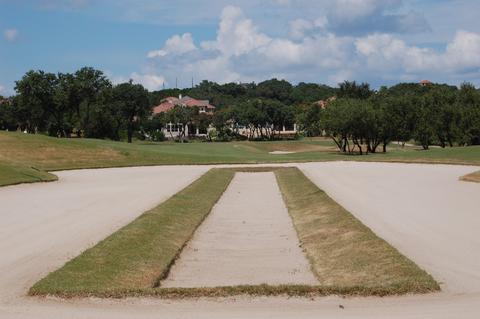 bunkers plopped down in the middle of other bunkers, but I generally liked the way the fairways bent around mesquite trees. Falconhead, which is negotiating with the PGA Tour to sever connections so it can control its own destiny, is going to have to find a way to invest more money in their facilities. For a daily fee course, lockers are not a necessity, but clean bathrooms are. That said, the folks in the pro shop and snack bar were among the friendliest I have ever met in a clubhouse.
Avery Ranch, another daily fee course, was a beehive of activity, with numerous homes under construction around the course. After awhile, the sound of hammering was as natural as bird chirping. Although the heavy rains of the night before had left casual water in the bunkers, the fairways and greens had drained well. Tee placement was especially important on the front nine, with mesquite trees at the edges of fairways to block approach shots to the well-protected greens. Avery is a course where length is not as important as accuracy. I found the heavy iron fences behind virtually all the houses on the course unnecessary; the homes weren't close to the field of play.
The University of Texas Golf Club in the huge (6,500-acre) Steiner Ranch community was a terrific surprise for me, the first Bechtol Russell designed course I've played. The elevation changes seemed entirely natural and forced a few changes of clubs in the fairway to ensure appraoch shots did not roll back down hills in front of the green. Virtually all the par 4s and 5s are doglegs of some stripe or the other, making it important to  "shape" your shots if you want to shorten the approaches to the greens. Conditions were superb, as was the professionalism of all staff I met. The club's Golf Academy has all the latest high-tech software, including two cameras that check your putting stroke. I was impressed by the three "indoor" hitting bays with large doors that opened out onto the driving range. Members and the UT golf teams are pampered at the UT Golf Club.
River Place was odyssey golf, which is to say occasionally weird and occasionally wonderful. For a first timer, the course was quite difficult, posing too many blind tee shots and blind approaches. One par 5 was horribly designed, with a big hill running down from lay-up range to a pond in front of the green. People I met in the days before sniffed about the River Place layout, but despite the par 5 and a few balls I lost "in plain sight," I would like to give River Place another shot someday. It was in superb condition, the hills around the course were the most dramatic of the week and, unlike at the other communities, the vistas were not burdened by high-tension wires. The surrounding community, with most houses perched on ridgelines, was also the most attractive of the week.
At The Hills Country Club at Lakeway, about 35 minutes from Austin, you can belong to two private courses, two daily fee courses or to all four of them. I played the private Hills course, an early Jack Nicklaus design (1981) that shows the Bear's raw talents. The trees in the fairway and his bias toward high left to right shots is in evidence at the Hills, but Nicklaus showed considerable overall restraint in embedding the course in the gently rolling hills near Lake Travis. The routing was easier on the eyes than it was on my golf clubs, but it was not as relentlessly tough on mid handicappers as some Nicklaus courses of the ‘80s tend to be. The Hills hosts the annual FedEx/Kinko's event on the Champions Tour, and it was almost in tournament shape in September, beautifully landscaped with greens that, although top-dressed with sand and aerated a week earlier, were near flawless.
None of the golf carts I used during the week had protective covers for your golf clubs, even those at the private, higher end country clubs. I know it rains in Austin but maybe never on a golf course. And for a large state that is known to do everything big, I will never get used to the size of the housing lots in Texas cities. Even 3,000+ square foot houses are within just 20 feet of their neighbors' houses. One acre lots and higher are few and far between. Those used to lots of space might feel claustrophic in an Austin golf community. One last note: In six days, I saw two cowboy hats, one in a coffee shop and one at the airport as I was leaving town. How weird is that?
I'll report at greater length on the golf and the real estate in the Austin area in an upcoming issue of HomeOnTheCourse.
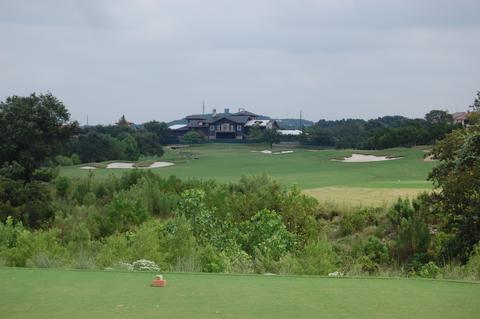
The 18th at University of Texas Golf Club is backed by the soon to open $16 million clubhouse.
[where: 78705]
Designer Nicklaus cut his teeth at Austin's Hills
I've finished up my week in the Austin area. I'd say the golf was good to outstanding, the best being Wednesday's tour around the University of Texas Golf Club course and today's round at The Hills in Lakeway.
The Hills Country Club golf course was one of Jack Nicklaus' earliest designs, circa 1981. The Golden Bear's design affectations are on full display throughout the imaginative, often difficult routing. First and foremost is the Bear's tree fetish; he just has to put them in places few others are bold enough to consider -- that is, more or less in the middle of fairways, forcing precision drives and extra length off the tees. (I played the blue tees at 6,358, but the rating and slope of 70.8/133 give an idea of how difficult the course is.) A good drive on the #1 handicap hole, the 380 yard par 4 8th, leaves you with a tree and water to come over (unless you are well left). On other holes, fairways are pinched in at the landing areas, with trees at one pinch point or the other, and occasionally both.
My camera wasn't working today, but a few holes will be etched in my memory for some time. The par 3 7th plays to just 151 yards but is both beautiful and intimidating, with all carry over waterfalls at the green's front and right. It is a terrific hole that demands one club more than it looks off the tee.
The par 4 18th plays as the 9th when The Hills hosts an annual Champions Tour event in the spring. At an average 4.65 strokes for the senior pros, it is one of the most difficult on their tour. For me it played a modest 372 yards, but for the pros around 450. One of Jack's trees will force anyone who hits to the right edge of the fairway to pitch out for a wedge third shot. The green is significantly elevated, the highest of any on the course, and is guarded by a bunker in front and a pond with more waterfalls at front left. I wound up on the slope in front of the green in three, above the bunker, with the pin at front, and I holed out for a par, beating the professionals by 65/100 of a stroke. Hurrah.
The course was in splendid condition, and despite a recent aeration and covering of sand, the greens were medium fast and near perfect, as well as difficult to read, as most of the greens in the Texas Hill Country tend to be. My cart mate, Jack, told me that the first couple of years of the tournament, the senior pros had a difficult time reading the greens. Thanks to him and his mates Mike and Joe for helping me with directions around the course. It made for a most pleasant day.
The Hills and its sister course, Flintrock Falls, are owned and managed by Club Corp, which provides members with reciprocal privileges at many of the company's other golf courses nationwide. For membership information at The Hills, contact Leah Carter at (512) 343-3806, or leah.carter@ourclub.com. The club's web site is at www.TheHillsCC.com.
I'll have more to say about The Hills, its adjacent community and about Austin itself in an upcoming issue of HomeOnTheCourse. For subscription information, please click here.
Good eats, wild golf in Austin
Thankfully, tee shots on the par 3s at River Place, like the 16th, are not blind.
Blog visitor and friend Bill Field left a comment suggesting I should eat at County Line Barbecue while I am in Austin, He is a mind reader. I ate there yesterday afternoon after a terrific visit to the University of Texas Golf Club at Steiner Ranch. Although County Line was virtually empty at 4 p.m., the kitchen performed as if it were Friday night. I ordered the 5 Meat Combo to sample as much as I could, and except for a heavy hand with the barbecue sauce poured over the meats, everything was spot on.
I've been on a brisket taste comparison this week, and County Line's was excellent, a little thinner cut than Bill Miller's but just as moist. It could have used a little more smoke, although under the spicy/tangy 'cue sauce, it might have been hard to discern any smoke. The meaty taste of the huge beef rib, though, came bursting through, as did the half rack of baby backs, which did have a little bit of smoke but not enough to hide the earthy taste of the pork. Hiding under everything, including the sauce, were a few generous slices of County Line's turkey breast, which took well to a slight dose of smoke and a hint of pepper. I took a bite of meat #5, a sausage, and decided to finish it only if I had any room left. I didn't.
Generous portions of cole slaw, potato salad and baked beans accompanied the meat, and all were first rate. The cole slaw was my favorite type, only slightly dressed, the taste of fresh cabbage the dominant note, not vinegar or mayonnaise. It was as close to cabbage-only as slaw gets, and with all the sauce on the plate, didn't need its only wetness. I tasted the potato salad, which was excellent and fresh tasting, but I knew I wouldn't have a shot at finishing the meats if I went further. The baked beans were another story; I am not a baked beans fan, but when I saw those shards of meat in the cup with the beans, I had to try. I finished them all.
For consistency of meat preparation, I give County Line my slight nod over Bill Miller's, although the brisket was a toss up. Tonight I took a break from barbecue and ate at the outstanding Asian restaurant Satay, where I had both a dish I always order, the coconut infused Tom Kha Gai (Thai chicken soup), as well as two I had not seen before. The appetizer, five jumbo prawns wrapped in rice paper, deep fried and served with a spicy peanut sauce, had crunch, a little fire and fresh seafood taste. Terrific. The entree, called Hok Mor, is hard to describe, a kind of curry souffle into which were buried shrimp, squid, a large mussel and some pieces of fish. It was unusual, tasty and forced me to order a second Singha, the excellent Thai beer. I may just go to Satay again tomorrow night; the menu is wide-ranging and interesting.
Okay, this is a golf blog site, so here are a few notes on the course I played today in Austin, River Place. It was originally designed by Tom Kite in the early 80s, then redesigned just three years later (with Kite's involvement again). The former University of Texas golf star apparently can do no wrong in the Austin area, but I found a few things wrong with the course, although not the views which were the best of the week I've been in town. First the positive: The course was in wonderful shape, the greens fast and perfectly smooth and very difficult to read. I had a half dozen putts inside 10 feet that I hit exactly where I wanted; they only broke when I thought they were straight, and vice versa. Homes are everywhere in sight but all are a long distance away and up a lot higher or considerably lower than the fairways. Remarkably for the area, I only spotted high-tension wires once or twice; at the excellent UT and Avery Ranch courses, they were all over the place. The River Place community was beautifully landscaped, the nicest I've seen, although I never saw the river (or Lake Austin, as it is called locally) from the course.
River Place offers some interesting holes, but I have a few gripes, one of which I will raise here. The par 5 13th is short, at just 476 yards from the Bronze tees (6,128 yards total, but a chesty 131 slope). I hit my drive down the middle but it did not roll far. At 230 over a pond to a green with a retaining wall in front, I decided to lay up. The GPS in the cart said 180 yards to the water; I hit 6-iron which, when I hit it properly, is my 165 club. I hit it properly, but when I got to the landing area, it was clear the ball had gone into the water because Tom Kite, or whoever, had seen fit to build a large hill from about 100 yards away from the green. My "safe" layup had hit the hill and taken off down into the water.
That is just bad design. You should never be penalized for a well-played layup shot. I would have had to hit 9-iron to have come up short of the water. Just silly.
Okay, with that off my chest, I must say that River Place did not live down to the beating it took from people I met on golf courses earlier in the week. Yes, it is a little wacky, and so many blind shots rob the golfer of one great treat of the game -- to see the result of a well-played stroke. But on the fairer blind-shot holes, I enjoyed the modest tension of not knowing where the shot wound up, and once or twice I was pleasantly surprised. I could see River Place growing on me if I played it a few times a week, but I could never grow to love the 13th.
River Place is an active country club with pool, fitness center, tennis and other activities you would expect. Full golf memberships are available at $10,000. Because the club is owned by the local Dominion Golf Group, members have full access to the well-regarded Onion Creek course south of town for just cart fee, and to the Dominion Golf Club in San Antonio for a modest surcharge. For membership info, contact Raquel Hebben at (512) 346-1114. The club's web site is at www.riverplaceclub.com.
The course stunk...and I loved it
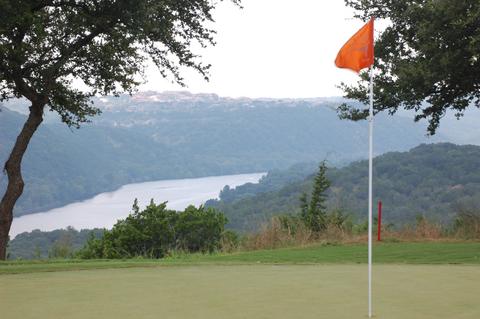
The best view of many great ones at the University of Texas Golf Club was behind the 15th green, with a look down to Lake Austin, which is actually the Colorado River.
Golf Course Review: University of Texas Golf Club
I played the University of Texas Golf Club today. The course smelled pretty ripe after an application of organic fertilizer to the greens -- organic as in chicken manure. I'm not complaining, mind you. It is good for the planet and the local wildlife, and real golfers will put up with a lot if a course's greens are good, and these putted in inverse proportion to how they smelled. The rest of the course was pretty special as well, a splendid Bechtol Russell Golf design that has been babied to near perfection by the club's owners and course superintendent.
Despite heavy rains in the prior days that forced cart-path only restrictions, I saw no casual water on the course, and even though we were beyond the workers who were raking the sand bunkers, the sand was essentially dry with no casual water anywhere. You can tell the owners, who are putting the finishing touches on a new $16 million clubhouse to open in the spring, lavish much attention and investment in the course. Everyone has been exquisitely trained as well. The greetings from the bag drop to the pro shop to the snack bar were as friendly as I've encountered at any private club, with a professionalism to match. Assistant pro Jean-Paul Hebert, a former All American for the UT Longhorns, even furnished me with a rangefinder that was icing on the cake for the good yardage book available to guests and members.
I played with two members, Ron and Gareth, in a best two of three-ball match with the threesome in front of us. Ron, a former regional director for the U.S. Bureau of Alcohol, Tobacco and Firearms, and Gareth, a lawyer and former tax executive, were excellent companions and played Mutt and Jeff for most of the 18 holes (I contributed just one of our group's six birdies for the round). We beat the other guys out of few dollars.
The UT course is not for the timid but it will delight anyone who appreciates the kind of design that rewards and punishes in about equal measure. From the white Longhorn tees we played at 6,600 yards, there are some intimidating drives over ravines, and correct fairway placements on your tee balls are imperative to have reasonable entries to the well-bunkered and tilted greens. The views from a number of holes are quite impressive, nowhere more so than behind #15 which is perched pretty much at the edge of a cliff overlooking Lake Austin way below.
The focus on the member "experience" at the UT Golf Club is apparently quite strong. One example: The course, just five years old, was redesigned a year or so ago with input from Tom Kite, Ben Crenshaw and Justin Leonard, as well as the original designers. The owners put four different types of sand in the bunkers for three months and then asked members to vote their preference. That's the sand that is now in all the bunkers on the course. I'll have much more on this terrific golf course and the Steiner Ranch community in an upcoming issue of the HomeOnTheCourse community guide.
For membership information, contact UT Golf Club's Lisa Coffman at (512) 266-6464. The club's web site is at www.utgolfclub.com.

Ron, left, and Gareth were fine companions and fierce competitors. They led us to victory in a best ball match against another threesome at the University of Texas Golf Club.
Austin, Texas golf review
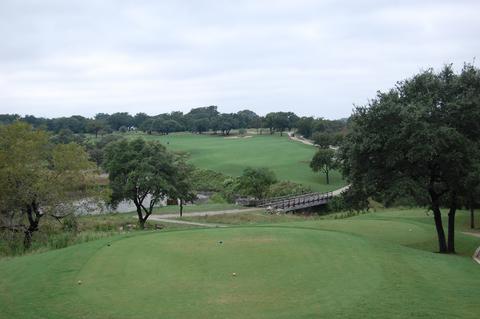
The uphill dogleg 7th is what a short par 4 should be -- challenging off the tee with a tough approach shot (see photo below).
Rain doesn't dampen experience at Avery Ranch
It was cart path only and water-filled sand bunkers at Austin's Avery Ranch golf course today after a night and morning of heavy rains. The course was very wet; that's the bad news. The good news is that only a few groups were out there, so I could savor a trip around a nice routing with many interesting views, some challenging shots and some brutal pin positions. And greens fees were incredibly reasonable at just $52, cart included. I'll report on the course in detail in an upcoming issue of HomeOnTheCourse, but here are a few highlights.
In launching me out onto the five-year-old routing, conceived by Nicklaus Design protégé Andy Raugust, the friendly starter Gil warned me to stay on the right side of the fairways on the front nine. The indigenous mesquite trees block shots that are just a little left of the fairways, and on the 2nd hole, after my slightly hooked drive ended up on the left edge of the fairway, I had to lay up and around the trees from 135 yards. Always listen to the starter.
I was struck by how many pin positions were tucked just over steep sand bunkers at greenside. On the very short par 4 16th, which plays to just 300 yards from the middle tees (6,229 yards overall), I had a lob wedge from 55 yards over a sand trap to a front pin position on an elevated green. I thought I hit the lob perfectly, and with spin. But the front pin was on a slope that tilted from front to back; my ball hit about three feet short of the pin and rolled 25 feet past. With a lob wedge! I suppose such short par 4s should be tough around the greens, but the positioning of a pin should never be such that birdie is impossible.
The greens at Avery Ranch were wonderful to putt if difficult to read. A few times I misread putts I was sure of when I lined them up. I thought the greens were a little slow. When I mentioned this in the pro shop after the round, the two assistant pros insisted the stimpmeter readings were around 10 and invited me to the 18th green for a test with the stimp stick. (They had some time on their hands because of the weather.) The reading was 9.6. Close enough.
Par 5s were all challenging and most required three good shots to get to the putting surface. The par 3s were all approachable and a nice variety of short (145 yards) and long (205 yards) from the middle tees. Of the testing par 4s, my favorite design was #7, an uphill dogleg left that played to only 360 yards from my tees. The drive needed to carry 180 yards to clear a ravine. Left of the fairway was wilderness stroke-and-distance territory, while a trap at the elbow of the dogleg 235 yards out was within reach. Good players would probably opt for 3-wood or less. Then the approach had to clear a creek, a rock wall and a bunker to get anywhere close to the pin. It was a wonderfully designed short par 4, one of many nice holes at the fine Avery Ranch Golf Club.
Avery Ranch Golf Club, Avery Club Drive, Austin, TX. (512) 248-2442. Black tees, 7,121 yards (recommended for 0 to 4 handicap players), 74.3 rating, 133 slope. Gold tees, 6,594, 71.8, 133. Blue tees, 6,229, 70.0,126. Ladies white tees, 5,724, 74.0, 135.
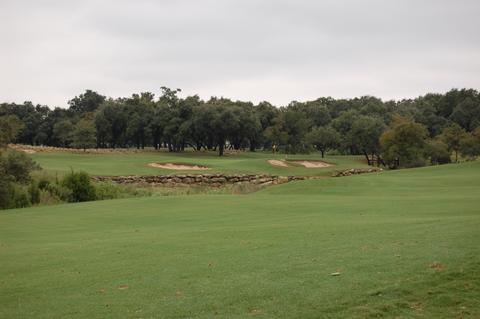
The approach at #7 at Avery Ranch is both intimidating and exhilarating.
Footnote to those who care about my Texas barbecue obsession: Tonight I sampled the smoked brisket from Bill Miller's in Austin, with a side of cole slaw (just mediocre, a little too shredded and a little too much vinegar). The brisket was terrific in texture and taste, more moist than Rudy's brisket (see yesterday's post). Bill Miller's cows must really love their salt licks because the meat was saltier than it needed to be; the tasty, mild barbecue sauce that was generously spooned out for me would have been enough seasoning for the smoke and natural beefiness of the meat. On the other hand, the salt sure made the beer taste better. On my rating scale of 1 to 5, I give Miller's brisket 4 pigs (might have been a 5 if they had rationed the cows' salt licks). Yes, I know brisket does not come from pigs.
Back online, and in Austin
Sorry, yesterday was the first day I haven't posted something in months. I was traveling to Austin, Texas. I will be in Austin this week, with planned visits to some of the area's best communities and one round a day. I am also dedicating myself to finding the best barbecue brisket in greater Austin, not an easy task I come to find. After a round of golf today at Falconhead in the Lake Travis area to the west of the city, I asked in the pro shop where I should stop for takeout barbecue on my 40-minute drive back to my hotel.
A riot almost broke out. The young lady at the snack bar suggested Rudy's. The assistant manager advised me to stop at Smoky Moe's. The golf pro said, no, he much prefers the 'cue at County Line Barbecue. I went with the first suggestion, Rudy's, which I had read some good reviews about, and I stopped there, and ordered a half pound of "moist" brisket (you can also have it "extra lean") and a half pound of baby back ribs, plus a few side orders.
The brisket was outstanding, easily cut with a fork, smoky and tasty. The ribs were another thing, tough and overly salty. Those poor ribs had spent way too long sunning themselves in a tanning booth. I think I will stick to brisket the rest of the week. The sides of cole slaw and creamed corn were excellent, the slaw leaning a llittle more toward mayonnaise than vinegar, and the creamed corn the real thing, fresh corn and what tasted like a homemade (and very fattening) cream sauce. On my rating scale of 1 to 5 pigs, I give Rudy's a 4 for the brisket, a 1 for the ribs and a 4 for the sides. Their barbecue sauce, which you serve yourself, had a nice peppery bite to it and did not taste commercial at all (even though they are happy to sell you bottles of the stuff).
Oh, the golf. I liked Falconhead, which offers some rolling fairways, open fairways interrupted by a few indigenous trees, and nice elevation changes. I made a mistake by playing the blue tees at 6,300 yards. Some of the holes were a little dinky from there; the tees at 6,800 would have afforded a much better challenge. For the first time, I used a Taylor Made R5 driver today with a regular shaft, hoping it would force me to swing more easily and forgive some badly pushed drives. It worked well; indeed one par 4 on the course played to just 258, and I was pin high and just off the green. I left the chip 10" short, my only birdie of the day.
More on Austin and its golf courses in the coming days.
The 16th at Falconhead is a short and reachable par 4 at 258 from the middle tees.
FedEx Cup runneth over for me
Count me among the apparent few who think the FedEx Cup is just fine so far. As a fan I am not insulted that Tiger in Week One and Phil this weekend stayed home with their kids. Many of us complain about selfish, money-grubbing athletes, and then when they turn their backs on the potential for a million dollar payday, we complain that they don't care about the fans or the game. Baloney; we don't own the gaziilionaires like Tiger and Phil any more than we own Lucas Glover and Brandt Jobe. I think Phil, Tiger, Ernie and other no-shows set a great example when they put family first.
Anyway, Tiger the consummate front runner brought the field back in by staying away in Week One, making these last few weeks even more exciting; and Phil, a notoriously good handicapper of the odds in a few other sports, deduced that he could take his daughters to school this week and still be in the top five headed to the final showdown in Atlanta. So we the fans, and presumably the tour itself, will get what we want at East Lake; Tiger and Phil in the hunt, with the possibility of a Cinderalla story emerging in the form of Steve Stricker... although if I hear one more time about how incredible it is that he repaired his game so dramatically in the last 18 months, I might explode. What happened with Stricker seems pretty simple to any of us who understand that, after achieving a certain level of competence, golf is almost exclusively a mental exercise.
HE GREW UP! He stopped whining internally that he was away from his wife and kids and that the good old days of his wife carrying his golf bag, and comforting him at the end of a mediocre round, were over. He decided that doing something that he is good at would do more for his family than teaching golf at the local driving range back in Wisconsin. So here's hoping that Steve Stricker wins the FedEx Cup, pockets the $10 million prize, and stays home as long as he wants with his family.
Caveat emptor
Headed for Austin, TX
Way to go
Small Alabama towns hit a few high notes
Day of rest...kind of

Now on Sale

- The only book about golf communities in the last 10 years.
- 156-page step-by-step guide to finding your dream golf home.
- Info on nearly 100 golf communities the author has visited.
- Paperback version costs less than a sleeve of Pro VIs.
Here is what the experts are saying:
“The book is chocked full of information…applicable to anyone looking for a move to the Southeast regardless of whether they are looking for a golf community or not.” — John LaFoy, golf architect (Linville Ridge CC, CC of Charleston, The Neuse GC)
“Larry has done a tremendous amount of work and anyone — like me — who is looking to search for a golf home now or in a few years needs this book.” — Brad Chambers, golf blogger, ShootingYourAge.com
“Wow! What a thorough piece of work…a must for anyone moving South. This book will help many people.” — Brett Miller, owner and founder of MMA, Inc, a golf industry consultancy
Buy It Now at Amazon.com or BarnesandNoble.com.