Mother Nature does it to Wild Dunes, again
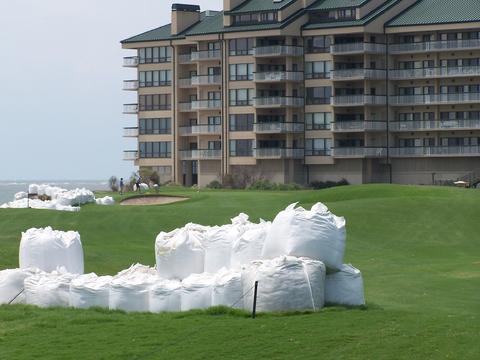
This is what the 18th hole looked like in August. The condos behind the green could be next to go.
I was just about to go to press with the latest edition of the HomeOnTheCourse Community Guide, with an entire issue dedicated to the golf communities near Mt. Pleasant, SC, including the famed Wild Dunes Resort. Then word came this afternoon that I would have to update the copy; the 18th green on Tom Fazio's Links Course has fallen into the sea.
As I indicated here a month ago, it was inevitable, based on what I saw in early August during what could have been one of the last times anyone played the par 5 18th. The hole, which is a beauty, runs along the ocean and is flanked by now-threatened condominiums down the right side and behind the green. Huge white sandbags propped up the left side of the fairway beginning over 100 yards from the green and running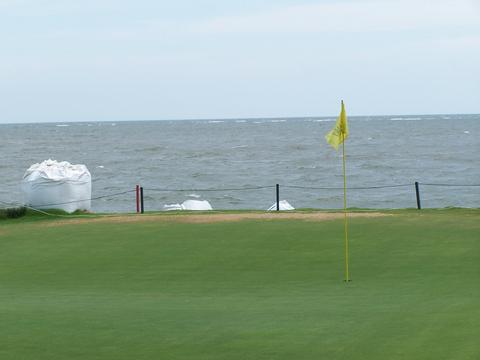 down the edge of the fairway to the green, where more sandbags seemed to be all that was propping up the putting surface. The surf was pounding on the bags, and a few had split open.
According to an article today in the Charleston (SC) Post & Courier, the 18th hole has been relocated away from the ocean and turned into a par 3, shaving a full two strokes off the formerly par 72 course. Who knows if the 18th will ever return to ocean side, given environmental regulations regarding dunes, beaches and the sea turtles that lay their eggs just below the fairway.
Ocean holes are too few to begin with, and they aren't building any more. Here's hoping Fazio and the owners of Wild Dunes can work some magic and fool Mother Nature.
 Home On The Course newsletter
Click here to sign up for our Free monthly newsletter, loaded with helpful information and observations about golf communities and their golf courses.
Private golf courses at your disposal...for one day
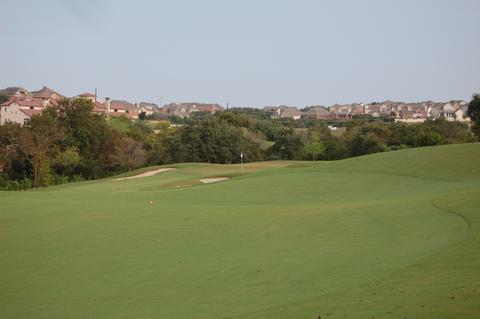
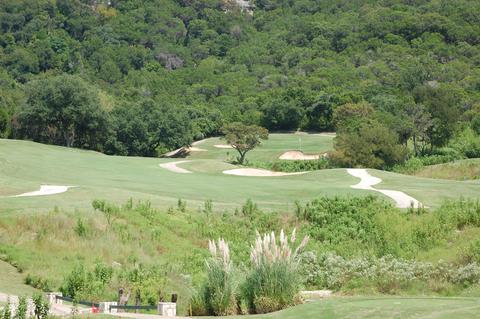
You know you are in Texas Hill country as you approach #4 at the U of Texas Golf Club.
ClubCorp. will open 94 of its private clubs to the public on October 19 to benefit four charities. The owner/operator of hundreds of clubs throughout the U.S. will make many of its golf courses available for a donation of $150. The company is billing the Charity Classic as "the largest one-day golf and dining charity event."
You can read all about it at GolfVacationInsider.com. You can also click here for a list of the courses and other private clubs ClubCorp will make available on the 19th.
Two of the courses on the ClubCorp. list, both in Austin, TX, are fresh in my mind. I played The Hills course at Lakeway and the University of Texas Golf Club just a few weeks ago. Both are worth the $150 price tag if you happen to be in the Austin area on October 19.
Golf is not the only good reason to visit Austin -- country music, outstanding barbecue and a major university are just a few of its many attractions -- and if you can catch a cheapo flight on Southwest Airlines, which serves the area, you could build a nice few days around the golf. The daily fee courses in the area are excellent, and I would put high on your list Avery Ranch, Barton Creek, Wolfdancer and River Place (make sure you play with a River Place member to show you where to place your blind tee shots and then help you look for your ball).
If you would like to look at golf course communities while you are in Austin, or just gather some real estate information, I have a terrific contact there who can give you a guided tour or as much information as you can handle. Contact me and I will be happy to put you in touch.
Kite, Bechtol & Russell architects reaching for new heights with NC project
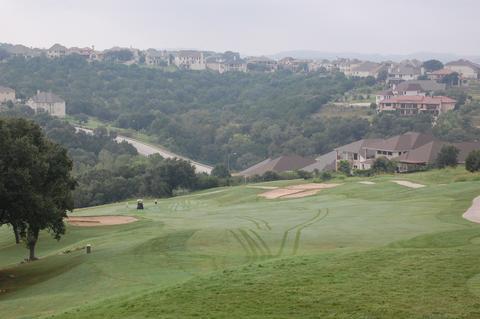
The first hole on most courses is a warmup, a routinely mild introduction to the rest of the course. But at River Place, the tricky placement off the tee to a sloping fairway signals just how tough the rest of the layout will be.
Okay, they aren't exactly Tiger Woods or Phil Mickelson, who have been tapped recently to build their second courses in the mountains of North Carolina, but the Austin, TX, firm of Kite, Bechtol & Russell have a lot more experience. Their course at Laurelmor, currently under construction, won't be able to avoid comparison, for better or worse, with the Woods & Mickelson layouts an hour away.
The Ginn Company hired Kite et al to build the first golf development in the Boone, NC, area in more than two decades. The firm's primary work is in the Texas/Oklahoma area, giving them some experience in working with hills, if not mountains. We hope the Laurelmor course provides fewer blind shots than the exhausting River Place course in Austin, a mid-1980s design by Kite that had to be redone two years after it opened because its sloping fairways and preponderance of blind shots generated some nasty feedback. I played the course recently without the benefit of a member in my group; that was a big mistake. I lost a few balls I thought I placed perfectly, and in one case - a six iron lay-up that wound up in a pond in front of the green on a par 5 - I was more than a little annoyed.
But all that said, I would play River Place again. If Kite, Bechtol & Russell can avoid the confusing blind shots at Laurelmor, Tiger and Phil could be looking over their shoulders.
You can read an article about progress at Laurelmor at GolfCourseNews.com.
From some tees at River Place, the landing areas seem narrow and barely approachable. No tee shot seems more difficult than at the medium length par 4 14th.
Developers put own distinctive signatures on courses
Competition in golf-rich areas push course owners to do some odd things. At the Barefoot Resort's Davis Love course in Myrtle Beach, you can hit long to the fourth green and bounce a shot off the ruins behind. At The Pit near Pinehurst, a par three plays over the ruins of an old iron foundry. Many courses use dramatic waterfalls, both natural and manmade, to add memorable highlights to a round of golf.
Sometimes these touches are integrated into the on-course experience and sometimes they are just add-ons. After a pleasant round at the wonderfully groomed University of Texas Golf Club in Austin a few weeks ago, I got in my cart behind the 18th green, wrote down my score and then drove over - not under - a stream that flowed from the area of the clubhouse. On a hot day and after a so-so round, I felt like taking off my shoes and socks and wading through. But I resisted the temptation; I hope to be invited back someday to the excellent UT course.
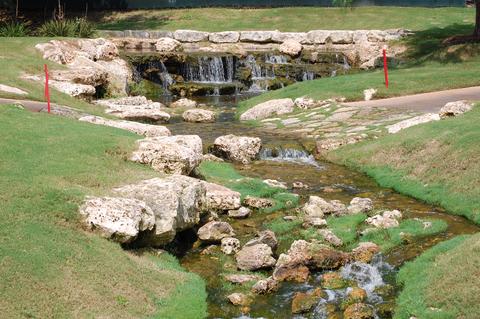
Stream of consciousness: Golf course developers want you to remember the extra touches as at the University of Texas Golf Club, where a stream runs over, not under, the cart path behind the 18th green.
Living like kings and queens
Real estate appreciation over the last decade in London has been wild, fueled by Russian oil barons, wealthy industrialists from emerging India and investors from other resource rich countries. It is getting so that the British can't afford to live in their own capital city anymore (residents of New York City will understand this). Astronomical housing prices - a median price of almost $800,000 in London -- also means that people who provide essential services, like sanitation, subway (Tube) and building maintenance workers, can't afford to live where they work. Soon, the urban rich will be bidding against each other to determine whose toilets (loos) get cleaned.
I am old enough to remember the heady days of the strong dollar. We Americans traveled far and wide, bragging to our friends and neighbors about the bargains we picked up overseas. My wife and I, for example, bought beautiful wool sweaters on our honeymoon in Greece for about $20 nearly three decades ago. I get teary eyed when I recall what we paid for our hotel room on Corfu and for our meals.
We were surprised to hear a fair bit of English spoken in the mountain villages on Corfu. We shouldn't have been. Immigrants from Greece, Ireland and other European countries had been coming to the U.S. for decades, working and saving enough to return years later to the lands of their birth, where they bought the biggest homes in their villages and lived out their days like kings and queens. The strong dollar in the Land of Opportunity did this.
The U.S. is still the Land of Opportunity, only now the opportunity is to buy American and buy it cheap, whether it is a great college education, a Gulfstream jet or a nice house in a golf course community. The U.S. dollar is currently pegged at less than one half the British pound. In a manner of speaking, U.S. housing is on sale at 50 percent off for many overseas investors, more if you consider the softness in some markets in the U.S. This is our way of making it up to owners of homes in London, whose market own real estate market now seems to be peaking, thanks to a low quality export from the U.S. - the sub-prime mortgage.
If you are interested in golf community property in the U.S., send me a note indicating what kind of home, golf course and community you are looking for, and I will be happy to offer some ideas by return note, with no obligation to you whatsoever (and I had nothing to do with the sub-prime mess!)
We "scoop" the Wall Street Journal...by eight months
Choked with traffic, burdened with increasing property tax and insurance rates in the wake of hurricanes and too bloody hot in the summer, Florida is losing its status as a retirement paradise. I lapse consciously into off-color British prose above because so many Europeans think of Florida as the only warm place to vacation or purchase a second-residence in the U.S. Strong suggestion to our faithful offshore readers: As you consider investing your strong pounds Sterling and Euros, look north of Florida first. The sun does shine in Georgia and the Carolinas.
Florida real estate is still overpriced, with many who paid too much in the waning days of the boom unwilling to yield to the reality that they cannot sell their homes for what they thought they might. Property taxes are high, in part the natural consequence of offsetting the lack of a state income tax, and also to prop up school systems that saw an explosion of students in the last 10 years. Cities like Naples have over-expanded wildly, packing high-density and high-end condos into ever disappearing properties along the Gulf, in effect imprisoning residents inside their gated communities. And consistent with a great Florida tradition that goes back to the 1950s at least, local legislators and town planners have shown little backbone in dealing with aggressive developers.
The bloom, it appears, is off the orange blossom. Approach any investments in Florida real estate with caution.
The Perfect Hole
On most courses I play, the #1 handicap hole on the scorecard is a long par 4. That's the way it is at my home course, Hop Meadow in Simsbury, CT, where the par 4 7th runs to about 420 yards, the last 80 or so uphill to a green that is crowned in the middle. Off the tee on the slight dogleg right, you have to maneuver your drive between a trap at the knee of the dogleg and one at the crook. But there is about 40 yards in between, and bigger hitters can hit over the bunker on the right. The #2 and #3 handicap holes on the course also stretch well beyond 400 yards.
The truly great holes are the ones that require for finesse than length to be challenging. The par 4 6th at Oyster Harbors in Osterville, MA, nicknamed "Water Dog," is just such a hole. It plays just 388 yards from the white tees (course total 6,514 yards), but since it is a dogleg left, you can cut off at least 40 yards by drawing one around the angle...if you dare. Fly the trap that guards the crook of the dogleg at the corner and you risk bounding down the sloping fairway and into the pond on the far right side. Pull your tee shot a little left, and you will be shut out by trees that run up alongside the bunker. Pull it hard left and you are in the trees.
The correct play is right of the trap, about 210 to 225 off the tee; the angle to the elevated green is better from the right side of the fairway, but hit it too far and you will find a lie in some gnarly New England rough or, worse, in the trees beyond. Then comes the approach to a green that forces an all-carry shot, nearly one club more than the distance would imply in order to fly over the very false front. The green slopes right to left, and left is the play when the pin is on the right; at Oyster Harbors, you never ever want to be above the hole (see my article earlier in the week about five-putting).
Number 6 is a stunningly well-designed hole, only the fifth longest par 4 on the course, and deserving of its status as the toughest. It is as perfectly a conceived hole as I have ever played.
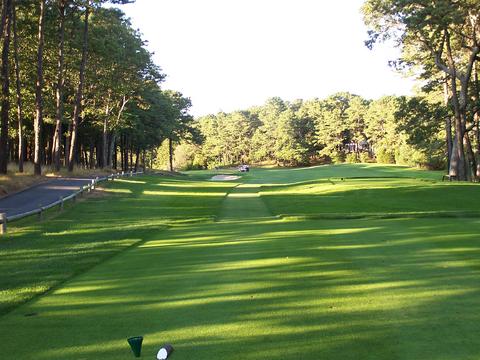
Driver is a liability off the 6th tee at Oyster Harbors. A 220 yard shot placed from center to far end of the fairway leaves a medium iron to the elevated green.
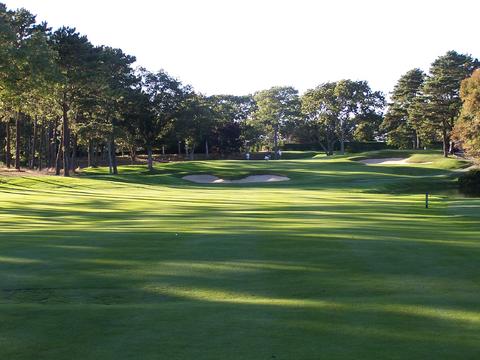
The green at #6 is more elevated than it appears here. The play is center left when the pin is right.
Trying to hide the blindingly obvious
San Diego has about the best climate in the nation, which means darn close to 365 days a year of golf weather. And the real estate market there, about as bad as it gets once you discount (no pun intended) Las Vegas, Miami, and Phoenix, seems like the classic buying opportunity for folks who have intended to move there all along (assuming they don't need a sub-prime mortgage to swing it). I have no interest in moving to the Left Coast, but I defend anyone's right to do so, especially at bargain basement auction prices. This could be one of those opportunities, and I was hungry for more details.
Fuhgeddaboutit. I checked the Horton web site and found no mention of any auction. I tried a web search with the terms "Horton," "San Diego," "real estate" and "auction." Nothing...except a blog article by Diana Olick of CNBC online describing how, she too, had searched largely in vain for some info about the auction. She cross referenced an auction house's online listings for this Saturday in San Diego with the names of Horton's communities there and discovered that 53 units in two of the communities were under the gavel this weekend. Nowhere on the site for the Real Estate Disposition Corporation is there mention that these are Horton homes. I wouldn't be surprised if REDC is a wholly owned subsidiary of Horton (although there may be rules against that).
Publicly traded companies like Horton owe the investment community a bit more transparency than that. Last week, a competitor, Hovnanian, bellied up to the bar and announced deep discounts on more than 2,000 homes. It isn't as if the rest of us are in the dark about how bad the housing market is at the moment.
But these must be demoralizing times inside building companies. Maybe Horton has had to lay off the copywriter in the investor relations department who usually posts news about the company on their web site. (The writers are always the first to go!) Better they should lay off the schizophrenic employee with the naming rights to the Horton communities. The two being auctioned off this weekend are the appropriately named Esperanza, which means "hope," and La Boheme. I am not an opera fan, but I understand the Puccini opera is about struggle and poverty, and it ends miserably. Let's hope the weekend is more esperanza and less boheme for Horton.
You can read Ms. Olick's article here, and find the auction site here.
My first five-putt on a course like few others
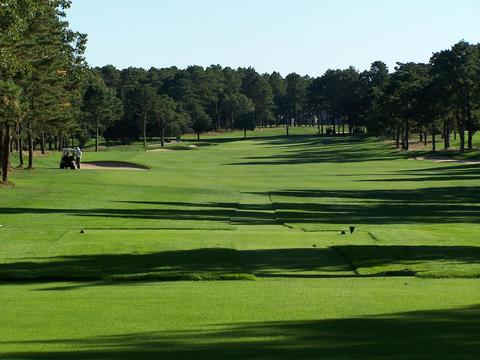
Like so many holes at Oyster Harbors, the 2nd looks fairly tame from the tee, but all the action begins on or around the greens. I would have welcomed a three-putt today.
For many reasons, I won't forget my last two days at Oyster Harbors, one of the most celebrated of all Donald Ross courses. I played miserably, with no excuses for missing the very generous fairways on the course and hitting about five greens in regulation. My partner, Bob Penney, was quite tolerant. I barely broke 90 on the first day, and didn't on the second, my only compensation being that no one could accuse me of sandbagging with my 10 handicap. The capper was the five putts I took on the 2nd hole today, something I had never done in more than 45 years of golf. When you can play like that, still smile coming off the last hole and consider the two days very well spent, you know you have been in the company of fine fellows and a phenomenal golf course.
Fine fellow Dick Farr is the eminence behind what has come to be called the "Fall Frolic." A member of the private Oyster Harbors, which is located in Osterville, MA on Cape Cod, Dick has organized the outing for the last 25 years as a way to gather his friends to appreciate a great golf course, share their passions for the game and have a wonderful dinner (the food at Oyster Harbors is first rate). Over time, Dick's friends' friends have become his as well. I learned all this during Dick's dinner "pontifications" (his word).
There is certainly some "frolic" to the two days. Each of the 50 participants is assigned a partner with a similar handicap. The game is net better ball of two, but with a twist best described as "best of the worst." Of the 18 scores not used for the best ball, each team was required to add up the best 12 of them and then add that total to the best ball total. Also, on day one, everyone had a chance to guess the total score of all 50 participants on the short, but tricky, par 5 2nd hole. I thought I was pretty smart with my estimate of 333 strokes, about a 6.3 average. And during the round, when I saw the pin at the bottom of a whale of a hill (literally), I figured the field could not break an average of bogey on the hole.
Well, I underestimated; the average came in at 5.5 strokes. Well done, field!
The wonderfully groomed course itself is frolicsome, when it isn't frustrating in the classic Donald Ross way, which is to say the wide fairways give no indication of the terror that awaits at and near the green. Greens are undulating, generally not wildly so but enough to make your knees knock. I had a few putts that broke five feet or more, but I found those a lot easier to read than the more subtle putts that wound up breaking less than the width of a cup (and often the "wrong" way). Pin positions the first day were in corners and at edges, and any miss on the short-side yielded bogey at best. The Ross bunkers were snuggled up to the greens in some places, but some of the larger traps extended to 30 yards in front; misplayed shots into the stiff breezes resulted in some difficult long explosion shots. Fairway bunkers on some holes make you think, and others are only in play if you scuff your drive off the tee.
But everything is about the green complexes at Oyster Harbors, and at dinner, fellow golfers who had played Ross' famed Pinehurst #2 described Oyster Harbor's greens as every bit as tough (some felt strongly that Pinehurst's fairways are more generous). Oyster Harbors' greens are all difficult, but a few are punishing in the extreme if the pin is in the wrong place, none more so than at the otherwise mild-mannered 2nd hole, which plays as a par 4 or par 5, depending on which tees you play.
I met my Waterloo today at #2. The pin was perched on the edge of a swale that runs in a small arc from right front to middle rear on a medium-sized green. I had hit a good drive into the wind, a good three wood lay-up and then a crisp 9 iron I thought was stiff. It landed a few feet short of the pin and then, without making a dent in the green, rolled back 25 feet below the hole.
My putt was directly uphill (always a good thing at Oyster Harbors) with a right to left break of about three feet. I felt confident, despite the warning of the group in front of us to "be careful; two of our guys five putted." I hit the best putt I had hit in weeks and thought it was going in, but two turns from the hole it dove left and stopped just six-inches below the hole - stopped, that is, for a microsecond before it began its descent down the hill, picking up speed and stopping 20 feet below the hole.
Now I had a straight uphill putt, another one I thought I hit perfectly, but it broke left instead of right, and this time wound up two feet above the hole. At least it stopped. At the Fall Frolic, no putts are conceded, and thinking more about the last two putts than the next, my comeback two-footer nicked the right edge of the cup and away it went, down the hill to the magic 20-foot mark again. Two more strokes and I was done, with the only 8 on my card this year and the only five-putt of my golfing career. Later, I learned that one of the other guys in the field had picked up on the hole...after seven putts.
The par 72, 6,514-yard Oyster Harbors could be the toughest course in America with a rating under 72 (it's 71.2) and a slope under 130 (it is way under-rated at 126). It is exciting and exhausting all in one. It would be interesting to hit every shot where you want to on the course and see what kind of score you could produce. With a straight drive and approach shot below the hole, it is possible to score well. One fellow in our group today played beautiful position golf and shot 76. The low round the first day was a 75, and the fellow had a triple and a double bogey. And that is probably the essence of a course like Oyster Harbors; you can score well, but somewhere along the way, and most assuredly it will happen on a green, there will be pain. Exquisite pain.
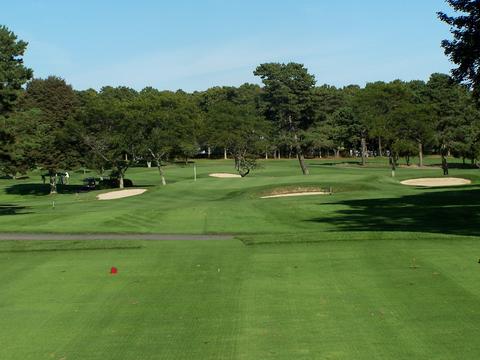
Some pin positions at Oyster Harbors, like this one at the par 3 17th, are what they seem -- diabolical.
Getting over selling your house at a loss
In 1984, my wife and I bought a house in the suburbs of Hartford, CT. We paid $129,000 for a faux colonial style home with vinyl siding. After spending a couple of thousand dollars to rip out the shag carpeting and apply a coat of paint to the cigarette-smoke-stained walls, we had ourselves a nice house at a bargain price. Two years later, in a strong housing market, we accepted an offer of $199,000 because we had fallen in love with a 200-year-old house nearby.
The owners of the old house wanted just $199,000. We made some "modest" changes to our new/old home at a cost of $70,000. Then three years later, our son Tim was born and we felt the need to move from our home on a busy street to a neighborhood. But the housing market had gone into a deep funk in 1990, and the best offer we received after a year was $189,000. We were mortified, but we took the offer, absorbing an $80,000 beating (the $199K we paid plus the $70,000 we had put into the house).
Many people face this same crisis today in an awful housing market. They are deferring their dreams of a new home elsewhere because they can't get past the psychology of losing money on their current home. From my own experience, holding out for a price above the true value of your home is a fool's paradise. Here's some brutal advice if you really truly want to sell your home:
- Your house is not worth what you think it is. The market, not you, determines your home's value. You can control how your house looks, but not what it is worth.
- If you have owned your home for at least a few years, you probably paid less than it is worth today. To borrow a phrase from the stock market, "pigs get slaughtered." Don't be piggish when pricing your house for sale.
- The market virtually everywhere is in the toilet. The house you buy elsewhere will be priced much lower than its owner thinks it is worth. Their loss is your gain, just like your loss is someone else's gain. Last week, the big building company Hovnanian cut prices on more than 2,000 of its homes by as much as 30 percent. Other builders will follow suit this week. And they all have shareowners they report to.
- You can't put a price on doing the right thing for yourself. Living where you want to live is more important than wringing every last irrational dollar from your house. What is your happiness worth?
- You could be harming your local economy and indirectly shooting yourself in the foot. If you overprice your house, no one will buy it. If your fellow citizens overprice their homes, people won't accept jobs that involve a move to your area. The market could stagnate, possibly driving your home's value lower.
- Finally, memories do not translate to house value. Okay, so you raised your children in the house. Those are priceless memories, as in "You can't put a price on them." So don't.
Builders' houses on fire sale
Over Under in Williamsburg, VA
Know thy neighbors...before you buy
3 hole stretch: Colonial Heritage
Lower prices on Daufuskie Island

Now on Sale
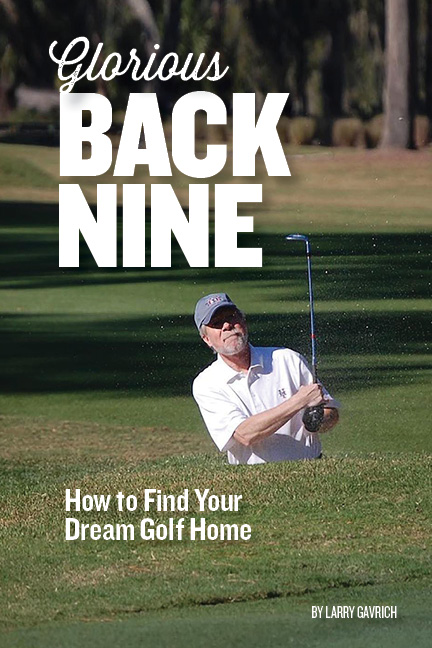
- The only book about golf communities in the last 10 years.
- 156-page step-by-step guide to finding your dream golf home.
- Info on nearly 100 golf communities the author has visited.
- Paperback version costs less than a sleeve of Pro VIs.
Here is what the experts are saying:
“The book is chocked full of information…applicable to anyone looking for a move to the Southeast regardless of whether they are looking for a golf community or not.” — John LaFoy, golf architect (Linville Ridge CC, CC of Charleston, The Neuse GC)
“Larry has done a tremendous amount of work and anyone — like me — who is looking to search for a golf home now or in a few years needs this book.” — Brad Chambers, golf blogger, ShootingYourAge.com
“Wow! What a thorough piece of work…a must for anyone moving South. This book will help many people.” — Brett Miller, owner and founder of MMA, Inc, a golf industry consultancy
Buy It Now at Amazon.com or BarnesandNoble.com.