Review: Salem Glen Golf Club, Clemmons, NC
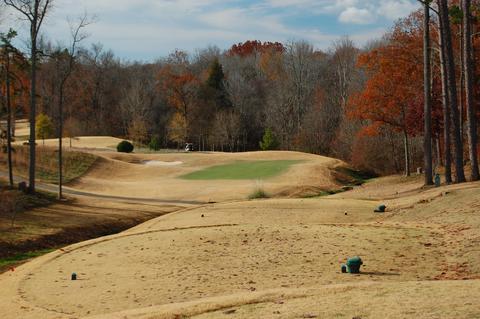
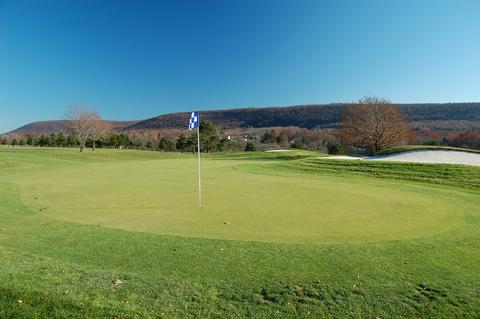
Target golf: When fairways are dormant, greens can look like bulls eyes.
If you are as old as I am, you just might remember the gasoline station wars of the 1950s. One gas station would lower its prices and the one across the street would follow suit, undercutting the competition by a dime a gallon. Then the other competitor would undercut by another dime and, before you knew it, gas was something like 19 cents a gallon.
The Saudis won't let that happen today, but golf courses are under no such price controls. When you consider how expensive it is to maintain a course, $40 or even $50 green fees (cart included) seem like a zero-sum game. Clemmons, NC, just outside of Winston-Salem, is a microcosm of the problem. I am spending a few days in the area and, I have to tell you, it is great to be a daily fee golfer but it must be miserable to be a golf course operator. In the last two days I've played top-notch golf for much less than $50 a pop. In the words of former New York City retail huckster, the "prices are so low they are practically giving it away."
Yesterday I played the fine Nicklaus Design course at the Salem Glen Golf & Country Club, a place that looks and feels like a private club but, like a widow, is forced to take in boarders (aka daily-fee players). By all rights Salem Glen should be private, except there is too much good and cheap golf in the area to entice enough members to the club. It seems that $1,500 member fees and reasonable dues aren't enough, especially if you can play for $1,000 a year unlimited golf at Tanglewood Park, whose R.T. Jones Championship Course is good enough to have hosted a PGA Championship (1974) and other pro tournaments, including the Seniors Tour Vantage Championship. I played Tanglewood's Championship Course today, and if I lived in the area, I'd gladly pluck down $1,000 annually to play it and its companion Reynolds course.
Salem Glen is not the only course in the Winston-Salem area in this predicament; there is Oak Valley, a newer Arnold Palmer design, the Meadowlands, a Hale Irwin track, and the private Bermuda Run, with two courses by Dan and Ellis Maples. They are all begging for members.
The drive to the clubhouse at Salem Glen took me past some substantial brick homes on nicely landscaped lots, but on the drive into the un-gated community and throughout the round, I was amazed at how close some of the largest homes were to their neighbors, just 10 yards or so in some cases. Home prices in Salem Glen run the gamut, from the low $300s all the way to $1 million. The sweet spot appears to be around $550K.
For late November, the trees along the fairways and on the surrounding hills still showed some color, lovely burnt oranges and bronzes, but the fairways and rough had gone totally dormant. It's refreshing that these courses in areas with an actual winter don't over-seed; the contrast between the cream colored fairways and bright green putting surfaces is attractive, and I could swear my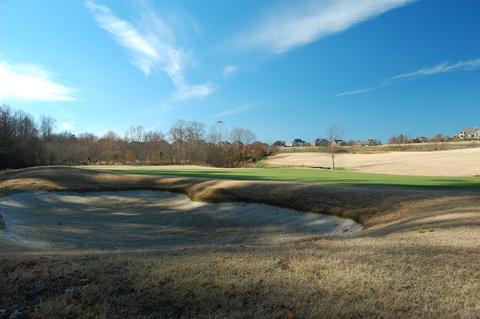 approach shots under such conditions are typically a little sharper, as if that green target is a bulls eye that forces just a little more concentration.
Salem Glen's clubhouse is warm and inviting, with a nice dining room, pro shop and bathrooms, although I found it odd that the members' locker room required a key code (I guess membership has its privileges.) The golf (with cart included) was a ridiculous $22 to play as a member of the Private Club Network to which I belong by virtue of my private club membership in Connecticut; the regular walk-in rate at Salem Glen this time of year is an almost equally absurd $35 (the same price I paid at Tanglewood today).
I was impressed right from the start with Salem Glen's 400-yard par 4 starting hole, which presented a wide fairway and a few fairway bunkers on the right side about 225 yards from the tee. The green was not very deep, making the downhill approach shot challenging if not too long. The quick speed of the green was a surprise, even though I had stroked a few on the practice green prior to the round. I liked that Salem Glen hadn't babied the greens as the weather turned cooler. They were not furry in the least.
Here are some additional notes I took about my round at Salem Glen: I didn't find a clunker hole among the 18, and a few were quite well designed. The par 5s were medium long, but with some significant challenges that made attempts at reaching the green in two a dicey proposition. On the 528 yard 4th, for example, a stream crossed the fairway 100 yards from the green. On the 525 yard 7th, a large pond on the right ran from 125 yards to greenside, and the front of the green was pinched in, bunkers guarding both sides. And on the 535 yard 14th, a creek ran across the front edge of the banked green, Augusta National style.
The grass on the dormant fairways was tight and wonderful to hit from. The dormant Bermuda rough was not unfairly deep. I played by myself, without the benefit of local knowledge, but the hole-by-hole layouts on the scorecard, with yardages, was a great companion. The practice area is terrific, with a wide and long practice range, a modest-sized and modestly sloping putting green, and a chipping green with a sand bunker that was not the afterthought it sometimes is; this one was filled with plenty of sand and perfectly raked. Everyone I met during the day -- from the pro shop to the starter to the pro who came out to give me a coupon on the 9th fairway for a free cup of soup at the turn to the young lady with the Russian accent who ladled out the terrific tomato basil soup -- was friendly and helpful to the max.
There were a few things I did not like, none of them fatal but definitely worth noting. Salem Glen has lots of out of bounds stakes behind the many homes that ring the course. Those homes are almost always in view, and a few are almost claustrophobically close. I don't know what the homeowner's association was thinking when it permitted a few residents to erect iron fences; these sporadic distractions to the landscape might make good neighbors, but they don't make for harmonious views from the course. More annoying than the OB stakes were the cart paths, some just a yard or two from the stakes. Any pulled or pushed shot that hit or rolled across the paths would pass the OB line, which seems like a double penalty. If you push or pull the ball that much, the rough and severe angle back to fairway or toward the green is penalty enough.
My final petty annoyance is that the color system for pin positions at Salem Glen is downright bizarre. Blue, which on most courses denotes a back position, means front of the green at Salem Glen. Red, which almost always indicates a front position, is middle at Salem Glen, and yellow is the back position. In daring to be different, Salem Glen's flag system comes off as a silly affectation.
That said, Salem Glen is well worth the price of admission, whether for the full-fledged member or the occasional daily-fee player.
Salem Glen Golf & Country Club, 1000 Glen Day Dr., Clemmons, NC, 336-712-1010. Architecture by Nicklaus Design. Web: http://www.salemglen.com. Gold tees: 6,716 yards, rating 73.1, slope 134. Blue tees: 6,275, 70.5, 131. White: 5,821, 68.1, 125. Red: 4,665, 67.4, 115.
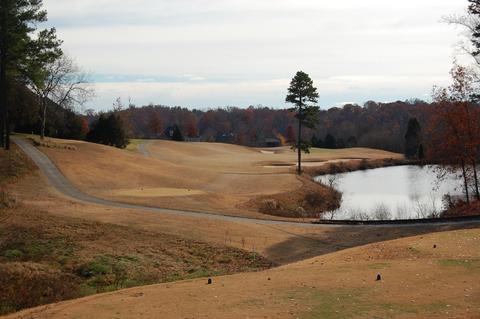
Water at Salem Glen comes into play infrequently, but it sure looks nice.
 Home On The Course newsletter
Click here to sign up for our Free monthly newsletter, loaded with helpful information and observations about golf communities and their golf courses.
Review: Sugarloaf Golf Club, Sugarloaf, PA
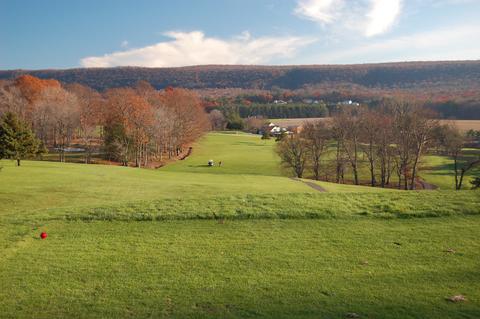
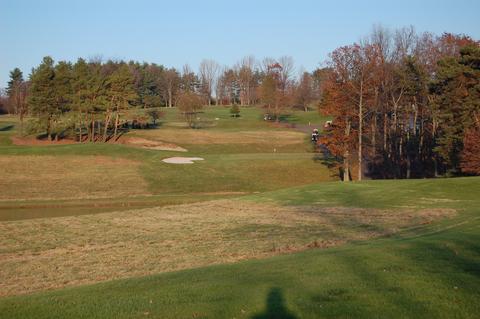
Most of Geoffrey Cornish's designs are in the northeast, and he is particularly adept at making his layouts harmonious with the surrounding mountains. This shot is from the 12th tee at Sugarloaf.
Because daily fee golf courses face survival challenges no matter where they are located, it amazes me that some people build courses far from population centers. How some survive over decades is anyone's guess, but survive they do.
Sugarloaf Golf Club is a few minutes from Interstates 80 and 81 but 30 miles from the closest urban area, Wilkes-Barre, Pennsylvania. It is very much out in the country, and you wonder how a course, even one rated a four-star "Place to Play" by Golf Digest, can survive at $25 a clip, what we paid after 12 noon on Sunday. (Regular green fees aren't much more.) Looking back 40 years, to when the club was founded, the logic behind building a course like Sugarloaf then is hard to comprehend. Was it the power of the King, Arnold Palmer, who made golf the popular sport it is? Was it the confidence that if you built it, people would come from the interstates?
After a most pleasant 18 holes at Sugarloaf on Sunday, I'm hoping that whatever has kept it going for 40 years keeps it going at least another 40. The course provided a wonderful respite from a nine-hour drive from Connecticut to Virginia.
The long par 3 15th I wrote about yesterday that is the course's toughest hole was one of a few pleasant surprises on the Geoffrey Cornish layout. The hole's PGA Tour length, a robust 266 from the back tees and 220 for us "normal" players, wasn't quite the longest par 3 I have played, but it certainly was the longest with an all-carry shot from the tee (see yesterday's article).
The 15th's degree of difficulty was out of proportion with the rest of the course which, despite many blind tee shots played without benefit of a yardage book or GPS system, was a good half dozen strokes easier than our home course of Hop Meadow CC in Simsbury, CT, also a Cornish design. Fairways were quite generous and the tiny course layout on the back of the scorecard provided more than enough guidance. Even when we over-compensated for a dogleg or just plain missed our aiming lines, the resulting lies in the rough were not at all punishing.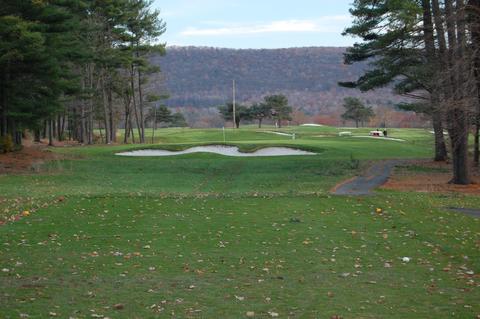
The Cornish greens at Sugarloaf are less geometric in their shapes than others of his courses we have played, and certainly different than the more circular putting surfaces at Hop Meadow. Some greens were downright amoeba-like, and four of them were shaped like Mickey Mouse's head. Pins were stuck in a few of the Mickster's ears, at back left or right. Perhaps to save wear and tear on the main parts of the green as the course prepares to close for the season, most pin positions were less than 12 feet from back and front edges.
The course was in very nice condition for a cool day in late November in northeastern Pennsylvania. The greens were in good enough shape and just fast enough to produce some sharp breaks on putts to front pin positions. The surfaces had been aerated a couple of weeks earlier and, although bumpy, were of medium speed and rolled pretty true. (My son Tim, who believes the gods are out to get him when he is presented with aerated greens, one-putted the first five holes, three of them for birdie, none of them gimmees). I didn't hit a putt I thought was bumped offline until the 15th, when I was too lazy to remove a forest-full of oak leaves from my line on a 40-foot putt. We did not roll the ball over once in the fairways, and although lies in the rough sat down a couple of inches, shots came out clean. The course was a little wet and divots resembled beaver pelts on a few shots. Most greens held medium to short iron shots well, although those greens at the highest elevations seemed to have a thin layer of frost beneath the surface.
The layout was a little tricky for us first-timers; we saw very few of our drives land, but the blind shots were only slightly so, no huge hills to negotiate. It was fairly easy to pick the top of a tree along the fairway as a directional guide, and we lost only one ball all day between the two of us. (I 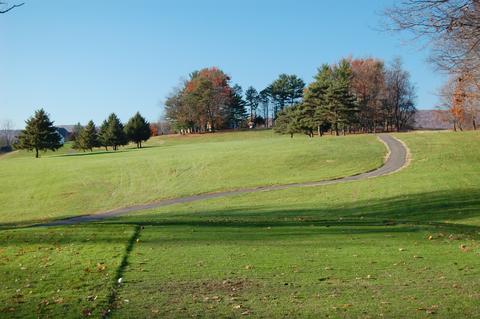 suspect that one might have been hiding under leaves.) Although I played from the blue tees at 6,300 yards, the course seemed to play a little shorter. The 15th aside, I thought the most difficult hole was the rather short par 4 11th that played about 375 yards from my tees. After a straight drive with a fairway metal, the approach shot is straight uphill to a smallish green; you can only see the top of the flagstick from below. I pushed my drive right and was dead behind the trees and bunker that guarded the right side of the hill.
Sugarloaf's owners, Wayne and Judy Knelly, are eager to please. We arrived just after noon and were greeted warmly on a cool day; temperatures did not get past 50 F during our round, but with abundant sunshine and only a mild breeze at most, a light sweater was enough. The aforementioned green fees of $25, cart included, also warmed my heart. And although the dated clubhouse is a building that time forgot, we were there to play golf not chat with the locker room attendant (there was none, and the locker room did not seem a healthy place to spend any time in). But, heck, the hot dogs at the snack bar were good, and the young lady in the pro shop gave us a large bag of cheddar and jalapeno potato chips for free. "We are trying to get rid of them before we close for the year," she said. Later, Wayne wished us a safe journey as we were departing.
Those kinds of personal touches count for a lot, and Sugarloaf's attitude, as well as its playable and scenic course, most probably has contributed to its longevity. We'll be back.
Sugarloaf Golf Club, Golf Course Road, Sugarloaf, PA. Tel: 888-342-5784. Web site: www.sugarloafgolfclub.com. Designer: Geoffrey Cornish. Par 72. Blue tees: 6,981, rating 72.2, slope 126. White tees: 69.5, 120. Red tees: 5,670, 71.2,121. Closes in December, reopens around April 1.
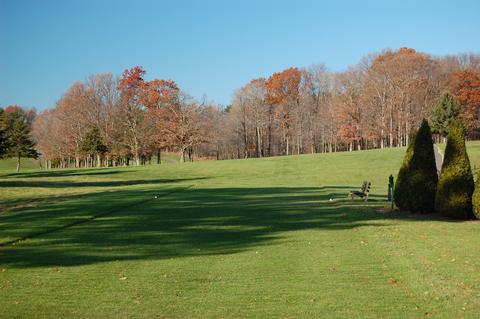
Although most tee shots are "blind" at Sugarloaf, trees and the slope of the fairways provide good directional signals, as at the 10th hole.
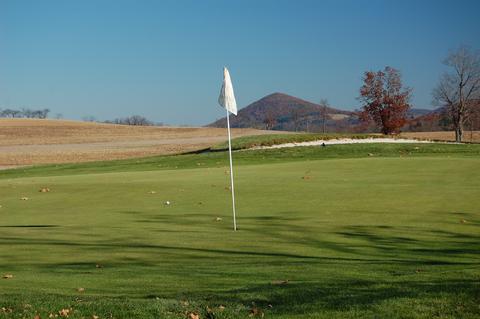
The town of Sugarloaf and the golf course get their names from a local mountain that bears a strong resemblance to the more famous Sugarloaf in Rio de Janiero, Brazil. Looks more like Mt. Fuji to me.
Cornish designed some kidney shaped greens that resemble Mickey Mouse's head.
Toughest par 3 in America?
The par 3 15th at Sugarloaf (above) is harder than another tough par 3 at Cliffs at Keowee Vineyard (see bottom) because the Sugarloaf hole provides no bailout.
Quick, when was the last time you played a golf course where the number one handicap hole was a par 3? More often than not, the par 3s on a card occupy handicaps 15 through 18, regardless of how difficult they play. Par 3s are the Rodney Dangerfields of golf holes: They "don't get no respect."
Therefore, it was a surprise and a delight to play the 15th hole at the Geoffrey Cornish-designed Sugarloaf Golf Club, just off Interstate 81 in eastern Pennsylvania, rated as the toughest hole on the course. As my son, Tim, and I stepped to the tee, we could see why. From the tips, which he played, the hole stretches to 266 yards, although the tees were "up" on Sunday at about 245 yards. I played the 220-yard tees. The shot is all carry over water below and left and a 45-degree hill that sweeps up to the front fringe. The pin was about 12 feet from the front edge, making it the devil's playground to try to get close. I opted to balloon a three-wood that hit beyond pin high on the right side of the green and almost rolled off the back right edge, stopping about 45 feet above the hole. Tim flared his three wood way left, but then hit a splendid lob wedge about 50 yards to about seven feet above the hole. I was happy to leave myself a chance for par when I putted five feet past the hole, but I missed it coming back. Tim lipped his putt, and we both settled for bogey. (Keep this quiet, but if I had been offered bogey as I stood on the tee, I might have opted for it!)
Tim and I tried to recall the hardest par 3s we had played. He said this was his toughest, but I recalled #17 at Tom Fazio's Cliffs at Keowee Vineyard, almost as long as the 15th at Sugarloaf, with a lake to the right and behind the green. A bunker guards the right side, more as a buffer between the water and green than a hazard, and one at the rear performs a similar function. But what makes the Sugarloaf three-shotter tougher is that you can bail out at Keowee by hitting short and left, leaving a pitch from a wide open fairway. At Sugarloaf, the only "bailout" is to hit to the back or over the green, leaving a downhill chip along the sloping sloped surface. The 225+ yard shot straight shot may be in your bag but not always in mine. Sugarloaf #15 is the toughest par 3 I have played.
If you know of a par 3 that is tougher than Sugarloaf's, please let us know.
I'll have a few more thoughts about Sugarloaf in this space tomorrow.
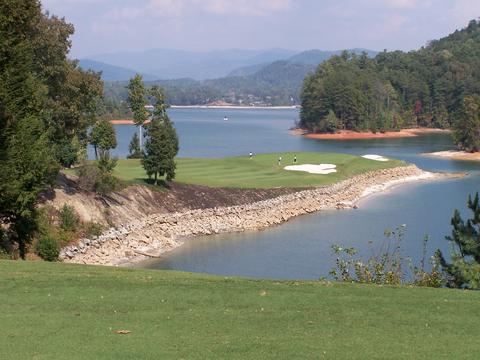
The 17th at Keowee Vineyard was the toughest on the Nationwide Tour a few years ago.
Good, bad, and ugly in housing market
It is hard to find any silver lining in the U.S. residential housing market, but if you look hard enough, or read today's USA Today, you will find a glimmer of positive news. Most states "continue to have stable home values," the paper quotes First American LoanPerformance, and a half dozen other states even showed a little growth over the last year. That's the good that counters the bad -- that prices fell in 17 states year to year.
The ugly, according to Zillow.com, one of our favorite sites for determining home prices across the U.S., is that 16% of those with a mortgage owe more than their homes are worth.
I'll be reporting from Winston-Salem, NC, this week, as well as posting a review here later today or tomorrow about a course in Pennsylvania with what could be the toughest par 3 in America.
Note to U.S. homebuilders: Advertise overseas
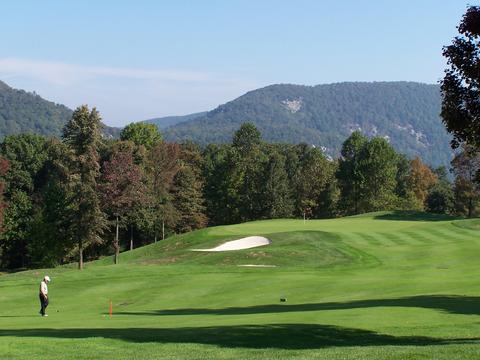
Higher-end communities like The Cliffs might benefit by some offshore marketing
The current U.S. housing market doldrums are like an ocean liner chugging ahead at full steam. They can try whatever they want, but the residential construction industry will not turn it around quickly.
Even the economists who wear the rosiest-colored glasses, like those who toil without shame for the National Association of Realtors, see no change for the better until mid 2008 or later. If they think 2008, then tack on at least a year for the Pollyanna effect always built into their predictions. Anyone trying to time the U.S. real estate market would do well to look to 2009 or even later before the turnaround. The end is not near.
In the meantime, here is some free advice for all those builders trying for ways to survive: Start a marketing blitz overseas. Free market capitalism has spread globally, with more than 3 billion people in China, India, Russia and other former socialist (and communist) countries now emerging into some form of capitalism. One result is the rapid emergence of a new class of nouveau riche. New wealth typically has a need to show off its gains with conspicuous spending on baubles, bangles, international travel and real estate.
Conspicuous spending on real estate certainly is evident in New York City, for example, where real estate prices continue to run counter to the national trends. Russian oil weaIth and the rapidly emerging industrial rich in India are fueling the market in the Big Apple. Like Manifest Destiny, and encouraged further by the devalued dollar, new foreign wealth could spread west and south seeking new solid assets.
It is time for domestic builders to enlist the services of some creative marketing agencies and start pitching their wares beyond the U.S.'s choppy shores. And perhaps for higher-end residential communities to start hanging signs that say "Russian spoken here."
In the news
Live like Greg Norman
By all measures, Greg Norman is a successful businessman - a clothing designer, golf course architect, cattle rancher, winemaker and, lest we forget, former PGA tour player. If he gets anywhere near the asking price for his house in Florida, you can add real estate investor to the list.
According to the Wall Street Journal, Norman has listed his house in Jupiter for, gasp, $65 million. The Journal notes that Tiger Woods paid "just" $44.5 million for 12 acres nearby. The Shark's property includes a main house of 8,100 square feet built in 1902, a two-bedroom beachside guesthouse, a three-bedroom carriage house, huge pool, a 17-car garage and other amenities you would expect in a stratospherically priced house.
Just 16 years ago, Norman paid $4.9 for the property and has made some improvements since - but certainly not $60 million worth. With the kind of appreciation he is likely to get from the sale, he shouldn't care that he hasn't won much at competitive golf the last few years.
If the Shark's house is too rich for your taste, a more modestly priced home is available in Osterville, MA, home to the fabulous Oyster Harbors Golf Club, a splendid Donald Ross design I played in September. The waterfront estate on 2 ½ acres has many of the features of Norman's estate, including main and guesthouses, tennis court, pool and dock. The price is a relatively modest $8.9 million.
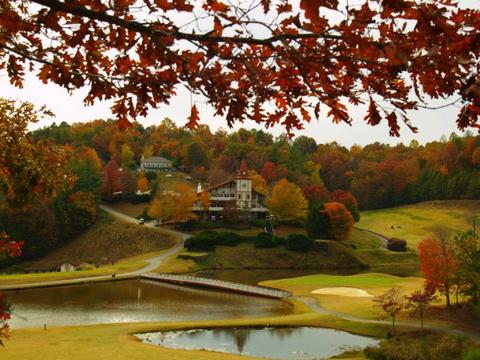
Innsbruck Golf Club & Resort picks up the Alpine gestalt of the rest of Helen, GA
Alpine golf in the U.S.
Many years ago, I happened upon the town of Solvang, CA, "The Danish Capital of America." The town was swarming with tourists who were all too happy to escape the U.S. for a day without the imposition of airfare or the need for a passport. I thought of Solvang today as I read a feature in the New York Times about Helen, a northwest Georgia town about 90 minutes from Atlanta that has successfully - if you define success in terms of two millions visitors a year - turned itself into a Bavarian town.The main attractions in town include Oktoberfest, which lasts for eight weeks in the fall and turns the rural town into one giant beer hall, the mountain landscapes and the reasonably priced real estate. (The only "cons" seem to be traffic, especially during Oktoberfest.) The article includes a photo of a 4-bedroom house in the gated Innsbruck Golf Resort priced at just $359,000 and with a view of the 2nd fairway, two large decks and a 7-person hot tub (hubba hubba). Innsbruck is a public course, plays to 6,800 yards and was designed by Bill Watts in 1987. The rating is 72.6 and the slope 132, and judging from the photos on the Innsbruck web site, water and trees come into play. Six other 18-hole courses, including one for members only, are within 16 miles, but they may not include 19th holes. The county that surrounds Helen is dry. If you want to stop by for a stein of Warsteiner or Erdinger, there are plenty of reasonably priced rentals in the area for as little as $80 a night.
Heading south next week: Taking requests
I am heading towards the Winston-Salem, NC, area next week to visit the limited number of golfing communities in this attractive and growing city in the northern part of the state. On tap so far are visits to the Salem Glen community and golf course, as well as potential rounds at the private Old Town Golf Club and Forsyth Golf Club. Old Town is where the accomplished Wake Forest University golf teams practice.
If you want me to check out any other communities in the area, or any in the Chapel Hill area where I will be stopping for a day, let me know by clicking on the Contact Us button above. In the meantime, for those who will be celebrating the Thanksgiving holiday tomorrow, best wishes to you and your families. If I don't post anything here Thursday, it just means Mrs. G. has me in the kitchen, getting ready for our 26 guests -- families, friends and two strangers from Germany who are visiting local friends. They won't be strangers by the end of the meal, I am sure.
Strength in numbers: Crime data can help you choose a safe path if you use it wisely
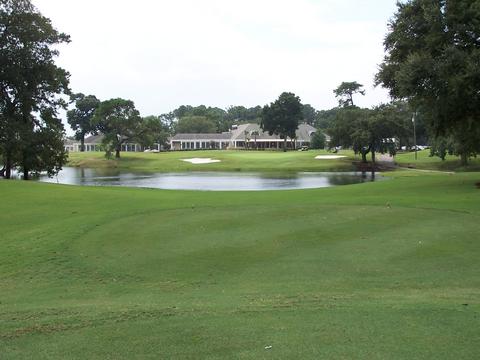
The well established Surf Club is located in zip code 29582 in North Myrtle Beach. According to crime data, the zip code has ratings of 7 for violent crime and 7 for property crime on a scale of 1 to 10, a surprise to anyone who has played the course and driven through the area.
A colleague of mine in the corporate world once advised me to "Torture the data and it will confess." That is not bad advice for those of us contemplating a move to what we hope will be, among other things, a safe and secure neighborhood. Yet most data in books that help us choose the "best place" to live unfortunately traffic in crime statistics that are misleading. They almost always average crime data for an entire metro area, rather than by zip code. Sorry, but if I am going to live in a golf community 10 miles from the center of the local city, I am more interested in data pertinent to my local zip code. Typically the numbers from a city tend to skew the overall crime statistics in the metro area. Not helpful.
Take Myrtle Beach, for example. Most magazines and books that report crime statistics rate Myrtle Beach pretty poorly. I decided to check all the zip codes in the Myrtle Beach area by using the helpful BestPlaces.net, which provides data not only about crime but also taxes, population, and healthcare. On a scale of 1 to 10 (worst), BestPlaces gave the city of Myrtle Beach violent and property crime ratings of 7 and 8 respectively. The Myrtle Beach metro area received a 6 & 6 and the surrounding Horry County a 5 & 6. However, individual zip codes within the Myrtle Beach metro area ranged from a 3 to an 8, a wide swath. Therefore, while the overall data could scare you away from considering any community in the area, zip code 29587, for example, which brackets highway 17 near the Beachwood and Possum Trot golf courses, scored ratings of 5 and 5. On the other hand, 29582 in North Myrtle Beach and home to the stable and now private Surf Club, rated a 7 in both categories.
Those who plan to avail themselves of the cultural and entertainment options of a nearby city should consider the crime rates there, but most cities are by nature less secure than the surrounding area. If you plan to avail yourself of the culture and entertainment a local city might have to offer, then city crime data is worth considering, if only to remind you to lock your car doors and park in well-lighted areas. But don't get snookered into thinking a generalzied crime rate has anything to do with the community down the road.
Bankruptcy leaves Myrtle Beach owners adrift
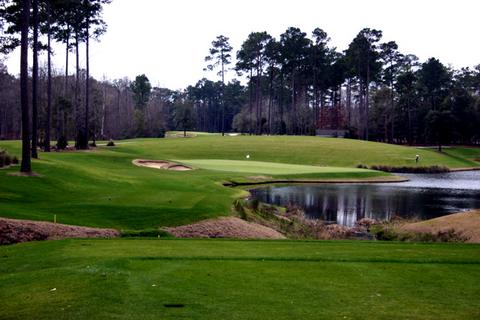
TPC of Myrtle Beach in Prince Creek is just a short drive from the Seasons development whose builder, Levitt & Sons, has declared bankruptcy. Photo by Elliot DeBear
The Seasons community in the Prince Creek West community of Murrells Inlet, SC, seemed to have everything going for it. Prices for single-family homes were reasonable in the low six-figures for a neighborhood within a short distance of a TPC golf course. Plenty of good shopping is nearby, but not so close as to push too much traffic past the gates of Prince Creek. Beaches and nice restaurants are no more than 15 minutes away. And the builder, Florida-based Levitt & Sons, had promised a nice set of amenities, including a 26,000 square foot clubhouse. If the name Levitt has a familiar ring to it, yes, it is the company that built the famed Levittown on Long Island, NY, 60 years ago. The company's name is ingrained in the history of real estate development in the U.S.
But stuff happens, and Levitt & Sons had leveraged itself with a lot of debt, putting itself at risk. All it took was the new home construction market to go into the dumper and Levitt had no room to negotiate with its bankers. After posting a $170 million loss in the third quarter that ended in September, Levitt filed for Chapter 11 bankruptcy, leaving its customers in various states of concern. Those who own one of the 80 built homes in Seasons wonder if they will continue to live in a "ghost town" devoid of the promised amenities. In worse shape are those whose homes are completed; they are waiting for a closing that may not come for months until a bankruptcy court declares next moves for the troubled company. And then there are the pour souls who borrowed money in order to build and now have liens against their unfinished homes; foreclosure is closing in on them.
The 460 planned homes may never be built in Seasons but, for now, that is the least of the worries of those staring at months, if not years, of uncertainty.
Odds and sods
Some items from newspapers, magazines and web sites that caught my eye recently:
If you read the New York Times on Friday, you might have seen the front-page story in the Escapes section. The lightly researched article "When the Golf Course Isn't Enough " by reporter Sallie Brady tries to make the point that vacation home buyers are moving away from purchasing "cookie-cutter spec homes" in "old style resorts" like those in Myrtle Beach, SC, and moving toward a wider range of accessible amenities. Where's the news here? Golf communities for years have been offering everything from spas to nature trails (including naturalists on staff) to airplane landing strips to wellness centers.
Examples the reporter uses to anoint this as a "trend" are exclusively in high-end communities where prices begin in the millions, the implication being that only the most upscale communities are filling the need. The examples include Carnegie Abbey near Newport, RI, with prices starting at $850,000 for a condo; the Windsor community in Vero Beach, FL, (starting at $1.5 million for a tennis cottage); and Isleworth in Windermere, FL, home to Tiger Woods and Annika Sorenstam, where 4,000 square foot villas start at $2.95 million. Yet there are scores of more modest communities, and especially age-restricted communities, that for years have been supplementing the golf with other amenities. Advice to the Times: One Robb Report in the world is quite enough...
According to the December issue of Money magazine, some housing markets in the U.S. are still "red hot." Representing the southern U.S. are Richmond, VA (prices up 6.9% in the last year), Asheville, NC (+10.9%), Charlotte, NC (+8.6%), Raleigh, NC (+8.6%), Wilmington, NC (+9.1%) and Austin, TX (+10.8%). (I visited Austin recently and will report on the metro area and its golfing
We were north of Atlanta in October, and the serious drought in the area was causing great concern and frayed relationships between the states of Georgia and Florida. Water flow from Lake Lanier, the main water source for Atlanta, also supplies federally protected mussels downstream on the Florida coast. On Friday, the U.S. Army Corps of Engineers cut the water flow from Lake Lanier by 5% after the U.S. Fish and Wildlife Service said the mussels could survive with less water. The Corps has indicated the reductions could drop as much as 17% without harm to the mussels. Of course, no one has bothered to ask the mussels...
The passive voice is a protected species in golf community advertising. In the passive voice, stuff happens but you never know who is responsible for the action (as opposed to the active voice, where the subject is, well, active). Spring Island, for example, a nice upscale community in South Carolina, touts its golf this way: "Our golf course is considered Arnold Palmer's finest..." That, of course, begs the question, "Considered by whom?" The aforementioned Mr. Woods and Ms. Sorenstam might disagree with Spring Island's un-attributed assessment since their course at Isleworth is an Arnold Palmer design. The passive voice robs you and I of the ability to separate fact from ad copy. Give us the names of those who think Spring Island the "finest"; we'd like to ask them how many other of The King's courses they've played...
And, finally, in the Hype a 59-Year Old Web Site Editor Can Certainly Live With category, an ad for Colonial Heritage, an age-restricted community in Williamsburg, VA, extends invitations to "active adults 55 and better."
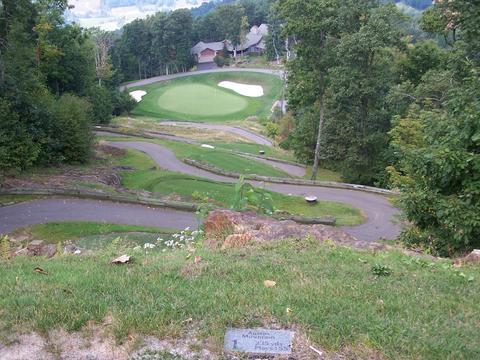
Asheville remains one of the hot real estate markets, and Mountain Air, a half hour outside of town, offers an amenities loaded community, including a mountaintop airstrip.

Now on Sale

- The only book about golf communities in the last 10 years.
- 156-page step-by-step guide to finding your dream golf home.
- Info on nearly 100 golf communities the author has visited.
- Paperback version costs less than a sleeve of Pro VIs.
Here is what the experts are saying:
“The book is chocked full of information…applicable to anyone looking for a move to the Southeast regardless of whether they are looking for a golf community or not.” — John LaFoy, golf architect (Linville Ridge CC, CC of Charleston, The Neuse GC)
“Larry has done a tremendous amount of work and anyone — like me — who is looking to search for a golf home now or in a few years needs this book.” — Brad Chambers, golf blogger, ShootingYourAge.com
“Wow! What a thorough piece of work…a must for anyone moving South. This book will help many people.” — Brett Miller, owner and founder of MMA, Inc, a golf industry consultancy
Buy It Now at Amazon.com or BarnesandNoble.com.